
Choosing Temple Materials for Premium Comfort
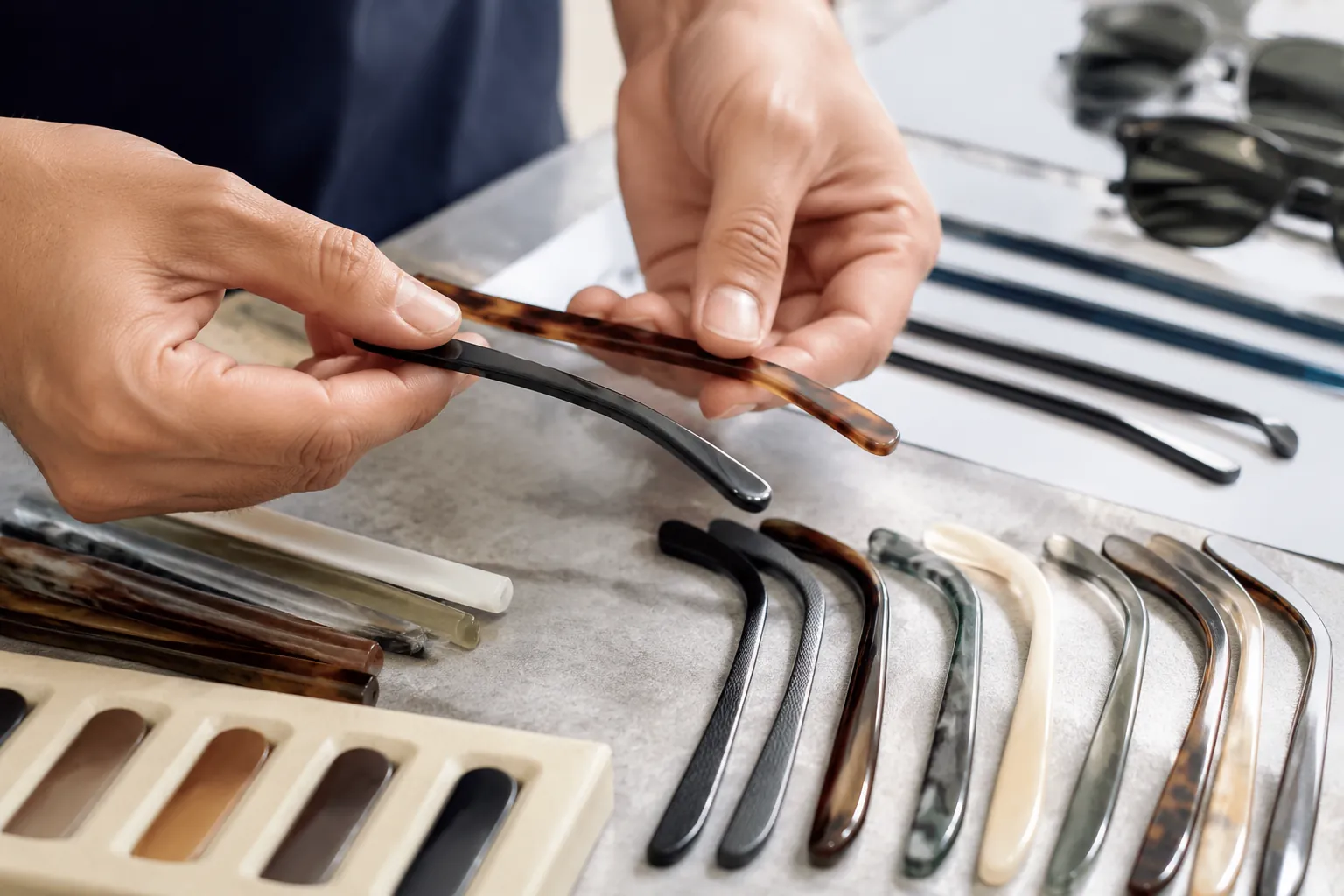
This is for brand owners, importers, distributors, and retail buyers who need sunglasses that feel comfortable on face and still support a clear price story. Temple material is not just a design detail. It changes weight, clamp force, adjustability, branding space, and return risk. If you are buying custom sunglasses in volume, the wrong temple build shows up fast in complaints about pressure, slipping, or heat on skin.
Why temple material drives comfort perception
Most buyers look at front frame shape first. That is a mistake. In wear tests, the temple set decides whether the frame feels stable after 30 minutes or annoying after 3 hours. The front may carry the brand, but the temples carry the comfort complaint.
Comfort positioning is a mix of weight distribution, skin feel, hinge response, and how the tips sit behind the ear. A heavy front can be tolerated if the temples balance it. A light front can still feel bad if the temples bite at the mastoid or slide when the user sweats. Premium comfort is usually about control, not softness.
From a merchandising view, temple material also shapes the story you can sell. Acetate signals density and polish. Metal signals precision and a slimmer profile. TR90 signals light weight and active use. Hybrid builds let you combine two signals, but they add process steps and tighter assembly control.
Acetate temples: warm feel, strong brand surface
Acetate temples are the easiest way to deliver a dense, premium hand feel. Buyers like them because the surface can be polished to a deep gloss, layered color looks richer, and laser engraving or inlaid details are easy to read. For fashion and premium lifestyle assortments, acetate still sells because it looks intentional.
The comfort trade-off is weight. A full acetate temple typically feels more substantial than TR90 or thin metal. That is not automatically bad. Some customers interpret weight as quality. But if the frame front is already thick, a full acetate temple can push the product into "presentable but tiring" territory.
Process matters. Acetate temples are cut from sheet, milled, tumbled, polished, and then fitted with hinges and end tips. On volume programs, the clamp area around the hinge must be controlled carefully. If the fit is loose, you get wobble. If it is too tight, cracks show up later during heat aging or repeated opening and closing.
For premium comfort positioning, acetate works best when the temple is kept slim, the edge is softened properly, and the weight is balanced with a moderate front thickness. At LumiShades, acetate cutting and CNC milling are done in-house, which helps keep temple symmetry and hinge alignment within production tolerance instead of leaving it to guesswork.
Metal temples: slim, adjustable, and easy to tune
Metal temples are the cleanest option for light visual weight. They make the frame look thinner and more technical, which is useful when the product needs to read as refined rather than bold. For buyers targeting office wear, optical crossover, or minimal fashion, metal is a practical choice.
The real comfort advantage is adjustability. A metal temple can be bent at the end tip or adjusted around the ear with more control than rigid plastic. That matters for fit recovery in the field. If a retailer or optician needs to tune the frame for a customer, metal gives more room to work.
There are limits. Bare metal can feel cold at first touch. Poor plating or weak coating will show wear fast. If the temple is too thin, it may flex in a way that feels cheap instead of light. If the alloy or plating stack is wrong, sweat exposure will expose it. That is not a theory. It is what returns look like after summer use.
Metal temples also support more precise branding through pad printing, laser marking, or small logo plates. For premium comfort positioning, the key is not to over-thin the profile. Buyers should ask for a sample set with the hinge torque checked, because a loose hinge kills the perceived quality even if the material choice is right.
TR90 temples: light weight with clear use-case limits
TR90 is the comfort-first option for many volume programs. It is light, flexible, and forgiving in wear. For active lifestyle sunglasses, kids' frames, and any SKU where users care more about reduced pressure than tactile richness, TR90 does the job.
The upside is obvious: low mass, good recovery, and lower break risk in normal handling. The downside is also obvious: the premium feel is weaker unless the design is controlled carefully. If the geometry is too thick, TR90 can look blunt. If the finish is too matte or mold lines are visible, the product loses price authority fast.
TR90 temples are usually best when the front price point needs to stay competitive while the buyer still wants a comfort story. They can work well in stackable retail programs because they reduce shipping weight and are tolerant of everyday handling. For programs with logo decoration, you need to confirm the decoration method early because some inks and coatings behave differently on nylon-based materials.
At LumiShades, injection molding is handled in-house, which helps with repeatability on temple wall thickness and mold flow. That matters because a 0.2 mm wall difference can change the feel in hand more than buyers expect. If you want a soft-touch premium claim, TR90 alone is usually not enough. The design has to do the heavy lifting.
Hybrid temple builds: where the margin usually is
Hybrid temples combine materials to balance comfort, cost, and presentation. Typical examples are acetate fronts with metal temple cores, metal fronts with acetate end pieces, or TR90 cores with coated outer shells. This is where many premium comfort programs end up, because one material rarely solves everything.
The strongest hybrid use case is a frame that needs visual richness up front and comfort at the ear. A thin metal core hidden inside a sculpted acetate temple can reduce flex issues without losing the richer surface look. Another common setup is a metal temple with acetate or TR90 end tips to soften skin contact and improve grip.
Hybrids do add risk. More components mean more assembly steps, more tolerance stack-up, and more chances for misalignment at the hinge or temple tip. If the factory does not control fit well, the right temple and left temple can feel different even when they pass visual inspection.
For a buyer, hybrid builds usually make sense when the SKU has enough margin to justify the extra process steps and decoration. They are also useful when the retail message needs to support a higher ticket without making the frame visually heavy. If the target price is tight, hybrids can eat the margin quickly unless the factory already runs those builds every day.
Material trade-offs buyers should compare side by side
Use a buying matrix, not a feeling, when you choose temple material. The same frame can land very differently depending on channel, target age group, and expected wear time. The table below is a practical starting point for custom sunglasses programs.
| Temple build | Comfort feel | Weight | Branding / finish | Typical buyer use | Trade-off |
|---|---|---|---|---|---|
| Acetate | Warm, dense, premium in hand | Medium to high | Strong gloss, rich color, laser work | Fashion, lifestyle, higher perceived value | Can feel heavy in long wear |
| Metal | Light visual feel, adjustable fit | Low | Clean lines, plates, engraving, printing | Minimal, office, optical crossover | Cold touch, plating quality matters |
| TR90 | Soft pressure, easy daily wear | Very low | Less premium in appearance unless well designed | Sport, kids, price-sensitive comfort programs | Less tactile richness, finish control is critical |
| Hybrid | Balanced if engineered well | Low to medium | Best for mixed-material storytelling | Premium comfort, better margin positioning | More assembly complexity and tighter tolerance control |
For volume buying, do not treat "premium" as one material. It is the result of the build, finish, and fit working together. A poorly tuned acetate temple feels worse than a well-made metal one. A badly plated metal temple feels cheaper than a good TR90 frame.
How to spec temples for production without surprises
Good samples often fail in bulk because the buyer approves the look, not the process. Temple builds need concrete specs. Ask for these early:
- Temple length, thickness, and taper at measured points
- Hinge type, screw size, and open-close torque target
- End-tip geometry and contact area behind the ear
- Surface finish standard, including gloss level or matte level
- Decoration position, logo size, and allowable shift
- Material declaration for REACH and market-specific compliance
For premium comfort work, hinge consistency matters more than people admit. If the hinge is too loose, the temple drifts. If it is too stiff, the user feels pressure. Ask for a sample run that is checked for left-right symmetry, not just visual matching. A 0.5 mm mismatch in temple drop or tip angle can show up on face faster than on a drawing.
Lead time also changes by material mix. At LumiShades, samples are usually 7-10 days and bulk 25-35 days, but hybrids can push the schedule if tooling or decoration needs adjustment. MOQ starts at 50 pairs per design, yet pricing improves materially at 300, 1000, and 5000+ pairs. On volume, the unit cost can drop to about $2.10 per pair, but only if the spec avoids unnecessary component complexity and rework.
Compliance, QC, and the buyer checklist
Temple material choice does not replace compliance. It sits inside it. For overseas programs, the frame must still clear the relevant safety and chemical requirements for the target market. The real certifications and standards LumiShades works with include CE EN ISO 12312-1, FDA registration, ANSI Z80.3, AS/NZS 1067, REACH, ISO 9001, and BSCI.
Do not assume the same temple material behaves identically across markets. Plating chemistry, decoration ink, and surface finish can affect REACH concerns. Metal parts need corrosion checks. TR90 needs a look at stress whitening and finish stability. Acetate needs attention to polish quality, hinge retention, and long-run shape stability.
A practical QC flow should include incoming material check, in-process hinge fit review, final wear inspection, and sample retention by lot. For premium comfort positioning, a simple face-fit test is worth the time: open and close the temples repeatedly, check tip pressure, then wear the frame for at least 15 minutes. If it starts to bite or shift, the buyer will hear about it later from the market.
Rule of thumb: choose the material that supports the retail promise, then force the factory to prove it in hinge fit, finish, and wear. Comfort is built in the tooling and assembly, not the brochure.
Have a custom sunglasses project in mind?
Send us your styles, target market and quantities and we will return a detailed quote with MOQ, lead time and a sample plan.
Get a QuoteWhy source this from Wenzhou with LumiShades
Wenzhou in Zhejiang Province is widely regarded as China’s eyewear manufacturing capital, producing a large share of the world’s sunglasses. That concentration matters to buyers: a deep local supply chain for acetate sheet, hinges, lens blanks, plating and packaging means shorter component lead times, easier color and material matching, and a workforce with decades of eyewear-specific skill. LumiShades has manufactured in this ecosystem since 2009, and our vertical integration — in-house injection molding, acetate cutting, CNC milling, lens tinting, decoration and quality control — means no part of your order is quietly subcontracted to a workshop you cannot audit.
For international buyers, that vertical control translates into accountability. When a single factory owns every step, defects are traced and fixed at source rather than bounced between vendors, and your specifications survive intact from first sample to bulk. For procurement review, buyers can request process records, approved samples, quality checkpoints and project-specific compliance files before placing a bulk order. Required testing and documentation are confirmed against the destination market and product specification rather than assumed from a generic certificate list. Explore our manufacturing capabilities and quality control process to see how this works in practice.
Frequently asked questions
Which temple material feels most premium to consumers? Acetate usually feels most premium in hand because it has more density and a richer surface finish. That said, a well-made metal or hybrid temple can outperform acetate if the fit and hinge feel are better.
What is the best option for lightweight comfort? TR90 is usually the lightest and easiest on the nose and ears for long wear. It is the safest choice when comfort and low weight matter more than a dense luxury feel.
Can metal temples be comfortable for all-day wear? Yes, if the temple geometry is correct and the hinge torque is controlled. Metal can be very comfortable, but the fit must be tuned or users will feel cold touch and pressure points.
How should I position hybrid temples in retail? Use hybrids when you need a premium look with better comfort balance than full acetate. They work well in higher-margin programs, but only if the factory can hold assembly tolerance consistently.
What should I ask a factory before approving temple materials? Ask for measured thickness, hinge torque target, finish standard, decoration method, REACH-compliant material details, and a wear sample from the actual bulk process. Do not approve by photos alone.
Will temple material affect MOQ or lead time? Yes. Simple single-material temples are easier to scale. Hybrids often add assembly steps and can lengthen sampling or bulk lead time, especially if new tooling or decoration is involved.
Ready to start?
Explore our shield & oversized sunglasses or request a quote — our sales team replies within 12 hours.
Request a Quote