
Laminated Acetate Color Effects for Premium Frames
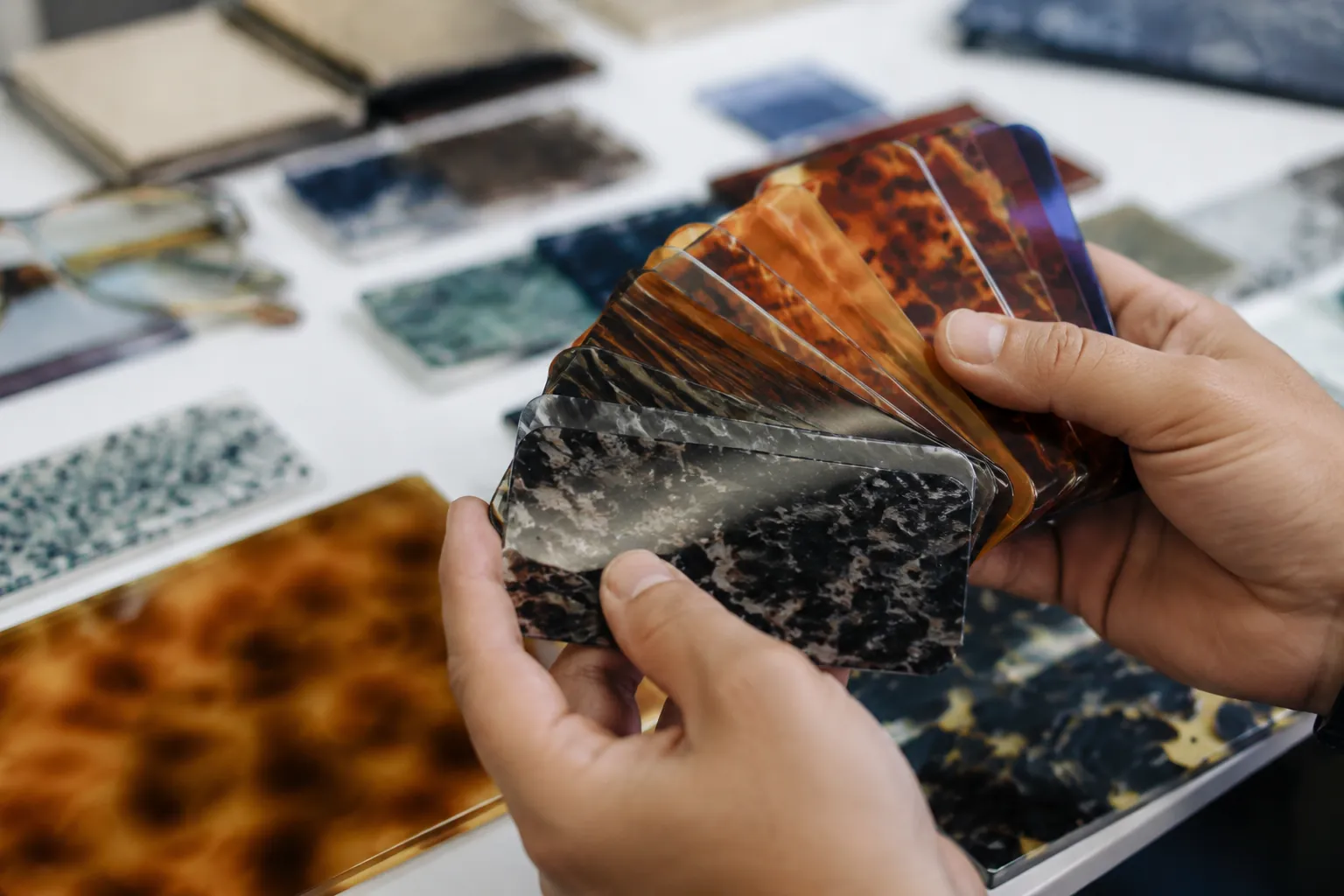
This guide is for eyewear brands, importers, distributors, and retailers developing acetate sunglasses at production volumes. The goal is simple: create a more premium retail look without driving scrap, repeated sample corrections, or unstable bulk quality. Acetate can deliver depth, translucency, stripe effects, and pattern movement that painted or injection-colored frames often cannot match. But the effect has to survive real production. If you understand laminated sheet construction, exposed edge depth, pattern yield, and finishing tolerance, you can build a stronger collection with fewer revisions and better cost control.
Why laminated acetate adds perceived value
Laminated acetate often looks more valuable because it shows depth. Customers notice light transmission, edge detail, and pattern movement fast. They do not start with hinge spec or inside-temple branding.
A plain black front can look clean and commercial. A transparent top layer, contrast core, or visible stripe line usually reads richer at first glance. That matters at retail.
For sourcing, this is useful because a stronger material story does not always require complex sculpting or heavy decoration. A classic square or soft-panto shape cut from the right laminated sheet can look better than a more complicated frame made from flat mono-color stock. This is especially relevant at lower MOQs, where trims, added logos, and packaging upgrades can raise cost faster than they improve shelf appeal.
Still, the raw sheet is not the product. The real question is whether the finished frame keeps the intended depth, contrast, or transparency after cutting, beveling, tumbling, hand polishing, and assembly. That is where good concepts hold up. Or fail.
How laminated acetate is built and where problems start
Laminated acetate is made by bonding two or more cellulose acetate layers into a single sheet before fronts and temples are cut. Buyers focus on color and pattern. Factories have to control bond integrity, sheet thickness tolerance, internal cleanliness, stress stability, and how each layer will look after CNC milling and polishing.
- Material layers are selected by color, transparency, pattern family, and nominal thickness.
- Layers are bonded into a laminated panel under controlled heat and pressure.
- The sheet is stabilized before further processing.
- Fronts and temples are sawn or CNC cut with attention to pattern position and usable yield.
- Lens grooves, bevels, bridge shaping, hinge pockets, and end-piece geometry are milled.
- Parts are polished, assembled, heat adjusted, and visually sorted before packing.
Problems usually begin when the design ignores finishing loss. A strong contrast layer on a raw cross-section can look much weaker after edge rounding and polish. A temple stripe can fade or disappear near the tip if the taper gets too narrow. Highly transparent top layers also make haze, trapped dust, or bond-line defects easier to see if lamination quality is not clean and stable.
During sampling, ask one direct question: where will the color line still be visible after final polishing? The answer should cover the front edge, brow area, end piece, and outer temple edge if those zones matter to the design. If a supplier can only describe the raw sheet and not the finished reveal, expect more sample revisions.
Color effects that hold up in production
Not every good rendering is buildable. The safest premium acetate programs start with effects that still look intentional after normal tolerance variation, polishing depth changes, and commercial sheet yield. The effect has to survive the factory. Not just the concept board.
- Transparent over solid core: A crystal smoke, tea, olive, or champagne outer layer over a darker inner layer creates depth with manageable production risk. It works best when enough material remains after finishing for the contrast to stay visible.
- Dual-layer edge contrast: A lighter inner layer or side stripe exposed on the face edge and temple edge gives a clear premium cue without the instability of highly random marbling. The contrast layer must be thick enough in the exposed zone to remain visible after polishing.
- Controlled tortoise or directional pattern: Medium-density tortoise in brown, grey, green, or honey families is usually easier to manage in bulk than chaotic statement sheets. Natural variation remains, but carton-to-carton consistency is generally easier to hold.
- Inner-outer tonal lamination: A quieter outside color paired with a brighter inside tone adds interest without making the retail face too aggressive. This suits brands that want a detail visible during try-on rather than a loud front-facing effect.
These options usually perform better than overbuilt concepts that rely on multiple thin layers, heavy sculpting, and high-contrast pattern exposure at the same time. Once a frame depends on several exposed transitions, yield becomes more sensitive to cutting position and polishing depth.
A practical rule helps here: give each SKU one main material effect. Translucency. Stripe reveal. Pattern movement. Trying to maximize all three at once usually makes production less stable.
What to specify for pattern placement and tolerance
Many acetate disputes start with vague approvals. A buyer signs off on one attractive prototype, then bulk arrives with weaker stripe visibility, mismatched temples, or poor pattern balance. The fix is straightforward: define measurable approval targets before sign-off, especially on the zones customers actually see.
| Spec item | Commercial target | Common tolerance or rule | Risk if uncontrolled |
|---|---|---|---|
| Front raw sheet thickness | Match the approved design intent and finished appearance | Confirm the finished front look, not only the raw stock number | Thin appearance or weak bevel exposure |
| Visible laminate line | Maintain enough depth to remain visible after final polish | Approve visibility by zone on the finished sample | Stripe disappears or becomes inconsistent |
| Left-right pattern balance | Commercially similar rather than digitally identical | Define acceptance criteria at PP sample stage | Pairs look mismatched on display |
| Temple continuity | Front and temple stay within the same color family | Use a matched cutting plan for key SKUs when required | Parts look sourced from different material lots |
| Edge polish radius | Keep the reveal consistent across production | Control carefully on transparent and contrast laminates | Visible change in reveal depth from unit to unit |
For premium programs, state which zones matter most. Usually that means the outer front face, brow line, end-piece area, and outer temples. The inside temple and hidden underside can usually accept more natural variation. Put that in the brief so the factory focuses control where shoppers will notice it.
Also remember this: acetate sheets are not repeated digital graphics. Even consistent tortoise and directional sheets show natural movement. The right target is controlled variation, not clone-level repetition. If exact symmetry is required, the factory will need more sorting and may reject more parts during cutting.
MOQ, cost, and lead-time trade-offs
The best-looking acetate effect is not always the best commercial choice. Cost and lead time depend on how many variables enter the project at once: custom lamination, special sheet sourcing, pattern matching, logos, custom lens tint, and packaging all compete for time and margin. Add too many at once and the sample cycle usually gets longer and less predictable.
| Effect type | Best MOQ range | Relative cost impact | Sample timing | Bulk note |
|---|---|---|---|---|
| Standard solid or transparent acetate | Best for entry MOQ and shape testing | Low | Usually the fastest option | Best route for validating fit and silhouette first |
| Two-layer laminated acetate | Suitable for small to mid-volume programs | Moderate | Typically longer than standard stock acetate | Strong premium gain with manageable complexity |
| Pattern acetate with controlled pairing | More efficient when volume supports sorting | Moderate to high | Depends on sheet selection and pairing requirements | Yield is sensitive to sheet planning and visual sorting |
| Custom multilayer lamination | Best when volume justifies custom development | High | Usually the longest development cycle | Most suitable when the color story is central to the collection |
Low MOQ can be useful for testing a silhouette or entering a new market, but complex custom sheet builds do not always scale well at very small quantities. Setup, sourcing, and approval effort are spread across fewer units. That is why two-layer laminated effects are often a practical middle ground for smaller runs. They create a visible upgrade without the same risk level as a fully custom multilayer build.
Lead times vary by factory capability, sheet availability, and the number of custom components involved. Ask for timing based on the exact construction. Do not assume a laminated acetate project will follow the same schedule as a standard stock acetate style. If speed matters, it is usually smarter to customize one or two visible elements well than to customize every component in the bill of materials at once.
How to pair acetate effects with lenses and decoration
Frame material, lens tone, and branding should work as one visual system. A transparent olive laminate paired with a strong blue mirror can fight the frame. A dense tortoise front with oversized metal logo plates can make the product look heavy instead of refined. More visible features do not automatically add value.
A practical development method is to choose one primary visual driver and one supporting detail. If the frame uses a smoke-over-grey laminate, a restrained grey, brown, or green lens tone will usually support it better than an aggressive mirror finish. If the acetate is visually quiet, a logo plate, visible core wire, or temple engraving can carry more of the brand signal.
- Laser engraving: Useful for subtle branding on temples or inner surfaces where low visual noise is preferred.
- Pad printing: Practical for logos and legal marks, but often less effective on premium exterior surfaces if overused.
- Metal logo plates: Effective when temple thickness and section width support clean installation.
- Hot foil or filled engraving: Can work well on inner temples when a polished branded finish is needed without crowding the outer profile.
- Lens tinting: Should support the acetate tone rather than overpower it; solid tints are usually safer on already complex fronts.
Develop these choices together. If lens tint is approved separately from the acetate tone, the final product can end up too warm, too cool, or simply too busy. Integrated development improves PP sample accuracy and reduces the gap between prototype and sellable product.
Compliance, QC, and pre-production control
Premium appearance means little if the sunglasses fail market requirements or arrive with visible inconsistency. Keep appearance approval and compliance approval separate. They support each other, but they are not the same document.
Depending on the target market and product type, relevant standards and requirements may include CE EN ISO 12312-1, ANSI Z80.3, AS/NZS 1067, REACH, and FDA registration. The key point is simple: compliance applies to the finished sunglasses, especially lens performance, labeling, and market-specific requirements. A premium acetate sheet does not make the final sunglass compliant on its own.
Supplier systems also matter. ISO 9001 can indicate a documented quality-management process, and BSCI can be relevant when buyers need social compliance review in the supply chain. Neither replaces product testing, but both can support supplier qualification.
For QC, premium acetate programs usually need tighter visual control than entry-level frames. Buyers should ask for checks on front warp, temple alignment, hinge fit, lens seating, polish consistency, laminate-line consistency, and color-family matching within packed pairs. Transparent laminates also need closer attention to internal cleanliness because haze, dust, and bond defects show more easily than on opaque frames.
One of the most useful controls is a pre-production sample made from the same sheet family intended for bulk, not a near substitute. If the approved sample uses one tortoise family and production uses another with a different density or undertone, the retail look can shift enough to weaken the collection. For premium acetate, material substitution should be approved explicitly. Never assumed.
A sourcing brief that cuts revisions
Many sampling delays come from incomplete briefs, not resistance at the factory. If the goal is premium-looking acetate without unnecessary complexity, the brief should tell the supplier what must stay fixed and what can flex for manufacturability. A good brief does more than describe the design. It sets commercial priorities and approval standards.
- Define the hero visual effect: translucency, stripe reveal, directional pattern, or inner-outer color contrast.
- State the target quantity tier clearly and note whether volume may scale after approval.
- Give a target price band so the supplier can screen out unrealistic constructions early.
- Mark the critical visible zones: front face, brow, edge line, end piece, and outer temple.
- Set the pairing expectation: tight left-right similarity or normal commercial variation.
- List decoration method, logo size limit, and whether branding is primary or secondary.
- Confirm lens family, base color direction, and any market-specific compliance requirements.
- Approve against a physical hand sample made from the actual material family intended for production.
This kind of brief gives the supplier room to solve the product correctly without drifting away from design intent. It also exposes weak concepts early. If the laminate line is too thin to survive polishing, if the temple taper will erase the contrast stripe, or if the MOQ is too low for custom multilayer sheet development, those issues can be identified before packaging, compliance labeling, and launch timing are locked.
Have a custom sunglasses project in mind?
Send us your styles, target market and quantities and we will return a detailed quote with MOQ, lead time and a sample plan.
Get a QuoteWhy source this from Wenzhou with LumiShades
Wenzhou in Zhejiang Province is widely regarded as China’s eyewear manufacturing capital, producing a large share of the world’s sunglasses. That concentration matters to buyers: a deep local supply chain for acetate sheet, hinges, lens blanks, plating and packaging means shorter component lead times, easier color and material matching, and a workforce with decades of eyewear-specific skill. LumiShades has manufactured in this ecosystem since 2009, and our vertical integration — in-house injection molding, acetate cutting, CNC milling, lens tinting, decoration and quality control — means no part of your order is quietly subcontracted to a workshop you cannot audit.
For international buyers, that vertical control translates into accountability. When a single factory owns every step, defects are traced and fixed at source rather than bounced between vendors, and your specifications survive intact from first sample to bulk. For procurement review, buyers can request process records, approved samples, quality checkpoints and project-specific compliance files before placing a bulk order. Required testing and documentation are confirmed against the destination market and product specification rather than assumed from a generic certificate list. Explore our manufacturing capabilities and quality control process to see how this works in practice.
Frequently asked questions
What acetate effect gives the best premium look at low MOQ? For most low-MOQ programs, a two-layer laminated acetate or transparent-over-solid construction is the most practical place to start. It creates visible depth and edge interest without the development burden of a fully custom multilayer sheet. Ask the factory for a finished sample that shows the reveal after polishing, not just a raw material chip, and confirm whether the sheet is stock or custom because that directly affects lead time and cost.
Can I require mirror-image pattern matching on tortoise acetate? You can ask for tight left-right similarity, but exact mirror matching is not a normal commercial expectation for most acetate sheet patterns. Acetate pattern flow is natural, not digitally repeated. If tighter matching matters, define acceptable balance at the PP sample stage, identify the visible zones that matter most, and expect more sorting, lower yield, and potentially higher cost. In most cases, 'commercially balanced pair appearance' is more practical than 'perfect mirror match.'
How should I brief a factory on visible laminate lines? Specify the exact zones where the contrast line must remain visible after final polishing, such as the front edge, brow, end piece, and outer temple edge. Ask the supplier to confirm visibility on the finished approved sample and, if possible, provide photos of those zones from multiple angles. Also confirm whether the design includes narrow tapers or heavy edge rounding that may reduce the reveal. That gives the factory a measurable target instead of a vague request for 'strong contrast.'
Does laminated acetate affect lead time? Yes. Laminated acetate can add development time because sheet selection, bonding quality, stabilization, and finished appearance all need approval. If the material is a stocked laminated sheet, timing may stay manageable. If the project needs a new color combination or custom multilayer development, lead time usually increases. Ask the supplier to break timing into three stages: sample preparation, PP approval, and bulk production based on the exact material plan.
Which compliance documents matter for acetate sunglasses sold overseas? The answer depends on the destination market, but common requirements may include CE EN ISO 12312-1, ANSI Z80.3, AS/NZS 1067, REACH, and FDA registration. Buyers should confirm requirements market by market before placing bulk orders. Ask the supplier for compliance documents tied to the finished sunglasses, not just frame material information, and verify that lens performance, markings, and labeling match the country where the product will be sold. If you also qualify factories at the supplier level, ISO 9001 and BSCI can be useful supporting documents, but they do not replace product compliance testing.
Ready to start?
Explore our square sunglasses or request a quote — our sales team replies within 12 hours.
Request a Quote