
Acetate Frame Thickness and Edge Finish Guide
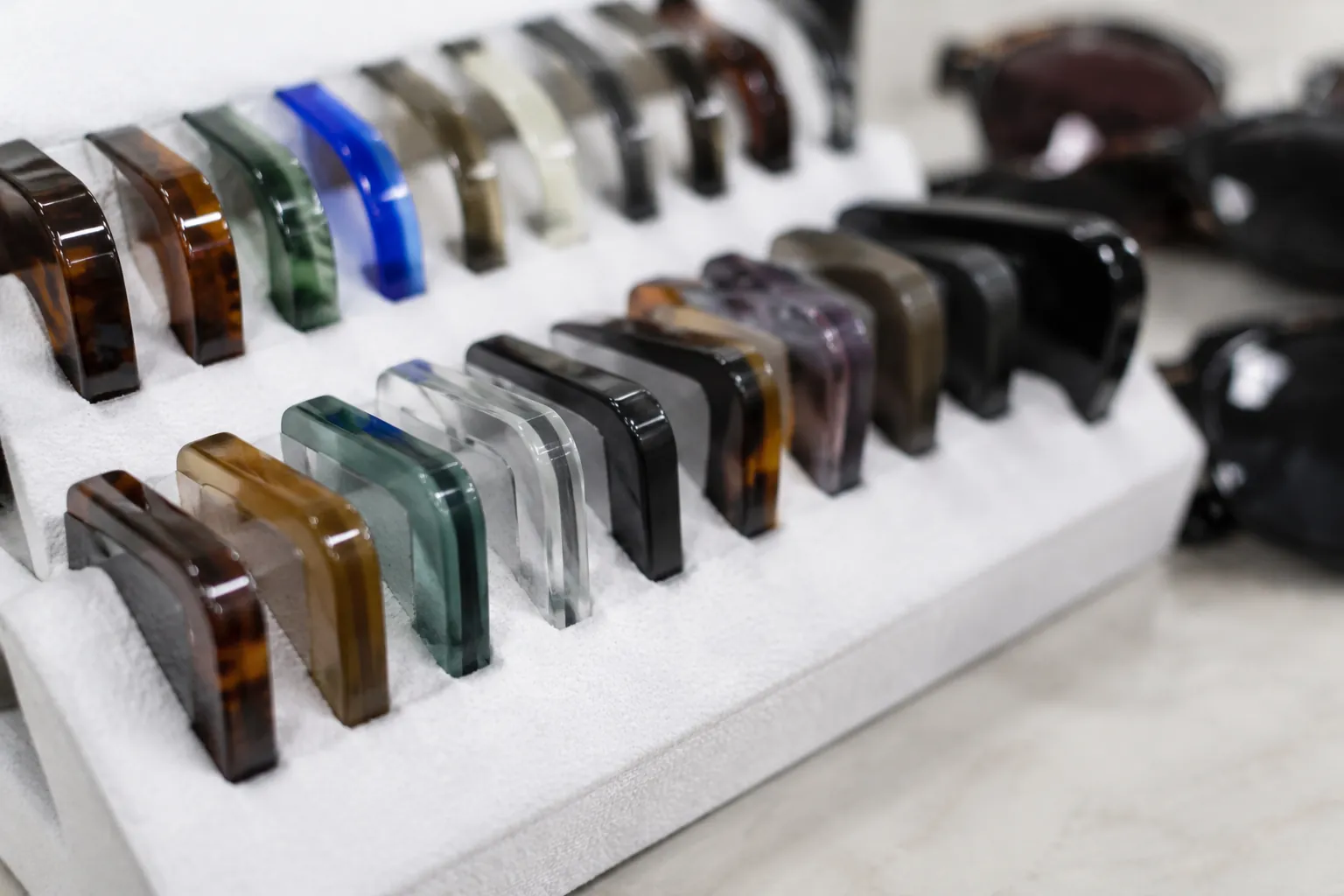
This guide is for eyewear brands, importers, distributors, and retailers sourcing acetate sunglasses at volume. It explains how sheet thickness, bevel profile, polish level, and edge detailing affect hand feel, comfort, optical fit, production yield, and retail perception. It also shows where cost usually comes from: material use, CNC time, polishing labor, reject risk, and extra development rounds. If you want a frame to look and feel premium without paying for the wrong construction choices, these are the specifications to control.
Why thickness changes perceived value fast
On acetate frames, thickness is one of the quickest visual signals of price position. Before a customer notices hinge branding, logo treatment, or lens category, they usually read front mass, rim depth, and edge definition. In retail terms, a front finished around 4.2 mm often looks lighter and more commercial. A front finished around 5.5 mm to 6.0 mm, with a controlled bevel and clear polish, usually looks more premium. Above 6.5 mm, the frame starts to signal stronger fashion density and statement styling, if the proportions stay balanced.
Thicker is not always better. That is the mistake. Acetate already has enough density that extra thickness is easy to feel once metal hinges, demo lenses or sunglass lenses, and core-wire temples are added. A blunt 7.5 mm front with soft, over-polished edges can look heavy without looking refined. A disciplined 5.8 mm front with a 30 to 45 degree bevel, a crisp rim line, and even gloss often looks more expensive because the geometry is controlled.
Buyers also need to separate nominal sheet thickness from finished thickness. A factory may start from a 6.0 mm or 8.0 mm acetate sheet, but after CNC shaping, bevel cutting, tumbling, buffing, and final hand polishing, the visible thickness changes across the frame. How much material is removed depends on the shape, edge profile, and polish target. State whether the requested dimension is before or after final polish.
For most private-label sunglass programs, the useful working range is still about 4.0 mm to 8.0 mm before finishing. Cost does not rise only because of raw acetate. It also rises because of longer machining paths, more sanding time, higher risk of asymmetry on thick bevels, and more scrap on shapes with narrow bridges, sharp corners, or laminated color blocks.
Common thickness ranges and where they fit
Thickness should match channel, target retail, and wearer, not trend alone. A fashion chain selling seasonal sunglasses at fast turnover usually needs lower weight, tighter cost control, and fewer fit complaints. A boutique brand or design-led label can carry more visual mass, but still needs to manage bridge contact, temple taper, and finished weight. Thickness works best as part of a full build spec, not as a standalone number.
| Front thickness | Typical finished weight effect | Commercial positioning | Main production notes |
|---|---|---|---|
| 4.0-4.5 mm | Lightest option; easier to keep the full frame near 28-36 g depending on size and lens | Entry premium, fashion volume, easier all-day wear | Lower material use, faster polishing, limited depth for stepped or diamond edges |
| 5.0-6.0 mm | Common full-frame range around 32-42 g depending on lens and temple build | Balanced premium mass-market | Good room for bevel detail, stable hinge area, manageable reject rate |
| 6.5-8.0 mm | Often pushes the frame above 40 g and sometimes above 48 g on large shapes | Bold premium, fashion-forward, statement styles | More CNC time, more hand correction, higher polishing labor, more risk at bridge and end-piece transitions |
| Laminated build-ups | Varies by stack; weight rises quickly if double layers are used | Design-led, high perceived value | Extra bonding steps, yield risk, visible seam control, longer sampling and approval cycle |
For many overseas buyers, 5.5 mm to 6.0 mm at the front and 4.0 mm to 4.5 mm at the temple root is a practical starting brief. That range usually gives enough visual substance to read premium without pushing the factory into excessive polishing or the wearer into unnecessary nose pressure. If the target look is heavier luxury, specify the whole construction together: front thickness, bridge cut depth, end-piece width, temple taper, lens thickness, and target finished weight.
Do not brief "8 mm premium acetate" on its own. It is too vague. That shorthand is one of the most common causes of slow sampling and avoidable remake rounds.
How edge finish changes the same frame
Edge finish can move the same acetate frame into very different retail tiers. Two frames cut from the same sheet and using the same hinge can feel very different in hand because of bevel geometry, polishing sequence, and surface clarity. Buyers are not just paying for thickness. They are paying for controlled light reflection.
The main edge directions are simple, but each has a different labor profile and visual effect:
- Sharp or defined bevel: usually cut at a controlled angle to create clean light breaks along the brow or eyewire; best for architectural shapes and restrained branding.
- Soft rounded edge: commercially safe and comfortable, but it needs control so the frame does not lose definition.
- Diamond or stepped edge: shows more visible craftsmanship; works best when the front is thick enough to show two distinct planes clearly.
- Flat polished edge: useful when the goal is to show lamination lines, crystal acetate depth, or pattern clarity along the sidewall.
Edge quality starts at CNC. A clean tool path cuts later labor. If milling leaves chatter or drag lines, the polishing team has to remove more surface, and that softens the intended shape. Tumbling or barrel polishing helps smooth micro-marks, but it does not replace precise hand control on premium bevels. Final buffing should remove haze without losing symmetry. On thick fronts, even a small change in hand pressure can make one rim shoulder look fuller than the other.
Over-polishing is a real cost issue and a quality issue. It rounds corners, blurs stepped edges, weakens pattern definition on laminated builds, and can thin high-stress areas more than intended. Under-polishing leaves haze, drag lines, or rough contact points around the bridge and temple ends. Check samples under direct light from several angles. Front-facing photos are not enough.
Comfort depends on where thickness sits
Consumers notice total weight, but they notice pressure points first. A frame can weigh 40 g and still feel stable if mass is distributed well. A frame can also weigh less than 34 g and still feel bad if the bridge contact is narrow, the pantoscopic angle is wrong, or the temples stay too straight and thick at the tips. Premium acetate development needs zone-by-zone control.
Three construction areas matter most:
- Bridge area: Too much bulk here increases nose pressure and can reduce contact stability, especially on low-bridge fits. On thicker fronts, selective underside relief is often better than thinning the whole front.
- End pieces and hinge blocks: These need enough material for secure hinge setting and durability, but too much thickness makes the frame side-heavy. This is more obvious with spring hinges or wider temples.
- Temple taper and tips: A temple can look premium at 4.5 mm near the hinge but should usually reduce progressively toward the ear for comfort and grip. Keeping the same thickness all the way back often creates fatigue.
In practice, many factories start with a thicker temple blank and remove mass through CNC shaping before final polish. That is usually the right approach. It keeps visual substance at the outer temple while lowering weight at the tip. Lens choice matters too. A Category 3 dark fashion lens or a thicker nylon lens can make the front look visually heavier, so the frame may not need as much acetate volume to achieve the same effect.
When reviewing samples, ask for a target finished weight range, not only thickness numbers. That ties aesthetic intent to wearable performance and reduces redesign after bulk cost talks have already started.
Process controls that affect thickness and finish
Serious buyers should ask how the factory builds the frame. Acetate quality depends more on process discipline than on the sketch. A typical route includes acetate sheet selection, moisture and flatness check, front and temple cutting, CNC shaping, lens groove cutting, hinge slot preparation, tumbling, hand sanding, buff polishing, assembly, decoration, lens fitting, alignment, and final QC.
Thickness accuracy can shift at several points. Sheet thickness may vary slightly by supplier batch, especially on patterned or laminated acetate. CNC sets the first real geometry, including bevel depth, bridge relief, and groove position. If cutters are worn or feeds are inconsistent, the nominal dimension may be correct in the center but weak at the corners or rim shoulder. Polishing then removes more material. On a premium frame, even a small dimensional change shows if the bevel plane narrows unevenly from left to right.
Decoration methods also interact with finish quality. Common options include hot foil logo stamping, laser engraving, metal logo plates, silk-screen temple printing, and core-wire exposure on transparent acetates. Each needs a stable surface first. A laser mark on cloudy polish or a metal logo plate on a vague temple edge does not add value. It only highlights the flaw.
For custom programs, in-house control of acetate cutting, CNC milling, polishing, decoration, and QC usually improves repeatability because fewer steps are passed to subcontractors. On the buyer side, the practical control method is simple: approve a physical sample with the edge profile clearly identified, lock a sealed reference sample, and record key dimensions such as front thickness, temple root thickness, lens groove depth, hinge type, and target weight.
Cost, MOQ, lead times, and where money shows
Not every premium-looking upgrade costs the same, and not every cost increase is visible to the customer. Buyers often overspend on hidden mass and underspend on visible surface control. The better strategy is simple: spend where the hand and eye notice the difference in the first few seconds.
The best-return upgrades usually include cleaner bevel definition, more consistent high-gloss polishing, selective thickness at the browline or outer rim, and restrained decoration that supports the edge quality. By contrast, adding 1.0 mm of material across the whole frame can raise weight, machining time, and reject risk without improving premium perception enough to justify the extra spend.
MOQ logic matters. At around 50 pairs per design, unit price is driven heavily by setup, programming, color preparation, and manual finishing time. A small material increase may not change cost much, but a more complex edge profile often will. Around 300 pairs, reject management becomes more efficient, and it is easier to justify tighter polishing consistency or a refined stepped edge. At 1000 pairs and above, cost engineering becomes more precise because setup cost is spread better and yield planning is more reliable. Simpler acetate or mixed-material programs at large volume can reach lower entry pricing, but thick, heavily sculpted acetate frames with premium finishing sit well above that floor.
Lead-time logic follows the same pattern. A straightforward acetate style with standard hinge hardware and simple polish may sample in about 7 to 10 days and run bulk in roughly 25 to 35 days. Add lamination, custom metal trims, exposed core-wire styling, or multiple finish variants, and development time extends because each feature adds approval points and more chances for correction. Clear technical briefs save more time than late-stage comments about edge language after the first sample is already polished.
Compliance, QC, and the brief buyers should send
Premium perception does not matter if the product creates compliance issues or inconsistent bulk output. For sunglasses, thickness and finishing choices still need to support structural stability, lens seating, and market-specific documentation. Common buyer requirements may include CE EN ISO 12312-1, ANSI Z80.3, AS/NZS 1067, REACH, FDA registration, ISO 9001, and BSCI depending on destination market and buyer protocol. The documents should match the final construction, not an early prototype that later changed in thickness, hinge style, or lens specification.
Thickness affects compliance indirectly. Heavier fronts can place more stress around the lens groove and hinge zone if the geometry is not balanced. Aggressive polishing can also thin critical sections, especially near narrow bridges, lower rim corners, and end-piece transitions. During QC, the factory should inspect symmetry, polish clarity, edge feel, logo position, lens seating, and alignment after final assembly, not only before lens insertion.
A practical factory brief should include the following:
- Front thickness target: for example 5.8 mm before final polish, or a finished thickness target at the brow.
- Temple thickness target: for example 4.5 mm at the hinge reducing to 2.8 mm to 3.2 mm near the tip.
- Edge profile: sharp bevel, soft round, stepped, diamond, or flat polished sidewall.
- Finish level: high gloss, medium gloss, satin, or a vintage hand-finished effect.
- Decoration method: foil stamp, laser mark, metal logo plate, printed temple mark, or exposed core-wire feature.
- Target weight and market: state whether priority is visual heft, long-wear comfort, and which compliance market applies.
Then ask for three items in the first sample round: one commercial reference sample, one finish variation, and one comfort-adjusted variation if the frame is close to the upper weight limit. That gives the buying team a real decision set. In most cases, the best premium result is not the thickest frame. It is the frame with the cleanest proportions, the clearest edge language, stable compliance, and the least wasted material.
What to check at final approval
Final approval should be based on what the product actually does in hand, under light, and on face. A frame that photographs well can still fail in person if the edge line is uneven, the polish is cloudy, or the balance is wrong. Check the same points on every sample. Keep it repeatable.
The most useful checks are simple: front symmetry, bevel clarity, left-right consistency, hinge set, temple spring action if applicable, lens seating, contact comfort, and whether the frame weight matches the intended wear position. On premium acetate, the edge should feel deliberate, not rounded by accident. The finish should show control, not excess buffing.
If a sample misses the target, isolate the real cause before asking for a remake. Sometimes the issue is thickness. Sometimes it is the edge angle, the polishing sequence, or the temple taper. Correcting the wrong variable creates extra rounds without improving the result. The strongest approvals happen when the team can say exactly what needs to change and why.
That is what separates a frame that merely looks expensive from one that can be manufactured consistently at scale.
Have a custom sunglasses project in mind?
Send us your styles, target market and quantities and we will return a detailed quote with MOQ, lead time and a sample plan.
Get a QuoteWhy source this from Wenzhou with LumiShades
Wenzhou in Zhejiang Province is widely regarded as China’s eyewear manufacturing capital, producing a large share of the world’s sunglasses. That concentration matters to buyers: a deep local supply chain for acetate sheet, hinges, lens blanks, plating and packaging means shorter component lead times, easier color and material matching, and a workforce with decades of eyewear-specific skill. LumiShades has manufactured in this ecosystem since 2009, and our vertical integration — in-house injection molding, acetate cutting, CNC milling, lens tinting, decoration and quality control — means no part of your order is quietly subcontracted to a workshop you cannot audit.
For international buyers, that vertical control translates into accountability. When a single factory owns every step, defects are traced and fixed at source rather than bounced between vendors, and your specifications survive intact from first sample to bulk. For procurement review, buyers can request process records, approved samples, quality checkpoints and project-specific compliance files before placing a bulk order. Required testing and documentation are confirmed against the destination market and product specification rather than assumed from a generic certificate list. Explore our manufacturing capabilities and quality control process to see how this works in practice.
Frequently asked questions
What acetate thickness usually looks premium without becoming too heavy? For many sunglass programs, a finished front around 5.5 mm to 6.0 mm is a practical premium starting point. It usually gives enough visual substance for a defined bevel while still leaving room to manage comfort through bridge shape, hinge area, lens weight, and temple taper. Ask the factory to confirm whether the number is before or after final polish, because that changes the finished appearance.
Does a thicker acetate sheet always justify a higher retail price? No. Retail value usually comes from proportion, bevel definition, polish clarity, and consistency across the pair. A thicker frame only feels premium if the geometry is controlled. When briefing a supplier, ask for a physical sample that proves the finish, not just a thicker blank sheet or a nominal thickness callout.
How should I brief edge finish to avoid vague sampling results? Use production language. Specify whether you want a sharp bevel, soft round, stepped edge, diamond edge, or flat polished sidewall. Then add the gloss target, whether lamination or pattern lines must remain visible, and which edge must stay crisp after polishing. Keep one sealed reference sample for bulk comparison.
What MOQ and lead times should I expect for custom acetate sunglasses? MOQ and lead time depend on design complexity, color work, finish level, and hardware. A common starting point is 50 pairs per design for custom development. Straightforward styles often sample in about 7 to 10 days and bulk production can run about 25 to 35 days, while lamination, extra decoration, or multiple finish variants usually extend both stages. Ask the supplier to quote MOQ and lead time together so you can see where complexity changes the schedule.
Which compliance points matter most for acetate sunglasses programs? The main buyer-side check is whether the final product can be supported by the required market documentation. Common requirements may include CE EN ISO 12312-1, ANSI Z80.3, AS/NZS 1067, REACH, FDA registration, ISO 9001, and BSCI depending on the destination and customer protocol. Confirm that the documentation matches the final frame and lens construction, because changes in thickness, finish, hinge style, or lens specification can make earlier sample-stage documents unusable.
Ready to start?
Explore our aviator sunglasses or request a quote — our sales team replies within 12 hours.
Request a Quote