
TAC vs PC Lenses for Private-Label Sunglasses
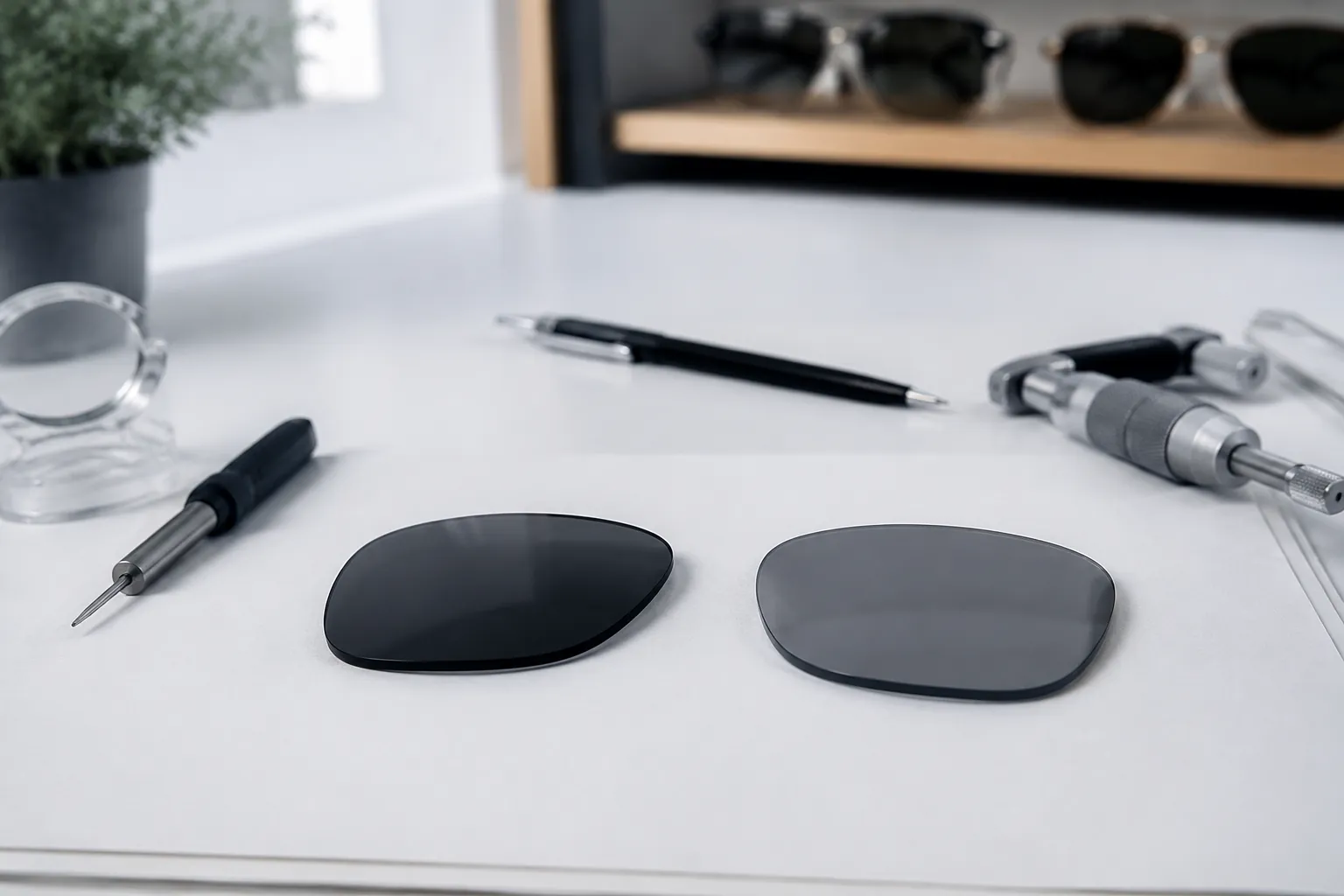
This guide is for brand owners, importers, and retail buyers choosing lens materials for private-label sunglasses. Lens choice affects returns, price position, compliance, and how the product feels in daily use. The problems usually appear later: scratched lenses, edge separation, distorted vision, poor frame fit, uneven tint, incorrect labeling, or impact claims the specification never supported. This article compares TAC polarized lenses and polycarbonate lenses across optics, impact behavior, coatings, fit tolerances, MOQ, lead time, compliance, and landed-cost logic. It is written for buyers approving real pre-production samples, not catalog photos.
Start with the product brief
Buyers often ask, Which lens is better, TAC polarized or PC? Too broad. Start with a harder question: What does this sunglass need to survive, and what price must it hit?
For a fashion-led polarized sunglass sold at a tight retail price, TAC often makes sense. It delivers polarization at a lower cost than many higher-spec lens builds. For sport, youth, driving, cycling, fishing, beach, or active-outdoor styles, PC is usually the better first material to test. Drops, flex, wrap geometry, and rough handling change the answer fast.
Before requesting a quote, define these buying inputs:
- Target retail and ex-factory price: a promotional sunglass, mid-market lifestyle frame, and sport performance style each need a different lens-cost structure.
- Polarization requirement: mandatory, optional, or limited to selected lens colors.
- Use case: fashion, driving, beach, fishing, kids, cycling, running, sport, or general outdoor.
- Frame geometry: flat fashion shape, moderate curve, 6-base wrap, 8-base sport wrap, shield, rimless, or semi-rimless.
- Target markets: confirm the applicable requirements, which may include CE EN ISO 12312-1, ANSI Z80.3, AS/NZS 1067, REACH, and local labeling rules.
- Known return risk: scratches, breakage, lens pop-out, coating wear, color inconsistency, optical distortion, or edge separation.
A practical sourcing discussion starts by sorting the program into a fashion-cost structure or a durability-led structure. That decision affects the lens material, hard-coat grade, groove design, fitting pressure, packaging protection, test plan, and inspection method.
What TAC and PC mean in production
TAC means triacetate cellulose. In mass-market sunglasses, TAC polarized lenses are usually laminated with a polarizing film between protective layers. The details matter. Adhesive system, layer thickness, coating quality, and edge finishing vary by supplier, so approve the supplier's lens data and the actual sample. Do not buy the material name alone.
PC means polycarbonate. It is an injection-molded thermoplastic lens material known for high impact resistance at low weight. PC lenses may be non-polarized or polarized. Polarized PC normally costs more than standard non-polarized PC because the substrate, polarizing element, molding or insert process, coating adhesion, and optical stress control all have to work together.
| Factor | TAC polarized lens | PC lens |
|---|---|---|
| Best commercial fit | Fashion polarized sunglasses, promotional programs, lifestyle collections | Sport, kids, active outdoor, wrap frames, and durability-focused consumer styles |
| Typical construction | Laminated polarized lens; thickness and layer structure depend on supplier specification | Injection-molded lens; thickness depends on size, base curve, design, and impact expectation |
| Polarization | Common, mature, and cost-effective for fashion sunglasses | Available, but typically higher cost than TAC polarized |
| Impact behavior | Suitable for many normal fashion-use programs; not the first choice for rough active use | High impact resistance; often preferred for active use, youth styles, and wrap designs |
| Optical risk | Edge separation, waviness, color mismatch, or stress when used in unsuitable wraps or tight grooves | Molding stress, prism variation, distortion, or warpage if tooling and processing are poorly controlled |
| Coating priority | Stable lamination, scratch-resistant surface, clean edging, mirror adhesion where specified | Hard coat is essential; mirror, AR, hydrophobic, and oleophobic layers need controlled surface preparation |
| Cost position | Usually the lower-cost route to polarized fashion sunglasses | Non-polarized PC can be efficient; polarized PC is normally a higher-spec option |
Short version: TAC is usually the commercial answer for affordable polarized fashion sunglasses. PC is usually the technical answer for active use, larger lenses, wrap frames, and higher durability expectations.
Optics, curvature, and fit
Consumers do not talk about prism, base curve, transmittance, or lamination stability. They say the sunglasses feel wavy, make me dizzy, look cloudy, or the two lenses do not match. That is the complaint you will hear. The causes are usually haze, distortion, tint mismatch, uneven polarization, lens warpage, or excessive fitting stress.
TAC polarized lenses can look clean in plano fashion builds, especially in flatter or moderate-base frames. They are generally better suited to standard fashion geometries than aggressive wraps. Once the design moves into high wrap, rimless screws, drilled lenses, or very tight eyewire pressure, the laminated structure needs closer review. Poorly finished edges can expose layers. Excessive pressure can create stress that later shows up as edge separation or optical distortion.
PC lenses usually handle wrap geometries better. Still, PC is not a guarantee of good optics. Injection molding parameters, gate location, cooling time, tool condition, coating process, and post-mold handling all affect visual quality. A high-wrap PC lens should be checked across the full viewing area, not only at the center. For shield lenses and 8-base sport designs, review thickness distribution, warpage, frame fit, and distortion before bulk approval.
Useful production tolerances to discuss include:
- Lens size tolerance: agree on the acceptable tolerance for the frame type, edging process, and groove design.
- Lens pair color tolerance: approve under indoor light and daylight; do not rely on one office lighting condition.
- Frame groove fit: the lens should seat firmly without forcing the eyewire, whitening the edge, chipping the lens, or creating stress marks.
- Polarization axis: confirm consistent orientation between left and right lenses to avoid uneven glare reduction.
- Base-curve match: do not put an unsuitable flat lens into a high-wrap frame to save cost; distortion and pop-out risk increase.
Approve the exact material, tint, mirror, base curve, coating stack, and frame fit that will be used in production. If any of those elements changes, repeat the sample approval. Small changes can create large complaints.
Impact and failure modes
This is where TAC and PC separate most clearly. PC is usually the better choice where lenses may be dropped, flexed during assembly, used by children, worn during sport, or stored roughly in bags, cars, and outdoor gear. It is also more forgiving in larger wrap frames because it tolerates handling and impact better than laminated TAC in many sunglass applications.
TAC is not automatically low quality. It is widely used because it works well for the right product: fashion-led polarized sunglasses with suitable frame geometry, clean edging, stable lamination, and adequate surface protection. The mistake is treating TAC as a sport-performance solution when the real use case involves impact, bending, heat, humidity, or repeated rough handling.
Common TAC field issues include:
- Edge separation or delamination: layer separation may be caused by weak bonding, exposed edges, heat, moisture, aggressive cleaning chemicals, or poor edging.
- Edge stress: tight frame grooves, rough cutting, or forced assembly can create stress points.
- Surface wear: weak scratch resistance leads to complaints, especially when sunglasses ship without a pouch or protective sleeve.
- Heat and humidity sensitivity: storage in hot cars or damp beach environments can accelerate problems in lower-grade laminated lenses.
Common PC issues are different:
- Scratching: uncoated or poorly coated PC scratches easily, so a reliable hard coat is important for retail-quality sunglasses.
- Molding stress: fast cycles, uneven cooling, poor tooling, or uncontrolled post-mold handling can create visible distortion.
- Coating adhesion: mirror, AR, hydrophobic, or oleophobic layers can fail if cleaning, surface activation, curing, and handling are inconsistent.
- Fit noise or pop-out: if the lens edge profile and frame groove are not matched, even a strong lens can fit poorly.
Material choice and frame engineering cannot be separated. A good PC lens in a poor frame can still fail. A TAC lens in an over-tight groove may develop avoidable edge defects. Review lens edging, groove fit, hinge alignment, coating appearance, frame adjustment, packaging protection, and final wear comfort together.
Coatings, mirrors, and decoration
Do not quote TAC or PC as a bare material only. The coating stack often decides the user experience, complaint rate, and final cost. A cheap PC lens without a good hard coat can perform worse in the market than a better-specified TAC lens in a fashion program.
Common lens options include:
- Hard coat: recommended for both materials and especially important for PC.
- Mirror coating: silver, blue, green, red, gold, or custom fashion mirrors; adhesion and color consistency must be checked on production-intent samples.
- Back-side AR: reduces rear reflections but adds cost and requires cleaner handling.
- Hydrophobic or oleophobic top coat: improves wipeability and fingerprint resistance when applied correctly.
- Gradient tint: popular in fashion frames but requires tight control between left and right lens height and color transition.
- Polarized film or polarizing element: standard in most TAC polarized programs; optional and higher-cost in PC polarized builds.
Frame decoration also affects the lens budget because all customization competes for the same ex-factory target. Common private-label decoration methods include pad printing on temples, laser engraving on metal or acetate, hot stamping, silk-screen printing, custom metal logo plates, debossed temple marks, printed inner-arm text, custom hinge trim, and branded pouch or box packaging. For small runs, pad print and laser marking are often easier to justify than new molds or custom metal hardware.
Ask the supplier to separate the cost of lens material, coating, frame material, decoration, and packaging. This prevents a common sourcing problem: approving a premium mirror sample, then discovering the bulk quote assumed a basic tint. Also confirm that the approved sample and bulk production use the same coating type, color target, curing process, and inspection criteria.
MOQ, price, and lead time
For many buyers, the decision is commercial and technical at the same time. MOQ, tooling, decoration setup, packaging, test requirements, and inspection time all shape landed cost. A lower unit price is not useful if the lens choice increases returns, fails the market requirement, or forces a late redesign.
MOQs vary by supplier, frame platform, color, decoration method, lens type, coating, and packaging. Existing frame molds and standard lens colors usually support lower starting quantities than new molds, unusual mirrors, custom hardware, or fully custom packaging. Unit cost typically improves as volume rises because setup time, decoration fixtures, packaging preparation, material purchasing, and QC planning are spread across more units.
| Order volume | Best use | Lens-cost logic | Timing expectation |
|---|---|---|---|
| Small test order | Testing new styles, capsules, buyer samples, market validation | TAC polarized or standard PC can keep cost controlled; setup cost has a larger effect per pair | Confirm whether materials are in stock before promising a launch date |
| Small retail launch | Initial brand release, resort program, boutique reorder | TAC polarized becomes more efficient when polarization is a selling point; simple decoration is easier to justify | Lock artwork, lens color, and packaging early to avoid sample revisions |
| Established private-label program | Repeatable seasonal program or multi-color collection | More room to optimize hard coat, mirror, logo method, packaging, and compliance testing | Use a pre-production sample and written specification before bulk release |
| High-volume program | Chain retail, promotional volume, large seasonal order | Material choice should be based on margin plus expected return rate, not unit price alone | Forecast components and packaging earlier; inspection planning and labeling control matter more |
Lead time also varies. Standard materials and available frame platforms can move faster than new molds, special lens colors, custom hardware, unusual coating stacks, or multiple packaging versions. Ask for separate timing for sampling, pre-production approval, bulk production, testing, inspection, and shipping. If you switch from TAC to PC after sample approval, recheck lens fit, tint, optical appearance, weight balance, labeling, and compliance documents before bulk release.
Compliance and pre-production checks
Compliance paperwork must match the actual sunglass build, not a generic product family. Common requirements may include CE EN ISO 12312-1 for Europe, ANSI Z80.3 for the United States, AS/NZS 1067 for Australia and New Zealand, and REACH for chemical compliance where applicable. Supplier credentials may include ISO 9001, BSCI, and FDA registration, depending on the supplier, buyer, and market.
Lens category, UV protection, visible light transmittance, traffic-signal recognition where relevant, polarization, and labeling must align with the target market. A smoke lens, brown lens, mirror lens, and gradient lens may not share the same transmittance category. Changing from TAC polarized to PC polarized, or from non-mirror to heavy mirror, can require fresh confirmation because the tested build may no longer match the bulk product.
Before mass production, confirm these items in writing:
- Approved sample code, frame code, lens material, lens thickness, base curve, and color.
- Polarization status and polarization axis consistency.
- UV400 or relevant UV performance claim supported by applicable test data.
- Visible light transmittance category and required warning labels for the target market.
- Coating stack: hard coat, mirror, AR, hydrophobic, oleophobic, or other finish.
- Scratch, appearance, and cosmetic defect limits, ideally tied to AQL inspection criteria.
- Logo placement tolerance, color tolerance, barcode data, and packaging specification.
- Final QC plan covering lens fit, hinge function, frame alignment, screw tightness, color matching, and label accuracy.
Many production disputes begin because the buyer approved only appearance. Put the lens specification on the purchase order, sample approval form, test request, and packaging brief. If the bulk build changes, the approval should change too.
Buyer decision framework
Use this framework when choosing between TAC and PC:
- Choose TAC polarized when the product is fashion-led, polarization is a key selling point, retail price is tight, and the frame is not intended for rough active use.
- Choose non-polarized PC when impact resistance, kids' use, sport handling, or wrap shape matters more than glare reduction.
- Choose polarized PC when you need both durability and glare control, such as fishing, driving, cycling, boating, or premium outdoor collections.
- Upgrade the coating before over-optimizing the material price if scratch complaints would damage the brand or retailer relationship.
- Re-sample after any material switch because fit, color, weight, optical behavior, and compliance status can change.
Then pressure-test the choice with three questions. Will the customer wear this mainly for style or for activity? Is a scratch complaint more likely, or is breakage and impact handling the bigger risk? Does the retail price leave enough margin for the coating stack, pouch, case, logo, testing, labeling, and inspection the product needs?
For most private-label collections, the clean starting split is simple: TAC polarized for fashion and lifestyle sunglasses; PC for sport, youth, wrap, and harder-use collections. Not a universal rule. A useful default.
Practical buying tip: ask for two production-intent samples of the same frame, one with TAC polarized lenses and one with PC lenses. Compare lens appearance, fit pressure, edge seating, weight, scratch resistance, polarization, distortion, and comfort in daylight. A direct sample comparison usually answers more than a long email thread.
Have a custom sunglasses project in mind?
Send us your styles, target market and quantities and we will return a detailed quote with MOQ, lead time and a sample plan.
Get a QuoteWhy source this from Wenzhou with LumiShades
Wenzhou in Zhejiang Province is widely regarded as China’s eyewear manufacturing capital, producing a large share of the world’s sunglasses. That concentration matters to buyers: a deep local supply chain for acetate sheet, hinges, lens blanks, plating and packaging means shorter component lead times, easier color and material matching, and a workforce with decades of eyewear-specific skill. LumiShades has manufactured in this ecosystem since 2009, and our vertical integration — in-house injection molding, acetate cutting, CNC milling, lens tinting, decoration and quality control — means no part of your order is quietly subcontracted to a workshop you cannot audit.
For international buyers, that vertical control translates into accountability. When a single factory owns every step, defects are traced and fixed at source rather than bounced between vendors, and your specifications survive intact from first sample to bulk. We back this with 15+ years of experience, shipments to 60+ countries, more than 5 million pairs produced per year and a 98.5% on-time delivery rate. Our certifications — CE EN ISO 12312-1, FDA registration, ANSI Z80.3, AS/NZS 1067, REACH, ISO 9001 and BSCI audit — mean the compliance documentation your market requires already exists. Explore our manufacturing capabilities and quality control process to see how this works in practice.
Frequently asked questions
Is TAC always polarized and PC always non-polarized? No. TAC is commonly used for laminated polarized sunglass lenses, but the material name alone does not prove polarization, UV performance, or coating quality. PC lenses can be non-polarized or polarized. For any order, ask the supplier to state the lens material, polarization status, UV claim, visible light transmittance category, coating stack, and applicable test standard in writing.
Which lens is better for sport sunglasses? PC is usually the better starting point for sport sunglasses because it offers higher impact resistance and suits wrap shapes, youth use, active handling, and larger lenses. If glare reduction is also part of the product promise, specify polarized PC and approve a production-intent sample for optical distortion, hard-coat quality, frame fit, and labeling compliance before bulk production.
Which lens is more cost-effective for a fashion polarized line? TAC polarized is usually the more cost-effective choice for fashion and lifestyle sunglasses where polarization is a selling point and the frame geometry is not too aggressive. Buyers should still confirm lamination quality, scratch resistance, edge finishing, mirror adhesion if used, lens color consistency, and compliance documents for the target market.
What should I confirm before switching from TAC to PC or PC to TAC? Re-sample the frame. A material switch can change lens thickness, edge profile, fit pressure, weight, tint appearance, mirror color, optical distortion, polarization behavior, and compliance status. Confirm the revised lens specification, coating stack, visible light transmittance category, UV claim, packaging labels, and test reports before releasing bulk production.
What compliance documents should I ask for? Ask for documents that match the target market and exact bulk build. Common references include CE EN ISO 12312-1 for Europe, ANSI Z80.3 for the United States, AS/NZS 1067 for Australia and New Zealand, and REACH where chemical compliance is required. If supplier credentials matter to your buyer or retailer, request current ISO 9001, BSCI, and FDA registration documentation where applicable. Confirm that the tested lens material, color, mirror, transmittance category, polarization, and labeling match the approved production specification.
Ready to start?
Explore our shield & oversized sunglasses or request a quote — our sales team replies within 12 hours.
Request a Quote