
Mirror-Coated Sunglasses: Failure Risks for Buyers
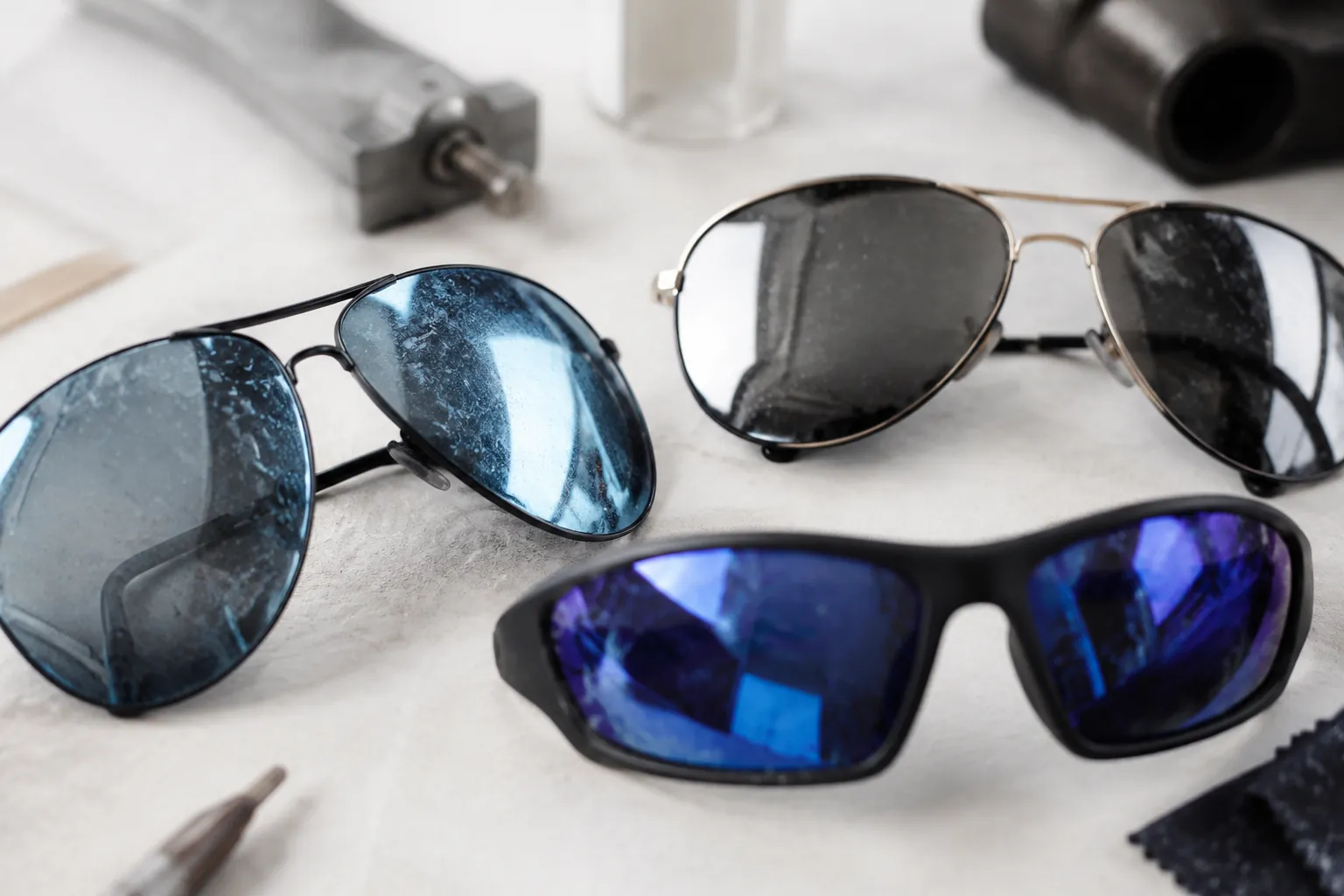
This guide is for brand owners, importers, distributors, and retail buyers sourcing mirrored sunglasses at volume. Mirror lenses sell on appearance. They also create avoidable claims if the coating stack, lens material, packaging, and inspection standard do not match the selling channel. That is the real issue. Not whether mirror coatings are good or bad. The question is whether the approved construction suits the expected use, destination-market compliance, and handling from production through retail.
Start with the commercial reality: mirror coatings are decorative first
A mirror finish is not a hard protective layer. In most sunglass builds, the mirror effect comes from a thin reflective coating on the outer lens surface, often within a stack that may include a hard coat and a protective top layer. Its main job is appearance. Depending on the base tint and coating design, it may also affect visible light transmission, or VLT. It does not make the lens scratch-proof.
That matters because the outside lens surface gets abused. Dry wiping. Sunscreen residue. Sweat. Salt. Dust. Storage with keys or other hard objects. Heat in cars. Retail try-on handling. Mirror-coated lenses usually show damage faster than plain dyed lenses because scratches, rub marks, and coating voids break the reflective surface. A mark that looks minor on a smoke or brown lens can stand out on silver, blue, green, red, or revo mirror.
For buyers, the target is not zero wear under all conditions. That is unrealistic. The target is a defensible match between coating type, lens material, intended use, price point, and claim policy. A promo sunglass for a short campaign should not carry the same durability promise as a sports or premium retail model. At entry level, a light flash mirror may be acceptable if the limitation is understood up front. For core retail, buyers should usually require a documented lens construction, a controlled appearance standard, and an approved packing method. For active-use or premium programs, specify abrasion resistance, adhesion checks, pair matching, and assembly controls before bulk production.
Set that expectation at sample approval. Many disputes start with the sales promise, not the factory defect. Premium language gets attached to an economy mirror finish. Then the claims arrive.
The four failure modes behind most claims
Mirror-lens complaints often get lumped together as "bad lenses." That is too vague to fix anything. Buyers should sort failures into clear categories so the supplier can correct the right step.
- Scratch visibility after handling: The lens may leave the factory within the agreed appearance limit, but wiping, pouch friction, store handling, or consumer use creates visible rub lines. This is common when the top layer has limited abrasion resistance or when packing allows repeated contact with the lens surface.
- Adhesion failure: The mirror layer or top layer peels, flakes, crazes, clouds, or turns patchy after tape testing, heat exposure, sweat exposure, chemical contact, or normal handling. Likely causes include poor substrate cleaning, incomplete hard-coat cure, incompatible coating chemistry, or weak control of coating thickness and cure conditions.
- Color inconsistency: Lenses within the same order, or left and right lenses within one pair, show visible differences in shade, reflectivity, or base tint. Strong mirror colors and revo effects make small process differences easier to see. Variation in the tint under the mirror can make mismatch look worse.
- Abrasion from assembly or packaging: The coating may pass incoming or in-process inspection, then get damaged during lens insertion, frame adjustment, tray contact, pouching, polybagging, carton compression, or transport vibration.
These failures can look similar in a claim photo. The correction is not the same. Packaging scuffing may require better lens protection or a different folding method. Adhesion failure may require process review, a new coating stack, or tighter cure control. Color inconsistency may require stricter pair sorting and batch control. If a buyer asks only for replacements, the next shipment may carry the same weakness.
Where failure starts: lens material, coating stack, and process control
Mass-market mirrored sunglasses commonly use PC or TAC lens constructions, but the right choice depends on use case, compliance target, and price level. Material choice affects coating adhesion, scratch behavior, heat tolerance, and assembly risk.
- PC, or polycarbonate: PC is widely used because it is lightweight and impact resistant. For mirrored sunglasses, PC normally needs a stable hard coat before mirror deposition. If that hard coat is thin, uneven, contaminated, or under-cured, scratch resistance and coating adhesion can both become inconsistent.
- TAC polarized constructions: TAC polarized lenses are laminated constructions. They can offer good optical performance in polarized sunglass programs, but lamination quality, edge sealing, adhesive compatibility, and heat exposure must be controlled. Buyers should be careful with high-temperature storage, aggressive solvents, and frame designs that stress the lens edge.
- Other lower-cost materials: Some price-driven programs use acrylic or other low-cost lens materials. Cost may drop. Risk can rise. Buyers should confirm optical quality, impact expectations, coating compatibility, and destination-market requirements before approval.
The process chain matters as much as the material. A typical route may include lens molding or cutting, cleaning, hard coating, curing, mirror deposition, topcoat application, final cure, edging, assembly, inspection, and packing. Weakness at any stage can show up later as a market claim.
Ask process-specific questions. Broad quality assurances are not enough.
- Cleaning method: How are dust, oils, mold-release residue, and handling contamination removed before coating?
- Hard-coat control: What hard coat is used, and how are cure conditions and coating consistency controlled?
- Mirror and topcoat stack: Is the approved sample a light flash mirror, dense mirror, revo mirror, or another defined finish, and is a protective topcoat included?
- Cure discipline: Are cure time, temperature, and handling intervals documented for the approved construction?
- Edge stress: Does the frame groove, lens bevel, or wrapped shape create stress or scuffing during insertion?
- Decoration sequence: Are pad printing, laser marking, hot stamping, plaques, or other decorations done in a way that protects the lenses from extra handling damage?
Traceability also matters. If lens tinting, coating, frame production, decoration, and final assembly are handled by different parties, the approved specification should state who controls each step and how defects are traced by batch or lot.
Choose the right spec, not the strongest mirror effect
The most reflective option is not always the best commercial option. Buyers should specify mirrored lenses by intended use, not just by a color chip, rendering, or competitor photo.
| Use case | Typical lens/coating approach | Typical landed-cost logic | Risk level | Buyer note |
|---|---|---|---|---|
| Promo, event giveaway, short-life campaign | Light flash mirror on a basic approved lens construction | Designed around a low unit cost and limited-use expectation | Higher | Do not promise premium scratch resistance or long field life unless the construction has been tested for it |
| Fashion retail, moderate daily use | PC or TAC construction with mirror finish and protective topcoat | Balanced option for many private-label retail programs | Medium | Require written appearance, adhesion, rub, and packing standards before bulk approval |
| Sports, beach, outdoor activity | PC construction with controlled hard coat, mirror finish, and improved abrasion-resistant top layer | Higher specification is justified when users will wipe and handle lenses often | Lower when properly specified | Confirm sweat, sunscreen, salt, heat, and cleaning instructions are considered in testing and claims policy |
| Kids, convenience, rough-handling channels | Tinted lens or light flash mirror with simple care expectations | Commercially safer than heavy mirror at low price points | Lower than dense mirror | Heavy full mirror can create avoidable returns if the channel involves rough handling |
If the target price is tight, reducing a dense full mirror to a lighter flash effect can lower visible-claim risk while preserving the mirrored shelf look. That tradeoff often makes sense in channels where consumers are unlikely to use lens cloths or protective cases consistently.
Also separate sample approval from production validation. A sample can confirm appearance, tint, lens fit, and basic handling. It does not prove consistency across a bulk run. Before larger orders, require a pre-production sample or pilot approval that confirms the exact coating stack, lens material, frame fit, logo process, packaging method, and inspection criteria.
Set realistic QC standards before sample approval
Many mirror-lens claims start with a weak approval process. One sample under office lighting is not a standard. Mirror finishes need agreed controls for appearance, left-right matching, adhesion, abrasion, assembly marks, and packing protection.
The QC standard does not need to be long. It does need to be written and repeatable.
- Appearance distance: Define inspection distance and lighting. For example, inspection may be done at a stated distance under neutral white inspection light. Phone flash and extreme-angle photos should not become the default claim standard unless they are part of the agreed method.
- Pair matching: Left and right lenses should be visually matched for base tint, mirror shade, and reflectivity under the agreed inspection condition.
- Adhesion check: Require a documented tape-pull or supplier-approved adhesion test on the approved construction, especially after heat or humidity exposure if the product will ship through demanding conditions.
- Controlled rub check: Define the cloth, number of strokes, direction, and pressure or test method. Random dry rubbing with unknown fabric is not a valid comparison.
- Edge-area inspection: Inspect the bevel and lens perimeter after frame insertion, because coating damage often appears first near the frame groove.
- Packing simulation: Approve the pouch, polybag, individual box, tray, divider, and master-carton arrangement before bulk shipment.
Useful acceptance language is specific: no obvious scratches, coating voids, peeling, or left-right color mismatch visible under the agreed inspection condition; no coating lift after the agreed adhesion check; no new lens scuffing after the approved packing simulation. The exact method can vary by factory. The buyer still needs a clear way to compare bulk goods against the approved standard and retain sample.
Compliance must also be confirmed for the destination market. CE EN ISO 12312-1, ANSI Z80.3, and AS/NZS 1067 address sunglass performance requirements such as transmittance and related safety criteria. Mirror color can change final VLT, so the finished lens construction, not just the base tint, should be checked. For chemical and supply-chain expectations, buyers may also request REACH-related documentation, FDA registration where relevant to the supplier or importer setup, ISO 9001 certification, or BSCI audit status. Those documents do not replace product testing. They do help verify operating controls.
Packaging and handling damage more lenses than buyers expect
A mirror-coated lens can leave the coating line in acceptable condition and still arrive damaged. This happens often. Packing gets approved late, or treated as a generic accessory instead of part of the lens-protection system.
Focus on three stages: assembly, inner packing, and export packing. During assembly, tight grooves, rigid fronts, thick rims, or too much lens flex can mark the coating near the edge. During inner packing, the lens surface may rub against hinges, bridge hardware, metal trims, tags, pouches, or the opposite lens. During export shipping, loose packing or carton compression can turn small contact points into repeated abrasion.
Ask direct handling and packing questions:
- Are pairs individually polybagged, pouched, boxed, or tray-packed?
- Is removable lens protector film needed for dense mirror or high-value finishes?
- Does the pouch fabric shed lint, trap dust, or have rough seams that can touch the lens?
- When temples are folded, can hinges, screws, metal decorations, or temple tips touch the lens surface?
- Are dividers, tray cavities, or individual boxes needed for premium or high-risk orders?
- Is the master carton packed tightly enough to limit movement without crushing the frames?
- Will barcode labels, hangtags, stickers, or cleaning cloths touch the mirror surface during transit?
For mirrored products, packaging is a QC decision, not just a presentation decision. The approved sample should include the exact packing setup used for bulk goods. If the supplier changes pouch material, polybag thickness, folding method, label placement, or carton layout after approval, treat that as a specification change.
Lead time, MOQ, and price: reduce risk without guessing
Development timing and order quantity vary by factory, coating process, decoration method, and material availability. Buyers should not treat a sample lead time or quoted MOQ as proof that the construction is production-ready. Fast is not the same as controlled.
A disciplined development flow should include these gates:
- Initial sample: Confirm frame shape, base tint, mirror color, lens category target, and general appearance.
- Revised sample or pre-production sample: Confirm frame-lens fit, edge quality, logo position, coating stack, and packing method.
- Pilot or first-production review: Check early production units or production photos for left-right matching, color consistency, assembly marks, and packing condition.
- Bulk release: Release production only after the spec sheet, compliance path, packing method, retain sample, and acceptance criteria are approved.
Order size changes the risk profile. A small trial order mainly tests market response. A larger wholesale or retail order adds more cartons, more operators, more handling, and more opportunity for color variation or packing damage. Even a low defect percentage gets expensive once replacement freight, retailer chargebacks, staff time, and brand reputation are factored in.
The rule is simple: if the product is sold for repeated use, outdoor activity, or premium presentation, specify it that way. Do not buy an entry-level mirror construction with minimal packing and vague inspection language, then expect premium field performance.
Buyer checklist: reduce mirror-lens claims before the PO is placed
Use this checklist before placing the order. Prevention is cheaper than arguing over liability after goods land.
- State the destination market and applicable compliance path, such as CE EN ISO 12312-1, ANSI Z80.3, AS/NZS 1067, REACH, FDA registration where relevant, ISO 9001, or BSCI documentation.
- Confirm lens construction in writing: PC, TAC polarized, acrylic, or another approved material.
- Confirm whether the mirror is light flash, dense mirror, revo, or another defined finish.
- Decide whether a full mirror is necessary, or whether a lighter flash mirror gives the required look with lower visible-claim risk.
- Approve mirror shade under defined lighting, inspection distance, and viewing angle.
- Set left-right pair-matching and appearance limits in writing.
- Require adhesion and controlled rub checks on approved samples and pre-production units.
- Review frame fit, lens insertion method, and edge condition after assembly.
- Approve the exact packing setup, including pouch material, polybag use, divider need, label placement, and any protective film.
- Ask which defects are screened in final QC and whether inspection results are recorded by lot or production batch.
- Keep a signed retain sample from approved production as the comparison standard for future claims.
Mirror coatings are not unreliable by default. They are just less forgiving than plain tinted lenses. Buyers who define the use case, lens construction, durability expectation, compliance path, QC tolerance, and packing method before production will be in a much stronger position with factories, retailers, and end customers.
Have a custom sunglasses project in mind?
Send us your styles, target market and quantities and we will return a detailed quote with MOQ, lead time and a sample plan.
Get a QuoteWhy source this from Wenzhou with LumiShades
Wenzhou in Zhejiang Province is widely regarded as China’s eyewear manufacturing capital, producing a large share of the world’s sunglasses. That concentration matters to buyers: a deep local supply chain for acetate sheet, hinges, lens blanks, plating and packaging means shorter component lead times, easier color and material matching, and a workforce with decades of eyewear-specific skill. LumiShades has manufactured in this ecosystem since 2009, and our vertical integration — in-house injection molding, acetate cutting, CNC milling, lens tinting, decoration and quality control — means no part of your order is quietly subcontracted to a workshop you cannot audit.
For international buyers, that vertical control translates into accountability. When a single factory owns every step, defects are traced and fixed at source rather than bounced between vendors, and your specifications survive intact from first sample to bulk. We back this with 15+ years of experience, shipments to 60+ countries, more than 5 million pairs produced per year and a 98.5% on-time delivery rate. Our certifications — CE EN ISO 12312-1, FDA registration, ANSI Z80.3, AS/NZS 1067, REACH, ISO 9001 and BSCI audit — mean the compliance documentation your market requires already exists. Explore our manufacturing capabilities and quality control process to see how this works in practice.
Frequently asked questions
Are mirrored lenses more likely to scratch than regular tinted lenses? The lens material does not necessarily scratch more easily just because it has a mirror finish, but scratches and rub marks are usually more visible on a reflective coating than on a plain tint. Heavy mirror finishes carry higher visible-claim risk. Buyers should specify a protective topcoat, a controlled rub check, clear care instructions, and packing that prevents lens-to-hardware contact.
Can a mirror coating meet CE EN ISO 12312-1 or ANSI Z80.3? Yes, if the finished lens construction meets the applicable requirements. Compliance is based on the complete lens, including base tint, material, mirror coating, polarization if used, and final VLT. Before bulk approval, ask the supplier to confirm the destination standard, lens category or transmittance target, and test documentation for the exact colorway ordered.
What is the safest option if I want the mirror look but fewer claims? A light flash mirror is usually the safer commercial option because minor wear is less obvious than on a dense mirror or strong revo finish. If the product needs a strong mirror look, specify the coating stack in writing, require adhesion and controlled rub checks, inspect left-right matching, and upgrade packing so temples, hinges, tags, pouches, and cartons cannot rub the lens surface.
Is a sample enough to judge mirror-lens durability? A sample is enough to judge appearance, color direction, basic lens fit, and initial handling. It is not enough to prove consistency across a production run or long-term field use. For a new mirror program, approve a pre-production sample, define the inspection method, require adhesion and rub checks, confirm packing, and keep a retain sample for claim comparison.
What order size justifies tighter QC controls on mirror lenses? Any order with mirrored lenses benefits from written QC controls because the surface shows defects clearly. Controls become more important as the order moves from a market test into wholesale or retail distribution. At minimum, require written appearance limits, left-right matching, adhesion and rub checks, packing approval, final inspection criteria, and a retained production sample.
Ready to start?
Explore our rimless sunglasses or request a quote — our sales team replies within 12 hours.
Request a Quote