
How to Verify Polarized Lenses in Bulk Orders
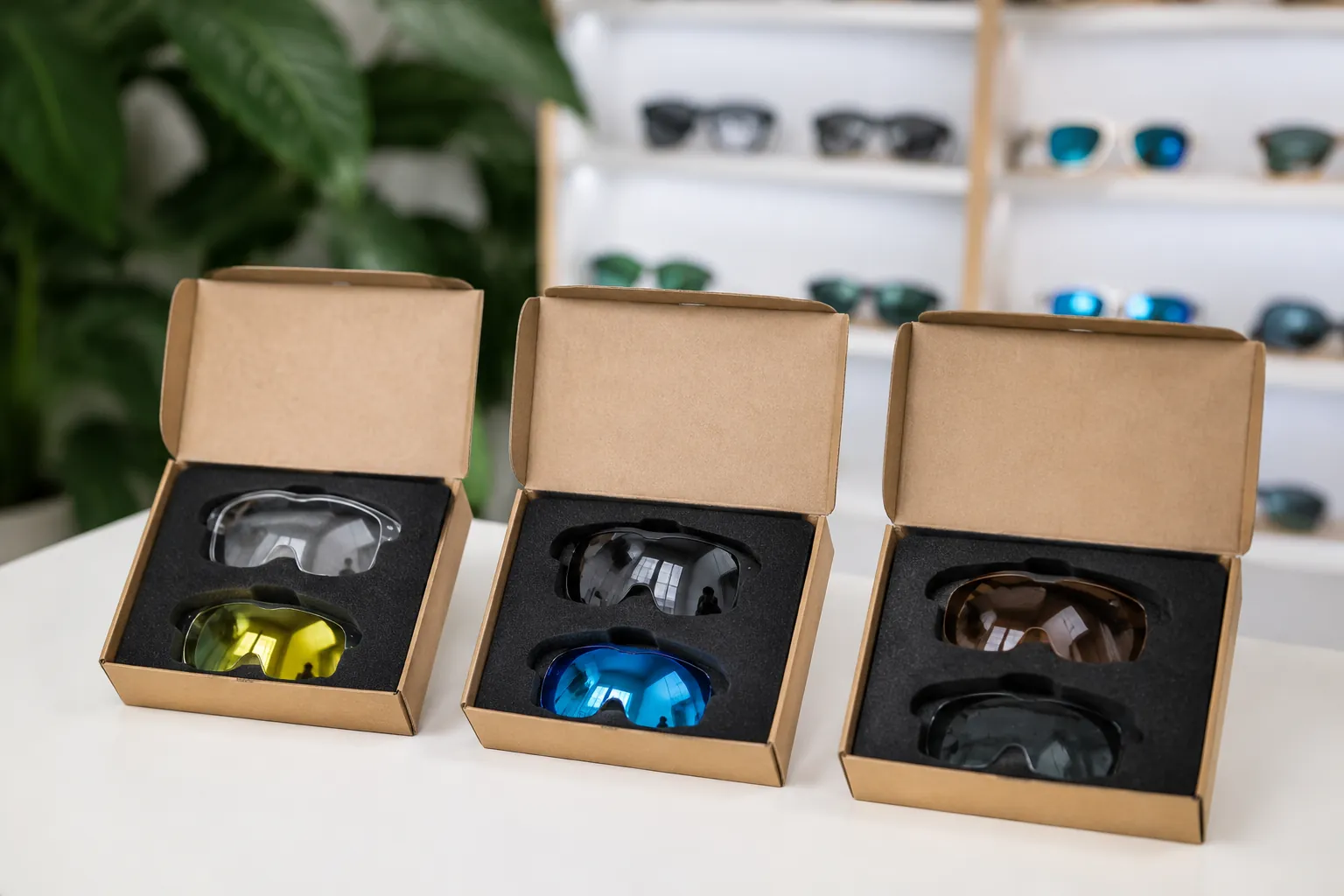
This guide is for brands, importers, distributors, promotional buyers, and retailers buying polarized sunglasses in volume. It explains how to verify polarization before shipment, set clear acceptance criteria, keep usable records, and reduce disputes after delivery. The goal is simple: make sure product claims on hangtags, retail cards, and online listings match the sunglasses actually shipped.
Define the Polarization Requirement
Polarized sunglasses are not just dark sunglasses. A polarized lens contains a polarizing film or layer positioned to reduce horizontally reflected glare from roads, water, snow, and glass. If that layer is missing, misaligned, damaged, wrinkled, or mixed with non-polarized stock, the lens may still look tinted but fail the polarized claim.
Write polarization into the shipment requirements. Do not leave it as a marketing description. Put it in the purchase order, approved sample file, artwork approval, packaging approval, QC checklist, and final inspection instruction. A practical requirement is straightforward: every sellable pair marked as polarized must show a clear extinction effect when checked against the approved test card, reference lens, or other agreed method.
Use two levels of verification. First, a functional pass/fail check. The lens should darken clearly when rotated about 90 degrees against a known polarized reference. Second, optical measurement. Use that only if the retailer, market, or compliance program requires recorded data such as visible light transmission, lens category, UV performance, prismatic imbalance, or optical distortion.
Set acceptance language before production starts. For example: both left and right lenses must show comparable extinction at the agreed angle; no lens may show zero extinction; obvious left/right axis mismatch is rejected; visible distortion that affects normal wear is rejected. Stickers, lens stamps, hangtags, and packaging icons are not proof. They only repeat the claim. The lens test proves the product.
Sample Stage: Lock the Approved Standard
The sample stage gives the buyer the most control. Use it to confirm more than frame shape and logo placement. The approved sample should identify lens material, tint, mirror or coating, frame material, decoration method, temple artwork, packaging, and polarization status.
For a small pilot run, testing every pair before shipment may be realistic. For larger production, sampling is usually enough, but the plan must cover every SKU, lens color, coating, and carton group. If the order includes multiple lens colors, gradient lenses, mirror coatings, or several packaging languages, keep records by SKU and lens batch wherever the supplier can provide that traceability.
- Seal two approved samples: one kept by the buyer and one kept by the factory, each labeled with model code, lens color, frame color, logo method, packaging version, and approval date.
- Photograph the extinction test: test the lens over a polarized card, reference lens, or LCD reference, rotate about 90 degrees, and keep photos of the light and dark positions.
- Record lens category: polarization and darkness are different. Two polarized lenses can have different visible light transmission and fall into different sunglass filter categories.
- Check both lenses separately: left and right lenses can be cut, edged, or inserted with different orientation errors.
- Freeze packaging claims: do not approve polarized icons, retail cards, QR pages, or online listing copy until the approved sample passes the agreed polarization check.
If the buyer needs CE EN ISO 12312-1, ANSI Z80.3, AS/NZS 1067, FDA registration, REACH documentation, ISO 9001 records, or BSCI records, request them at sample approval. The document request must match the actual frame material, lens material, lens tint, coating, decoration, and target market.
Factory Risks That Cause Polarization Failures
Most polarization failures come from weak process control, not broken equipment. A polarized sheet may be loaded at the wrong angle. A non-polarized blank may get mixed into a polarized bin. A laminated lens may see too much heat. A lens may be stressed by a tight frame rim. Cleaning, pad printing, laser marking, or packing may scratch coatings if handling is poor.
Material choice matters. TAC polarized lenses are common in fashion and promotional sunglasses because they are light and cost-effective, but poor lamination or heat exposure can lead to edge separation or waviness. PC polarized lenses are often used where impact resistance matters, but molded or cut lenses still need control for stress and optical distortion. Nylon lenses appear in some sport and premium products, where flexibility and processing control matter. Acetate and injection frames both need accurate rim dimensions so the lens seats without bending.
A practical factory QC plan should check at least three stages: incoming lens material, post-cutting or edging, and finished goods before packing. That helps isolate the source of the problem fast. Lens sheet. Cutting angle. Frame fit. Decoration. Final handling.
- Incoming lens check: confirm lens sheet or blank code, tint, mirror color, thickness, and extinction behavior before cutting.
- Cutting check: verify left and right lens orientation after cutting or edging, especially for wrap frames and large sport lenses.
- Assembly check: inspect for edge chips, stress marks, loose fit, excessive rim pressure, and left/right axis mismatch.
- Decoration check: confirm pad printing, laser engraving, metal logo plates, and temple prints do not scratch, contaminate, or stress the lenses.
- Final check: test finished pairs after cleaning, tagging, pouch insertion, barcode labeling, and carton packing.
Choose a Test Method and Stick to It
Not every order needs lab equipment. Every polarized order does need a repeatable method. Use the same method at sample approval, pre-shipment inspection, and arrival inspection. If the method changes after delivery, results get harder to compare and harder to use in a claim.
| Method | Best Use | Acceptance Detail | Limit |
|---|---|---|---|
| Polarized test card | Factory line checks, buyer checks, third-party inspection | Both lenses should show clear darkening when rotated approximately 90 degrees against the approved card | Confirms polarization function but does not measure VLT or optical quality |
| LCD screen rotation | Quick field verification during receiving, showroom checks, or spot checks | Lens should darken strongly at one rotation angle and lighten again when rotated back | LCD polarization varies by screen type and orientation, so it is not ideal as the only formal record |
| Reference polarized lens | Comparing bulk goods to the approved sample | Left and right lenses should match the approved sample response with no obvious axis shift | The reference pair must be controlled, clean, undamaged, and clearly identified |
| Spectrophotometer or optical tester | Retail compliance programs, higher-value orders, regulated market checks | Records values such as visible light transmission, lens category, UV-related data, and consistency | Requires suitable equipment, trained handling, and agreed measurement points |
For normal commercial inspection, keep the tolerance practical: both lenses must show extinction comparable to the approved sample; no lens may show no extinction; visible left/right mismatch is rejected; lens category should match the approved sample and market claim. If measured programs apply, define numeric ranges before production. That includes the VLT target, allowed shade variation, measurement location, and whether readings are taken at the lens center only or at multiple points.
Set Clear AQL Rules for Polarization Defects
Many sunglass inspections focus on scratches, dust, loose hinges, logo position, frame color, barcode accuracy, and carton condition. Fine. But polarization needs its own defect class. If a pair is sold as polarized and one lens is not polarized, that is not a cosmetic defect. It is a product-claim failure.
For most branded or retail orders, classify missing polarization as a major defect at minimum. If packaging, hangtags, advertising, or online listings make a clear polarized or glare-reduction claim, the buyer may classify a non-polarized lens as critical because the claim is false. Severe axis mismatch between left and right lenses should also be classified clearly because it can affect comfort, visual performance, and return rates.
A useful inspection instruction can read: test both lenses on every sampled pair using the approved test card or approved reference method. Rotate the pair against the reference. Both lenses must show comparable darkening at the agreed angle. Any lens with no darkening effect, obvious left/right mismatch, severe optical distortion, or lens stress affecting normal wear is recorded as a major defect unless the buyer has defined it as critical. Record the SKU, lens color, carton number, defect type, and quantity.
For mixed-color orders, do not test only the highest-volume smoke lens. Smoke, brown, green, blue mirror, silver mirror, gradient, and fashion tints may come from different lens batches or production runs. Split sampling across each SKU, lens color, coating type, and carton group. This matters even more when a trial color ships with a replenishment color.
Match Product Claims to Compliance Documents
Polarization is one performance feature. It is not the whole compliance picture. Standards are not interchangeable labels. CE EN ISO 12312-1, ANSI Z80.3, and AS/NZS 1067 cover sunglass optical requirements in different markets. REACH covers restricted substances for the EU. FDA registration relates to the US framework for sunglasses. ISO 9001 and BSCI cover management systems and social compliance. They do not prove that a specific lens is polarized.
Ask the supplier to identify exactly which report, declaration, registration, or certificate applies to the product being shipped. A document for one frame and lens combination may not apply to another combination with a different frame material, lens tint, mirror coating, decoration, or metal component. Lens tint changes can also affect visible light transmission category.
Before shipment, a solid document pack should include the approved sample record, final inspection report, packing list, material description, applicable compliance documents, and photos or video of the polarization test. Request only the standards and records needed for the target market, retailer requirement, and product claim. Then check the details. Model. Material. Color. Date. They should line up across the file.
Practical rule: if the hangtag says polarized, verify polarization. If the market requires optical compliance, verify the correct standard separately. One does not replace the other.
Pre-Shipment Approval and Arrival Checks
Build polarization verification into the production and inspection schedule. Do not leave it for the last day before shipment. That creates pressure to release goods before the problem is understood. Confirm the inspection window, sample quantity, test method, defect classification, and reporting format before mass production starts.
Order size should determine the reporting level. For a small order, production-line photos, carton labels, and a short QC summary may be enough. For larger orders, ask for a structured final inspection report with sampled quantity, pass count, fail count, defect photos, SKU references, and carton numbers. For complex orders with several lens colors or coatings, add in-process checks by lens color, coating, and batch reference where available.
- Before packing: request photos or short videos showing the approved polarization test method on finished pairs.
- During final QC: require sampled pair counts, failed pair counts, SKU references, lens colors, defect descriptions, and carton numbers.
- Before balance payment: review the inspection result, packing list, approved sample reference, compliance document references, and product photos.
- For third-party inspection: send the approved sample and exact test instruction before the inspector enters the factory.
The inspection still needs normal eyewear checks: lens scratches, frame deformation, hinge tension, screw security, temple alignment, nose pad fit, logo durability, barcode accuracy, polybag labels, pouch quality, and master carton condition. A polarized lens in a warped frame is still a defective product.
Once goods arrive, inspect quickly. Do not wait for a retailer, distributor, or end customer to find the issue. Pull cartons from different pallet positions, carton numbers, and SKU labels. Test both lenses on sampled pairs using the same method approved before shipment.
Record evidence so the supplier can act on it. A message saying many pairs are not polarized is weak. A report listing SKU, lens color, carton numbers, sampled quantity, failed quantity, lens side, and failure type is usable. Keep failed samples unchanged. Do not remove stickers, swap lenses, clean aggressively, or repack them with other SKUs. Photograph the carton mark, polybag label, hangtag, left lens test, right lens test, and any visible distortion or stress marks. If third-party lab testing is needed, send sealed samples from the affected cartons and record who selected, packed, shipped, and received them.
Disputes are easier to resolve when buyer and factory agreed on the same pass criteria before production. A written verification plan protects both sides.
Have a custom sunglasses project in mind?
Send us your styles, target market and quantities and we will return a detailed quote with MOQ, lead time and a sample plan.
Get a QuoteWhy source this from Wenzhou with LumiShades
Wenzhou in Zhejiang Province is widely regarded as China’s eyewear manufacturing capital, producing a large share of the world’s sunglasses. That concentration matters to buyers: a deep local supply chain for acetate sheet, hinges, lens blanks, plating and packaging means shorter component lead times, easier color and material matching, and a workforce with decades of eyewear-specific skill. LumiShades has manufactured in this ecosystem since 2009, and our vertical integration — in-house injection molding, acetate cutting, CNC milling, lens tinting, decoration and quality control — means no part of your order is quietly subcontracted to a workshop you cannot audit.
For international buyers, that vertical control translates into accountability. When a single factory owns every step, defects are traced and fixed at source rather than bounced between vendors, and your specifications survive intact from first sample to bulk. We back this with 15+ years of experience, shipments to 60+ countries, more than 5 million pairs produced per year and a 98.5% on-time delivery rate. Our certifications — CE EN ISO 12312-1, FDA registration, ANSI Z80.3, AS/NZS 1067, REACH, ISO 9001 and BSCI audit — mean the compliance documentation your market requires already exists. Explore our manufacturing capabilities and quality control process to see how this works in practice.
Frequently asked questions
Should every pair in a polarized sunglasses order be tested? For a very small pilot run, yes, that can be practical and gives the buyer a clean baseline. For larger orders, use AQL sampling, but test both lenses on every sampled pair and split the sample across all SKUs, lens colors, coatings, and carton groups. Put the sampling plan and defect classification in the inspection instruction before production starts.
Is an LCD screen enough to verify polarization? It is useful for a quick field check because a polarized lens should darken and lighten as it is rotated against the screen. It should not be the only formal method for higher-volume retail orders because screen polarization varies. For formal QC, use an approved polarized test card, controlled reference lens, or optical equipment, and keep the method consistent from sample approval through arrival inspection.
What defect level should a non-polarized lens be assigned? If the product is sold as polarized, assign it as a major defect at minimum. If the packaging, hangtag, advertising, retailer file, or online listing makes a clear polarized or glare-reduction claim, many buyers classify it as critical because the claim is false. Define that classification in the AQL instruction before inspection.
Can mirror coating or dark tint hide polarization problems? Yes. A dark or mirrored lens can look correct in a visual check while failing the extinction test. Do not judge polarization by darkness, mirror color, lens stamp, or sticker. Test the actual polarization effect on both lenses using the approved method and compare the result with the approved sample.
What documents should I request before paying the balance? Request the final inspection report, packing list, approved sample reference, photos or video of the polarization test, material description, and the documents required for your sales market. Depending on the market and claim, these may include CE EN ISO 12312-1, ANSI Z80.3, AS/NZS 1067, REACH, FDA registration, ISO 9001, or BSCI records. Check that the documents match the shipped model, lens material, tint, coating, frame material, and order date.
Ready to start?
Explore our cat-eye sunglasses or request a quote — our sales team replies within 12 hours.
Request a Quote