
Sunglass Lens Thickness for Bulk Orders
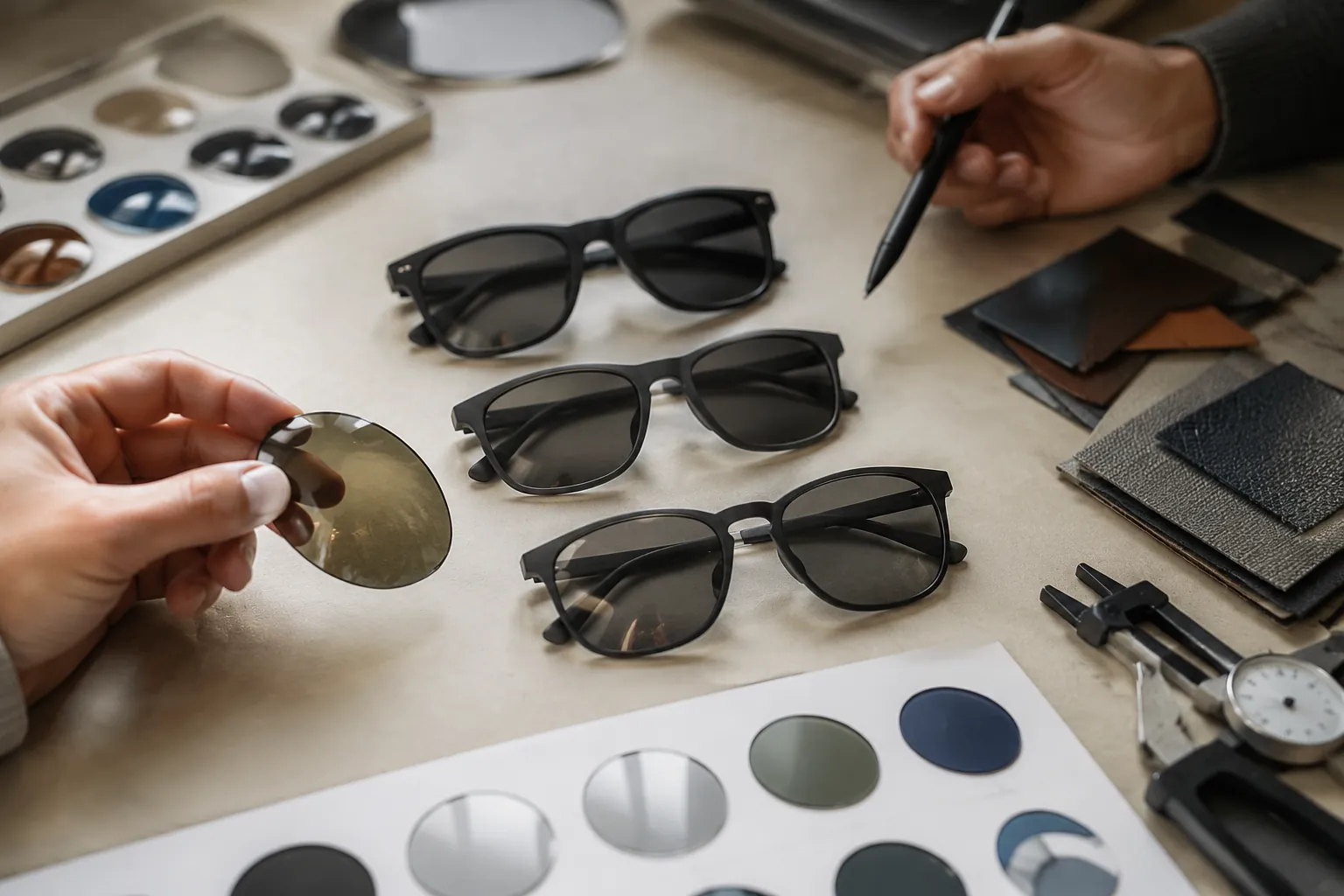
This guide is for brands, importers, distributors, and retailers that need to specify sunglass lens thickness before placing a custom order. Thickness affects frame groove design, edging, lens curve, assembly pressure, tint appearance, packaging clearance, product weight, inspection criteria, and compliance testing. It is not just a choice between 1.0 mm and 1.5 mm. The right specification connects material, nominal thickness, tolerance, frame construction, lens curve, coating, decoration, target market, and the approved physical sample that production must follow.
Start With Use Case, Frame Geometry, and Risk
Lens thickness problems often start before anyone talks about thickness. The frame shape, logo method, target price, and packaging get fixed first. Then the lens is expected to fit the decision already made. That is risky.
A thin lens may work in a flat promotional full-rim frame. Put the same lens in a high-wrap sport frame and it may flex, gap, or pop out. A thicker lens can improve retention, but it can also make a slim rim hard to assemble or create pressure marks if the groove was designed for a thinner lens.
For bulk orders, choose thickness from the use case and frame geometry first. Event giveaways usually prioritize low unit cost, low freight weight, and fast repeatability. Fashion retail needs clean visible edges, consistent tint, acceptable comfort, and predictable packaging. Kids sunglasses need impact-conscious material, smooth edges, secure retention, low front weight, and decoration that does not create small-parts concerns. Sport sunglasses need curve control, stronger retention, reduced flex, and careful optical review.
Lock lens thickness during sample development, before the buyer approves tooling, lens cutting files, decoration placement, and packaging. Changing thickness after sample approval can affect edging dimensions, groove fit, assembly speed, quality control criteria, optical appearance, and carton packing. If the order must meet a specific market standard, confirm the test plan before sample approval. Test the finished sunglass against the right requirement.
Practical rule: if the frame has high wrap, thin rims, kids sizing, shield construction, or sport positioning, do not choose the thinnest lens only to save cost.
Practical Thickness Ranges and Tolerances
High-volume non-prescription sunglass programs commonly use lenses from about 0.8 mm to 2.2 mm. The right range depends on material, frame construction, curve, and target price. Some promotional products use thinner lenses. Shields, sport frames, and thicker polycarbonate options may sit above 2.0 mm.
Specify both nominal thickness and tolerance. A thickness target without tolerance is hard to inspect and easy to dispute.
For many commercial sunglass programs, a practical tolerance may be around +/-0.05 mm to +/-0.10 mm. The right number depends on material, supplier process, cutting method, and inspection capability. Tighter tolerance can increase sorting, rejection, and cost. Wider tolerance can create fit variation, especially on slim rims, metal frames, semi-rimless constructions, and high-wrap fronts.
| Lens thickness | Typical use | Process note | Main risk |
|---|---|---|---|
| 0.7-0.9 mm | Low-cost flat promotional sunglasses and short event programs | Lower material use; best for simple full-rim frames with stable support | More flex, weaker edge feel, easier deformation during assembly or packing |
| 1.0-1.2 mm | Entry fashion, retail basics, many adult full-rim frames | Common balance for injection or acetate frames when groove design is stable | Needs accurate edging to avoid movement, rattle, or visible gaps |
| 1.4-1.6 mm | Better retail, kids programs, thicker fronts, stronger edge presentation | Improves rigidity and can give a cleaner visible edge when finished well | Higher lens weight and cost; may stress slim rims if groove fit is wrong |
| 1.8-2.2 mm | Sport, shield, wrap, and higher-retention designs | Requires curve control, groove matching, and optical review on the finished frame | More expensive, harder to fit in slim rims, possible distortion if curve is mismatched |
These are sourcing ranges, not compliance guarantees. Standards evaluate the finished sunglass, not thickness alone. Testing may cover visible light transmittance category, optical quality, frame and lens performance, labeling or markings, chemical requirements, and claim review. In the RFQ, discuss CE EN ISO 12312-1, ANSI Z80.3, AS/NZS 1067, REACH, FDA registration where applicable, ISO 9001 factory system information, and BSCI audit status where the buyer requires it.
Material Changes the Thickness Answer
A 1.2 mm polycarbonate lens and a 1.2 mm TAC polarized lens do not behave the same. Material affects impact behavior, stiffness, optical quality, coating performance, cutting quality, heat resistance, humidity resistance, and price. Choose thickness together with material. Do not add it later.
- PC lenses: often selected for kids, sport, and more durable retail programs because polycarbonate has strong impact resistance compared with many common sunglass lens materials. Surface coating and optical distortion still need review.
- TAC polarized lenses: widely used for polarized fashion and outdoor sunglasses. Buyers should check lamination quality, polarization efficiency, edge quality, humidity resistance, and heat exposure risk.
- Acrylic lenses: used in some cost-sensitive fashion or promotional products. Acrylic can give clear color appearance, but buyers should be careful with durability, impact, and sport claims.
- Nylon lenses: used in some higher-performance curved eyewear because nylon can support flexibility, lighter weight, and good optical potential when processed correctly. It usually costs more than basic promotional lens options.
Thickness also changes appearance. Smoke, brown, green, gradient, mirror, and polarized lenses can look darker or more saturated at the edge when thickness increases. Mirror coatings may show edge color variation after cutting if the finishing process is rough. Approve physical samples under daylight, indoor LED lighting, and against a white background. Screen images are not reliable for final tint approval.
Fit, Edge Quality, and Assembly Stress
Thicker lenses usually resist flex better. That does not fix poor engineering. Many failures start at the edge.
A sharp edge, uneven CNC path, tight groove, aggressive heating process, unsuitable screw pressure, or wrong curve can create stress. A lens may look acceptable at first inspection and later crack, loosen, or show stress marks after shipping, heat exposure, or handling.
For injection frames, the lens groove and lens edge must match. A groove that is too shallow can leave visible gaps. A groove that is too tight can bite the lens. For acetate frames, the lens shape must account for heating, hand assembly, and front curvature. For metal frames, screw torque, rim closure, and washer choice matter. A lens that is only slightly thicker than planned can slow assembly, distort the frame front, or increase rejection if the frame was not designed for it.
Use a direct sampling check. Insert the lens. Open and close the temples repeatedly. Flex the front lightly by hand. Inspect the edge under strong light. Look for lens movement, stress whitening, bite marks, gaps, and visual distortion. For bulk QC, include surface scratches, bubbles, coating marks, tint consistency, fitting tightness, visible gaps, lens category, optical distortion, and packaging rub. The approved sample should define what is acceptable. Written specifications alone often miss fit and appearance details.
Decoration, Coating, and Packaging Details
Lens thickness also affects branding and finishing. Many sunglass programs use temple logos, lens logos, metal badges, hang tags, pouches, microfiber bags, printed inserts, or retail boxes. Confirm decoration before final sample approval. It can change handling, assembly sequence, stress points, small-parts review, and final inspection.
Common decoration methods include pad printing, silk-screen printing, laser engraving, hot stamping, metal logo plates, injected logo inserts, and lens corner printing. Pad printing is common for temples and cost-sensitive programs. Laser engraving can look clean on suitable metal or acetate parts, but position control matters. Metal plates can add perceived value, but they also add weight and may need extra review for kids products. Lens printing should stay outside the optical zone and should not conflict with required markings, category information, or buyer labeling rules.
Coating choices add more variables. Polarized TAC, mirror coating, anti-scratch coating, gradient tinting, and anti-reflective effects each affect production control. A thicker curved lens with mirror coating may need more careful handling to prevent edge chipping or coating rub. Check packaging with the real finished pair, not only CAD or an empty box. Large shields and thicker lenses can touch the pouch, tray, insert, or microfiber bag in transit. Marks can appear before the buyer ever receives stock.
Weight, Comfort, MOQ, and Price Logic
A small increase in lens thickness can change comfort on oversized square frames, shields, and kids styles. Consumers rarely describe the issue as lens thickness. They say the sunglasses feel heavy, front-loaded, slippery, tight, or awkward.
For many adult fashion sunglasses, a mid-range lens is enough when the frame is not highly wrapped and the lens is well supported. For kids sunglasses, material choice and retention usually matter more than maximum thickness. Keep front weight suitable for smaller faces.
Ask for finished pair weight, not only lens thickness. Compare the complete sunglass, including hinges, screws, nose pads, logo plates, trims, lens material, and packaging. Weight affects wearing comfort and freight planning across bulk orders. For sports frames, slightly more lens weight may be acceptable if the nose pads, temple grip, and frame geometry hold the sunglass securely during movement.
Lens thickness can affect price through material use, cutting speed, coating yield, rejection rate, packing weight, and assembly time. The effect may look small during sampling. It becomes clearer at production quantity. The bigger cost risk is rework: lens movement, visible gaps, pressure marks, packaging rub, failed inspection, or an unsupported product claim can cause repacking, delayed shipment, retesting, or replacement production.
- Confirm destination market and required standard before sample approval.
- Choose frame material, lens material, lens curve, and thickness together.
- Define nominal thickness plus tolerance, not only a single target number.
- Approve physical samples with final tint, logo, coating, packaging, and lens curve.
- Keep a signed reference sample with date, version, order number, and approved lens specification.
- Inspect bulk against retention, surface, tint, optical, marking, and packaging criteria before shipment.
Use-Case Recommendations and Spec Sheet Details
The following ranges are practical starting points for sourcing discussions. They do not replace product testing. They help buyers avoid weak first samples and unnecessary revisions.
| Program type | Recommended direction | Thickness logic | Buyer watchout |
|---|---|---|---|
| Event promo | Thin to mid lens, simple tint, simple full-rim frame | 0.8-1.1 mm often helps control cost and weight | Do not make durability, polarization, UV, or sport claims unless the material, frame design, and testing support them |
| Fashion retail | Mid lens with clean edge finish and controlled tint | 1.0-1.4 mm often balances appearance, comfort, and price | Check tint edge color, mirror consistency, lens movement, and logo alignment on physical samples |
| Kids sunglasses | PC lens, smooth edge, secure fit, low front weight | 1.2-1.6 mm can improve rigidity without automatically making the frame too heavy | Confirm retention, sharp edges, small decoration parts, REACH requirements, and the target sunglass standard |
| Sport sunglasses | Thicker PC, nylon, or another suitable performance lens | 1.6-2.2 mm may be needed for wrap, retention, and stronger positioning | Review curve distortion, nose fit, temple grip, sweat contact points, and packaging pressure |
For high-wrap frames, ask for a lens curve check and finished optical review. A lens that is too thin can flex in the frame. A lens that is too thick can create distortion or assembly stress if the curve and groove are not matched. Catch both problems during sampling, not after production starts.
A clear sunglass spec sheet prevents the factory from choosing a merely workable lens by default. It also gives purchasing, production, and QC the same target. For B2B sourcing, define the lens in enough detail that an inspector can check the product without relying on email history.
- Lens material: PC, TAC polarized, acrylic, nylon, or another approved material.
- Thickness target: nominal thickness and acceptable tolerance, such as 1.2 mm +/-0.10 mm where appropriate.
- Lens curve: especially for wrap, shield, and sport frames.
- Lens category: visible light transmittance category required for CE EN ISO 12312-1, ANSI Z80.3, or AS/NZS 1067 as applicable.
- Color and coating: smoke, brown, green, gradient, mirror, polarized, anti-scratch, anti-reflective, or other finish.
- Frame fit: full rim, semi-rimless, rimless, injection, acetate, metal, or mixed material.
- Decoration: pad printing, laser engraving, hot stamping, metal plate, lens logo, or packaging branding, with placement confirmed away from stress points where possible.
- Testing target: CE EN ISO 12312-1, ANSI Z80.3, AS/NZS 1067, REACH, FDA registration where applicable, ISO 9001 factory system information, or BSCI audit status where required by the buyer.
- Packaging clearance: pouch, box, insert, microfiber bag, barcode label, and any transport protection that touches the lens or frame.
Keep the approved sample and mark it with date, version, order number, lens material, thickness, tint, and coating. A retained sample gives purchasing, production, and QC one physical target and reduces disputes during final inspection.
Have a custom sunglasses project in mind?
Send us your styles, target market and quantities and we will return a detailed quote with MOQ, lead time and a sample plan.
Get a QuoteWhy source this from Wenzhou with LumiShades
Wenzhou in Zhejiang Province is widely regarded as China’s eyewear manufacturing capital, producing a large share of the world’s sunglasses. That concentration matters to buyers: a deep local supply chain for acetate sheet, hinges, lens blanks, plating and packaging means shorter component lead times, easier color and material matching, and a workforce with decades of eyewear-specific skill. LumiShades has manufactured in this ecosystem since 2009, and our vertical integration — in-house injection molding, acetate cutting, CNC milling, lens tinting, decoration and quality control — means no part of your order is quietly subcontracted to a workshop you cannot audit.
For international buyers, that vertical control translates into accountability. When a single factory owns every step, defects are traced and fixed at source rather than bounced between vendors, and your specifications survive intact from first sample to bulk. We back this with 15+ years of experience, shipments to 60+ countries, more than 5 million pairs produced per year and a 98.5% on-time delivery rate. Our certifications — CE EN ISO 12312-1, FDA registration, ANSI Z80.3, AS/NZS 1067, REACH, ISO 9001 and BSCI audit — mean the compliance documentation your market requires already exists. Explore our manufacturing capabilities and quality control process to see how this works in practice.
Frequently asked questions
Is a thicker sunglass lens always more durable? No. Thickness can improve rigidity, but durability also depends on material, lens curve, edge finishing, groove fit, screw pressure, coating quality, and assembly stress. A well-fitted 1.2 mm lens can perform better than a poorly fitted 1.6 mm lens. Ask the supplier to confirm material, nominal thickness, tolerance, curve, retention check, and the standard used to test the finished sunglass.
What lens thickness should I choose for low-cost promotional sunglasses? For simple flat promotional sunglasses, many buyers start around 0.8-1.1 mm to control cost and weight. Keep the frame simple, preferably full-rim, and avoid claims such as sport performance, high impact resistance, or polarization unless the material and test results support them. Confirm UV and visible light requirements for the destination market before approving the sample.
Do kids sunglasses need thicker lenses? Kids sunglasses need suitable material, smooth edges, secure lens retention, low front weight, and chemical compliance more than maximum thickness. PC lenses around 1.2-1.6 mm are a common starting point, but the final choice should be checked against frame size, groove fit, decoration, REACH requirements, and the applicable sunglass standard such as CE EN ISO 12312-1, ANSI Z80.3, or AS/NZS 1067.
Will changing lens thickness affect lead time? It can. A thickness change may require new edging settings, groove review, curve adjustment, coating review, packaging clearance checks, and a new approved sample. Treat a thickness change after approval as an engineering change, not a small purchasing edit. Ask the supplier whether the change affects tooling, sampling, testing, QC criteria, and shipment date.
Which compliance standards should I mention in the RFQ? State the destination market first, then list the required standard or documentation. Common references include CE EN ISO 12312-1 for many EU sunglass programs, ANSI Z80.3 for the US, AS/NZS 1067 for Australia and New Zealand, and REACH for chemical compliance where applicable. FDA registration may be relevant for US import documentation. ISO 9001 and BSCI are factory system or audit references, not substitutes for finished product testing.
At what order size does lens thickness start to affect price seriously? Lens thickness can affect price at any quantity, but it becomes more visible when production volume is high enough for material use, cutting speed, coating yield, rejection rate, and freight weight to matter. Ask for a side-by-side quote using the same frame, coating, packaging, and compliance requirement with only lens thickness changed. That is the cleanest way to see the real cost impact.
Ready to start?
Explore our sport wrap sunglasses or request a quote — our sales team replies within 12 hours.
Request a Quote