
Polarized Lens QC Before Bulk Production
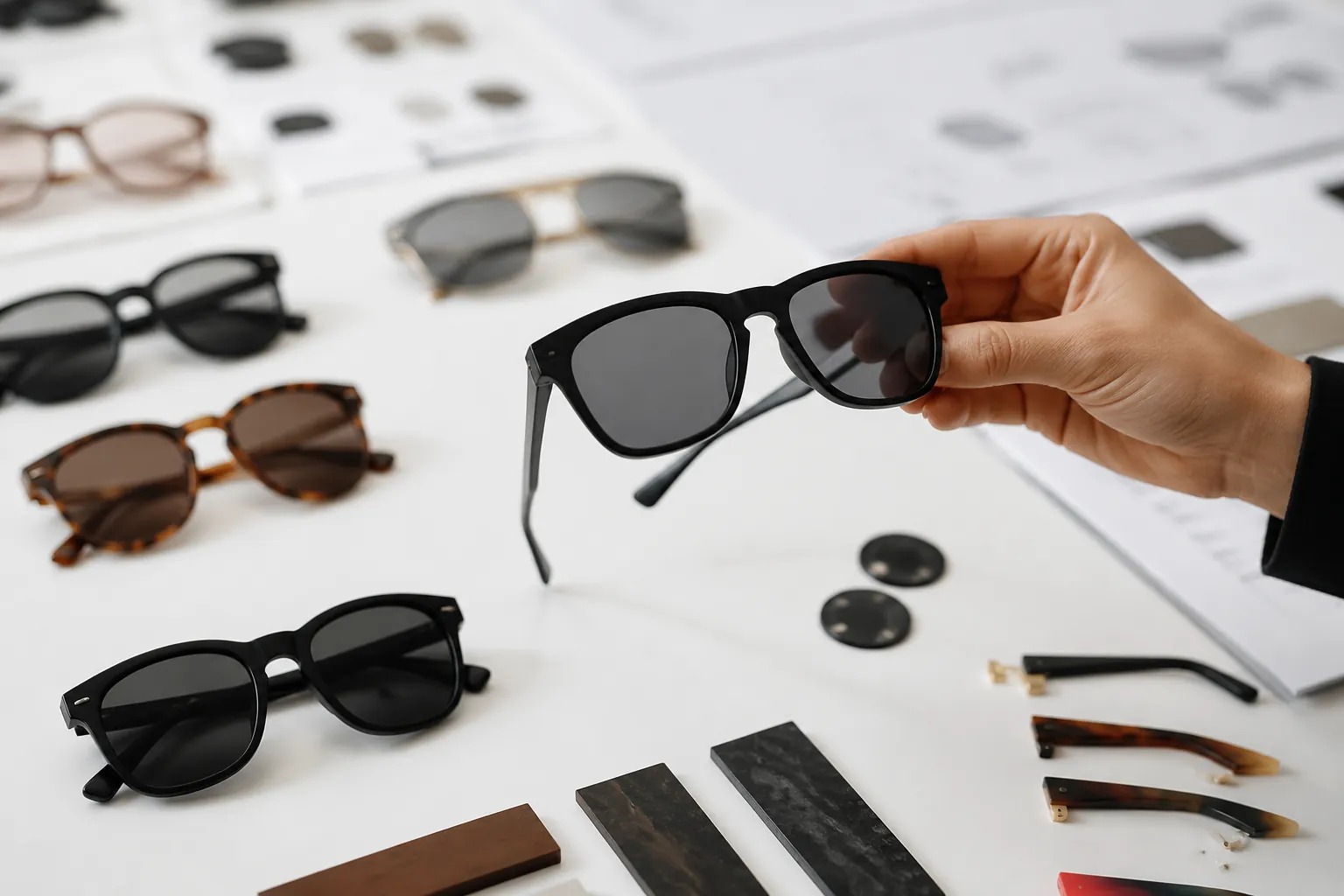
This guide is for eyewear brands, importers, distributors, and retailers ordering custom polarized sunglasses before bulk production. It shows which lens checks to request before sample approval, how to set measurable pass/fail limits, and what evidence the factory should provide. The aim is simple: fewer rejected shipments, fewer color disputes, fewer lens complaints, and faster approval decisions.
Approve A Lens Pack, Not Just One Sample Pair
A sample pair shows how one unit looks. It does not prove that a bulk order will keep the same polarization, color, fit, coating quality, and compliance status. Before production starts, ask for a lens approval pack. Keep frame approval and lens approval separate.
For polarized sunglasses, the pack should include finished sample pairs, loose lenses from the same approved construction, a written lens specification, polarization test evidence, visible light transmission data, controlled color photos, and packaging or labeling notes where lens category claims appear. If one lens color is used across several frame colors, approve the lens once and then confirm mounting fit in each frame mold or frame construction. If each frame color uses a different tint, mirror coating, gradient, material, or base curve, treat each lens as a separate approval item.
Fixes are easier before materials are purchased, coated, cut, or assembled at scale. Tint density, edging size, mirror strength, logo placement, and groove fit can all become expensive once production is moving. The approval pack must identify the approved version clearly, so the factory, buyer, and third-party inspector use the same reference.
- Master sample pair: one signed or formally approved pair for appearance, fit, logo placement, lens color, and wearing feel.
- Loose lenses: at least two pieces where practical for polarization, VLT, color, coating, edge, and thickness checks.
- Lens spec sheet: material, base curve, thickness, tint, coating, UV claim, lens category, and target standard.
- QC evidence: controlled photos, readings, or short videos using the same light source, screen, grid, and inspection distance.
- Retained sample: one factory-held master with project code, version number, approval date, and buyer sign-off record.
Write The Lens Spec In Measurable Terms
Vague wording causes disputes. Phrases such as good polarized lens or same as sample are not enough for bulk production. The lens specification should be clear enough for QC staff to inspect without asking the sales team what the buyer meant.
Start with material. Common sunglass options include TAC polarized lenses for lightweight promotional and commercial orders, PC polarized lenses where impact resistance is a priority, nylon lenses for many sports or wrap styles, and CR39 lenses where optical clarity matters but impact performance still needs checking against the applicable standard. TAC is cost-effective, but its laminated structure needs careful edge control. PC can offer higher impact resistance, but stress, coating adhesion, and optical distortion must be managed. Nylon often suits curved sports frames, though cost and processing requirements vary by supplier.
Then define the optical and commercial details: base curve, center thickness, VLT range, lens category, UV400 claim if used, mirror or anti-reflective coating, gradient direction, logo method, and whether the lens is plano or prescription-ready. Do not judge darkness by eye. A smoke lens and a brown lens can look similar on a desk and measure differently in a test. Mirror and gradient coatings can also change the final category.
| Lens Item | Typical Buyer Target | Why It Matters | Evidence To Request |
|---|---|---|---|
| Polarization efficiency | Supplier-stated minimum, with buyer-approved acceptance limit; many commercial programs specify 95 percent or higher | Controls glare reduction performance | Instrument record or controlled comparison record by lens color and batch |
| VLT range | Category-specific range aligned with the selling market and intended use | Controls darkness, labeling, warnings, and use claims | Transmittance reading linked to lens color and sample version |
| Lens thickness | Specified by lens material, frame type, and impact or mounting requirement | Affects mounting stress, durability, optics, and weight | Caliper check at center and edge where relevant |
| Base curve | Matched to frame geometry and intended fit | Reduces distortion, stress, and forced mounting | Lens drawing, supplier specification, or sample measurement |
| Color tolerance | Physical master match; Delta E target if instrument control is used | Prevents shade drift across SKUs, production batches, and repeat orders | Master lens plus lightbox photos or spectrophotometer record |
Check Polarization With Screening And Batch Records
The fastest check is to rotate the lens against a known polarized screen or another polarized lens. A correctly oriented polarized lens should darken strongly at the blocking angle and brighten again when rotated back. This catches obvious weak polarization, wrong film direction, and left-right mismatch. It is useful. It is not a full measurement.
For pre-production approval, ask the factory to confirm polarization efficiency by instrument or by a documented controlled comparison method. A practical buyer specification should state the required minimum, the test method, the sampling point, and whether the requirement applies before or after mounting. Many commercial polarized sunglasses programs specify 95 percent or higher. Premium outdoor, fishing, boating, snow, or driving programs may need tighter limits. Confirm that the selected lens material, tint, curve, coating, and frame construction can meet the target after cutting and assembly.
Test the left and right lenses separately. Check near the optical center and, where practical, near the upper, lower, nasal, and temporal areas. Weak zones near the edge can appear when polarized film is stretched, overheated, poorly laminated, or stressed during edging. Wrap frames need extra attention because lens curvature and rim pressure can expose film stress faster than flatter fashion frames.
For bulk control, request records by lens color and batch. Small trial orders should still receive visual polarization screening before packing. Larger orders should include incoming lens checks before assembly and finished-pair checks after mounting. For repeat or high-volume programs, keep retained samples from both pre-production and bulk production. Complaints and reorders need dated references, not memories.
Check Distortion And Stress After Mounting
A loose lens can pass inspection and still fail after it is mounted. The frame groove may be too tight. The edged lens may be oversized. The base curve may not suit the frame. A metal screw may apply too much pressure. Polarized lenses are sensitive because the laminated film can show stress patterns under polarized light.
Ask for a grid distortion check on the finished sample pair, not only on loose lenses. The method is simple: view a straight-line grid through the lens at a fixed distance and check whether the lines bend, wave, or pull near the edges. For plano sunglasses, the main viewing area should not create obvious warping. Minor edge distortion may be acceptable on some high-wrap sports frames, but the buyer should define the primary line of sight and the rejection limit.
Also request stress inspection using crossed polarizers. Stress often appears as bright, rainbow, or crescent-shaped marks around screw points, rim edges, drilled holes, and bridge areas. Treat these marks as warnings. If stress is visible in the approved sample, it may get worse during bulk assembly because production mounting conditions may differ from sample-room handling.
The fix is usually mechanical, not cosmetic. The factory may need to open the groove slightly, reduce lens edging size, adjust the bevel, lower mounting pressure, change screw torque, or switch to a better-matched base curve. If distortion or stress appears in the main viewing area, require corrected samples before bulk release.
Watch Delamination, Heat, And Edge Quality
Polarized lenses are layered products. The polarizing film sits between lens layers or inside a bonded laminate structure. If bonding, tinting, cutting, drilling, coating, or heat exposure is poorly controlled, the lens can delaminate. Look for cloudy edges, bubbles, peeling film, whitening, or localized coating failure.
Before bulk production, ask for edge inspection after cutting and after mounting. Inspectors should check for milky lines, tiny bubbles, lifting near drilled holes, rough bevels, and white edge stress. Delamination often starts at the edge because cutting creates heat and mechanical force. Rimless and semi-rimless frames carry more risk than full-rim frames. Metal frames with tight screws and thin grooves can also stress the lens edge.
A limited heat and humidity check on sample lenses can be useful before production. It is not a replacement for accredited laboratory testing or a full aging program, but it can expose weak bonding early. Write the condition, duration, and acceptance criteria into the approval record. Do not leave them as chat notes.
Decoration can increase risk. Mirror coating, flash coating, gradient tinting, lens printing, pad printing near the lens edge, and laser marking must be compatible with the polarized structure. Aggressive solvents, high curing temperatures, poor masking, or abrasion during handling can damage coatings or weaken the edge. If the design uses mirror lenses, ask whether the coating is on the front surface, back surface, or protected within the lens construction. Define handling and scratch limits before production.
Approval rule: do not approve bulk production if the pre-production sample already shows edge clouding, bubbles, film lift, coating failure, or stress whitening. Sorting finished sunglasses is slow and unreliable once delamination has started.
Control Lens Color With A Physical Master
Color disputes are common because buyers approve a phone photo and then compare bulk goods under different lighting. Lens color should not be managed by memory or screen appearance. Use a physical reference. Control the batch.
For each polarized lens color, approve one physical master lens or master sample pair. Label it with project code, lens color, category, date, and version number. Ask the factory to keep one duplicate master and send one to you where possible. During bulk production, QC should compare production lenses to the approved master under the same light condition, preferably neutral daylight or a lightbox with a defined source such as D65.
If the factory uses instrument control, define a Delta E tolerance and the measurement method. The right limit depends on tint, mirror coating, gradient strength, lens material, and retail position. Left-right matching inside one pair should be tighter than order-wide shade variation because consumers notice mismatched lenses immediately.
MOQ and price can affect color control. Very small custom runs may use available lens stock or limited tint options, which can restrict process control. Larger runs may allow a more controlled lens batch per color, retained samples, and formal production records. Before issuing the purchase order, confirm whether special mirror coatings, extra sorting, separate tint batches, or tighter color tolerances affect cost, lead time, or minimum order quantity.
- Approve a physical master instead of only a digital image.
- Use one lens batch per color where possible to reduce shade drift between production days.
- Check left and right lenses together before packing, not only as loose lenses.
- Inspect under neutral light and avoid final judgment under yellow office lighting or mixed lighting.
- Record the lens category so dark fashion lenses do not conflict with the intended use claim or required warning text.
Tie Compliance And PO Limits To The Exact Lens
Polarized sunglasses still need to meet the rules of the destination market. The lens spec should connect appearance, performance, and compliance. Do not accept a generic compliance statement that fails to identify the lens color, material, model family, intended market, or test scope.
Common compliance references include CE EN ISO 12312-1 for Europe, ANSI Z80.3 for the United States, AS/NZS 1067 for Australia and New Zealand, FDA registration context for US supply, REACH for restricted substances, and factory system audits such as ISO 9001 and BSCI. These references do not prove the same thing. Product standards, chemical restrictions, regulatory registrations, and factory audits serve different purposes. Confirm which documents are required for the selling market and sales channel.
Confirm UV protection, visible light transmission, lens category, traffic signal recognition where applicable, impact requirements, restricted substances, warning text, and product marking. Very dark lenses, mirror lenses, gradient lenses, and fashion colors can change the category. Polarization does not make a lens suitable for every use. Some polarized lenses can interfere with digital displays, and some lens categories are unsuitable for driving or night use depending on the applicable standard and labeling rules.
| Market Or Need | Reference | Before Bulk, Confirm |
|---|---|---|
| European retail | CE EN ISO 12312-1 | UV protection, lens category, warnings, product marking, and declaration support |
| United States retail | ANSI Z80.3 and FDA registration context | Transmittance, impact where applicable, labeling, responsible supplier details, and product scope |
| Australia and New Zealand | AS/NZS 1067 | Category, traffic signal recognition where applicable, warnings, and product marking |
| Chemical restrictions | REACH | Frame, lens, coating, nose pads, inks, packaging contact materials, and decoration materials where relevant |
The purchase order should then state the enforceable limits. Include lens material, color, polarization requirement, UV claim, VLT range or category, coating, logo or decoration method, frame color, packaging, applicable standards, sample approval date, and bulk inspection requirements. If the sunglasses are for driving, water sports, snow, kids, festivals, promotional use, or another defined application, state that use.
Also define failure actions. Lenses with visible delamination, wrong color, weak polarization, heavy distortion in the main viewing area, coating scratches outside the agreed limit, left-right mismatch, or incorrect category should be rejected or replaced before shipment. Lens rework is limited. Often, replacement is the only reliable fix.
A strong PO line might read: polarized smoke grey TAC lens, category 3 if confirmed by test report for the approved lens, UV400 claim subject to the applicable market standard, VLT range to match the approved specification, polarization efficiency not lower than the buyer-approved limit, no visible delamination or edge whitening after mounting, color to match approved master sample identified by project code and date, left-right pair matching required, grid distortion not visible in the main viewing area, retained samples required from bulk production. That wording gives the factory, QC team, third-party inspector, and buyer the same inspection target before money and materials are committed.
Have a custom sunglasses project in mind?
Send us your styles, target market and quantities and we will return a detailed quote with MOQ, lead time and a sample plan.
Get a QuoteWhy source this from Wenzhou with LumiShades
Wenzhou in Zhejiang Province is widely regarded as China’s eyewear manufacturing capital, producing a large share of the world’s sunglasses. That concentration matters to buyers: a deep local supply chain for acetate sheet, hinges, lens blanks, plating and packaging means shorter component lead times, easier color and material matching, and a workforce with decades of eyewear-specific skill. LumiShades has manufactured in this ecosystem since 2009, and our vertical integration — in-house injection molding, acetate cutting, CNC milling, lens tinting, decoration and quality control — means no part of your order is quietly subcontracted to a workshop you cannot audit.
For international buyers, that vertical control translates into accountability. When a single factory owns every step, defects are traced and fixed at source rather than bounced between vendors, and your specifications survive intact from first sample to bulk. We back this with 15+ years of experience, shipments to 60+ countries, more than 5 million pairs produced per year and a 98.5% on-time delivery rate. Our certifications — CE EN ISO 12312-1, FDA registration, ANSI Z80.3, AS/NZS 1067, REACH, ISO 9001 and BSCI audit — mean the compliance documentation your market requires already exists. Explore our manufacturing capabilities and quality control process to see how this works in practice.
Frequently asked questions
Should I approve polarized lenses from photos only? No. Use photos for early screening only. Approve a physical master lens or sample pair, then record the project code, lens color, category, approval date, and version number. Ask the factory to keep a duplicate master so bulk lenses can be compared under the same light source during production inspection.
What polarization efficiency should I request? State a measurable minimum and the test method in the purchase order. Many commercial polarized sunglasses programs specify 95 percent or higher, but outdoor, fishing, boating, snow, or driving programs may need a tighter limit. Confirm with the supplier that the selected material, tint, curve, coating, and frame construction can meet the target after cutting and mounting.
Can I use the same polarized lens spec for every frame shape? Not automatically. High-wrap, rimless, semi-rimless, drilled, and tight metal frames can create stress, edge damage, or distortion even when the loose lens passes inspection. Approve the tint and material once, but check mounted distortion, stress under crossed polarizers, and edge quality in each frame style.
How early should lens QC be finished before bulk production? Finish lens QC before the factory purchases or locks lens materials, coating, tinting, cutting, and assembly plans. The buyer should approve the lens spec, physical master, VLT or category evidence, polarization evidence, mounted distortion check, and edge inspection before bulk production is released.
Which compliance documents matter for polarized sunglasses? Match documents to the selling market and exact product. Common references include CE EN ISO 12312-1 for Europe, ANSI Z80.3 and FDA registration context for the United States, AS/NZS 1067 for Australia and New Zealand, REACH for restricted substances, and ISO 9001 or BSCI for factory system or social audit context. Ask for documents that identify the product scope, lens type, lens category, model family, and test date.
Is a 50-pair MOQ enough to test polarized lens quality? Yes, a small trial can test the core approval process if the buyer requests the right checks: physical master approval, polarization screening, VLT or category confirmation, color matching, mounted grid distortion inspection, stress inspection under crossed polarizers, and edge delamination review. It may not prove long-run shade consistency, so repeat orders should still use retained samples and batch records.
Ready to start?
Explore our square sunglasses or request a quote — our sales team replies within 12 hours.
Request a Quote