
UV400 Sunglasses: Bulk Buyer Verification Guide
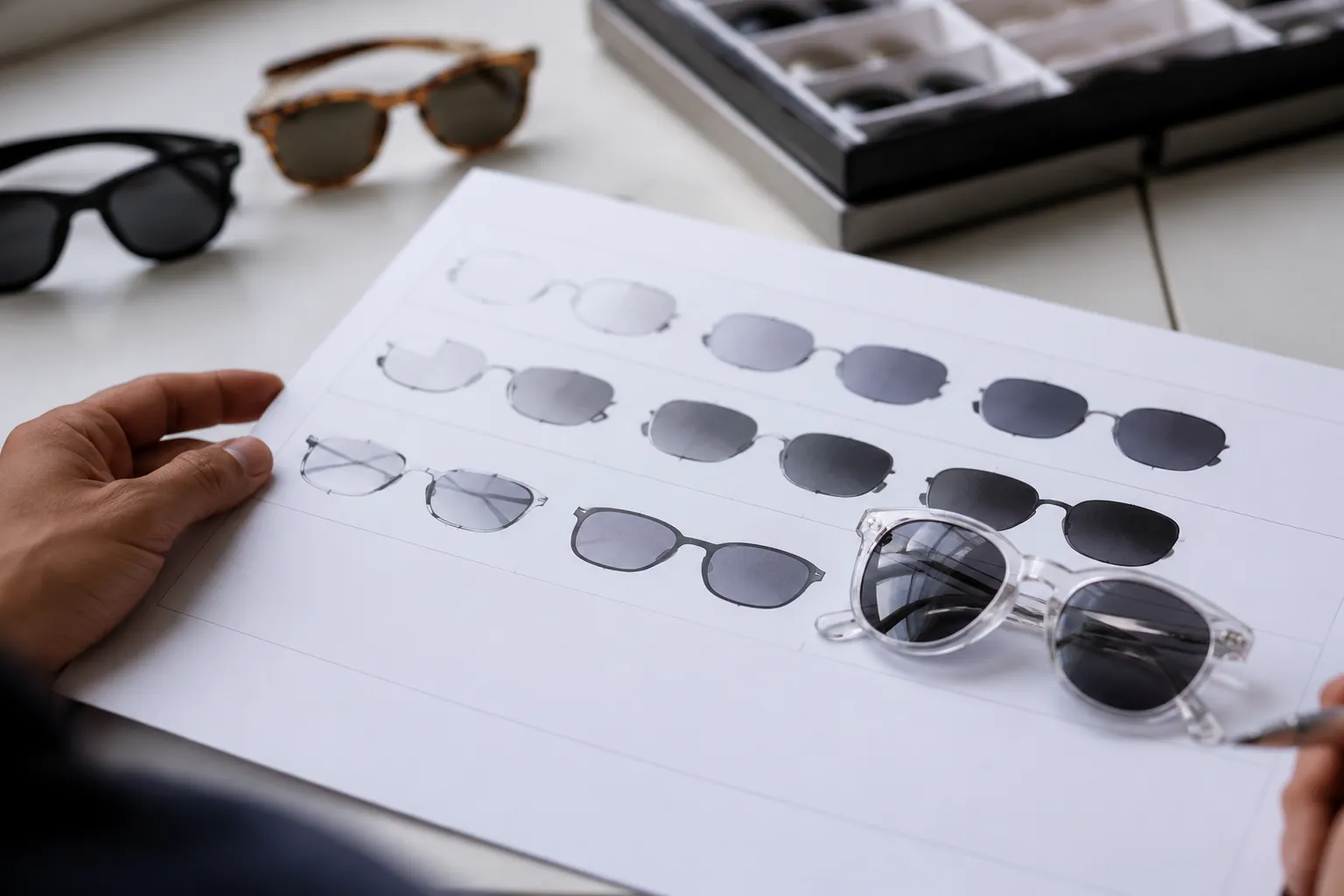
This guide is for brands, importers, distributors, and retailers buying UV400 sunglasses in volume. Its purpose is practical: what to verify before paying a deposit, approving a pre-production sample, or releasing shipment. "UV400" is a technical claim, not a sticker. In bulk orders, that claim should be tied to the right test basis, a fixed lens specification, stable production, accurate labeling, and the correct filter category for the market where the goods will be sold.
What UV400 proves—and what it does not
UV400 generally means the lens is intended to limit transmission of ultraviolet radiation up to 400 nm, covering UVA and UVB. That matters. It does not prove everything.
By itself, a UV400 claim does not confirm visible light transmission (VLT), driving suitability, optical quality, impact properties, restricted substances, coating durability, or hinge performance. Those points must be checked separately under the relevant product standard, chemical requirement, or buyer QC specification.
In bulk sourcing, the usual failure is not that a factory cannot make a UV-blocking lens. The real risk is drift after sample approval. A buyer approves one sample. Production then uses a different lens material, tint depth, mirror finish, or lens supplier. Same style number. Different technical basis.
For a purchase order, UV400 should be written as a measurable requirement, not a loose sales term. At minimum, buyers should lock:
- Lens material: PC, TAC, nylon, CR-39, or other defined material
- Lens construction: solid tint, gradient, mirrored, polarized, photochromic, or another named construction
- Test basis: the applicable market standard and a report tied to the same lens family and colorway, where relevant
- VLT target: for example, a defined range consistent with the intended filter category
- Approved market: EU, US, AU/NZ, or another named destination market
- Inspection rule: what happens if final production measures outside the agreed tolerance or differs from the approved sample
Simple rule: UV performance must stay tied to the exact lens specification that will be mass-produced.
Pick the market standard before approving the tint
The wrong sourcing question is: "Can you make UV400?" Most factories will say yes. Ask a better one: "Which standard must this exact SKU meet in the country where it will be sold, and what lens category can we use there?"
For Europe, buyers commonly work to EN ISO 12312-1 for sunglasses and related eyewear. For the United States, ANSI Z80.3 is a common reference for non-prescription sunglasses. For Australia and New Zealand, AS/NZS 1067 is the relevant framework. REACH covers restricted substances in materials, coatings, inks, and decorations. ISO 9001 and BSCI can help qualify a supplier, but they do not prove that a specific sunglass lens blocks UV or meets a performance standard. FDA registration may appear in US supply files, but it should not be treated as lens-performance proof.
| Market or requirement | What it checks | Typical buyer mistake | Correct buyer action before order |
|---|---|---|---|
| EN ISO 12312-1 | UV transmission, sun glare filter requirements, optical quality, category labeling | Using a generic CE statement with no model or lens reference | Request a report tied to the actual lens type, color, and construction |
| ANSI Z80.3 | US sunglass performance requirements, including optical and transmittance criteria | Copying EU packaging language into a US program | Align packaging, product claims, and ecommerce copy to the US test basis |
| AS/NZS 1067 | AU/NZ sunglass performance and filter category framework | Shipping EU-only warnings into AU/NZ | Confirm category wording and warning statements before artwork approval |
| REACH | Chemical restrictions for frame, lens, coating, paint, ink, and decoration materials | Testing only the frame base material but not the coating or logo ink | Map every material and surface treatment in the BOM |
| FDA registration / supplier file | Administrative status in US supply documentation | Treating registration as proof of lens performance | Keep it in the compliance file, separate from sunglass test evidence |
If one style will be sold in more than one market, do not rely on one vague "certificate." A usable compliance file should name the standard, sample description, date, and, ideally, the lens color and construction. If the tested sample is smoke PC and production is brown gradient TAC polarized, do not assume the report still applies.
Lens category and VLT decide actual use
UV protection and lens darkness are different. A clear or lightly tinted lens can still be UV400 if the resin or coating blocks ultraviolet radiation. A dark lens can still be unacceptable if UV control is poor. Buyers need both pieces under control.
VLT determines filter category and practical use. Do not approve lens darkness by photo, screen display, or verbal description alone. Ask for a target category and a measurable VLT range. If your retail program expects a category 3 sunglass, do not leave the supplier free to deliver anything from very dark to mid tint. That can move the product into another filter category and change both labeling and use.
| Lens category | Typical VLT range | Typical use | Buyer control point |
|---|---|---|---|
| Category 0 | 80% to 100% | Very light fashion tint or clear lens | Ensure packaging does not overstate sun protection use |
| Category 1 | 43% to 80% | Light tint, fashion use, or lower light conditions | Check that light colorways still have valid UV data |
| Category 2 | 18% to 43% | General outdoor wear | Control batch-to-batch color consistency in replenishment orders |
| Category 3 | 8% to 18% | Bright sunlight, common sunglass retail category | Confirm market-specific wording for driving and use instructions |
| Category 4 | 3% to 8% | Very strong sunlight, specialist use | Warnings are critical; such lenses are commonly not suitable for driving |
For tinted production, tolerance matters. Define an acceptable measured range before production starts. The exact band depends on category, color, and finish, but the control point is constant: production lenses must stay within the agreed VLT window and remain visually consistent with the approved reference sample.
What the pre-production technical file should contain
A serious UV400 order needs a compact but complete technical file before production begins. This file prevents disputes later between sales, QC, the lab, and the buyer.
- Model identification: frame code, color code, size, and revision number
- Frame material: for example PC, TR90, acetate, metal, or mixed construction
- Lens material: for example PC, TAC, nylon, CR-39, or another defined material
- Lens specification: base curve, nominal thickness, tint name, solid or gradient, mirror color, and polarization if applicable
- Category and VLT range: defined against the approved sample and target market
- UV requirement: UV400 supported by the named standard or test basis
- Decoration method: pad print, screen print, hot foil, laser marking, metal logo plate, embedded logo, or inside-temple print
- Markings and packaging: required symbols, warnings, barcode, country of origin, carton marks, and user information where required
- QC plan: AQL level, defect classification, any agreed functional checks, and retention-sample rule
Material choice changes risk. PC lenses are common in value programs and can offer good impact resistance, but scratch performance depends heavily on coating quality. TAC polarized lenses add another control point because lamination quality and polarization alignment matter. Acetate frames can give a premium look, but polishing consistency, hinge fitting, and color matching are more labor-sensitive than standard injection frames. Metal frames often need tighter control of plating, paint, and weld quality.
The technical file should also identify the approved bill of materials and, where possible, the approved source for key lens components. If those inputs change, the buyer should review whether new testing or re-approval is required.
How to verify UV400 before mass production
Good verification is repetitive and documented. A spectrophotometer is commonly used to measure lens transmittance across relevant wavelengths and to assess whether the lens meets the UV-blocking requirement under the applicable standard. But the result only matters if the tested sample truly represents mass production.
Reject weak evidence. That includes a generic "UV400" statement with no sample description, no date, no named standard, or no lens material and finish. A report for grey PC does not automatically prove brown gradient TAC polarized. A non-mirror sample does not automatically prove a flash-mirror sample. A report issued before the latest BOM revision also needs checking.
- Approve the physical frame and lens sample first.
- Freeze the lens BOM: material, thickness, tint recipe, mirror coating, and polarization construction where relevant.
- Confirm the selling-market standard before artwork and packaging are released.
- Test the approved lens version, or confirm that an existing valid report covers the same construction and color basis.
- Issue and retain a pre-production sample that matches the order file.
- During production, block unapproved substitution of lens sheets, coatings, or tint formulas.
For higher-risk retail programs, third-party testing on pre-production or production samples is often justified. A common timing mistake is sending samples to the lab too late. If testing starts only after goods are packed, any nonconformity can delay shipment, trigger relabeling, or force rework after the order is supposedly finished.
Where bulk UV400 orders usually fail
Most UV400 problems in bulk orders are process failures, not technical mysteries. The wrong lens sheet gets issued to the line. A tint runs lighter than the approved sample. A mirror finish changes appearance and transmittance. Packaging still states category 3 after the buyer approved a lighter category 2 lens. The goods may still look fine in a casual review. The file and the product no longer match.
That is why in-process QC matters. Factory control should include incoming material checks, line inspections, and final random inspection. In practice, QC should look at more than UV:
- Lens color consistency against the sealed sample
- Visible defects such as bubbles, pits, flow marks, scratches, and edge chipping
- Optical distortion, warpage, and left-right lens mismatch
- Hinge alignment, opening angle, screw torque, and temple symmetry
- Logo adhesion for pad print, foil, or metal plate applications
- Frame surface issues such as sink, stress whitening, polishing marks, or plating defects
- Correct retail packout, warnings, barcode, and carton marks
For polarized programs, add polarization efficiency and axis consistency checks. For acetate, watch bevel finishing, polishing quality, and hinge fitting. For injection-molded frames, inspect areas where stress marks and molding defects are more likely to appear.
Blunt rule: if the buyer changes lens color, mirror finish, lens material, or lens supplier after sample approval, reopen the compliance file. Treat it as a technical change, not a styling tweak.
Inspection records should also identify the exact colorway and lens version inspected, not just a broad style-family name.
Cost, lead time, and documentation logic
UV400 itself is not usually the main cost driver. Cost more often moves with frame material, polarized versus non-polarized lenses, decoration complexity, packaging, and the level of testing or rework risk in the program.
| Order choice | Typical cost effect | Lead-time effect | Procurement logic |
|---|---|---|---|
| Small trial quantity | Higher unit cost because setup is spread over fewer pairs | Useful for market testing | Do not relax QC or documentation just because the order is small |
| Mid-volume pilot order | Better material and print efficiency | Often suitable for testing color consistency across one run | Good stage to verify whether the lens and packaging spec is repeatable |
| Stable production order | More competitive unit economics | Requires firm approval of BOM, packaging, and inspection timing | Best point to lock technical file and compliance responsibilities |
| Large-volume order | Can reduce unit cost, but raises exposure if anything is wrong | Needs stronger production planning and pre-shipment control | Use retention samples, final inspection, and clear substitution controls |
| Third-party lab testing | Adds direct testing cost | May extend schedule depending on lab queue | Book testing before goods are sealed and freight deadlines are fixed |
A simple molded frame with standard non-polarized UV-blocking lenses and basic print decoration is one kind of project. A polished acetate frame with TAC polarized lenses, custom metal logo parts, and rigid gift packaging is another. More steps mean more cost and more time.
Do not build your shipment plan on verbal estimates alone. The real production date should be tied to the last approved pre-production sample, final packaging artwork, and a complete compliance file. If any of those are still open, the order is not fully locked.
Final checklist before balance payment
Before releasing the balance or authorizing shipment, review the order like an inspector. A product that looks fine in a sales photo can still fail on documents, labeling, or technical consistency.
- Match model code, frame color, lens color, and material to the approved sample and test file.
- Verify that UV400 support references the correct lens construction and target market standard.
- Check lens category and VLT against the actual packaging claim and warning statement.
- Confirm that any REACH-related support covers coatings, paints, soft-touch finishes, and logo decorations, not only the base frame material.
- Keep ISO 9001 and BSCI in the supplier-qualification file, not as product-performance proof.
- Review any FDA registration records separately from sunglass test evidence.
- Inspect barcode placement, country-of-origin marking, carton labels, and pack assortment accuracy.
- Retain one sealed approval sample and one production sample for each colorway and lens type.
The quickest way to lose margin on UV400 sunglasses is to assume that one good-looking sample guarantees mass-production compliance. Put the technical numbers in writing. Tie the documents to the exact SKU. Inspect the bulk goods against that file.
Have a custom sunglasses project in mind?
Send us your styles, target market and quantities and we will return a detailed quote with MOQ, lead time and a sample plan.
Get a QuoteWhy source this from Wenzhou with LumiShades
Wenzhou in Zhejiang Province is widely regarded as China’s eyewear manufacturing capital, producing a large share of the world’s sunglasses. That concentration matters to buyers: a deep local supply chain for acetate sheet, hinges, lens blanks, plating and packaging means shorter component lead times, easier color and material matching, and a workforce with decades of eyewear-specific skill. LumiShades has manufactured in this ecosystem since 2009, and our vertical integration — in-house injection molding, acetate cutting, CNC milling, lens tinting, decoration and quality control — means no part of your order is quietly subcontracted to a workshop you cannot audit.
For international buyers, that vertical control translates into accountability. When a single factory owns every step, defects are traced and fixed at source rather than bounced between vendors, and your specifications survive intact from first sample to bulk. We back this with 15+ years of experience, shipments to 60+ countries, more than 5 million pairs produced per year and a 98.5% on-time delivery rate. Our certifications — CE EN ISO 12312-1, FDA registration, ANSI Z80.3, AS/NZS 1067, REACH, ISO 9001 and BSCI audit — mean the compliance documentation your market requires already exists. Explore our manufacturing capabilities and quality control process to see how this works in practice.
Frequently asked questions
Is UV400 the same as polarized? No. UV400 and polarization describe different functions. UV400 refers to ultraviolet blocking performance up to 400 nm. Polarization reduces reflected glare from surfaces such as roads or water. A lens can be UV400 without being polarized, and a polarized lens still needs its own UV and category verification. Ask for both the sunglass performance test basis and, if polarization is claimed, confirmation that production lenses use the approved polarized construction.
Can a light tint or clear lens still be UV400? Yes. UV protection is separate from visible darkness. The resin itself or a coating can reduce UV transmission even when the lens has high VLT. Do not judge UV performance by color alone. For purchasing, require a test report or other documented evidence tied to the actual clear or light-tint lens construction, because buyers often assume those lighter lenses are covered when only darker versions were tested.
Which documents should I request before placing a bulk order? Request: 1) the applicable sunglass test report for the target market, such as EN ISO 12312-1, ANSI Z80.3, or AS/NZS 1067; 2) lens category and VLT information for the exact lens version; 3) REACH-related material compliance support where relevant; 4) any FDA registration records only if needed for your supplier file; and 5) supplier-qualification documents such as ISO 9001 or BSCI. Make sure the sunglass report matches the actual lens material, color, finish, and construction you are ordering.
Should every lens color be tested separately? If the color, material, mirror coating, polarization construction, lens supplier, or another performance-relevant detail changes, do not assume one report covers all versions. In stricter programs, each lens variant is tested or otherwise documented separately. At minimum, ask the supplier and lab to confirm in writing whether the tested sample truly represents each production lens version. If not, request additional testing before mass production.
How should I control UV400 risk during production, not just at sampling stage? Use three controls together: first, freeze the lens BOM after approval; second, keep a sealed reference sample with the approved color and construction; third, require in-process and final inspection records that identify the actual lens version produced. If the supplier changes lens material, tint depth, mirror finish, or polarized construction, stop and reopen the compliance review. A report is only useful if production still matches the tested lens.
What should I check before releasing the balance payment? Confirm that the shipped goods match the approved sample and technical file. Check model code, colorway, lens material, category, VLT claim, packaging warnings, barcode, and country-of-origin marking. Review that the UV400 support is tied to the correct lens construction and market standard. Verify that REACH-related support covers coatings and decorations as well as base materials. Keep at least one sealed approval sample and one production sample for future claim handling or retest if needed.
Ready to start?
Explore our cat-eye sunglasses or request a quote — our sales team replies within 12 hours.
Request a Quote