
Stock Frame or New Mold? Sunglasses Cost Guide
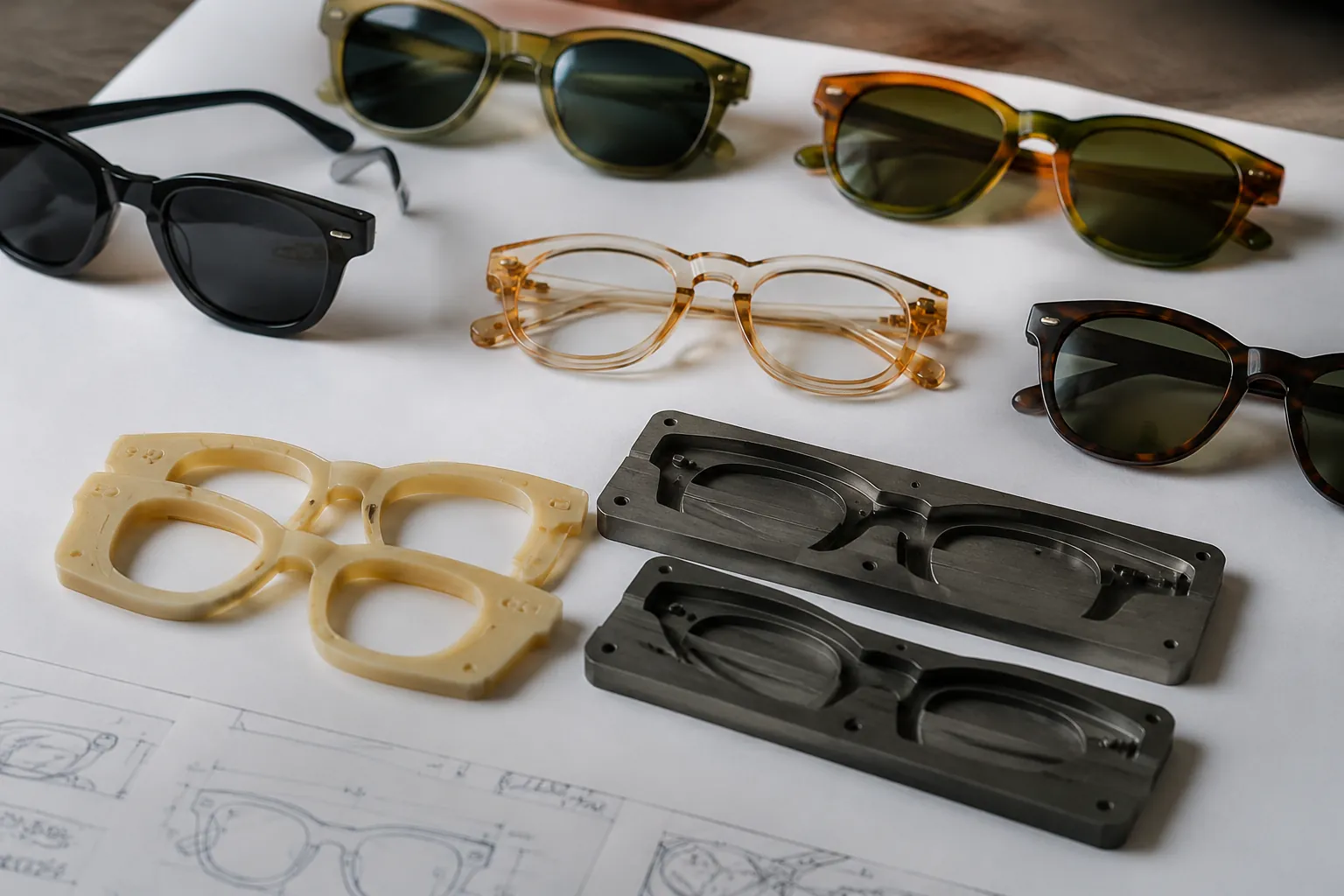
This guide is for buyers deciding whether to build sunglasses from an existing factory frame or pay for new tooling. Mold cost is only part of the decision. The real issues are unit economics, sample timing, fit consistency, testing scope, and whether you can reorder the same style later without drift. Three factors usually decide the route: expected volume over 12 to 24 months, how much the frame geometry is changing, and whether the program is a short market test or a style you expect to repeat. Use that filter before you approve samples, tooling, or production.
Start With the Three-Question Filter
Most buyers ask about tooling too early. Start with three commercial questions: how many pairs you can realistically sell in the first 12 months, what margin you need after freight, duty, testing, packaging, and markdown risk, and whether the style is a one-season test or a frame you expect to reorder.
If the first order is small and the design is close to a factory library style, stock should usually be the first option you test. Tooling fees, sample development, and extra approvals can wreck the economics of a limited run fast. For a market test, the issue is not whether custom development is possible. It usually is. The issue is whether the program can pay for it.
If you expect steady volume and the frame shape is part of the brand identity, new tooling is easier to defend. That is especially true when the changes are structural, not cosmetic: eye size, bridge form, front curve, temple profile, hinge position, or wrap angle. A style that must look and fit the same on future orders needs a stable production base.
- Choose stock or modified stock when volume is limited, launch speed matters, and the main changes are color, lenses, finish, logo treatment, or packaging.
- Choose new tooling when geometry must be repeatable, the style is expected to reorder, and the development cost can be spread across meaningful lifetime volume.
- Pause and revise the brief if you want a signature silhouette on a pilot budget. That math often does not hold.
Keep the decision simple. Are you buying a test program, or building a repeatable product? That answer should drive the route.
What You Can Change Without New Tooling
Buyers often assume any visible change needs a new mold. It does not. Many private-label programs start from an existing frame because the look can change a lot without changing the structure. The useful split is appearance versus geometry.
Changes that often do not require new tooling include frame color, finish, lens tint, mirrored coating, polarized lens upgrades where the base frame already supports that construction, logo print, laser marking, metal logo application, barcodes, pouches, and outer packaging. On acetate styles, sheet selection can also change the visual result without changing the frame design.
Changes that usually do push a buyer toward tooling include a different lens shape, new eye size, a wider or narrower bridge, a thicker or thinner front rim, a custom temple cross-section, different endpiece proportions, altered wrap, or hinge placement that changes fit and balance. If the lens perimeter changes, lens seating and groove geometry usually change too. That is structural. Not decorative.
Process limits matter. CNC can refine some acetate details such as bevels, edge profiles, or recesses, but it does not replace a full redesign when the silhouette itself is changing. Paint or coating can also change the look of an injection frame, but it cannot fix a bridge shape or temple geometry that misses the intended fit.
A useful sourcing test is blunt: if the frame should read as proprietary from across the room, stock modification may not be enough. If the value is mostly in branding, color, packaging, and speed, stock is often the more disciplined choice.
Cost and Lead-Time Breakdown Buyers Actually Use
Compare total program cost, not mold cost by itself. Buyers should look at startup cash exposure, development time, first-order economics, reorder stability, and the risk that a stock base frame could later change or disappear.
| Route | Typical upfront cost | Sample lead time | Bulk lead time | Typical MOQ logic | Best fit |
|---|---|---|---|---|---|
| Stock frame, logo only | Low; artwork setup and sample charges only | Shortest, because the frame already exists | Usually the fastest route once materials are confirmed | Often suitable for lower-volume programs, subject to factory policy and color split | Pilot orders, promotions, fast commercial tests |
| Stock frame with moderate modification | Low to medium; decoration, color development, upgraded packaging | Longer than logo-only, but usually faster than new tooling | Moderate, depending on materials and approval steps | Often more efficient at modest volume where color and packaging can be consolidated | Private-label retail programs |
| New tooling for injection frame | Medium to high; mold and development charges must be spread across volume | Longer, because toolmaking, trials, and revisions may be required | First production usually takes longer than stock-based routes | Usually justified only when expected volume and reorder probability are credible | Repeat programs with custom geometry |
| New tooling plus custom lens geometry | Highest; frame and lens development both add cost and approvals | Longest, because frame fit and lens performance both need review | Most complex first run | Best suited to styles with a long commercial horizon | Brand-defining shapes with strong reorder intent |
The exact numbers vary by factory, material, construction, and destination market. So ask for quotes in a format you can actually use: sample cost, tooling cost if any, production price by quantity break, packaging cost, and known testing or compliance charges.
Also separate first-order and reorder economics. Stock styles usually cut startup cost, but they can carry substitution risk if the base style changes later. New tooling raises the initial cash burden, but it can improve repeatability if the same frame is meant to run for multiple seasons.
Break-Even Logic by Volume and Amortization
The real question is not whether tooling is expensive. It is whether the tooling burden per pair stays low enough to protect your margin over the life of the style. That means doing an amortization calculation based on realistic lifetime volume, not just the first purchase order.
Use a simple process:
- Estimate realistic volume over 12 to 24 months, including likely reorders rather than best-case sales assumptions.
- Add tooling cost, sample charges, and approval-related costs to the startup total.
- Divide that startup total by expected lifetime units to estimate the development burden per pair.
- Add that burden to the quoted production cost, then test the full landed margin after freight, duty, packaging, channel fees, and expected markdown exposure.
- Ask whether you would reorder the exact same frame if the style sells. If the answer is unclear, use a conservative volume assumption.
For small pilot runs, stock is often the lower-risk choice unless the frame geometry is central to the brand and the margin can absorb custom development. As projected volume and reorder confidence rise, new tooling starts to make sense. The threshold is commercial, not theoretical.
Two mistakes show up again and again. First, buyers open tooling for a fashion test with weak demand visibility. Second, they keep a successful repeat style on modified stock long after fit consistency and brand control matter more than launch speed. One wastes startup cash. The other creates inconsistency and reorder friction.
Material, Tolerances, and Process Limits
Injection and acetate behave differently in development and production. Buyers should account for that early. Injection molding is generally better for repeatability and higher-volume programs. Once the mold and process conditions are stable, dimensions are usually easier to reproduce from run to run than in a heavily hand-finished process.
Acetate offers different strengths: visual depth, hand feel, and sharper edge definition. It also allows more post-process shaping through cutting, tumbling, heating, bending, polishing, and CNC operations. That gives you more finishing flexibility, but it does not remove the need for development when the core geometry changes. If you alter eye size, bridge architecture, lens shape, or hinge structure, you still need to validate fit and construction carefully.
Pay close attention to fit-critical points and tolerances. Common QC issues include lens seating, left-right symmetry, hinge alignment, temple opening and closing feel, finish consistency, and color consistency. Small variation may be acceptable on a low-cost promotional style. It is less acceptable on a signature retail frame. Bridge fit, lens retention, and alignment are especially sensitive because small drift can affect both wearability and assembly performance.
Lens development can also change the sourcing route. A stock frame using an established lens shape is usually easier to sample and approve than a frame requiring custom lens geometry, a non-standard base curve, or multiple coatings. Confirm early whether the requested lens construction is already proven in a similar frame or needs separate development and validation.
Decoration is usually the easier part. Pad printing, laser marking, and metal logos are standard options, but each still needs review for adhesion, appearance, durability, and consistency on the chosen material and finish. The bigger risk is usually elsewhere: approving the wrong base frame and then trying to solve structural problems with decoration or finishing.
Compliance, QC, and Approval Workflow
Compliance is part of the tooling decision, not a separate task at the end. A stock-based program that stays close to an existing construction is often simpler to review because fewer variables are changing. A fully new design usually adds more approval points, including fit, lens performance, labeling, and sometimes packaging details tied to the destination market.
Verify which documents and test standards apply to the exact product and market. Common references in sunglasses sourcing include CE EN ISO 12312-1, ANSI Z80.3, AS/NZS 1067, REACH, FDA registration, ISO 9001, and BSCI. These are not interchangeable. Product-performance standards, chemical compliance, quality-management systems, social-audit programs, and registration status each serve different purposes.
Before bulk approval, lock the following items in writing:
- Lens category, tint target, UV requirement, and whether polarization is required
- Frame material, color standard, and finish method
- Logo method, placement, and durability expectation
- Packaging configuration, barcode, and labeling language
- Market-specific documents required before shipment
- QC checkpoints for lens color, alignment, hinge function, and cosmetic defects
The approval sequence should also be explicit. First confirm the nearest stock reference or approved drawing. Then approve a branding or construction sample. Then approve the pre-production sample with final materials, lenses, decoration, and packaging. Many sourcing problems start the same way: the concept gets approved visually, while functional or compliance details stay unresolved until production is already moving.
Buyer Scenarios and the Final Decision Checklist
Consider a distributor planning a limited pilot for a resort or event program. The brief calls for a classic commercial shape, a small set of lens colors, a temple logo, and simple branded packaging. In that case, a stock-based route is usually the cleaner decision. It cuts upfront exposure, shortens development, and lets the buyer test demand before committing to a custom frame.
Now take a brand launching a signature unisex style where the bridge profile, temple taper, front thickness, and lens shape are central to the look. If the buyer has a credible reorder plan and the frame needs to stay visually consistent over time, new tooling deserves serious review. Here, geometry control matters more than saving money on the first sample round.
The most expensive path is often the compromise path. Buyers try to force a long-term signature style into a stock frame after the brand has already outgrown that solution. Early savings then get erased by repeated revisions, slow approvals, inconsistent fit, and reorders that no longer match the approved sample closely enough.
Before approving either route, use this checklist:
- Ask for the nearest existing frame reference and mark exactly what will and will not change.
- Confirm MOQ by design, color, and lens combination, not just a headline MOQ.
- Request a written sample-to-bulk timeline including approvals, material preparation, production, and QC.
- Check decoration durability for pad print, laser mark, and logo attachment on the final finish.
- Define QC standards for alignment, lens consistency, cosmetic defects, and packaging accuracy.
- Clarify reorder protection if using stock frames, including whether the exact base style is stable for future production.
- Match compliance paperwork to destination market before bulk production starts.
The right choice is not stock versus custom in the abstract. It is the route that gives you workable margin, an approval path you can control, and a frame you can reproduce with confidence if the style succeeds.
Have a custom sunglasses project in mind?
Send us your styles, target market and quantities and we will return a detailed quote with MOQ, lead time and a sample plan.
Get a QuoteWhy source this from Wenzhou with LumiShades
Wenzhou in Zhejiang Province is widely regarded as China’s eyewear manufacturing capital, producing a large share of the world’s sunglasses. That concentration matters to buyers: a deep local supply chain for acetate sheet, hinges, lens blanks, plating and packaging means shorter component lead times, easier color and material matching, and a workforce with decades of eyewear-specific skill. LumiShades has manufactured in this ecosystem since 2009, and our vertical integration — in-house injection molding, acetate cutting, CNC milling, lens tinting, decoration and quality control — means no part of your order is quietly subcontracted to a workshop you cannot audit.
For international buyers, that vertical control translates into accountability. When a single factory owns every step, defects are traced and fixed at source rather than bounced between vendors, and your specifications survive intact from first sample to bulk. We back this with 15+ years of experience, shipments to 60+ countries, more than 5 million pairs produced per year and a 98.5% on-time delivery rate. Our certifications — CE EN ISO 12312-1, FDA registration, ANSI Z80.3, AS/NZS 1067, REACH, ISO 9001 and BSCI audit — mean the compliance documentation your market requires already exists. Explore our manufacturing capabilities and quality control process to see how this works in practice.
Frequently asked questions
At what order size should I seriously consider new tooling for sunglasses? Consider new tooling when three conditions are true at the same time: you expect meaningful lifetime volume, you have a credible reorder plan, and the geometry matters enough that a stock frame cannot deliver the required look or fit. There is no universal unit threshold because tooling cost, product margin, and factory pricing vary. The practical step is to ask for two comparable quotes, one based on the nearest stock frame and one based on custom tooling, then amortize the development cost over realistic 12- to 24-month volume before deciding.
Can I make a stock frame look custom enough for private-label retail? Often yes, if the distinctiveness comes from color, lens treatment, finish, branding, and packaging rather than from a new silhouette. Ask the supplier for the nearest existing frame references and review them against your brief line by line. Mark which elements are cosmetic and which are structural. If the front shape, bridge fit, temple profile, or lens geometry are central to the brand concept, ask the factory to state clearly what can change without new tooling and what cannot.
How much faster is stock development compared with new tooling? Stock development is usually faster because the frame already exists and fewer variables need approval. New tooling usually adds design confirmation, toolmaking, trial parts, fit review, and extra approvals before bulk production can start. Do not rely on a vague lead-time claim. Ask for a written timeline that separates sample preparation, revision rounds, pre-production approval, and bulk production. That will show where time is actually being spent and whether the schedule is credible.
Does compliance change if I use a stock frame instead of a new mold? The legal requirement in the destination market does not change just because you use a stock frame. What changes is the amount of product variation you introduce. A stock program that stays close to an existing construction may be simpler to document and evaluate, while a new design can create more testing or approval questions. Confirm which standards and documents apply to the exact product and market, including whether CE EN ISO 12312-1, ANSI Z80.3, AS/NZS 1067, REACH, or FDA-related requirements are relevant, then match those requirements to the final approved specification rather than the concept sample.
What is the biggest sourcing mistake in this decision? The biggest mistake is choosing a development path that does not match the commercial reality of the style. That usually shows up in two ways: paying for tooling on a low-confidence market test, or keeping a successful repeat style on modified stock after consistency and reorder control have become critical. Avoid both with a written stock-versus-custom comparison covering cost, timeline, MOQ by variant, structural changes, compliance scope, and reorder risk. Without that comparison, the decision is being made on instinct instead of sourcing evidence.
Ready to start?
Explore our shield & oversized sunglasses or request a quote — our sales team replies within 12 hours.
Request a Quote