
OEM vs ODM Sunglasses: Lowest-Risk First Orders
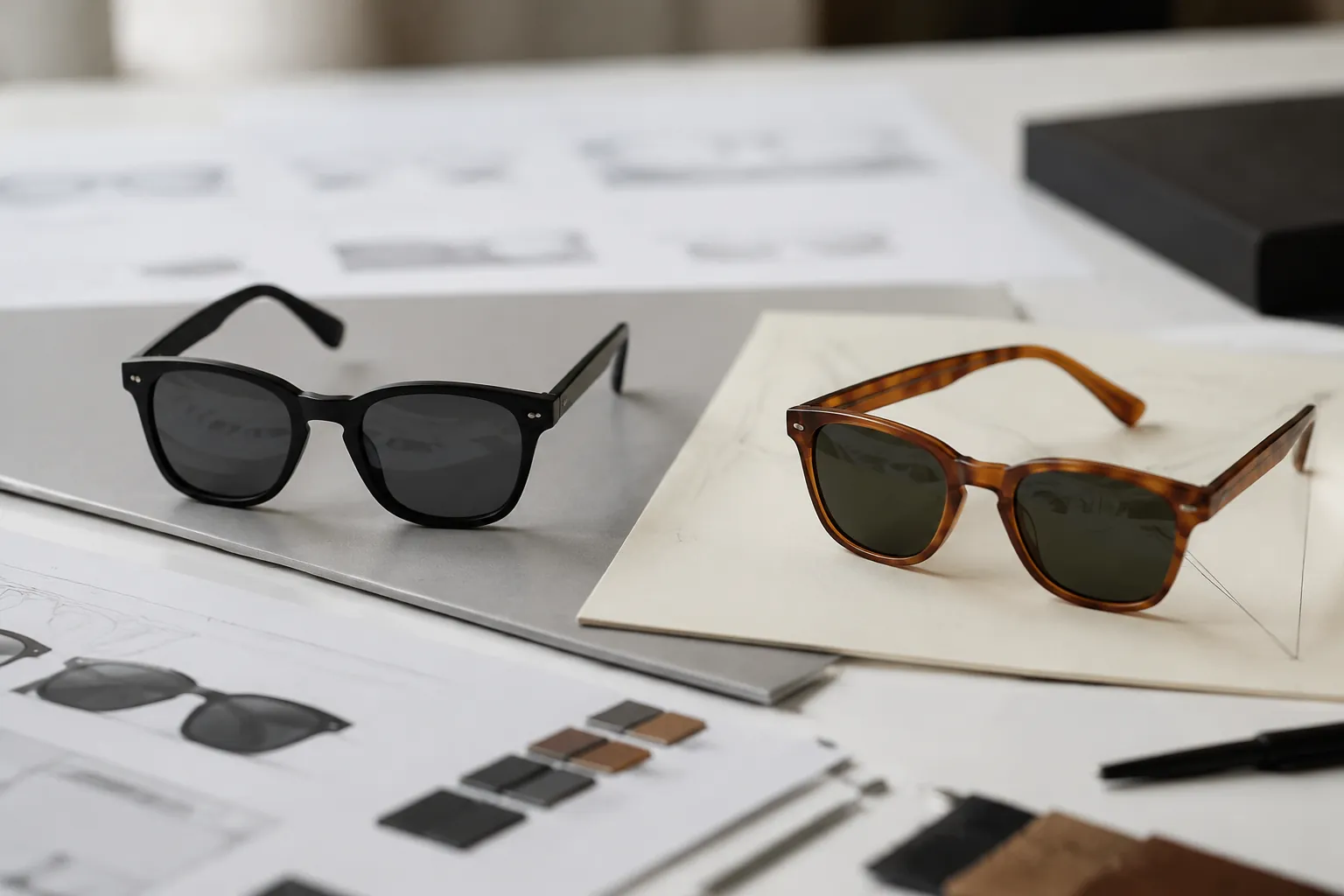
This guide is for brand owners, importers, distributors, and retailers planning a first custom sunglasses order from an overseas supplier. On a first PO, the main question is usually not which model sounds more premium. It is which buying model keeps risk under control across cash, development time, compliance, and unsold inventory while still giving you enough differentiation to sell. Use this framework to compare OEM, ODM, and semi-custom sunglasses based on the factors that most often shape first-order results.
Start with the risk you are actually carrying
First-time buyers often treat OEM versus ODM as a branding choice. In practice, it is usually a risk-allocation choice. If your opening quantity is small, the real exposure is rarely whether the hinge line is original. It is whether you can approve a consistent product, hit the selling window, and avoid tying up too much cash before demand is proven.
For first sunglasses orders, risk usually clusters in five areas: tooling spend, development delay, compliance mismatch, cosmetic inconsistency, and over-customization on an untested SKU. Each buying model shifts those risks in a different way.
ODM is usually the lowest-risk route when speed matters and you can work from an existing frame platform. The frame dimensions, lens groove, hinge position, and assembly process already exist. That cuts development uncertainty. Semi-custom sits in the middle. You start from an existing frame and change visible selling features such as color, lens tint, branding, finish, or packaging. OEM gives you the most control over the product itself, but it also creates the most exposure because it may require new tooling, prototype correction, fit validation, and more sample rounds before bulk production is stable.
A practical first-order rule is simple: if demand is not proven, protect cash and timing first. Many first POs go wrong for ordinary reasons. Buyers commit too much too early. Or they miss the season. Lack of originality is usually not the main problem.
The fastest comparison: OEM vs ODM vs semi-custom
| Buying model | Typical MOQ logic | Typical upfront exposure | Sample and bulk timing | What can realistically change |
|---|---|---|---|---|
| ODM | Usually the lowest MOQ because the supplier already has the frame program | Low; usually sample cost, logo setup, packaging cost, and any lens upgrade cost | Usually the shortest path because the base frame already exists; exact timing depends on factory capacity, materials, and approval speed | Frame color, lens tint, polarization, logo application, pouch, box, barcode label, and carton marks |
| Semi-custom | Often higher than straight ODM if custom components or finishes are added | Low to medium; may include custom trim, logo hardware, finish development, or packaging tooling | Usually longer than ODM because there are more materials and approval points to confirm | All ODM changes plus selective part changes, finish upgrades, hardware color, and trim details |
| OEM | Often requires higher committed volume to make tooling and development cost commercially reasonable | High; may include mold development, prototype revision, engineering review, and more sampling rounds | Longest path because bulk production generally starts only after the new design is validated | New frame geometry, custom dimensions, specialized fit, distinct temple architecture, and unique construction details |
For a first PO, this is the core tradeoff. If you need proof of concept with the lowest exposure, ODM usually makes the most sense. If you need the product to look more proprietary without paying for a full mold program, semi-custom is often the middle ground. OEM is more rational when the frame shape itself is central to the product story or channel requirement and the expected volume can support the extra work.
Where first-order money really goes
New buyers often focus on unit price too early. The more useful number is total cash committed before the product has earned a repeat order.
That cash does not sit only in the ex-works price. It also sits in sample charges, mold or tooling cost where applicable, packaging setup, artwork revisions, compliance testing where needed, freight decisions, and inventory that may not sell quickly. On small orders, those non-unit costs can matter as much as the piece price.
- Injection plastic frames: usually the most cost-efficient route for test orders, especially on existing molds.
- Acetate frames: higher material and labor cost because sheet cutting, tumbling, polishing, and fitting are more labor-intensive.
- Polarized lenses: usually add cost over standard tinted lenses because of lens structure and additional quality control requirements.
- Metal logo plates and custom packaging: often add setup cost that is more noticeable on small runs than on larger repeat orders.
The hidden cost is approval drag. A low quoted unit price means little if the project stalls in sampling and misses the shipping window. Extra revisions, late artwork, unclear lens color targets, or packaging changes after approval can all delay material booking and production scheduling.
Pay for uniqueness where the customer will actually notice it. On early-stage programs, faster sell-through and cleaner cash flow usually matter more than an expensive feature that does not change the buying decision.
Lead time is not one number
Factories usually quote a sample lead time and a bulk lead time. Buyers often compress that into one calendar number. That is a mistake. The real timeline depends on milestones. Bulk production usually starts only after the sample is approved, artwork is confirmed, commercial terms are cleared, and materials are booked.
- Style confirmation: frame shape, temple shape, lens type, lens color, logo position, packaging spec, and destination market.
- Sample making: existing-frame sample for ODM, modified sample for semi-custom, or prototype development for OEM.
- Approval cycle: check fit, finish, lens category, logo placement, labeling, and packaging details.
- Material booking: frame material, lenses, hinges, logo parts, pouches, boxes, labels, and any special trim.
- Mass production: molding or cutting, polishing, lens fitting, decoration, assembly, and cleaning.
- QC and packing: inspection, carton marking, export packing, and shipping handoff.
OEM usually stretches the calendar because normal engineering corrections need to be resolved before production is stable. Bridge fit, temple closing angle, lens groove tolerance, and hinge alignment may all need refinement. That is normal. It is part of turning a design into a repeatable production item.
Count backward from the in-market date, not the ex-works date. If your campaign starts in May, the important date is when the goods are available for sale after inspection, transit, customs clearance, and local receiving.
How much differentiation do you really need
Many first-time buyers overestimate how much originality is commercially necessary. In sunglasses, customers usually notice front shape, lens tint, color story, logo treatment, and packaging before they know whether the frame came from a new mold.
Semi-custom is often the most efficient middle path because it changes what the customer sees while keeping the production base more stable. A common route is to start from an existing frame with proven fit and then customize the visible selling details.
- Frame color in injection or acetate sheet selection
- Lens options such as smoke, brown, green, gradient, mirrored, or polarized
- Temple branding by pad printing, laser engraving, hot stamping, or metal logo plate
- Surface finish such as gloss, matte texture, or soft-touch coating where suitable
- Pouch, cleaning cloth, hangtag, barcode label, gift box, and master carton marks
That usually delivers most of the commercial benefit of a custom-looking product without the full cost and timing exposure of OEM. For many private label programs, especially at launch, the market rewards consistent quality, workable landed cost, and reliable replenishment more than a completely new mold.
Full OEM makes more sense when the frame architecture itself is the selling point: a very specific fashion proportion, a sport wrap with performance fit requirements, a fit profile aimed at a defined customer group, or a frame shape that must align with an existing branded line.
Use a blunt test. Remove the logo and ask why the shape itself must be unique. If the answer is weak, semi-custom is often enough for the first run.
Materials, decoration, and process details that change outcomes
Generic sourcing language such as "premium finish" or "full customization" is not enough for a first PO. Build choices affect manufacturability, consistency, and claim risk.
Frame materials: Injection plastic is efficient and repeatable for scale. It is often a practical option for price-sensitive test programs and more consistent color production, although exact shade control still depends on approved color standards or signed samples. Acetate offers a different hand-feel and pattern depth, but color variation between sheet batches can occur and should be controlled against an approved reference. Metal-combination frames add complexity because plating color, weld quality, and mixed-material assembly require tighter control.
Lens options: Standard tinted lenses are usually the simplest route for first orders. Polarized lenses can add value, but buyers should confirm visual quality expectations and test requirements for the target market. Mirrored coatings can create quick differentiation, but coating uniformity and scratch handling matter. Gradient lenses require clear approval because small tone differences can look obvious on the face.
Logo methods: Pad printing is cost-efficient and flexible for many private label orders, but position, size, and durability expectations should be agreed in advance. Laser engraving can create a more permanent mark on suitable materials, though contrast depends on surface color and finish. Metal logo plates can look more premium, but they add component cost, setup work, and another attachment point to control during production.
Fit and assembly checks: Even on stable programs, factories still need to monitor left-right symmetry, hinge smoothness, lens seating, logo consistency, and surface defects. Many first-order complaints come from practical issues rather than catastrophic failure: one temple opens looser than the other, lens tint differs from the approved sample, or logo placement drifts across part of the run. Those problems are usually preventable when the brief and approval standard are specific.
Compliance can turn a cheap order into an expensive one
The wrong buying model gets expensive fast if the product does not meet market requirements. Compliance should be part of product definition, not paperwork collected after the sample looks good.
Common documents and references in eyewear sourcing include CE EN ISO 12312-1, ANSI Z80.3, AS/NZS 1067, REACH, FDA registration, ISO 9001, and BSCI. They do not all mean the same thing. Some relate to product testing or market requirements. Others relate to factory systems or social compliance.
| Requirement or credential | Why buyers ask for it | Practical first-order note |
|---|---|---|
| CE EN ISO 12312-1 | Product compliance reference commonly used for sunglasses sold in Europe | Confirm that the report applies to the actual sunglass specification you are buying, including the lens category and relevant construction |
| ANSI Z80.3 | Product standard reference commonly requested for the US market | Check whether the product itself has been tested or evaluated to the relevant standard; factory registration is not the same as product compliance |
| AS/NZS 1067 | Product standard relevance for Australia and New Zealand | Request this early if those markets are the destination because lens performance and labeling requirements may affect the build |
| REACH | Chemical compliance concern for applicable markets | Especially relevant when coatings, plastics, inks, adhesives, or decorative parts differ from the supplier's standard build |
FDA registration is a factory-related point buyers often ask about for US programs, but it does not by itself confirm that a given sunglass style meets the applicable product requirements. ISO 9001 relates to quality management systems, and BSCI relates to social compliance expectations. Both can be useful supplier-screening signals, but neither replaces product-level testing or document review.
Compliance risk is often lower with ODM or semi-custom based on established constructions because there are fewer unknowns than with a brand-new design. OEM can create fresh testing exposure if the frame curve, lens structure, component material, or attachment method changes. Ask early which exact reports apply to the chosen build, whether the documents are current, and whether any planned feature change affects test scope.
Do not wait until production is finished to ask what was actually tested.
A practical first-order decision framework
Use this as a blunt screening tool.
| If your situation looks like this | Choose this model | Why |
|---|---|---|
| You need a fast launch, a lower opening MOQ, and want to test demand with limited inventory exposure | ODM | Usually the lowest upfront cost and the shortest path from approved sample to production |
| You need a branded product that does not look generic, but you cannot justify full tooling spend yet | Semi-custom | You can change visible selling features without opening a full development program |
| You already know the target retail position, expected volume, and the exact design language you need to protect | OEM | The extra cost and time have a clear commercial reason behind them |
| You are selling into regulated export markets and want fewer first-run compliance surprises | ODM or semi-custom | Established frame platforms usually carry fewer unknowns than new structures |
Before asking for a quote, send a usable brief. Include target quantity by style and color, destination market, material preference, lens requirement, branding method, packaging requirement, target price range, and required delivery window. Weak briefs lead to vague pricing, slower sample rounds, and avoidable disputes later.
If you are still unsure, ask one hard question: what must be unique on day one for this order to succeed? If the answer is mainly logo, color, lens, and packaging, ODM or semi-custom is usually the more disciplined starting point. Move into OEM after a style proves demand and the economics justify it.
Have a custom sunglasses project in mind?
Send us your styles, target market and quantities and we will return a detailed quote with MOQ, lead time and a sample plan.
Get a QuoteWhy source this from Wenzhou with LumiShades
Wenzhou in Zhejiang Province is widely regarded as China’s eyewear manufacturing capital, producing a large share of the world’s sunglasses. That concentration matters to buyers: a deep local supply chain for acetate sheet, hinges, lens blanks, plating and packaging means shorter component lead times, easier color and material matching, and a workforce with decades of eyewear-specific skill. LumiShades has manufactured in this ecosystem since 2009, and our vertical integration — in-house injection molding, acetate cutting, CNC milling, lens tinting, decoration and quality control — means no part of your order is quietly subcontracted to a workshop you cannot audit.
For international buyers, that vertical control translates into accountability. When a single factory owns every step, defects are traced and fixed at source rather than bounced between vendors, and your specifications survive intact from first sample to bulk. We back this with 15+ years of experience, shipments to 60+ countries, more than 5 million pairs produced per year and a 98.5% on-time delivery rate. Our certifications — CE EN ISO 12312-1, FDA registration, ANSI Z80.3, AS/NZS 1067, REACH, ISO 9001 and BSCI audit — mean the compliance documentation your market requires already exists. Explore our manufacturing capabilities and quality control process to see how this works in practice.
Frequently asked questions
Is OEM always better for brand building? No. OEM is only clearly better when the frame design itself is important to your positioning, margin, channel requirements, or IP strategy. If your customer mainly responds to color, lens look, logo treatment, and packaging, ODM or semi-custom usually provides enough differentiation with less cash and timing risk. Before choosing OEM, ask the supplier what new tooling is required, what part of the frame is actually new, how many sample rounds are expected, and what minimum repeat volume would make the development cost reasonable.
What MOQ should I use for a first test order? Use the lowest quantity that still gives you a meaningful sell-through test and commercially usable packaging. There is no universal correct MOQ because suppliers set minimums by frame, color, lens type, logo method, and packaging complexity. For a first order, ask for the MOQ at three levels: the base frame, the customized lens or logo version, and the fully packed retail version. That shows which feature is driving the minimum so you can decide whether to simplify the build for launch.
How many sample rounds should I expect? For straightforward ODM, one to two rounds is common when the brief, artwork, and packaging details are clear. Semi-custom often needs more back-and-forth because color, finish, or hardware details need confirmation. OEM usually takes the most rounds because fit, tooling, and construction details may need correction before approval. To reduce delays, approve against a checklist: frame color, lens color, lens category, logo position, logo method, hinge feel, packaging copy, barcode placement, and carton marks.
Does FDA registration mean the sunglasses are fully compliant for the US? No. FDA registration is not the same as confirming that the actual sunglass product meets the applicable US product requirements. For US programs, ask separately for the product standard reference being used, such as ANSI Z80.3 where applicable, and verify that the report matches the style you are buying or a materially equivalent construction. Also confirm whether any labeling or warning requirements apply to your sales channel and packaging format.
When should I move from ODM to OEM? Move after a style shows repeat demand and you have a clear commercial reason to protect a unique shape, fit, or construction. Good triggers include consistent reorders, margin strong enough to absorb development cost, customer feedback that specifically points to fit or shape needs, or a retail account that requires a more exclusive design. Before moving, compare the expected OEM tooling and development cost against projected repeat volume and ask how much of the final product difference will actually be visible to the customer.
Ready to start?
Explore our aviator sunglasses or request a quote — our sales team replies within 12 hours.
Request a Quote