
ODM vs OEM Sunglasses: MOQ, Margin, and Lead Time
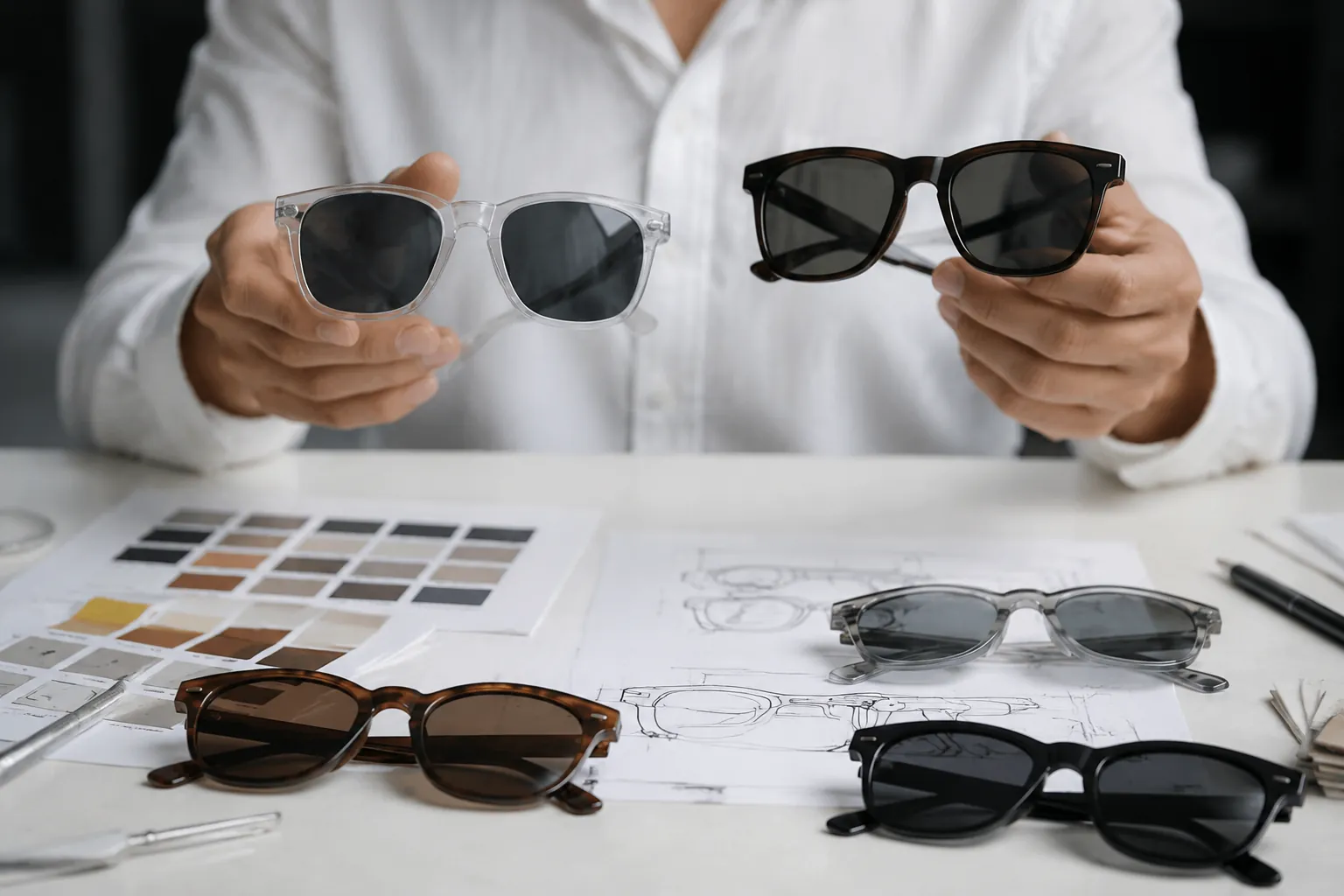
Choose the development route before you ask for quotes. ODM and OEM do not price, move, or scale the same way. Pick the wrong route and you usually get one of three outcomes: development cost that never pays back, sample rounds that miss the selling window, or a product that looks custom but is not meaningfully different. This is a commercial decision, not a styling exercise. The right answer depends on expected volume per SKU, required margin after landed cost, need for exclusivity, tolerance for upfront spend, and how much review time your team can actually support.
Start With Volume, Margin, and Deadline
Many buyers start with a sketch, a reference image, or a mood board. That is normal. It is also usually the wrong first step.
Start with three questions: how many pairs do you expect to sell per design in the first 12 months, what gross margin do you need after landed cost, and when must the goods ship?
ODM usually fits programs built on an existing factory frame platform. The buyer customizes visible elements such as frame color, lens tint, logo application, packaging, or selected trim details. OEM makes more sense when the frame structure itself is part of the sell: a buyer-specific lens shape, front construction, temple profile, hinge position, bridge geometry, or a custom acetate build that should not sit on a shared catalog base.
There is no fixed volume point that decides the route by itself. Lower-volume and time-sensitive programs often lean to ODM because the platform and tooling path already exist. Higher-volume carryover programs are more likely to justify OEM because development cost can be spread across more units and the buyer may need stronger differentiation.
The real sourcing question is simple: is this program driven by speed and lower upfront risk, or by structural control over time? Answer that first. Then discuss design.
Head-to-Head: What Actually Changes
| Factor | ODM | OEM |
|---|---|---|
| Base design | Existing factory frame platform with established construction | New buyer-specific frame structure developed from drawing, sample, or CAD |
| MOQ pressure | Often lower, but depends on factory policy, material, and color setup | Usually higher because development, setup, and in some cases tooling cost must be recovered |
| Sample timing | Normally shorter when changes are limited to color, logo, packaging, or minor trim | Normally longer because design review, prototyping, and revisions are part of the path |
| Tooling cost | Often low or none for standard cosmetic changes on an existing platform | May include CAD, machining, prototype charges, or mold investment depending on construction |
| Exclusivity | Limited unless exclusivity terms are defined by contract | Potentially stronger if drawings, molds, and ownership terms are clearly documented |
| Design freedom | Restricted by the existing geometry, hinge system, and lens curve | Higher control over shape, thickness, fit, detailing, and construction choices |
| Reorder economics | Often efficient for smaller repeat buys and quick color refreshes | Can become more efficient over time if repeat volume is high enough to absorb development cost |
The common mistake is paying for an OEM process when disciplined ODM customization would have done the job. The opposite mistake is forcing ODM onto a program that needs real exclusivity, then finding near-identical frames in the market with small cosmetic changes.
Some programs sit between those two poles. A hybrid route can work. Start from an existing fit block or platform, then adjust dimensions, temple branding, trim, hardware, or lens color. That can reduce timing risk while producing a result that is more distinct than a standard catalog pick.
Cost Stack: Piece Price Is Not the Whole Story
Do not compare only the ex-works unit price. That is one of the fastest ways to misread the economics.
The real difference between ODM and OEM sits in the full cost stack: development, samples, decoration, scrap exposure, quality risk, and reorder behavior.
- ODM cost profile: usually lower upfront spend, fewer engineering rounds, and less financial exposure if the style underperforms.
- OEM cost profile: usually higher upfront spend for design development, prototypes, and possible tooling, with a stronger case only when future reorder volume supports it.
- Decoration cost: pad print, laser marking, hot foil, and metal logo hardware do not carry the same setup cost, labor input, or alignment risk. Multiple logo positions increase both cost and inspection load.
- Material cost: injected polymers, metal builds, and acetate frames behave differently in yield, finishing time, rework rate, and scrap sensitivity.
Spread non-recurring development cost across expected orders, not only the first shipment. If an OEM program carries fixed development and sample charges, divide that cost by the realistic unit volume across the first production cycle. If the style is planned as a core carryover item, the math may work. If it is only a market test, the same cost burden may be hard to recover.
Ask for quotes that separate recurring unit price from non-recurring charges. That makes factory comparison cleaner and helps you test margin at different reorder volumes.
Lead Time Breakdown: Where Schedules Slip
Do not judge lead time by a headline promise. Judge it by the process path.
What matters is the number of approvals and technical dependencies between quotation and mass production.
ODM programs are usually faster because the frame platform already exists and the supplier is working from a known construction. Sample review often focuses on color match, lens tint, logo execution, packaging, and selected cosmetic details. If artwork, Pantone references, and packaging specs are clear, approval is usually more direct than it is for a new build.
OEM timelines are longer because each stage can trigger revision:
- Reference sketch, photo, or benchmark sample review
- CAD confirmation with dimensions, angles, and material callouts
- Construction decision: injection, acetate, metal, or hybrid
- Tooling or machining plan
- Prototype sample and fit review
- Revision for balance, hinge feel, lens retention, or branding placement
- Pre-production sample approval
- Bulk production
Two buyer-side delays damage schedules again and again: late artwork approval and vague color direction. A short hold at the logo or lens-color stage can push decoration, packaging approval, and final production release.
If the program has a fixed retail deadline, count back from the in-store date and allow time for at least one revision round. ODM usually gives better protection against seasonal timing risk because the platform has already been engineered and produced before.
Materials, Tolerances, and Process Control
ODM and OEM do not determine quality by themselves. Process control does.
A weak supplier can fail under either route. A disciplined supplier can run both well.
For injected sunglasses, the key variables include mold condition, resin control, cooling stability, shrink behavior, and hinge insertion consistency. For acetate, quality depends on sheet consistency, cutting accuracy, CNC control, polishing discipline, heat-forming stability, and alignment during assembly. Metal constructions bring different risks, especially in soldering, plating consistency, and dimensional control.
Ask practical tolerance questions. Not vague ones. On lens fit, how is lens retention checked during production? On logo hardware, what placement tolerance is accepted against approved artwork? On hinge feel, how is consistency monitored across the lot? Exact tolerances vary by construction, design, and factory process, so the useful test is whether the supplier can explain what is controlled, how it is checked, and when nonconforming pieces are removed.
Decoration method changes risk too. Pad printing is common and economical, but adhesion depends on substrate prep and curing control. Laser marking can be durable on suitable substrates, but the visual result varies by material. Metal logo plates can lift perceived value, yet they add assembly labor and alignment risk. Lens tint consistency depends on process discipline and inspection under controlled lighting.
That is why buyers should evaluate the supplier's process map, inspection checkpoints, and corrective-action discipline, not just the look of a sales sample.
Compliance: Lock the Market Requirements Early
Address compliance at the RFQ stage. Not after the design is approved.
Lens category, labeling, restricted substances, and destination-market documentation can affect material choice, coatings, and approval timing.
For sunglasses programs, the references buyers and suppliers discuss most often include CE EN ISO 12312-1, ANSI Z80.3, AS/NZS 1067, REACH, FDA registration, ISO 9001, and BSCI. These do not serve the same purpose. Separate product compliance, regulatory registration, management systems, and social-audit standards.
- EU: CE EN ISO 12312-1 is a key reference for non-prescription sunglasses sold into the EU market, covering performance and marking requirements for finished products.
- US: ANSI Z80.3 is commonly referenced for non-prescription sun eyewear. Buyers should also confirm whether FDA registration is relevant to their import documentation process and product category.
- Australia and New Zealand: AS/NZS 1067 is a relevant standard for sunglasses sold into those markets.
- Chemicals: REACH should be checked for applicable restricted substances in frame materials, coatings, inks, adhesives, and decoration components.
ISO 9001 and BSCI are not product-performance standards. ISO 9001 relates to quality management systems. BSCI relates to social compliance auditing. Both can matter in supplier qualification, but neither replaces style-level product compliance evidence.
Ask one direct question early: is the available documentation style-specific, material-specific, or only factory-level? That distinction matters because a factory certificate and a finished-product test report do not cover the same risk.
Decision Framework and RFQ Checklist
Use a commercial filter before you send the inquiry.
- Choose ODM if the program is relatively small, the deadline is tight, and the commercial goal is private label speed rather than structural ownership.
- Choose OEM if frame shape and construction are central to the brand, exclusivity matters, and expected repeat volume is strong enough to justify development cost.
- Choose a hybrid route if speed matters but the product still needs visible differentiation beyond standard catalog cosmetics.
A practical RFQ should include target market, target price, expected volume by design and color, required compliance documents, preferred frame and lens materials, packaging spec, branding locations, and the design elements that are truly non-negotiable. A useful supplier reply should identify frame material, lens material, decoration method by logo position, MOQ by design and color, sample charge, sample timing, bulk timing, tooling terms, carton details, inspection approach, and available compliance documents relevant to the target market.
Before placing an order, confirm three ownership points in writing: who owns the mold or tooling if one is created, whether the design or colorway is exclusive, and what happens to approved artwork and branded components after the project ends. Those terms often matter more than a small gap in unit price.
Have a custom sunglasses project in mind?
Send us your styles, target market and quantities and we will return a detailed quote with MOQ, lead time and a sample plan.
Get a QuoteWhy source this from Wenzhou with LumiShades
Wenzhou in Zhejiang Province is widely regarded as China’s eyewear manufacturing capital, producing a large share of the world’s sunglasses. That concentration matters to buyers: a deep local supply chain for acetate sheet, hinges, lens blanks, plating and packaging means shorter component lead times, easier color and material matching, and a workforce with decades of eyewear-specific skill. LumiShades has manufactured in this ecosystem since 2009, and our vertical integration — in-house injection molding, acetate cutting, CNC milling, lens tinting, decoration and quality control — means no part of your order is quietly subcontracted to a workshop you cannot audit.
For international buyers, that vertical control translates into accountability. When a single factory owns every step, defects are traced and fixed at source rather than bounced between vendors, and your specifications survive intact from first sample to bulk. We back this with 15+ years of experience, shipments to 60+ countries, more than 5 million pairs produced per year and a 98.5% on-time delivery rate. Our certifications — CE EN ISO 12312-1, FDA registration, ANSI Z80.3, AS/NZS 1067, REACH, ISO 9001 and BSCI audit — mean the compliance documentation your market requires already exists. Explore our manufacturing capabilities and quality control process to see how this works in practice.
Frequently asked questions
Can I get exclusivity on an ODM sunglass style? Sometimes, but it needs to be defined in writing before the order is placed. In an ODM model, the underlying frame platform usually remains the supplier's unless the contract states otherwise. Specify exactly what is exclusive: the full style, a colorway, a logo treatment, a sales territory, a channel, or a time-limited reservation period. Put the terms into the quotation or supply agreement and state the duration, market scope, minimum purchase requirement, and remedy if the same platform is sold outside the agreed terms.
At what volume does OEM usually make financial sense? There is no single number that fits every project. Cost depends on construction, prototyping complexity, tooling, and expected revision cycles. OEM makes sense only when projected repeat volume can absorb non-recurring costs and still leave acceptable margin after freight, duty, testing, and defect allowance. Ask the supplier to separate one-time charges from recurring unit price, then model cost per pair across realistic annual volume scenarios. That is more reliable than any generic volume rule.
Is sample timing for ODM usually shorter than for OEM? Yes, in most cases. ODM samples are usually faster because the supplier is modifying an existing frame platform rather than engineering a new one. Timing still depends on whether artwork, color references, packaging details, and approvals are complete and on time. OEM first samples generally take longer because the process may include CAD confirmation, prototyping, fit review, and revision rounds. Ask for a milestone schedule rather than one total number so delays can be traced to a specific stage.
What compliance documents should I ask for first? Start with documents tied to the destination market and the exact product being purchased. For EU programs, ask for CE EN ISO 12312-1 evidence for the relevant style. For the US, ask how the supplier addresses ANSI Z80.3 and whether FDA registration is relevant to the product and import process. For Australia and New Zealand, ask about AS/NZS 1067. For material control, ask for REACH-related information where applicable. Also confirm whether each document is style-specific, material-specific, or only factory-level, and request the report date, issuing lab, and product identification shown on the document.
How should I compare two factories if both quote the same unit price? Do not assume equal unit price means equal value. Compare the structure behind the quote: sample charges, development charges, tooling ownership terms, MOQ by design and color, revision policy, process coverage, inspection method, defect handling, packaging detail, and available compliance documents for the target market. Ask each factory to break out non-recurring charges separately and confirm what is included in the sample and bulk price. Once the hidden cost and execution risk are visible line by line, the better option is usually clear.
Ready to start?
Explore our square sunglasses or request a quote — our sales team replies within 12 hours.
Request a Quote