
Questions Before You Commit to Stock Sunglass Molds
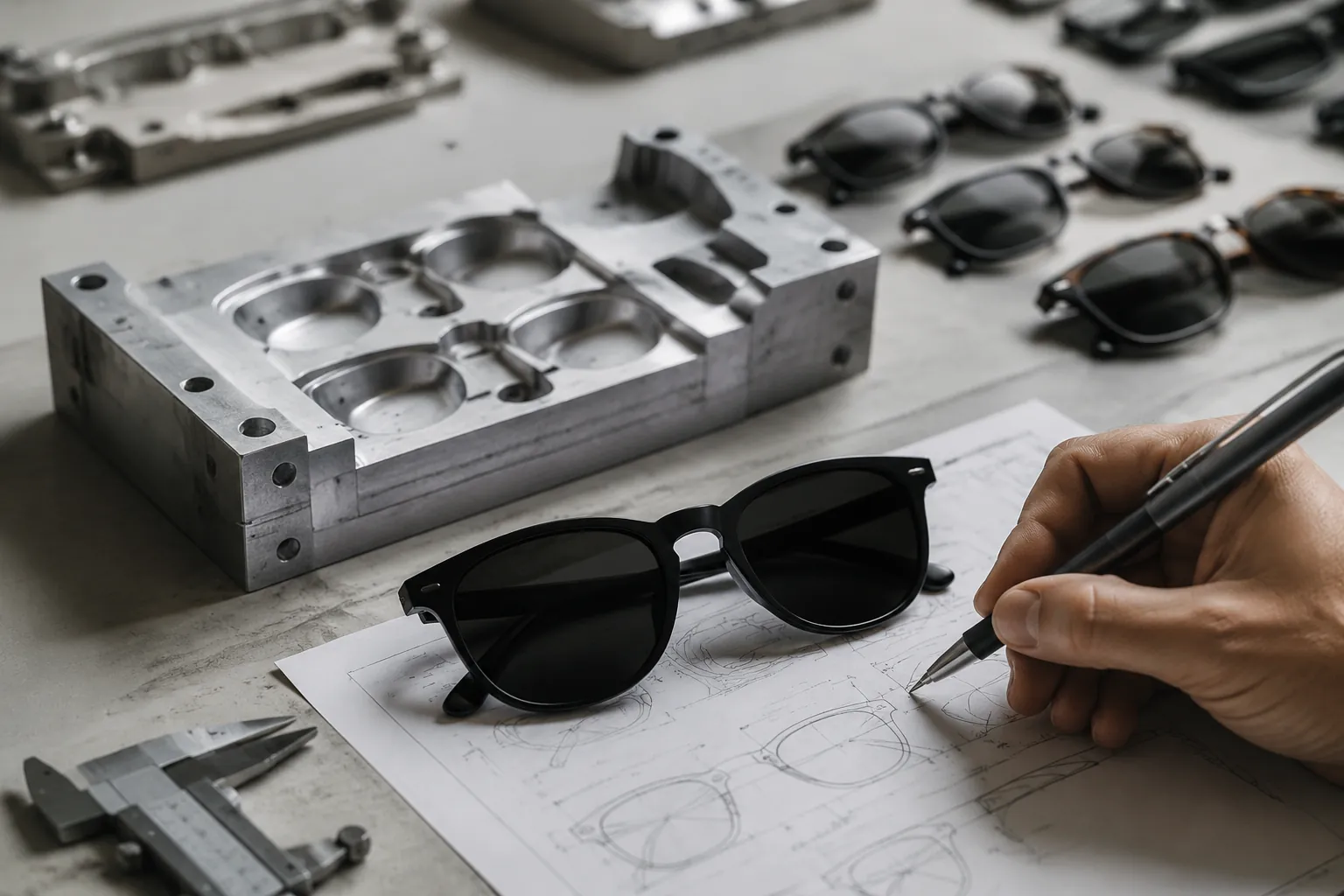
This guide is for brand owners, importers, distributors, and retailers sourcing private label sunglasses from existing factory molds. A stock mold can cut upfront cost and shorten sampling. It can also create expensive rework if the frame geometry, lens build, branding method, compliance path, and commercial terms do not already fit your program. Use the questions below to separate fixed features from adjustable ones, test claims that affect quality and compliance, and decide whether a stock mold is a real shortcut or just a faster way to buy the wrong frame.
Start with the real question: what are you actually saving?
The appeal of a stock mold is simple. The factory already has the tool, so you may avoid mold cost and shorten development compared with a fully custom frame. That helps when you want to test a style, move for a season, or launch with lower initial exposure.
But the saving only holds if the existing frame is already close to your target. Size, shape, material, lens build, and branding layout all matter. If you need structural changes, repeated sample rounds, or workarounds for logo placement and fit, the price advantage can disappear fast.
| Option | Upfront tool cost | Sample timing | Design freedom | Main risk |
|---|---|---|---|---|
| Use stock mold as-is | Usually none | Usually shorter than a new mold program | Low | Weak brand fit or poor sizing |
| Stock mold with color and logo changes | Usually none | Often still relatively fast | Medium | Decoration limits, adhesion, or wear issues |
| Stock mold with structural modifications | Case by case | Longer than a standard stock sample | Medium | Insert changes, process instability, or added development work |
| New mold | Highest | Longest | Highest | Higher upfront spend and longer payback period |
Ask for the exact mold code or style code, the version being quoted, and whether the sample will be made under normal production conditions or adjusted by hand for sampling only. If the supplier cannot define what is standard on that mold, the quote is not reliable.
Check frame geometry before you discuss color or branding
Many buyers start with lens tint, finish, or logo position. Start earlier. First confirm that the frame geometry fits the category, wearer profile, and market you are targeting.
- Basic dimensions: Request lens width, bridge width, temple length, front width, frame height, and lens horizontal and vertical size in millimeters.
- Tolerance range: Ask what dimensional tolerances the factory controls in production for this style, and which dimensions are treated as critical.
- Base curve and wrap: Confirm whether the frame is flatter or more wrapped, because this affects fit, lens cutting, and visual performance.
- Hinge position and opening angle: Ask how the factory defines the standard opening position and what tolerance is accepted in production.
- Weight: Request the finished product weight with lenses and hardware, not frame-only weight.
- Nose fit: On molded plastic frames, the nose geometry is usually fixed by the tool, so fit changes are limited without tooling changes.
Ask for a technical drawing, specification sheet, or sample measurement report. Front photos are not enough. If the frame will be sold in more than one region, ask whether the style exists in multiple sizes or whether the supplier expects one size to cover every market. Do not accept that assumption without testing it.
Get specific about what can change without new tooling
This is where many private label programs lose time. A stock mold does not mean every visible detail is flexible. The supplier should state, in writing, what is fixed by the tool and what can change through material choice, finishing, decoration, or assembly.
- Usually fixed by mold: front outline, bridge form, temple profile, lens shape, nose shape, and any molded surface features.
- Often adjustable without new tooling: frame color, transparency level, surface finish, lens tint, mirror treatment, logo printing, laser marking, and some added trim details.
- Conditional on MOQ, setup, or component availability: hinge upgrades, wire core options, polarized lenses, upgraded coatings, and certain metal logo applications.
- Potential issue to verify: whether any existing brand-specific detail is built into the mold or part design and how that would be removed or covered for your program.
Then review branding against the actual process. Not just the artwork.
| Decoration method | Typical use | Strength | Main limit |
|---|---|---|---|
| Pad printing | Temple logos, inside markings | Flexible and commonly used for small to medium runs | Can wear faster on high-contact areas |
| Laser engraving | Inside temples, metal parts, matte surfaces | Durable and precise | Visibility depends on substrate color and finish |
| Metal logo plate | Temple exterior branding | Higher perceived value | Requires suitable placement area and added assembly steps |
| Hot stamping/foil | Inside temple branding | Clean appearance on suitable surfaces | Durability depends on substrate, process, and wear conditions |
Ask for the minimum logo size, maximum decoration area, and any known limits on curved, glossy, textured, or high-flex parts. Also confirm whether the approved sample will use the same decoration method, tooling, and production settings planned for bulk output.
Material and lens choices drive cost, performance, and returns
Two sunglasses can look almost identical in a photo and perform very differently in production and in use. Start with the frame material. Ask what is standard on the quoted style and what alternatives are available. If the frame is injection molded, ask which resin is used. If it is acetate, ask how the supplier controls sheet consistency, machining, polishing, and alignment.
Then get into the lens specification. Lens details affect appearance, comfort, durability, and compliance.
- Lens material: Ask what lens material is standard and what alternatives are available.
- Tint method: Confirm whether the lens is solid tinted, gradient, mirrored, or otherwise treated.
- Visible light transmission: Request the target VLT range as a numeric value, not descriptive language alone.
- Lens category and intended use: Confirm how the lens is positioned for the destination market.
- Coating system: Ask whether hard coating, mirror coating, polarization, or other treatments are standard or optional upgrades.
- Lens retention: Ask how the factory verifies lens fit, insertion quality, and resistance to pop-out or stress cracking.
One question matters more than most: What exact frame and lens specification is included in this quotation, and what changes the price? Without that answer, you are not comparing quotes on a like-for-like basis.
Treat compliance as SKU-specific, not a general factory claim
Do not approve a stock mold because a supplier says it exports worldwide. That is not a compliance strategy. Compliance has to match the finished product configuration and the destination market. In sunglass sourcing, you will often hear terms such as CE EN ISO 12312-1, ANSI Z80.3, AS/NZS 1067, REACH, FDA registration, ISO 9001, and BSCI. These do not all mean the same thing. They do not all apply at product level.
Use a direct checklist:
- EU: Ask whether the finished sunglass configuration is tested or prepared to be tested against CE EN ISO 12312-1 requirements relevant to sunglasses for general use.
- US: Ask what documentation or test support is available for alignment with ANSI Z80.3, and clarify the role of FDA registration if the supplier brings it up.
- Australia/New Zealand: Confirm whether the lens specification is intended to align with AS/NZS 1067 requirements relevant to the product category.
- Chemical compliance: Ask what REACH-related controls or declarations are available for frame materials, coatings, inks, adhesives, and metal trims.
- Quality and social systems: If the supplier cites ISO 9001 or BSCI, treat those as factory-level management credentials, not proof that the finished sunglasses are compliant for your market.
A common mistake is assuming prior testing on a stock style automatically covers a private label version. It may not. A change in lens tint, coating, material, metal component, or decoration can affect the product being sold. Ask this plainly: Has this exact frame and lens construction been supplied to my target market before, and what is different between that version and mine?
Check mold history and process stability like a risk item
Not all stock molds carry the same production risk. Some are active tools with repeat-order history and stable process settings. Others are older tools that can still produce usable parts but need more sorting, finishing, or cosmetic rework.
Ask these questions directly:
- How often has this mold been used recently?
- Is it single-cavity or multi-cavity?
- Are there known cosmetic issues such as flash, sink, flow marks, gate witness, weld lines, or visible parting lines?
- Which dimensions are treated as critical, and how are they checked in production?
- Has the tool had repairs, insert replacements, or repolishing that changed the surface or part behavior?
This matters because a hand-picked sample can look better than average bulk output. Ask what the most common reject points are on that style and whether those issues show up more in certain colors, finishes, or decoration methods.
If the style is acetate, shift the conversation from mold wear to process control: sheet variation, machining consistency, polishing exposure, hinge alignment, and assembly repeatability. The issue is not whether the factory can make the style once. The issue is whether it can repeat the style at commercial quality across your order quantity.
Use MOQ, price breaks, and lead times with discipline
The lowest MOQ can be useful for a market test. It is not automatically the best commercial choice. Small orders usually carry a higher unit cost because setup, decoration prep, packaging work, and inspection time are spread across fewer units. Larger repeat orders can improve efficiency, but only after the specification is stable and sell-through is proven.
| Order size | Typical use case | Main benefit | Main trade-off |
|---|---|---|---|
| Low-MOQ trial order | Market test, capsule launch, retailer evaluation | Lower entry risk and faster commercial validation | Higher unit cost and fewer customization options |
| Small launch order | Initial launch with limited color range | Better cost absorption than a trial order | Still limited leverage on upgrades and packaging efficiency |
| Core SKU build | Established style with planned replenishment | Better cost position and production planning stability | Higher inventory exposure |
| Large repeat order | Proven high-volume program | Best chance of optimized unit economics | Requires stable demand, specification control, and supply planning |
Break lead time into parts: sampling, sample revision, bulk production, packaging prep, testing support if required, and shipment readiness. Then ask what restarts the clock, including artwork changes, color revisions, lens changes, packaging changes, or material substitutions.
Do not compare quotes on unit price alone. Compare the full package: packaging level, decoration method, lens specification, documentation support, inspection standard, spare policy if any, and the likely cost of rework if the style is technically marginal. First validate the mold. Then scale.
Use a hard approval checklist before you release the PO
Before you issue a purchase order, turn the program into a controlled specification. Most disputes start with one point that was assumed instead of documented.
- Approve the exact mold or style code and record key frame dimensions on the PO or approved specification sheet.
- Freeze materials: frame material, hinge type, wire core if applicable, lens material, tint, coating, and any metal trims.
- Freeze branding method with artwork file version, logo size, and logo position in millimeters.
- Confirm the compliance path for the destination market, including what documents, declarations, or test reports are expected.
- Approve a reference sample under normal viewing conditions, and review outdoor appearance when lens color or mirror effect matters.
- Define inspection points: lens scratches, logo position, alignment, opening and closing feel, color consistency, and packing method.
- Confirm timing: sampling, approval, production, and what changes restart any part of the schedule.
Keep one rule in view: if the supplier cannot explain clearly what is fixed and what is variable on a stock mold, the program is not under technical control yet. Existing tools create value only when their limits are understood before the order is placed.
Have a custom sunglasses project in mind?
Send us your styles, target market and quantities and we will return a detailed quote with MOQ, lead time and a sample plan.
Get a QuoteWhy source this from Wenzhou with LumiShades
Wenzhou in Zhejiang Province is widely regarded as China’s eyewear manufacturing capital, producing a large share of the world’s sunglasses. That concentration matters to buyers: a deep local supply chain for acetate sheet, hinges, lens blanks, plating and packaging means shorter component lead times, easier color and material matching, and a workforce with decades of eyewear-specific skill. LumiShades has manufactured in this ecosystem since 2009, and our vertical integration — in-house injection molding, acetate cutting, CNC milling, lens tinting, decoration and quality control — means no part of your order is quietly subcontracted to a workshop you cannot audit.
For international buyers, that vertical control translates into accountability. When a single factory owns every step, defects are traced and fixed at source rather than bounced between vendors, and your specifications survive intact from first sample to bulk. We back this with 15+ years of experience, shipments to 60+ countries, more than 5 million pairs produced per year and a 98.5% on-time delivery rate. Our certifications — CE EN ISO 12312-1, FDA registration, ANSI Z80.3, AS/NZS 1067, REACH, ISO 9001 and BSCI audit — mean the compliance documentation your market requires already exists. Explore our manufacturing capabilities and quality control process to see how this works in practice.
Frequently asked questions
Can I change the frame shape slightly on a stock mold without paying for new tooling? Usually only within narrow limits. Changes to the front outline, bridge, lens shape, temple profile, or molded nose area often require insert modification or a new tool, and the supplier should confirm that in writing. Ask for a marked drawing that shows which features are tool-defined and whether any proposed change affects lens cutting, hinge placement, assembly, or fit. If the supplier describes a shape change as a simple adjustment, ask whether the approved sample will be produced with the same tooling and process planned for bulk production.
What is the fastest way to test a stock mold for my brand? Choose a proven stock style and leave the structure unchanged. Keep the first round to color, lens tint, and one branding method the supplier already uses on that frame material. Before sampling, request the style code, key dimensions, standard material specification, and decoration limits for that model. Then approve one reference sample against a written specification so you can decide quickly whether to proceed, revise, or reject without opening a larger development cycle.
Does prior certification on a stock style mean my private label version is automatically compliant? No. Prior testing or market history on a stock style does not automatically cover your private label version if the lens tint, coating, frame material, metal parts, inks, adhesives, or other construction details change. Ask which parts of the product have already been tested, what exact configuration those records apply to, and what evidence is available for your target market under CE EN ISO 12312-1, ANSI Z80.3, AS/NZS 1067, and REACH-related controls as relevant. Also separate product compliance from factory-level credentials such as ISO 9001 or BSCI.
At what order size do stock molds usually become cost-effective? They are often most cost-effective when you want to avoid mold investment and launch with an existing design that already fits your market. The right quantity depends on your selling price, packaging level, compliance cost, and the amount of customization required. Ask the supplier for pricing at several volume tiers using the exact same specification, then compare the unit price change against your inventory risk and reorder plan. A small order can be the right choice for validation. A larger repeat order usually makes sense only after the style, specification, and sell-through are proven.
What QC points matter most on a stock sunglasses program? Focus on the points most likely to create returns, claims, or shipment disputes: frame dimensions, symmetry, lens fit and retention, visible defects, lens scratches, hinge alignment, opening and closing consistency, logo position, color consistency, and packing accuracy. Ask the supplier to identify the known defect risks for that specific style and material, then define acceptance criteria before production starts. A useful step is to put those points into the approved specification sheet or PO notes so inspection is based on the same standard used during sample approval.
Ready to start?
Explore our aviator sunglasses or request a quote — our sales team replies within 12 hours.
Request a Quote