
ODM vs OEM Sunglasses: Best Fit for Mid-Volume Buyers
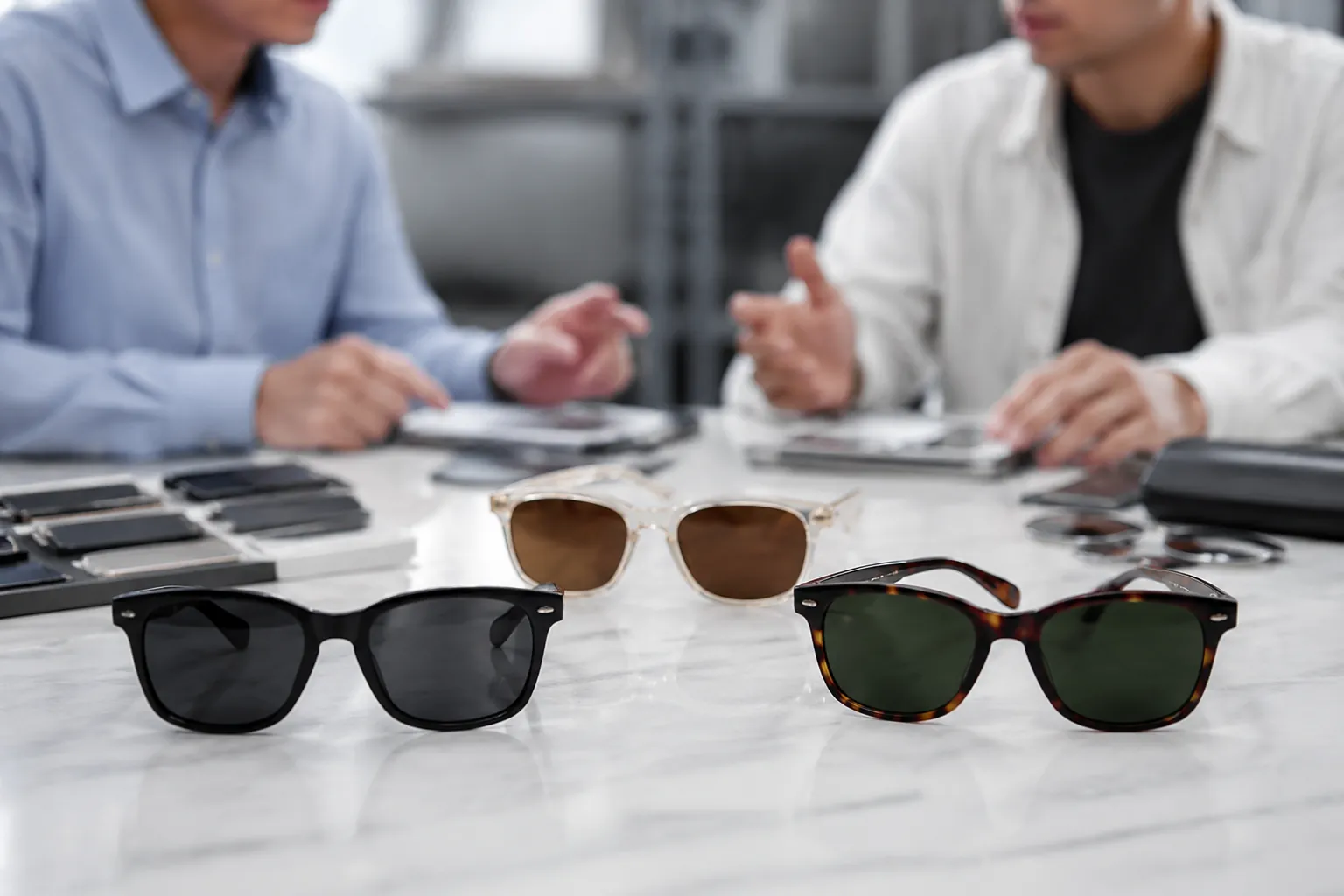
This guide is for brand owners, importers, distributors, and retail buyers building a sunglasses line in the low hundreds to low thousands per style. At that volume, ODM and OEM are not just label choices. They are different development models with different cash demands, sample timelines, compliance work, and first-order risk. The real question is simple: are you buying a new frame structure, or a market-ready version of a structure the factory already makes? That choice affects MOQ, lead time, approval complexity, and how much technical risk you carry into the first shipment.
Start With The Risk You Need To Remove
Most mid-volume buyers are trying to control four things at once: speed to market, cash tied up before sell-through, landed margin, and the chance of preventable quality problems in the first bulk order. ODM and OEM address those problems in different ways.
ODM starts with an existing frame platform the factory already produces. Common changes include lens tint, frame color, finish, logo application, packaging, and other appearance updates that do not require a new frame structure. OEM means the buyer is developing a new frame design or making structural changes that require new tooling, new machining programs, or a fresh engineering review of fit and assembly.
That difference matters because structure creates risk. A new sunglass front is not just a drawing. The factory still has to prove it can make the frame consistently, fit the lens correctly, place the hinge properly, and keep the finished product within the approved fit and appearance standard. Material matters too. Injection-molded plastic, acetate, and metal each bring their own process controls and failure points.
For buyers ordering a few hundred or a few thousand pairs per style, the first question should be direct: do you need a new frame structure, or do you need a strong commercial version of a proven base? If the silhouette already exists and your differentiation comes from branding, lens treatment, color, packaging, or channel strategy, ODM is usually the lower-risk start. If your brand depends on a proprietary shape, a specific fit architecture, or a construction detail that an existing platform cannot deliver, OEM may be justified. But call it what it is: a development program, not a simple purchase order.
- Choose ODM when you need to test multiple styles quickly with limited development spend.
- Choose OEM when frame geometry or construction is central to the product value and supports a higher selling price.
- Separate ODM and OEM programs in forecasting and scheduling because sample approval, compliance review, and production risk are not the same.
The Decision Table Buyers Actually Use
Buyers do not make this call on theory. They make it on MOQ, cash exposure, sample timing, and whether the first bulk run can land in time for the selling window. The table below reflects how factories and export buyers usually assess an eyewear program in practice.
| Decision Factor | ODM Platform | OEM Custom Frame | What It Means For A Mid-Volume Buyer |
|---|---|---|---|
| MOQ per design | Usually lower because the factory is using an existing frame platform | Usually higher because setup cost and development effort must be absorbed | ODM generally gives buyers more flexibility to spread budget across several SKUs and reduce dead-stock risk. |
| Sample lead time | Usually shorter for changes such as color, lens tint, logo, and packaging | Usually longer because prototypes, revisions, and technical approval are required | ODM is often better suited to seasonal launches and quick market tests. |
| Tooling and development cost | Often limited because the base model already exists | Can include mold cost, machining setup, prototype work, and fit corrections | OEM only makes sense when expected volume and margin can absorb one-time development cost. |
| First-run defect risk | Lower when the platform is already in stable production | Higher because a new structure still has to be validated in production | Smaller buyers usually feel rework, replacement cost, and delays more sharply than large-volume buyers. |
| Bulk lead time after approval | Often shorter because fewer variables remain unproven | Often longer on the first run because production settings may still need adjustment | ODM is generally safer when launch dates are fixed by retail sets or promotions. |
| Exclusivity | Limited unless the factory offers platform control or the changes are visually substantial | Higher when the frame shape and construction are genuinely custom | OEM is stronger when shape recognition is part of brand positioning. |
If your first order is modest and demand is still unproven, ODM is usually the rational default unless there is a clear structural reason to build from zero.
Where The Money Goes On A First Launch
Many buyers compare ODM and OEM using only ex-factory unit price. That is too narrow. The better comparison is approved launch cost per sellable pair.
On an ODM program, the buyer is usually paying for a proven frame plus visible customization. That keeps more of the initial spend in inventory, decoration, packaging, and freight rather than in development. The benefit is plain: you can build market variation without funding a new structure.
OEM adds cost in places buyers often underestimate. A custom frame may require new tooling, prototype sampling, repeated fit corrections, revised technical drawings, and more approval time between buyer and factory. Acetate and metal projects can also add extra machining, polishing, or assembly checks before the design is production-ready. Even when a factory does not break out every development item clearly in the quote, the buyer still pays for that work through setup charges, unit price, or a slower first production cycle.
Use a stricter method when you calculate first-order economics:
- Start with expected sellable volume per style, not just planned production volume.
- Add all one-time development cost to the first order, including tooling, revised samples, test fees, and packaging setup.
- Reserve budget for QC fallout, replacement units, and remake freight if the first bulk run needs correction.
- Check whether the style is still commercially viable if there is no second order.
That last step matters. A lot. If the margin only works after several reorders, the OEM model may be too fragile for a mid-volume launch. Assume the first order has to justify itself on its own economics.
Lead Time Is Several Clocks, Not One
Factories often quote lead time as if it were one block. It is not. Sunglasses production runs on several clocks at once: development, sample approval, material preparation, production scheduling, decoration, inspection, packing, and shipment booking. ODM shortens several of those clocks at the same time.
On a proven platform, the factory already knows the construction, assembly sequence, and common appearance checkpoints. Sample work is usually limited to approved changes such as color, lens treatment, logo placement, and packaging. Once the buyer signs off, bulk production can move faster because fewer technical variables are still unresolved.
OEM first runs take longer because the process itself has to be proven. For injection styles, the factory must confirm that the frame can be molded consistently and assembled without fit or appearance problems. For acetate, timing is often driven by cutting, CNC work, polishing, and final adjustment. Metal designs add their own complexity through soldering, plating, or assembly tolerances. That does not make OEM a bad choice. It just means the buyer should treat first-run timing as a development schedule, not a normal replenishment lead time.
- Injection programs: review lens fit, hinge position, left-right symmetry, and final frame alignment.
- Acetate programs: review color consistency, polishing quality, edge finish, and post-adjustment stability.
- Decorated parts: allow time for logo adhesion, placement checks, and packaging approval before bulk release.
If delivery dates are fixed, the takeaway is blunt: ODM usually protects the calendar because fewer production variables are still being proven during the first order.
What You Can Safely Change On An ODM Base
One common sourcing mistake is assuming any visible customization requires OEM. It does not. Many buyer-facing changes are cosmetic or packaging-level modifications that can be made on an existing platform without turning the project into full custom development.
On a stable ODM base, common low-risk changes include lens tint, polarized or non-polarized lens selection where the platform already supports it, frame color, finish, logo method, packaging, barcode labels, and carton marks. Some factories also support limited trim or temple-detail changes if those do not alter the core frame geometry or require new tooling.
Decoration methods usually include pad printing, laser marking, foil application, or metal logo parts, depending on frame material and finish. Each method should be reviewed for durability and appearance on the exact surface being used. A logo method that works well on one coating or color may perform differently on another.
Changes become more complex when they affect fit, structure, or lens interface. A new front shape, a different lens geometry, a new hinge position, or a material change that affects frame behavior can push the project into OEM because those changes require technical validation, not simple decoration approval.
For mid-volume buyers, the smartest use of ODM is to focus on the features the customer notices first:
- Lens category, color, and treatment
- Frame color, translucency, and surface finish
- Logo placement and decoration method
- Retail-ready packaging and carton labeling
- Merchandising consistency across a small style family
If those levers are enough to carry the commercial story, staying on an ODM base for the first launch usually leaves more capital for inventory, marketing, and distribution.
Compliance And QC Are Easier To Control On Proven Platforms
Compliance is one of the least visible but most expensive places to make a mistake. Sunglasses for export may require different documentation depending on destination market, lens category, material, and customer channel. Common standards and compliance references include CE EN ISO 12312-1, ANSI Z80.3, AS/NZS 1067, and REACH where applicable. Some U.S. import programs also raise FDA registration questions at the supplier level, especially when buyers source across broader eyewear categories, so that point should be confirmed directly. Factory management and social compliance credentials such as ISO 9001 and BSCI may also matter to retailer and importer audits, but they do not replace product compliance.
A proven ODM platform can help because the factory may already have experience with that frame and lens construction. That does not remove the need for testing or document review. It does reduce the chance that the buyer is combining an unproven structure, a new lens setup, and a tight launch schedule in the same order.
QC discipline matters just as much at mid volume because smaller orders have less room to absorb sorting loss or remake cost. A sensible inspection plan should include visual checks, hinge action, logo placement, lens cleanliness, left-right alignment, and pack-out accuracy. Basic dimensional checkpoints should be checked against the approved sample, especially on OEM programs where early drift is more likely.
Buyer rule: treat compliance and QC by SKU, lens configuration, and destination market. Do not assume one certificate or declaration covers every tint, coating, or material combination in the line.
When OEM Is Worth It And A Practical First-Order Path
OEM is not the wrong choice. It becomes the wrong choice when buyers use it before volume, margin, and reorder confidence can support the extra development work.
For most mid-volume programs, ODM is the safer launch model when demand is still uncertain. OEM starts to make more sense when the frame shape itself is part of the brand value, the intended selling price can support a longer development payback, and the buyer has reason to expect repeat volume rather than a one-time test order. This is a commercial judgment, not an ideological one.
Channel matters. In price-sensitive retail, promotional, or broad private-label programs, a strong existing platform with disciplined customization is often enough. In specialty retail, premium DTC, or tightly branded collections where shape recognition supports full-price sell-through, OEM can be easier to justify. Even then, buyers should stay honest about what the customer actually notices and pays for. Many mid-volume programs overrate hidden engineering uniqueness and underrate reliable delivery, stable quality, and clean packaging execution.
A delayed OEM launch can cost more than a simpler ODM launch if the key selling season is missed. That is why disciplined buyers often use a staged path: launch faster on ODM, review sell-through and returns, then move proven winners into deeper OEM development. It is a practical sequence.
- Shortlist existing frame platforms that fit your target retail price, customer profile, and channel margin.
- Request modified samples with exact lens tint, logo method, colorway, and packaging requirements instead of approving from generic references.
- Review fit, hinge feel, lens finish, logo durability, and carton pack-out against the real selling environment.
- Confirm compliance documents or testing plans for the exact SKU setup, including tint, lens treatment, and material combination for the destination market.
- Place a mixed first order across several validated designs instead of overcommitting to one unproven custom frame.
- Track sell-through, returns, and reorder speed by individual shape so future decisions are based on style-level data.
- Move top sellers into OEM only when forecast volume, margin, and launch timing can absorb added development cost.
This staged method works best with factories that control key processes directly and give clear accountability during sampling, approval, and QC. For mid-volume buyers, that operational control often matters more than the lowest nominal unit price.
The bottom line is simple: ODM is usually the better first move for low- to mid-volume sunglasses programs because it reduces tooling exposure, shortens sample cycles, and lowers first-order development risk. OEM earns its place later, when the shape has a clear business case and the buyer has evidence that the extra customization can return acceptable margin.
Have a custom sunglasses project in mind?
Send us your styles, target market and quantities and we will return a detailed quote with MOQ, lead time and a sample plan.
Get a QuoteWhy source this from Wenzhou with LumiShades
Wenzhou in Zhejiang Province is widely regarded as China’s eyewear manufacturing capital, producing a large share of the world’s sunglasses. That concentration matters to buyers: a deep local supply chain for acetate sheet, hinges, lens blanks, plating and packaging means shorter component lead times, easier color and material matching, and a workforce with decades of eyewear-specific skill. LumiShades has manufactured in this ecosystem since 2009, and our vertical integration — in-house injection molding, acetate cutting, CNC milling, lens tinting, decoration and quality control — means no part of your order is quietly subcontracted to a workshop you cannot audit.
For international buyers, that vertical control translates into accountability. When a single factory owns every step, defects are traced and fixed at source rather than bounced between vendors, and your specifications survive intact from first sample to bulk. We back this with 15+ years of experience, shipments to 60+ countries, more than 5 million pairs produced per year and a 98.5% on-time delivery rate. Our certifications — CE EN ISO 12312-1, FDA registration, ANSI Z80.3, AS/NZS 1067, REACH, ISO 9001 and BSCI audit — mean the compliance documentation your market requires already exists. Explore our manufacturing capabilities and quality control process to see how this works in practice.
Frequently asked questions
At what volume does OEM usually start to make more sense than ODM? There is no universal cutoff because the decision depends on tooling cost, target margin, selling price, and reorder confidence. In practice, OEM is easier to justify when you have a credible forecast for repeat orders and the frame shape itself supports higher pricing or stronger brand differentiation. Ask the factory for both scenarios in writing: the landed economics of an ODM option and the full first-order economics of an OEM option, including sampling, tooling, testing, and expected lead time. If the OEM version only works financially after multiple uncertain reorders, it is usually too early.
Can I still private label an ODM sunglasses design? Yes. Private label on ODM usually includes logo printing or marking, lens tint or treatment options, frame color changes, finish selection, packaging, labels, and outer-carton details. The key is to define those changes at sample stage with exact artwork, Pantone or color references where relevant, packaging specs, and approval criteria. Do not treat ODM as a generic stock buy if brand presentation matters. Lock the visual details before bulk production starts.
Does changing lens color require new compliance testing? It can. Lens color, mirror coating, gradient, polarization, and material can affect the final product's light-transmission performance and therefore its compliance status in the destination market. Buyers should ask the supplier to confirm whether the exact SKU configuration is already covered by valid test reports or whether new testing is required under standards such as CE EN ISO 12312-1, ANSI Z80.3, or AS/NZS 1067. The safe rule is simple: review compliance by exact lens setup, not by frame family alone.
What is the main production risk on a first OEM run? The main risk is process instability on a new structure. That can show up as poor alignment, inconsistent lens fit, hinge-placement issues, finish variation, or repeated sample corrections before bulk approval. The buyer response should be procedural, not verbal: require a signed approval sample, a clear specification sheet, defined inspection checkpoints, and confirmation of which issues will be checked in-line and at final inspection. On a first OEM run, undocumented assumptions are where most avoidable problems start.
How should I structure a first order if I am unsure about demand? Use several low-risk ODM styles or colorways instead of concentrating budget into one unproven OEM frame. Request final preproduction samples, approve exact packaging and labeling, confirm compliance documents for each SKU configuration, and set inspection criteria before bulk release. After launch, track sell-through, returns, and reorder speed by specific style and lens setup. That data should determine whether any design deserves a move into OEM development.
Ready to start?
Explore our rimless sunglasses or request a quote — our sales team replies within 12 hours.
Request a Quote