
Custom Sunglasses Tooling Cost Guide
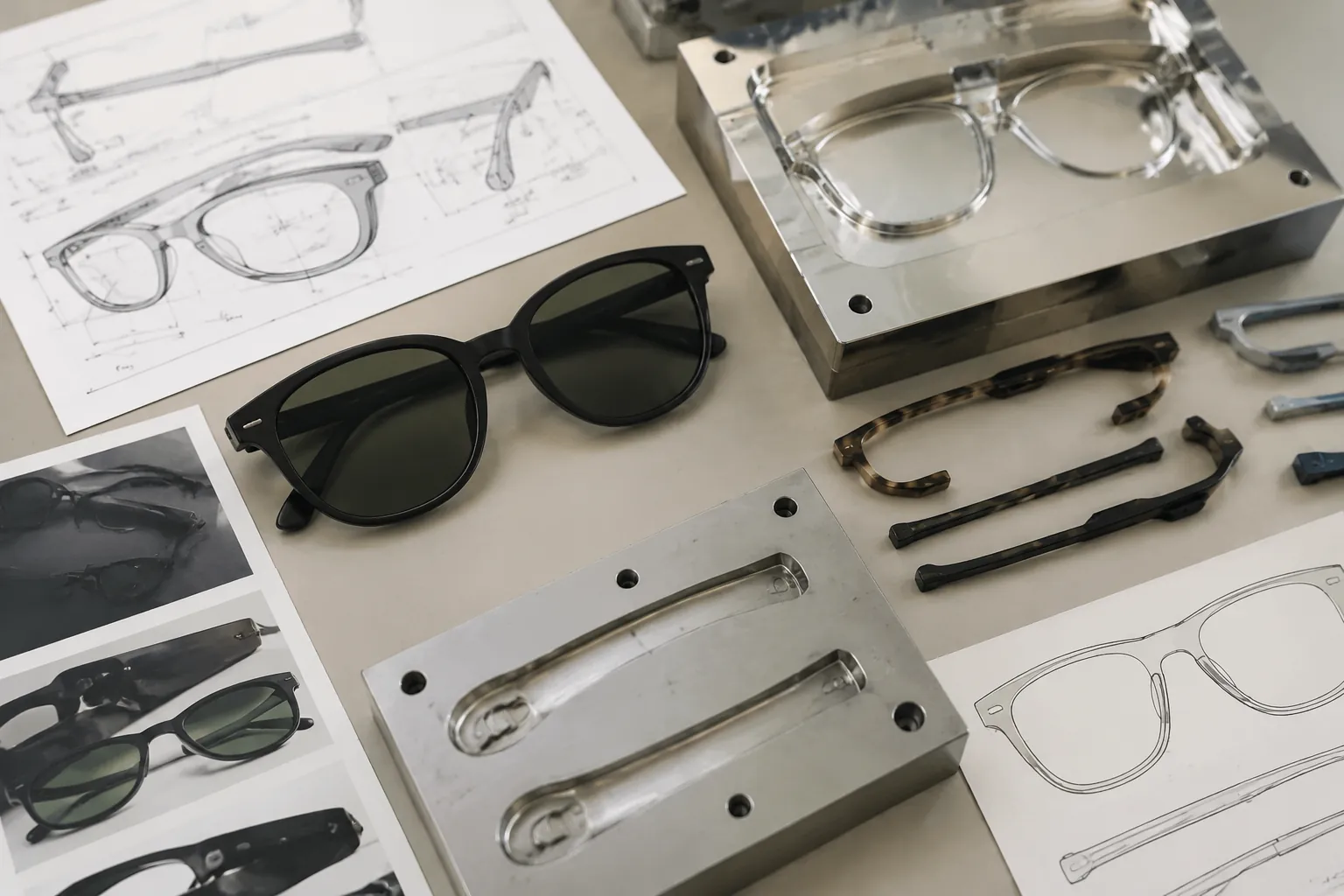
This guide is for brand owners, importers, distributors, and retail buyers deciding whether to fund new sunglass tooling or start from an existing frame shape. The mold fee is only part of the decision. You also need realistic reorder volume, target ex-factory cost, retail positioning, material choice, compliance scope, and a clear reason for custom geometry. If those numbers are solid, custom tooling can support repeatability and differentiation. If they are not, it can trap cash in a style that never reorders.
Start With the Three Numbers That Matter
Most tooling decisions come down to three commercial inputs: one-time development cost, realistic 12- to 24-month volume, and acceptable landed cost per pair. Many buyers fixate on the first number. That is not enough.
A practical comparison is simple. Divide the full one-time cost by the expected lifetime volume of the style, then add the quoted ex-factory unit price. That gives you a tooling-loaded ex-factory cost. Next, check whether the result still works after packaging, freight, duty, testing, and channel margin are added.
Example: if a custom mold package costs US$4,500 and the style is expected to sell 5,000 pairs over its commercial life, the tooling burden is about US$0.90 per pair. If the ex-factory unit price is US$2.10 at the relevant volume, the tooling-loaded ex-factory cost is about US$3.00 before packaging upgrades or lens treatments. The question is straightforward: does that still fit the retail model?
Be strict with volume assumptions. If the opening order is small and there is no reorder history for the shape, tooling payback is still hypothetical. Model the downside case, not just the optimistic one used in line planning.
When Existing Molds Are the Better Choice
If the priority is speed, lower upfront exposure, or market testing, existing molds usually win. You avoid most tooling cost, shorten development, and use a geometry the factory has already produced. That often means fewer unknowns around fit, lens seating, hinge installation, and general production consistency.
Existing molds are usually the right starting point when:
- You are launching a new brand or category and have no reorder history by shape.
- Your first run is small and meant to test demand.
- Your changes are mostly cosmetic, such as lens tint, mirror finish, temple print, laser marking, logo hardware, or packaging.
- Your target retail price leaves little room for tooling amortization.
They can also simplify sample approval because the frame construction is already known. That does not remove the need for review. It does reduce technical risk compared with cutting a new tool for an unproven style.
Put bluntly: if you are not confident one shape will reorder at meaningful volume, a fresh mold may be premature. A proven catalog frame with custom lenses, branding, and packaging is often the more disciplined first move.
When New Tooling Earns Its Cost
New tooling makes sense when design control is likely to drive reorder volume, account exclusivity, or stronger margin over time. This is usually a multi-season shape, not a short-run fashion test.
New molds are easier to defend when one or more of these conditions is true:
- You have a credible lifetime volume case supported by distribution plans or prior sales history.
- You need a front curve, lens shape, temple profile, bridge fit, or wrap angle that existing tools cannot deliver.
- You want a proprietary house shape instead of a frame that may appear in other supplier catalogs.
- You are building a higher-ticket line where silhouette, fit, and finish are central to the offer.
For injection-molded sunglasses, custom tooling can improve repeatability once the tool and process are stable. Common development issues include visible weld lines, sink marks, warpage, shrink-related fit changes, and lens-groove tolerances that affect retention. None of this is unusual. It still has to be solved before bulk production.
Acetate follows different economics. It may not need a large steel injection mold, but it still requires pattern development, CNC programming, fixtures, polishing trials, and fit correction. Treat acetate development as a real pre-production expense, not a free shortcut.
The rule is simple: pay for custom tooling only when it solves a real commercial or technical problem that an existing mold cannot solve efficiently.
Cost and Lead Time by Development Route
Before approving development, ask for a route-by-route comparison. Actual pricing and timing vary by frame structure, finish, lens specification, and supplier capability, but the decision logic stays consistent.
| Development route | Typical upfront cost | Sample timing | Best volume range | Main trade-off |
|---|---|---|---|---|
| Existing mold with color and logo changes | Low; often limited to setup charges, screens, or logo tooling | Usually the shortest route | Best for market tests and lower-volume runs | Fast and low risk, but limited shape control |
| Modified existing mold or minor hardware change | Moderate; may include inserts, temple changes, or logo hardware | Longer than a standard catalog sample | Useful when some differentiation is needed without full custom tooling | More flexibility, but original geometry still constrains the design |
| New injection mold for full custom frame | Highest upfront cost; depends on part count, tool construction, and revision cycle | Development usually requires multiple technical checkpoints | Best when the style is expected to reorder at meaningful volume | Strong design control and repeatability, but highest cash exposure |
| Custom acetate development with CNC setup | Moderate to high; depends on pattern count, revisions, and finishing complexity | Often requires several rounds to finalize fit and finish | Best for premium programs with a credible volume case | Material and finish appeal are strong, but development can be slower to stabilize |
Ask suppliers to separate one-time cost from recurring unit price. If those charges are blended together, second-order and third-order economics become hard to read. Also ask whether the quote includes maintenance, spare inserts, logo fixtures, and revision work. Those details change the real cost of ownership.
Retail Price Limits the Tooling Decision
Many sourcing mistakes start with weak merchandising assumptions, not factory execution. A value-price sunglass, a mid-market fashion program, and a premium acetate line cannot carry the same development burden. Tooling-loaded ex-factory cost has to fit the full commercial model.
Even if the frame unit cost looks acceptable, buyers still need to account for cases or pouches, cartons, barcode labels, freight, duty, testing, and retail or wholesale margin structure. That is why the tooling decision should be tied to the planned sales channel and target retail from day one.
A staged approach is often safer:
- Season 1: test shape acceptance with an existing mold and custom lenses, branding, and packaging.
- Season 2: reorder the strongest performer and improve unit economics through better quantity planning.
- Season 3: invest in custom tooling only after the silhouette has shown repeat demand.
This sequence gives you reorder data before you commit to a dedicated tool. That matters. The market pays for sell-through and margin consistency, not for the mere fact that a mold is custom.
Technical Checks Before You Approve Development
Before any new mold or acetate development package is approved, lock the technical specification in writing. Once steel is cut or fixtures are finalized, even small revisions can add cost and delay.
At minimum, confirm:
- Material: PC, TR, acetate, metal, or mixed construction. Each behaves differently in processing, finishing, weight, and fit.
- Lens specification: tint, polarization status, mirror or coating requirements, base curve, thickness, and fit to the frame groove.
- Dimensions and tolerances: eye size, bridge, temple length, front curve, and any fit-critical tolerances the supplier can control in production.
- Hinge and reinforcement: hinge type, screw specification, reinforcement design, and assembly method.
- Decoration method: pad print, hot foil, laser marking, or applied logo hardware, with expected durability and placement tolerance.
- Compliance package: destination-market testing and documentation for the final frame-lens combination.
Compliance should be handled as a product-specific requirement, not a generic factory claim. Depending on market and channel, buyers may need documentation aligned with CE EN ISO 12312-1, ANSI Z80.3, AS/NZS 1067, REACH, and FDA registration where applicable. Factory-level systems such as ISO 9001 or social-audit programs such as BSCI may matter for supplier qualification, but they do not replace product-level test evidence for sunglasses.
If the lens tint, visible light transmission category, polarization status, frame material, or labeling changes, ask whether the existing test file still applies to the final approved version. Sometimes it does. Sometimes it does not. Verify before production.
Supplier Documents Buyers Should Request
Tooling cost is only one part of the decision. The supplier also needs to show that it can control the product and support destination-market requirements.
Before placing a tooling deposit or bulk order, request and review:
- A formal quotation separating tooling, sampling, and recurring production price.
- A specification sheet or tech pack tied to the approved frame and lens construction.
- A clear statement of who owns the mold and what happens if the business relationship ends.
- Any available product test reports or declarations relevant to the destination market, matched to the final approved version.
- Factory-level qualification documents where relevant, such as ISO 9001 or BSCI status.
- A written sample and bulk lead-time schedule stating what event starts the clock.
This paperwork will not remove sourcing risk. It will make supplier comparisons more objective. It also exposes weak quotations early, especially when costs are bundled or compliance language is vague.
Use a Simple Payback Test Before Sending the Deposit
If you need a practical rule, run a basic payback test before approving tooling.
- Estimate total development cost, including molds, inserts, fixtures, logo tooling, and sample rounds.
- Estimate realistic 12- to 24-month volume by style, not by total collection volume.
- Calculate tooling cost per pair at that volume.
- Compare the custom route with an existing-mold route that meets the minimum design brief.
- Approve tooling only if the custom route is likely to improve reorder rate, margin, exclusivity, or fit enough to justify the added cost and time.
For example, one option may use an existing mold with custom lens color and branding, while another requires a new tool to achieve a unique geometry. If the style sells once and does not reorder, the lower-risk option often proves more efficient. If the shape becomes a repeat program across several orders, the custom route becomes easier to justify.
Short version: New tooling should be backed by expected reorder volume and a clear commercial reason, not preference alone.
Before releasing a deposit, settle the practical questions buyers often leave vague:
- Is the shape truly new, or can an existing mold be modified enough?
- What exactly is included in the tooling fee?
- Who owns the mold, and can it be transferred later?
- How many sample rounds are included before extra charges apply?
- At what order quantities do unit-price breaks apply?
- What event starts the quoted bulk lead time: sample approval, deposit, packaging approval, or all of them?
- Which compliance documents will be supplied for the final approved version?
These points matter because many tooling problems are actually specification and process-control problems found too late.
Have a custom sunglasses project in mind?
Send us your styles, target market and quantities and we will return a detailed quote with MOQ, lead time and a sample plan.
Get a QuoteWhy source this from Wenzhou with LumiShades
Wenzhou in Zhejiang Province is widely regarded as China’s eyewear manufacturing capital, producing a large share of the world’s sunglasses. That concentration matters to buyers: a deep local supply chain for acetate sheet, hinges, lens blanks, plating and packaging means shorter component lead times, easier color and material matching, and a workforce with decades of eyewear-specific skill. LumiShades has manufactured in this ecosystem since 2009, and our vertical integration — in-house injection molding, acetate cutting, CNC milling, lens tinting, decoration and quality control — means no part of your order is quietly subcontracted to a workshop you cannot audit.
For international buyers, that vertical control translates into accountability. When a single factory owns every step, defects are traced and fixed at source rather than bounced between vendors, and your specifications survive intact from first sample to bulk. We back this with 15+ years of experience, shipments to 60+ countries, more than 5 million pairs produced per year and a 98.5% on-time delivery rate. Our certifications — CE EN ISO 12312-1, FDA registration, ANSI Z80.3, AS/NZS 1067, REACH, ISO 9001 and BSCI audit — mean the compliance documentation your market requires already exists. Explore our manufacturing capabilities and quality control process to see how this works in practice.
Frequently asked questions
At what volume does a new sunglass mold usually start to make sense? There is no universal threshold. Tooling cost, unit price, frame complexity, and target margin all vary by project. The practical test is to divide the full one-time development cost by the expected lifetime volume of that specific style, then compare the tooling-loaded unit cost with an existing-mold alternative. If the custom route still fits your margin model and the style has a credible reorder case, it may be justified. Ask the supplier to quote both routes side by side so you can compare cost, lead time, and risk on the same specification.
Can I avoid tooling cost by choosing acetate instead of injection? No. Acetate may avoid a large steel injection mold, but it still requires paid development work such as pattern making, CNC programming, fixtures, polishing trials, and fit correction. When comparing acetate with injection, ask for a breakdown of all one-time charges, the number of sample rounds included, and which changes would trigger extra fees. That gives you a more accurate view of the real development cost.
Does changing lens color affect compliance paperwork? It can. A lens-color change may alter visible light transmission and the applicable category under the destination-market standard. Changes to polarization status, lens material, coatings, or labeling can also affect whether existing test evidence still applies. Before approving a color change, send the final lens specification to the supplier and ask whether the existing reports for CE EN ISO 12312-1, ANSI Z80.3, or AS/NZS 1067 still cover that exact version, or whether updated testing is required.
What is the lowest-risk way to launch a new sunglass line? Start with an existing mold, keep the opening order controlled, and customize through lenses, branding, and packaging rather than new geometry. This shortens development, lowers upfront cash exposure, and gives you real sell-through data before you commit to dedicated tooling. The next step is practical: identify two or three candidate shapes, request fully costed sample options, and test the one that best matches your target customer and price point.
How should I compare supplier quotes on tooling? Require each supplier to separate one-time tooling and development charges from recurring unit price. Then check five points: what the tooling fee includes, who owns the mold, how many sample rounds are included, what event starts bulk lead time, and which product-specific compliance documents will be provided for the final approved version. Also request any relevant factory qualification documents, such as ISO 9001 or BSCI status, but do not treat those as a substitute for product-level sunglass test reports.
Ready to start?
Explore our rimless sunglasses or request a quote — our sales team replies within 12 hours.
Request a Quote