
Custom Kids' Sunglasses Sourcing Guide for Buyers
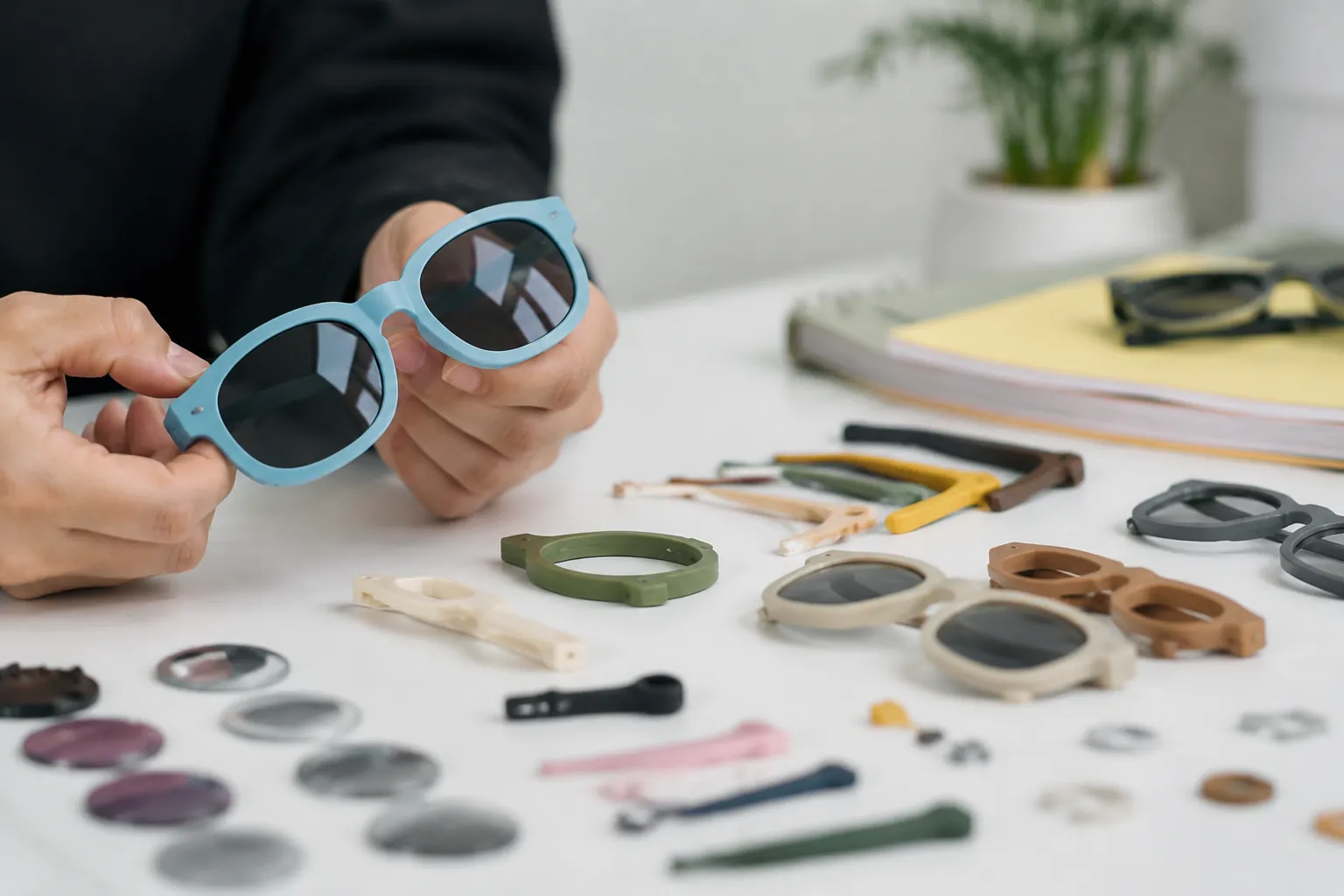
This guide is for brands, importers, distributors, and retailers buying children's sunglasses in volume. The biggest sourcing risk is rarely the quoted unit price. It is approving a product that fits badly, uses inconsistent lenses, has weak decoration, or ships without the documents and labeling required in the destination market. Use this checklist to define fit, lens performance, durability, decoration, packaging, QC criteria, and timing before you place the PO.
Start with the buyer scenario: retail line or giveaway
Kids' sunglasses programs usually follow one of two sourcing models: retail or promotional. A retail line needs cleaner finishing, stronger branding, tighter color control, retail packaging, and stricter cosmetic standards. A promotional giveaway usually puts cost, speed, and durability first. Keep it simple. Avoid upgrades the user will not value.
Before asking for prices, define four basics in writing: target age band, sales channel, target landed cost, and required compliance documents. These details affect almost every choice that follows: frame size, material, lens type, decoration, packaging, inspection standard, and production schedule. A sunglass style for ages 3 to 5 should not be an adult frame shrunk in proportion. Small faces need the right front width, shorter temples, suitable bridge contact, and enough cheek clearance.
LumiShades supports entry MOQs from 50 pairs per design. That can work for market tests, capsule launches, school programs, or regional campaigns. Still, low volume has a cost. Setup, decoration, sampling, and packaging work are spread across fewer units, so the unit price is higher. Pricing usually improves as volume increases, but the final cost depends on frame construction, lens specification, decoration, packaging, compliance needs, inspection requirements, and shipping terms. Treat any early quote as conditional until the approved sample, packaging, labeling, and document list are fixed.
- Retail brief: tighter cosmetic standard, stronger branding, shelf-ready packaging, barcode control, and more detailed QC.
- Promotional brief: simpler construction, fewer SKUs, controlled target price, and faster approval cycle.
- Age band: define 3-5, 6-8, or 9-12. Do not source against "kids" as one size group.
- Import market: confirm standards, labeling, importer information, and documentation before sampling.
Lock the fit first: age band, dimensions, tolerances
Bad fit kills repeat wear. It can also create returns and complaints. Children are unlikely to keep sunglasses on if the frame pinches, slides down the nose, touches the cheeks when they smile, or presses behind the ears. Approve fit before you spend time on final packaging or artwork variations.
Use measurements, not vague style names. For children's eyewear, the key dimensions are frame front width, lens width, bridge width, lens height, temple length, and base curve. Front width and temple length usually affect comfort first. As a starting point only, buyers often review frames for ages 3 to 5 at about 115-120 mm front width with 115-125 mm temples; ages 6 to 8 at about 122-128 mm front width with 125-130 mm temples; and ages 9 to 12 at about 128-135 mm front width with 130-135 mm temples. These are not regulatory standards. Fit test on the intended user group.
Do not approve fit from renderings or photos alone. Request physical samples. Measure them with calipers. Small dimensional changes are noticeable on kids' frames. Define tolerances on the approved specification sheet for frame front width, temple length, lens size, and logo placement. The exact tolerance should match the material, tooling, decoration method, and inspection plan agreed with the supplier.
- Frame front width: match the intended age band and face size, not a mini adult shape.
- Temple length: too short may push the front forward; too long may increase slipping.
- Bridge shape: younger children and lower nose bridges may need softer or better-supported contact.
- Lens height and cheek clearance: check clearance during smiling, talking, and head movement.
- Hinge alignment: temples should open evenly with no visible twist, uneven splay, or skew.
- End-tip pressure: pressure behind the ears can cause rejection even when the frame measures correctly.
At sample stage, request a controlled spec sheet. It should list critical dimensions, tolerances, reference photos, material, lens type, logo location, and packaging version. LumiShades has in-house injection molding, acetate cutting, CNC milling, decoration, and QC, which can reduce handoffs between development and bulk production. Buyers should still approve and retain a signed master sample.
Choose materials for use, not just appearance
Many quality problems in kids' sunglasses start with material and construction choices. Frames crack near the hinge. Temples deform in heat. Lenses scratch during packing. Printed logos wear too fast. Material selection should follow the use case, age group, retail position, and required test documentation.
| Option | Best use | Main advantages | Main trade-offs |
|---|---|---|---|
| Injected plastic frame | Promotional programs, school campaigns, value retail | Efficient for repeat production, suitable for simple colors and shapes, generally lower cost structure | Less premium hand feel than acetate; finish and branding zones depend on mold design |
| Acetate frame | Mid-tier retail collections | Richer color depth, polished finish, stronger perceived shelf value | Higher material and labor cost; usually heavier; hinge setting and edge finishing need close control |
| PC lenses | Most kids' sunglasses programs | Lightweight, common in volume eyewear, available in many tint options | Scratch resistance depends on coating, handling, and packaging protection |
| Acrylic lenses | Basic fashion programs where permitted by the buyer's specification | Low cost and good color appearance | Durability and impact behavior must be reviewed against the buyer's target use and required standards |
| TAC polarized lenses | Higher-value retail SKUs | Glare reduction and a clearer premium product story | Higher cost; lamination quality and visual consistency must be checked lot by lot |
For beach, park, and school use, an injected frame with PC lenses is often a practical starting point. For more premium kids' retail, acetate can work well. Check the finished weight, hinge setting, temple tension, and edge finish carefully. A premium material is not an upgrade if the frame feels heavy or uncomfortable.
Decoration also affects durability. Pad printing is common because it is flexible and economical, but adhesion depends on surface preparation, ink system, curing, and wear conditions. Laser engraving usually resists rubbing better because it is not a separate ink layer. Metal logo plates can improve retail appearance, but they add assembly steps. Check edge smoothness, secure attachment, corrosion resistance where relevant, and pull resistance. For younger children, avoid unnecessary small decorative parts unless the attachment method and child-safety review are documented.
Verify safety and compliance before the deposit
Children's sunglasses are consumer products. Import requirements vary by market. Paperwork problems can delay shipment even when the goods look fine. Request the exact documents required for the destination market before bulk approval. Confirm that each report, declaration, or registration applies to the actual product family, material, lens type, coating, and labeling being purchased.
Compliance references available from LumiShades include CE EN ISO 12312-1, ANSI Z80.3, AS/NZS 1067, REACH, FDA registration, ISO 9001, and BSCI. These references serve different purposes. EN ISO 12312-1, ANSI Z80.3, and AS/NZS 1067 relate to sunglass performance requirements in relevant markets. REACH relates to chemical compliance for the EU market. FDA registration is not FDA product approval. ISO 9001 relates to quality management systems. BSCI relates to social compliance auditing. Buyers remain responsible for confirming which requirements apply to their product, sales channel, and importing country.
- Confirm lens category and intended use. State whether the product is for general sun-glare reduction and define the visible light transmission range or lens category required for the market.
- Match paperwork to the destination market. EU programs may require CE documentation supported by EN ISO 12312-1 testing; US programs may reference ANSI Z80.3; Australia and New Zealand programs may reference AS/NZS 1067.
- Check chemical compliance needs. If REACH is required, confirm which materials, coatings, inks, and trims are covered by the documentation.
- Review labeling and packaging marks. Warning text, lens category, barcode, country of origin, importer details, age grading where used, and carton marks are frequent failure points.
- Inspect child-safety details. Check for sharp edges, loose trims, weak logo plates, exposed metal burrs, poorly fixed decorative parts, and unstable hinges.
Do this before the deposit where possible. If lens category, labeling language, barcode data, or importer information changes after production starts, packaging, inspection, and ship date may all be affected. Labeling control is part of product quality control.
Specify the lens. Do not leave it vague.
Many buyers spend more time on frame color than lens performance. That is a mistake. The lens is the functional part of the product, and inconsistency is easy for customers to notice. Common bulk issues include color drift between lots, uneven mirror appearance, inconsistent polarized lens appearance, surface scratches, edge chips, bubbles, coating marks, and poor cleaning before packing.
At development stage, specify lens material, tint color, visible light transmission range, lens category where applicable, UV protection requirement, polarization requirement if any, and cosmetic acceptance criteria. If you want mirror, gradient, flash, or other decorative effects, define the approved sample and allowed variation. Decorative lens treatments can increase rejection risk and may require longer approval and replenishment time.
LumiShades has in-house lens tinting, which can support better process control than a fully outsourced tinting process. Buyers should still request a retained sealed approval sample and define the QC comparison method. A practical approach is inspection under daylight-equivalent lighting against the approved master, with written pass/fail notes for color drift, scratches, bubbles, edge chips, coating marks, and obvious distortion.
Practical buying rule: For price-sensitive programs and younger age groups, choose a stable solid tint before choosing a decorative lens effect. Solid smoke, brown, or other approved neutral tints are usually easier to control in repeat production than mirror or gradient effects.
For polarized programs, ask how the factory verifies polarization and checks lamination-related visual defects. For mirrored or gradient programs, ask the supplier to define what variation is commercially acceptable and how it will be inspected. Agree on this before PO approval. Not after mixed cartons have already been produced.
Control cost, MOQ, and lead time with a fixed spec
The quoted unit price is only one part of landed cost. Kids' sunglasses programs often exceed budget because of extra sample rounds, revised packaging, changed decoration, updated labeling, or unclear compliance documents. Ask the supplier to break the quote into frame construction, lens specification, branding method, packaging, testing or documentation costs where applicable, inspection requirements, and freight assumptions.
| Program size | Typical MOQ logic | Commercial effect | Typical timing |
|---|---|---|---|
| 50 pairs per design | Entry MOQ for validation | Highest unit cost; useful for small retail tests, seeding, internal review, or regional promotion | Confirm sample approval path before committing |
| 300 pairs | Early volume break | Better absorption of setup, decoration, and packaging cost than very small runs | Bulk commonly planned after final sample and artwork approval |
| 1,000 pairs | Core retail or distributor order | More efficient material planning and production scheduling | Bulk timing depends on approved specification, packaging, and document readiness |
| 5,000+ pairs | Chain-store, distributor, or campaign volume | Best unit economics when specification is stable and SKUs are controlled | Requires frozen PO, packaging, labeling, and inspection plan to avoid delay |
For LumiShades, straightforward samples are typically planned at 7-10 days. Bulk production is typically planned at 25-35 days after final sample approval and order confirmation. Confirm these timelines on the quotation. New tooling, acetate development, complex packaging, metal logo parts, multiple colorways, special inspection requirements, or additional compliance review can extend the schedule. If artwork, lens color, warning text, barcode, carton marks, or insert cards change after approval, part of the process may need to restart.
Decoration choice also changes cost and timing. Pad print is usually economical for low to medium volumes, but adhesion must be checked. Laser engraving may reduce wear-related complaints, but it must be validated on the selected material and color. Metal logo plates add component cost, assembly time, and inspection steps. Packaging can also move the total cost. A polybag and hangtag is materially different from a printed box, pouch, barcode sticker, insert card, and retailer-specific carton labeling. Real savings usually come from a stable specification and fewer late changes, not from squeezing a small unit-price reduction while revising the product repeatedly.
Use a documented workflow before you issue the PO
Strong buyers use sampling to remove risk. They do not use it to collect endless options. Too many variants slow decisions and create confusion about which sample was approved. Keep the workflow disciplined. Put approvals in writing.
- Briefing: send target age band, retail or promo channel, target dimensions, material preference, lens color, branding method, packaging plan, destination market, compliance document needs, and target ship date.
- Sample build: review one or two controlled variants. Measure actual dimensions and compare them with the intended age group and user fit.
- Spec freeze: lock dimensions, tolerance, color standard, logo position, lens specification, packaging, carton marks, barcode data, warning text, and document list in one signed file.
- Pre-production confirmation: request a final confirmation sample when decoration, lens treatment, packaging, or labeling is new or retailer-specific.
- Bulk production: use in-process checks for molding, lens matching, hinge setting, temple alignment, print adhesion, assembly cleanliness, and packing ratio.
- Final QC: inspect appearance, hinge function, lens cosmetic quality, logo durability, labeling, carton marks, barcode accuracy, assortment count, and packing condition before balance payment and shipment.
Before releasing the deposit, confirm the following in writing:
- Approved sample with date, version code, and photo reference
- Full dimensions and tolerance notes
- Frame material specification and lens material specification
- Lens tint, visible light transmission range or lens category, UV requirement, and polarization requirement if applicable
- Decoration method: pad print, laser engraving, metal logo plate, or another approved method
- Packaging details including barcode, warning text, insert card, country of origin, importer information where required, and carton marks
- Compliance document list required for the destination market
- AQL or final inspection standard if your company or retailer requires one
- Production lead time counted from final approval and order confirmation, not inquiry date
- Shipment plan, incoterm, split-shipment rules, and responsibility for export/import documents
LumiShades' in-house injection molding, acetate cutting, CNC milling, decoration, and QC can reduce outside handoffs. Buyers still need approval discipline. If dimensions, packaging text, barcode data, importer information, or labeling are late, the production schedule may move even if the factory is ready.
Have a custom sunglasses project in mind?
Send us your styles, target market and quantities and we will return a detailed quote with MOQ, lead time and a sample plan.
Get a QuoteWhy source this from Wenzhou with LumiShades
Wenzhou in Zhejiang Province is widely regarded as China’s eyewear manufacturing capital, producing a large share of the world’s sunglasses. That concentration matters to buyers: a deep local supply chain for acetate sheet, hinges, lens blanks, plating and packaging means shorter component lead times, easier color and material matching, and a workforce with decades of eyewear-specific skill. LumiShades has manufactured in this ecosystem since 2009, and our vertical integration — in-house injection molding, acetate cutting, CNC milling, lens tinting, decoration and quality control — means no part of your order is quietly subcontracted to a workshop you cannot audit.
For international buyers, that vertical control translates into accountability. When a single factory owns every step, defects are traced and fixed at source rather than bounced between vendors, and your specifications survive intact from first sample to bulk. We back this with 15+ years of experience, shipments to 60+ countries, more than 5 million pairs produced per year and a 98.5% on-time delivery rate. Our certifications — CE EN ISO 12312-1, FDA registration, ANSI Z80.3, AS/NZS 1067, REACH, ISO 9001 and BSCI audit — mean the compliance documentation your market requires already exists. Explore our manufacturing capabilities and quality control process to see how this works in practice.
Frequently asked questions
What is a sensible MOQ for testing a new kids' sunglasses design? For an initial market test, 50 pairs per design can work if you need fast feedback and accept a higher unit cost. Use that quantity for fit checks, retail feedback, influencer or school-program testing, or internal buyer review. If the design is already approved, ask for price breaks at 300, 1,000, and 5,000+ pairs so you can compare unit cost against setup, decoration, packaging, and freight assumptions.
How long should I allow for samples and bulk production? For LumiShades, straightforward samples are typically planned at 7-10 days, and bulk production is typically planned at 25-35 days after final sample approval and order confirmation. Build extra time into your calendar for new tooling, acetate frames, metal logo plates, custom packaging, multiple colorways, retailer labeling review, or additional compliance documents. Count lead time from final approval, not from the first inquiry.
Which compliance references matter most for children's sunglasses? The answer depends on the destination market. EU programs commonly require CE documentation supported by EN ISO 12312-1 testing and may also require REACH-related chemical compliance. US programs may reference ANSI Z80.3 and may require FDA registration-related supplier information where applicable; FDA registration is not FDA product approval. Australia and New Zealand programs may reference AS/NZS 1067. Always ask whether the report or declaration covers the exact frame material, lens type, coating, and product family you are buying.
Is acetate a good choice for kids' sunglasses? Yes, acetate can be a good choice for mid-tier retail when you want richer color, a polished finish, and a more premium shelf appearance. Before approving it, check finished weight, hinge setting, temple tension, edge smoothness, and comfort on the target age group. For younger children, promotional programs, or rough-use environments, an injected plastic frame with suitable PC lenses may be more practical.
What decoration method lasts longest on kids' frames? Laser engraving generally resists rubbing better than pad printing because it is not a separate ink layer on the surface. Pad printing remains common and economical, but buyers should request adhesion checks and confirm curing on the actual frame material. Metal logo plates can look premium but must be checked for secure attachment, smooth edges, and suitability for the intended age group.
Ready to start?
Explore our aviator sunglasses or request a quote — our sales team replies within 12 hours.
Request a Quote