
OEM Sunglasses Tooling: Cost, Rights, Lead Time
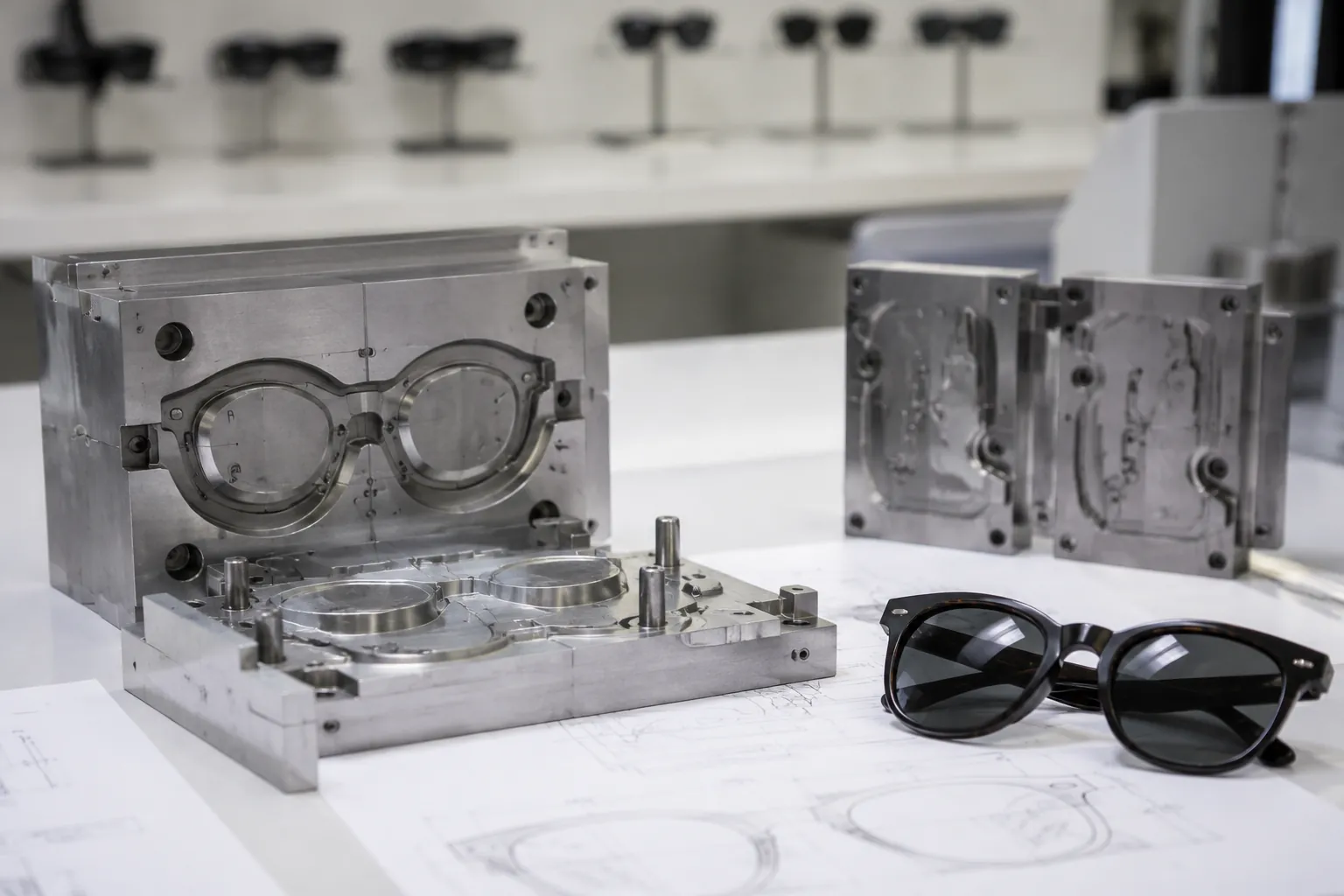
This guide is for brand owners, importers, distributors, and retail buyers sourcing custom sunglasses at volume. It explains when new tooling makes commercial sense, what to lock down in a tooling agreement, and how tooling decisions affect exclusivity, unit cost, development timing, and future reorders. If you are unsure whether to adapt an existing frame or pay for a new tool, start here.
First decide: stock platform, modification, or new tool?
Most buyers jump straight to mold cost. Wrong starting point. First decide whether the target frame can be built from an existing platform or whether the geometry really requires a new tool.
For OEM sunglasses, there are usually three routes:
- Stock platform + decoration: an existing frame with changes to lens tint, logo, printing, packaging, barcode label, or surface finish. This is usually the fastest and least complex option.
- Platform modification: keep the basic front and temple architecture, but change details such as temple profile, wire core shape, logo plate recess, bridge width, end-tip contour, or other secondary features that the factory can alter without building a fully new tool set.
- Full new tooling: a new front curve, lens opening, hinge position, temple section, wrap angle, and fit architecture built from fresh CAD and new production tooling or dedicated machining fixtures.
Base the decision on geometry, repeatability, and reorder plans. Not just looks. Changes such as lens tint, logo placement, or a switch from gloss to matte usually do not justify new tooling. But if the design needs a different front width, bridge fit, wrap profile, lens seating geometry, hinge position, or temple structure than existing platforms can support, forcing those requirements onto a stock frame often creates fit and quality problems.
A simple rule helps: pay for tooling only when shape, fit, brand distinctiveness, or long-term reorder control matter enough to justify a dedicated production reference.
When new tooling actually pays off
A new sunglass mold is not a design trophy. It is a capital decision. The return usually comes from one or more of four things: better fit, stronger exclusivity, better repeatability, or more efficient production at stable volume.
- Fit and lens retention: if the required eye size, base curve, groove depth, bridge geometry, or wrap falls outside the safe range of an existing tool, forcing it can lead to lens stress, weak retention, misalignment, or poor face fit.
- Exclusivity: if the silhouette is central to the brand, a dedicated tool reduces the chance that the same frame shape is sold to another buyer with only cosmetic changes.
- Reorder stability: a proper tool gives a fixed reference for future production instead of relying on hand-modified adjustments that are hard to reproduce consistently.
- Production efficiency: once a program is technically stable and reorder volume is real, the right tool can reduce rework, adjustment time, and yield loss compared with a compromised stock platform.
Process matters here. Injection sunglasses often use materials such as polycarbonate or TR90-type polymers and need design allowance for shrinkage, draft angle, and mold release. Acetate programs are different. The frame is cut and milled from sheet, then tumbled, hand-polished, assembled, and adjusted. In acetate, "tooling" may mean CNC programs, cutting dies, drilling jigs, polishing fixtures, and control gauges rather than a single steel mold.
So ask exactly what you are paying for. "New tooling" is too vague. A supplier should be able to say whether the charge covers steel mold fabrication, CNC programming, fixtures, trial corrections, approval samples, and master gauges.
What tooling changes in cost, lead time, and control
Tooling affects more than the upfront fee. It changes development risk, approval timing, and who controls future production. Use the comparison below before approving development.
| Option | Typical upfront cost | Sample lead time | Bulk lead time impact | Exclusivity | Reorder control |
|---|---|---|---|---|---|
| Existing mold + decoration | None to low | Usually shortest | Usually minimal if materials are standard | Low | Moderate if SKU, color, lens spec, and decoration specs are documented |
| Existing mold + structural modification | Low to medium | Longer than standard sampling because revisions may be needed | Can add checking and correction time | Medium | Good if modified features are frozen in drawings and signed samples |
| New injection mold | Highest | Longest because of tool build, trial shots, and corrections | Adds development time up front, then can improve repeatability | High if ownership and exclusivity terms are explicit | Strong if mold ID, storage, access rights, and approval sample are defined |
| New acetate program and fixtures | Medium to high | Depends on CNC setup and finishing complexity | Depends on hand-finishing capacity and process stability | High if shape and process are unique | Strong if CAD, fixtures, polishing standard, and process sheet are controlled |
The hidden cost is correction time. First shots from a new injection mold may need steel adjustment because lens seating is too tight, front warp is outside tolerance, or hinge pockets are off position. In acetate, an early run may show polishing loss that changes edge thickness or lens groove consistency. This is normal. It still costs time.
Factories with in-house injection molding, acetate cutting, CNC milling, lens processing, logo application, assembly, and QC can usually coordinate these steps more directly because fewer handoffs are external. That does not make tooling cheap. It can, however, reduce communication loss between separate vendors.
Write ownership terms. Never assume them.
This is where many buyers get burned. Paying a tooling fee does not automatically mean you own the mold, own the CAD, have exclusive production rights, or can move the tool to another factory.
Your tooling agreement should answer five points clearly:
- What is owned: define whether ownership includes the physical mold, CAD files, CNC programs, EDM electrodes, cutting fixtures, gauges, logo dies, and approved master samples.
- What exclusivity means: specify whether exclusivity applies worldwide, by territory, by sales channel, or only to the exact frame geometry produced from that tool.
- Where the tool is stored: identify the factory address, tool number, cavity count if relevant, and the party responsible for storage and protection.
- What happens if the relationship ends: state whether the tool can be transferred, what notice is required, and who pays packing, shipping, insurance, and any requalification work at the next factory.
- Who pays maintenance: define responsibility for routine cleaning, wear repair, refurbishment, and replacement at end of life.
If a supplier says "the mold is yours" but will not grant transfer rights or release supporting technical data, that is not full practical ownership. It is restricted access.
Also define reorder authorization. Name the legal entity or entities allowed to place orders against that tool. This matters if you operate through multiple importers, regional offices, agents, or distributors and want to prevent unauthorized runs.
For injection tooling, ask for a mold ID and cavity count. For acetate programs, ask for the CAD revision, fixture list, drilling standard, and polishing reference. Without those controls, "ownership" is hard to enforce in practice.
How tooling affects unit price, MOQ, and real process economics
Many buyers expect a new mold to lower price right away. Usually it does not. The first order often carries a higher effective cost per pair because of the tooling charge, trial work, and approval cycle. If there is payback, it comes later through process stability, lower rework, and better leverage on repeat volume.
Review pricing against expected volume. If annual demand is unclear, or the style may run only once, stock tooling plus custom decoration is often the safer choice. If the style is likely to repeat and the geometry cannot be achieved cleanly on available platforms, dedicated tooling may be easier to justify.
False economy is common. A modified stock design can look cheaper on a quotation but still require extra labor such as:
- hand grinding around the lens groove to fit a non-standard lens cut
- reworking hinge seats to correct temple closing angle
- manual trimming of metal logo plate recesses
- extra polishing to hide mismatch around modified surfaces
That labor may not show clearly on the quote. It shows up later in lower yield, slower throughput, or wider quality variation.
Ask for a cost split instead of one bundled number. You want to see:
- tooling fee or program development fee
- sample fee and revision fee, if any
- unit price by quantity break
- packaging cost
- extra charges for polarized lenses, mirror coating, metal logos, laser engraving, rubber coating, or special tinting
If everything is lumped together, it is hard to judge whether the tooling investment makes commercial sense.
Lead time: where new-tool projects slip
Standard sample development can move quickly when a supplier works from an existing platform. New tooling changes the schedule because development becomes the critical path.
A typical new-tool program runs through these stages:
- Design freeze: approved 2D drawing or 3D file with front width, lens width, bridge, temple length, wrap target, hinge type, material, and decoration positions.
- Tooling or fixture build: injection mold making or acetate program setup.
- Trial samples: first shots or first machined pieces checked for shrinkage, lens fit, hinge alignment, opening angle, and surface quality.
- Correction round: steel adjustment, CNC revision, polishing change, or fixture reset.
- PP sample approval: pre-production sample signed off before bulk.
- Bulk production: molding or cutting, lens processing, decoration, assembly, final QC, and packing.
Most delays are predictable. Artwork arrives late. Logo hardware dimensions are not final. Lens specifications change after sample approval. Fit comments stay subjective instead of being translated into measurable revisions. Another common problem is leaving compliance review until after design freeze.
For sunglasses sold in regulated markets, confirm early that the final construction can meet the applicable standard for the target market, such as CE EN ISO 12312-1, ANSI Z80.3, or AS/NZS 1067 where relevant. Materials may also need to align with REACH or similar chemical requirements depending on destination market. FDA registration may matter for importer documentation in the United States, but it does not replace product performance testing for sunglasses.
If supplier qualification matters to your sourcing policy, verify broader management or social compliance documents separately, such as ISO 9001 for quality management or BSCI for social audit status. Those do not prove product compliance, but they may still matter for supplier approval.
The documents and tolerances that protect reorders
If you want stable reorders, a mold alone is not enough. Consistency comes from technical documentation and a factory that can run to it and inspect against it.
A solid eyewear technical file should include:
- Approved drawing: front width, lens width, bridge, temple length, base curve target, hinge position, and critical tolerances.
- Material callout: resin grade or acetate sheet specification, lens material, hinge type, wire core if relevant, and logo plate material.
- Color standard: Pantone where applicable, acetate chip, lens tint reference, and finish level such as gloss, matte, or rubberized.
- Decoration spec: pad print position, laser engraving depth, hot-stamp foil color, metal logo plate size, and any adhesion or abrasion requirement.
- QC checkpoints: lens insertion fit, temple opening force, alignment, cosmetic defect limits, print durability, and carton labeling.
- Compliance file: reports tied to the approved construction, not to a vaguely similar sample.
Critical tolerances should be numeric, not verbal. The exact values depend on material, process, and design complexity, so they should be defined by the approved drawing and manufacturing method rather than guessed from generic benchmarks. If the supplier cannot state measurable tolerance limits and inspection methods, reorder consistency will be hard to control.
Decoration method also affects durability and cost. Pad printing is common and economical but needs a clear durability standard. Laser engraving is more permanent but depends on material contrast. Metal logo plates require controlled recess depth and adhesive application. Lens printing can add visual value, but it should be reviewed against intended use and the target market's rules.
One practical step: require both a golden sample and an archive sample from the approved run. Label them with tool number, color code, lens specification, approval date, and buyer PO. Future reorders should be checked against that physical reference, not just photos buried in email threads.
A simple framework before you approve tooling
Use this checklist before sending a deposit:
- Estimate annual volume honestly. If the design is still a market test, avoid new tooling unless shape exclusivity is commercially essential.
- Define what is truly unique. If only color, logo, and packaging differ, stay on an existing platform.
- Check technical fit. If the target lens size, bridge shape, wrap, or temple geometry cannot be achieved cleanly on stock tooling, move to new tooling.
- Ask for two quotations. One based on the closest existing mold, one based on new tooling. Compare not just price, but correction risk, lead time, and reorder stability.
- Write ownership terms before payment. Tool ID, exclusivity, storage, transfer rights, and maintenance must be explicit.
- Approve from a spec sheet, not a promise. Tie production to a controlled drawing, an approved PP sample, and a golden sample.
The bottom line is simple. Tooling makes sense when it gives you a shape you cannot get another way, protects a style you expect to reorder, and reduces future production friction. If it does not clearly do those things, adapting an existing platform is usually the lower-risk choice.
Have a custom sunglasses project in mind?
Send us your styles, target market and quantities and we will return a detailed quote with MOQ, lead time and a sample plan.
Get a QuoteWhy source this from Wenzhou with LumiShades
Wenzhou in Zhejiang Province is widely regarded as China’s eyewear manufacturing capital, producing a large share of the world’s sunglasses. That concentration matters to buyers: a deep local supply chain for acetate sheet, hinges, lens blanks, plating and packaging means shorter component lead times, easier color and material matching, and a workforce with decades of eyewear-specific skill. LumiShades has manufactured in this ecosystem since 2009, and our vertical integration — in-house injection molding, acetate cutting, CNC milling, lens tinting, decoration and quality control — means no part of your order is quietly subcontracted to a workshop you cannot audit.
For international buyers, that vertical control translates into accountability. When a single factory owns every step, defects are traced and fixed at source rather than bounced between vendors, and your specifications survive intact from first sample to bulk. We back this with 15+ years of experience, shipments to 60+ countries, more than 5 million pairs produced per year and a 98.5% on-time delivery rate. Our certifications — CE EN ISO 12312-1, FDA registration, ANSI Z80.3, AS/NZS 1067, REACH, ISO 9001 and BSCI audit — mean the compliance documentation your market requires already exists. Explore our manufacturing capabilities and quality control process to see how this works in practice.
Frequently asked questions
If I pay a mold fee, can the factory legally use the same design for another buyer? It depends on the written agreement. A tooling payment by itself does not automatically grant exclusivity. To protect the design, your contract or purchase agreement should state: 1) what is exclusive—the physical tool, the CAD geometry, or the commercial shape; 2) where the exclusivity applies—worldwide, by market, or by channel; and 3) whether the supplier is prohibited from selling identical or substantially similar frames to others. If exclusivity matters, do not rely on email language such as "for your use only." Put the restriction in the tooling agreement and reference the approved drawings or sample code.
Can I move my sunglass mold to another factory later? Only if transfer rights are clearly documented. Before paying, require written terms covering: ownership of the physical tool, ownership of CAD and related fixtures, storage location, release conditions, notice period, packing method, shipping responsibility, and who pays for any repair or requalification after transfer. Ask the supplier to identify the tool number and keep that number on invoices and approvals. In practice, a tool is much easier to move when the technical file, gauges, drawings, and approved samples are also under documented buyer control.
What is the safer choice for a first order of 100 to 300 pairs? Usually an existing mold with custom lens color, logo, and packaging. At that volume, it is often hard to justify new tooling unless the shape is central to the brand or existing platforms cannot meet the required fit and geometry. A practical approach is to test demand on an existing platform first, then invest in dedicated tooling only after the product shows repeat-order potential. Ask the supplier to show the closest available platform and identify which features are cosmetic changes versus structural changes.
What should I approve before bulk production starts on a new tool? Approve more than appearance. At minimum, sign off on: 1) the final drawing or CAD revision; 2) material specifications for frame, lens, and hardware; 3) color and finish standards; 4) decoration layout and method; 5) key QC checkpoints and tolerances; 6) the PP sample; and 7) the compliance requirement for the target market, such as CE EN ISO 12312-1, ANSI Z80.3, or AS/NZS 1067 where relevant. Keep a labeled golden sample and archive sample tied to the approved tool number, PO, and date so future reorders can be checked against a controlled reference.
Do compliance documents transfer automatically if I change lens color or frame material? No. A change in lens tint, luminous transmittance, lens material, frame material, construction, or even some fit-related features can affect the validity of prior test results. Before shipping a revised version, confirm with the supplier or test lab whether the change requires new testing or an updated report. Make sure the compliance file matches the actual approved build, not a similar sample from an earlier project. For regulated markets, keep the test report, material declarations where needed, and product specification in the same project file so your importer or compliance team can verify them together.
Ready to start?
Explore our round sunglasses or request a quote — our sales team replies within 12 hours.
Request a Quote