
ODM vs OEM Sunglasses: Cost, Speed, Control
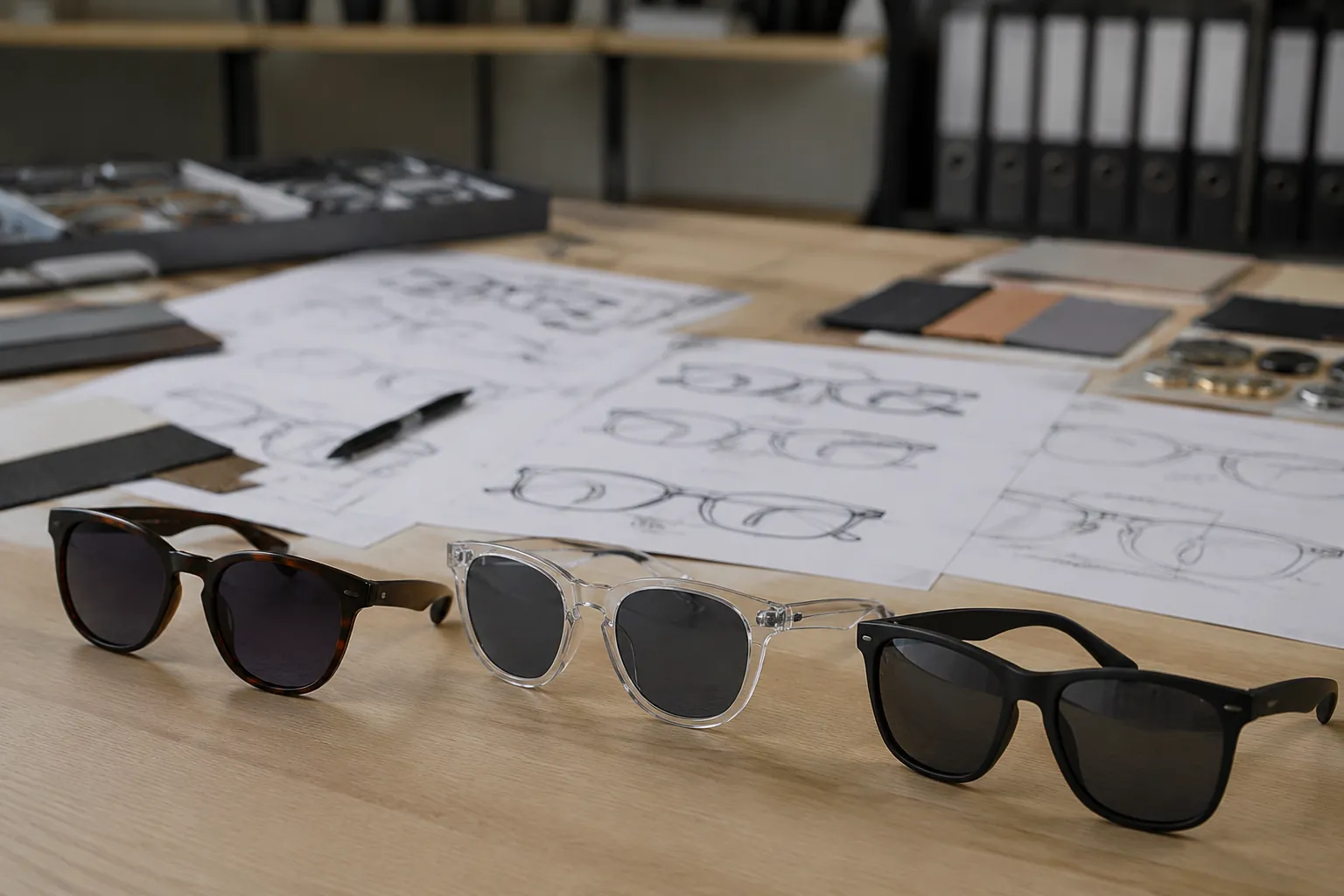
This guide is for brand owners, importers, distributors, and retail buyers choosing between existing factory sunglass designs and custom frame development. The wrong choice often looks fine at sample stage. The damage appears later: missed launch dates, weak realized margin, thin compliance files, or reorders that drift in fit, tint, finish, or logo placement. The decision is not just ODM versus OEM. It is a trade-off between speed, development spend, exclusivity, process control, and how tightly the final product is specified before production starts.
Start with the constraint that matters most
Many buyers start with unit price. That is too narrow. Ask a harder question first: what can this program not compromise on?
The answer may be launch date, landed margin, style exclusivity, fit consistency, documentation readiness, or reorder stability. ODM and OEM solve different problems.
ODM means starting from a factory-developed frame. The mold, base geometry, assembly route, and much of the production process already exist. The buyer usually customizes visible commercial elements: frame color, lens tint, logo application, packaging, barcode labels, swing tags, and sometimes small fit or decoration details.
OEM means developing a frame from the buyer's drawing, tech pack, CAD file, reference sample, or design brief. This gives stronger control over front shape, bridge width, endpiece form, hinge construction, temple profile, metal trims, logo recesses, and signature details. The cost is simple: more development work, more approval points, and possible tooling, fixture, or programming costs.
ODM is usually the lower-risk choice when the launch window is close and the buyer can accept an existing frame architecture. OEM is better when the line depends on a distinctive silhouette, proprietary hardware, or repeatable fit standards across seasons.
Here is a useful signal. If your brief includes lens width, bridge width, front wrap angle, base curve, hinge torque, logo recess depth, or tolerance limits, you are no longer buying basic private label. You are asking for OEM-level control.
ODM and OEM compared: speed, economics, and control
| Factor | ODM | OEM |
|---|---|---|
| Starting point | Existing factory frame design and established process route | Buyer concept, CAD file, drawing, tech pack, or reference sample |
| First sample timing | Usually faster because the base frame already exists; timing depends on color, lens, logo, and packaging requirements | Usually longer because structure, fit, tooling, components, and sample corrections may need review |
| Bulk lead time | Generally shorter once artwork, materials, lens specification, packaging, and compliance scope are approved | Generally longer if new molds, custom hardware, special lenses, or multiple sample rounds are required |
| Upfront cost | Lower because the frame tooling is already available | Higher when new molds, CNC programs, cutters, fixtures, logo hardware, or special components are required |
| MOQ logic | More practical for small runs when the supplier supports low minimums and SKU splits are controlled | More practical when the order volume can absorb development, tooling, and approval costs |
| Unit price trend | Often competitive at low and medium volumes because development cost is limited | Can improve at higher volumes as development and tooling are spread across more units |
| Exclusivity | Limited unless the factory contractually restricts access to the base style, colorway, or market | Higher when the frame architecture, tooling, and design files are controlled by agreement |
| Reorder control | Good if the base style remains active and the specification is documented | Strong if tooling, BOM, SOP, approved samples, and QC tolerances are locked |
There is no universal winner. ODM protects speed and cash flow. OEM protects differentiation and long-term control.
Volume changes the answer. Small orders can make sense for market testing, but they are sensitive to setup waste, decoration changes, lens tint runs, packing changeovers, and inspection time. Larger orders give the factory more room to stabilize price and process.
OEM becomes more rational when development cost can be spread across confirmed demand or likely reorders. Choosing OEM for a very small order often means paying for uniqueness before the market has proved it. Staying with basic ODM for a large repeat program may save time, but it can limit brand defensibility and pricing power.
Use this decision framework before requesting samples
A good sourcing decision can often be made before the first sample request. Be clear about volume, timing, and which points of uniqueness actually affect sell-through.
- If launch timing is fixed and near: start with ODM. Existing molds remove one major schedule risk.
- If your margin depends on a non-generic look: consider OEM or heavy ODM modification. Common shapes are easier to copy and easier for retailers to price-shop.
- If the order is small or demand is unproven: ODM is usually more rational because tooling and development costs have less volume to absorb them.
- If reorder stability matters more than first-launch speed: OEM becomes attractive once measurements, materials, process controls, and QC limits are documented.
- If the product will enter a regulated market: either model can work, but the final frame-lens configuration must be checked against the correct standard and destination-market requirements.
A blunt test: if your brief mainly covers logo, color, lens tint, and packaging, choose ODM first. If it calls out bridge width tolerance, logo placement tolerance, hinge type, metal insert dimensions, acetate bevel profile, lens base curve, or front wrap angle, you need OEM-level discipline.
For repeat business, define measurable acceptance points before sampling starts. Common examples include front width tolerance, temple length tolerance, logo alignment tolerance, lens tint range against an approved master, acceptable surface defects, and hinge opening feel within an agreed range.
Do not invent tolerances in isolation. Agree them with the supplier based on material, process, inspection method, and product positioning. Without that detail, a reorder can look close to the approved sample but still drift enough to create returns or retailer complaints.
Where the money goes: cost drivers buyers miss
Buyers often focus on frame material and miss the secondary costs that move the final quote. Those costs look different in ODM and OEM programs.
- Tooling and development: OEM may require injection molds, acetate cutting files, CNC fixtures, polishing jigs, component trials, or custom logo plates. Each custom part adds an approval point and a possible delay.
- Material loss: Acetate usually creates more waste than standard injected plastic because sheets are cut, milled, beveled, polished, and visually matched. Pattern acetate can look premium, but color and pattern distribution may vary by sheet and batch.
- Decoration method: Pad printing is common and efficient, but durability depends on surface preparation, ink system, curing, and wear conditions. Screen printing suits larger or flatter areas. Laser engraving can be more permanent on suitable materials. Stamped, screwed, or glued metal logo parts can look more premium but add component cost, assembly time, and alignment risk.
- Lens specification: Polarized lenses, mirror coatings, gradient tints, anti-scratch coatings, and specific visible light transmission categories can affect cost, scrap rate, and test scope.
- Packing and retail prep: Pouches, hard cases, microfiber cloths, barcode stickers, swing tags, polybags, carton marks, assortment labels, and retailer-specific packing instructions can materially change cost, especially on small runs.
Process control matters too. If the supplier controls injection molding, acetate cutting, CNC milling, lens processing, decoration, assembly, and final QC in-house, root causes are easier to trace. A crooked logo plate may be a fixture issue. Tint drift may come from lens batch control or coating process. Variable temple fit may be caused by polishing loss, hinge setting, or material movement.
The cheapest ex-factory price is not always the best commercial result. A faster ODM launch with fewer sample revisions may beat an OEM project with a better theoretical gross margin if the OEM shipment misses the selling window. The reverse is also true. A custom OEM frame can justify the extra work when it supports repeat orders, stronger brand identity, and less price comparison.
Where sunglass projects lose time
Most delays are not random. They come from predictable failure points, usually linked to incomplete approvals or late changes.
Failure 1: incomplete approval package. A buyer approves frame color but not lens color under agreed light conditions. Or artwork is approved without exact size and position. Production stops while people clarify what should have been fixed earlier. A complete approval package should include frame color reference, lens color reference, logo artwork file, logo size and position, material selection, packaging details, barcode and label requirements, and carton marks.
Failure 2: cosmetic changes after approval. Replacing a temple logo plate, changing hinge finish, moving a logo, or switching from a standard tinted lens to a mirrored polarized lens after pre-production can reset purchasing, testing, or assembly planning.
Failure 3: compliance assumptions. Buyers may assume a base style passed a previous test, so the new version is covered. That is risky. A change in lens material, tint, coating, frame structure, labeling, or destination market may change the test scope.
Failure 4: unrealistic SKU split. A small order divided across many frame colors, lens colors, logo methods, and packaging versions creates tiny runs for tinting, decoration, inspection, and packing. The order may still be possible. It will not be efficient.
Ask the factory for a milestone sheet that covers:
- Artwork and specification confirmation
- Sample making
- Sample approval and comment closure
- Material purchasing and incoming inspection
- Pre-production sample if required
- Mass production
- Final QC, packing, and carton verification
- Booking and shipment release
ODM timelines are usually more predictable once all comments are closed because the base frame is already industrialized. OEM timing depends on sample rounds, tooling, custom hardware, and special lens work. Ask for a written schedule tied to approval dates. Do not rely on a generic lead time quoted before specifications are complete.
Compliance is not a logo on the temple
Map the product to the destination market before ordering. Documentation terms are often used loosely. They do not mean the same thing. Product performance standards, chemical compliance, factory system certifications, and social audits are separate layers.
- CE EN ISO 12312-1: EN ISO 12312-1 is the key performance standard commonly used for sunglasses and sunglare filters in markets that apply this framework. CE marking requirements should be reviewed against the applicable European rules and the actual product category.
- ANSI Z80.3: commonly referenced for nonprescription sunglasses in the US market.
- AS/NZS 1067: relevant for sunglasses and fashion spectacles in Australia and New Zealand.
- REACH: concerns restrictions on certain chemical substances in applicable markets, including substances that may be relevant to frames, coatings, inks, and accessories.
- FDA registration: relevant to US regulatory handling for certain eyewear products, but registration or listing should not be treated as proof that a specific sunglass model meets optical, UV, labeling, or performance requirements.
- ISO 9001 and BSCI: relate to quality management systems and social compliance audits. They do not prove that a specific sunglass model passes a product performance standard.
The buying rule is simple: align testing to the final configuration. That means the actual frame material, lens material, tint, coating, decoration, labeling, packaging, and structural details intended for shipment. If you switch from a standard tinted lens to a mirrored polarized lens late in the process, confirm whether the existing report still applies or whether retesting is needed.
For importers and major retailers, lock a compliance file checklist before production begins. The file should identify the destination market, applicable standard or requirement, approved tech sheet, bill of materials, report or declaration scope, packaging warnings if applicable, traceability information, and carton labeling. Paperwork will not remove all risk. It will reduce the chance that packed goods sit waiting for missing documents.
Materials, process detail, and reorder stability
ODM versus OEM is also a materials and process choice. Different constructions behave differently across repeat production.
Injected plastic frames are usually efficient for volume and color consistency when the mold, resin, colorant, and machine settings are controlled. They suit promotional, private-label, and mid-market programs where repeatable output and cost efficiency matter.
Acetate frames often deliver a more premium look, better pattern depth, and stronger perceived value. They also need tighter visual control. Sheet pattern varies. Edge polish quality is visible. Hinge insertion affects both appearance and function. Buyers should approve an acceptable visual range, not expect every reorder to match one master sample exactly.
CNC-milled and assembled details matter in premium or signature programs. Bevel sharpness, logo recess precision, metal insert fit, hinge setting, and temple shaping are often where a brand's differentiation lives. This is where OEM tends to justify its cost.
In QC terms, define the points that must remain stable across reorders:
- Overall front width, lens width, bridge width, and temple length
- Lens tint range and visible tone under agreed viewing conditions
- Logo size, method, color, and placement tolerance
- Hinge feel, opening resistance, screw tightness, and left-right balance
- Surface standards for scratches, pits, sink marks, polish quality, sharp edges, and coating defects
- Packing method, barcode location, carton marks, assortment ratio, and retailer labeling
These details separate a clean repeat order from a frustrating one. If the buyer keeps only an approved photo and a note saying "same as last time," drift is likely. If buyer and supplier keep an approved BOM, golden sample, color reference, artwork file, SOP, and QC limit sheet, reorder reliability improves.
Best-fit buyer scenarios and a staged path
| Buyer situation | Best fit | Why |
|---|---|---|
| A retailer needs a seasonal capsule with private-label branding | ODM | Fast sampling, lower upfront cost, and practical customization of color, lens, logo, and packaging |
| An importer wants a proven shape for multiple markets with controlled packaging and documentation | ODM with strict spec sheet | Existing style reduces development risk while final-configuration testing and paperwork protect shipment release |
| A brand wants a hero style to reorder for several seasons | OEM | Custom geometry, hardware, fit, and design ownership support differentiation and long-term control |
| A distributor is testing several colors with uncertain volume | ODM first, OEM later | Market feedback should come before spending on tooling, custom components, and extended development |
For many buyers, the smartest route is staged. Launch with ODM to test shape acceptance, color demand, retail price, and channel response. If one style proves itself, convert that winner into an OEM program with tighter dimensions, upgraded hardware, stronger temple branding, or a refined silhouette.
That approach protects cash, shortens time to market, and still creates a path to exclusivity once demand supports it.
Short version: ODM buys speed. OEM buys control. The better choice is the one that matches your real commercial constraint, not the one that looks best in a sample meeting.
Have a custom sunglasses project in mind?
Send us your styles, target market and quantities and we will return a detailed quote with MOQ, lead time and a sample plan.
Get a QuoteWhy source this from Wenzhou with LumiShades
Wenzhou in Zhejiang Province is widely regarded as China’s eyewear manufacturing capital, producing a large share of the world’s sunglasses. That concentration matters to buyers: a deep local supply chain for acetate sheet, hinges, lens blanks, plating and packaging means shorter component lead times, easier color and material matching, and a workforce with decades of eyewear-specific skill. LumiShades has manufactured in this ecosystem since 2009, and our vertical integration — in-house injection molding, acetate cutting, CNC milling, lens tinting, decoration and quality control — means no part of your order is quietly subcontracted to a workshop you cannot audit.
For international buyers, that vertical control translates into accountability. When a single factory owns every step, defects are traced and fixed at source rather than bounced between vendors, and your specifications survive intact from first sample to bulk. We back this with 15+ years of experience, shipments to 60+ countries, more than 5 million pairs produced per year and a 98.5% on-time delivery rate. Our certifications — CE EN ISO 12312-1, FDA registration, ANSI Z80.3, AS/NZS 1067, REACH, ISO 9001 and BSCI audit — mean the compliance documentation your market requires already exists. Explore our manufacturing capabilities and quality control process to see how this works in practice.
Frequently asked questions
At what order size does OEM usually start making financial sense? OEM starts to make sense when expected volume or repeat demand can absorb tooling, engineering, sampling, and approval costs. Before requesting a quote, ask the supplier to separate unit price, tooling cost, sample cost, and custom component cost. Then calculate the effective cost per pair at the first order quantity and at expected reorder quantities. If the numbers only work after reorders, confirm demand before committing to OEM.
Can I make an ODM style feel more exclusive without full OEM development? Yes. Start with customer-facing changes: custom frame color, lens tint, lens coating, logo method, temple decoration, metal trim, case, pouch, cloth, retail card, barcode label, and carton presentation. Ask which changes require only sampling and which affect tooling, testing, or MOQ. Also ask whether the factory can restrict the same colorway, logo hardware, or market placement by written agreement. ODM can be commercially distinct, but it is not truly proprietary unless access is controlled by contract.
Does an old test report on a similar sunglass style cover my new order? Not automatically. Check the report scope against the final shipment configuration. Confirm the model or style reference, lens material, lens tint, coating, filter category if applicable, frame material, labeling, destination market, and standard tested. If you change the lens, coating, frame structure, decoration, or market destination, ask the test lab or supplier in writing whether the existing report still applies. Similar appearance is not documented compliance coverage.
What is the biggest cause of reorder inconsistency in sunglasses? Loose specifications. To prevent drift, keep an approved tech sheet, BOM, golden sample, lens color master, artwork file, packaging specification, and QC limit sheet. Define measurable checks for frame dimensions, lens tint, logo placement, hinge feel, surface finish, screw tightness, and packing. For each reorder, require the supplier to confirm that materials, components, and process route are unchanged, or to declare any substitution before production starts.
How should I use a low MOQ without creating production problems? Limit complexity. Keep the number of frame colors, lens colors, logo methods, and packaging versions low. Use the same lens and logo method across multiple colors where possible. Approve artwork, labels, and carton marks before sampling. Ask the factory to show the SKU breakdown by quantity so you can see whether any variant is too small for efficient tinting, printing, inspection, or packing. A low MOQ works best when the product is simple and the approval file is complete.
Ready to start?
Explore our shield & oversized sunglasses or request a quote — our sales team replies within 12 hours.
Request a Quote