
When Shared Molds Work for Private Label Sunglasses
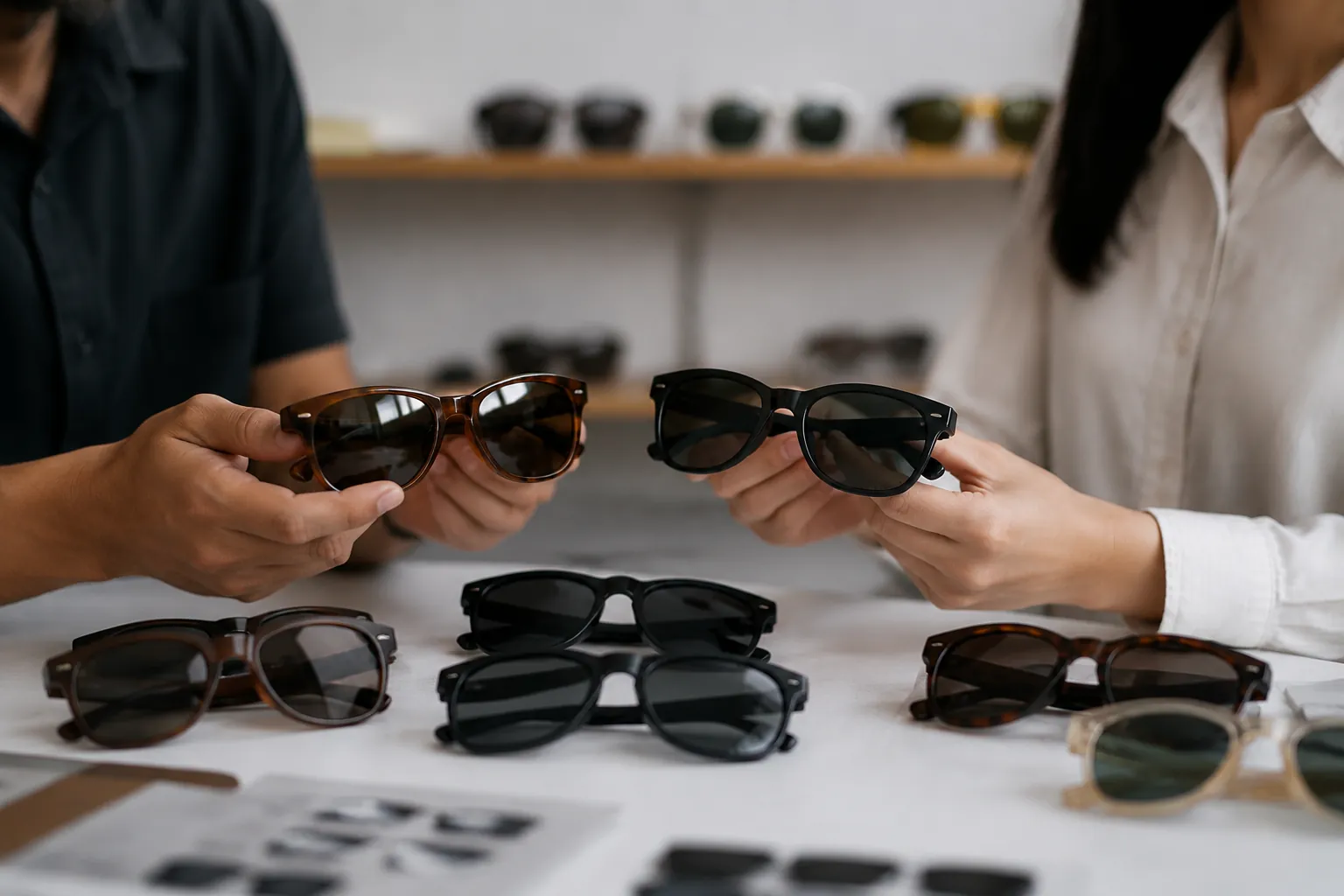
Shared molds can be a smart starting point for private label sunglasses. The frame geometry already exists, so you can spend more on the details customers notice: lens spec, color, branding, packaging, and opening stock. But shared molds are not always the right call. The real question is commercial, not aesthetic. Do you need a unique shape now, or do you need speed, lower risk, and a faster read on demand?
Use a commercial test, not a design impulse
A shared mold means the factory already has the core tooling for the frame front and temples, or an established acetate pattern and machining route for that style. You are not starting from zero. You are choosing an existing structure, then customizing the parts that can change without rebuilding the frame architecture: frame color, lens color, branding method, some trim details, and packaging.
This route usually makes sense in three cases:
- You are entering sunglasses for the first time and do not have reliable reorder history.
- You need a first shipment fast for a seasonal launch, event, retail program, or market test.
- You want broader SKU coverage with a fixed budget and would rather test several solid options than spend heavily on one new mold.
It makes less sense when your brand depends on a distinct silhouette, a protected design language, or fit geometry that an existing frame cannot match closely enough. Shared molds are efficient because the engineering work is already done. That is also the limit. The base shape is not exclusive.
For most private label buyers, the trade-off is simple: shape exclusivity versus launch efficiency. If your first-order budget is tight, putting more of it into inventory instead of tooling often gives better market feedback. Shared molds work best when the goal is to test demand with lower exposure. Not when the goal is to own a proprietary shape from day one.
What shared molds save on cost, time, and first-order risk
Tooling is one of the biggest cost variables in a first custom frame program. A fully custom frame can make sense, but usually only when repeat volume is likely to absorb the upfront development cost. With a shared mold program, that cost is often removed or reduced to setup charges for branding, packaging, or minor trim changes. That moves the buyer faster into sample approval and production planning.
| Route | Typical upfront cost | Sample lead time | First bulk lead time | Typical MOQ logic | Best fit |
|---|---|---|---|---|---|
| Shared mold, stock structure | Usually limited to sample or setup charges | Often shorter than full custom | Often shorter than full custom | Factory-dependent; often lower than full custom | Fast launch, lower-risk testing |
| Shared mold with custom logo, lens, packaging | Low to moderate, depending on branding and packaging setup | Usually longer than stock sample, shorter than full custom | Depends on lens and packaging complexity | Often manageable for private label entry programs | Private label ranges needing visible brand identity |
| Shared acetate platform with upgraded finishing | Low to moderate, depending on trims and finishing steps | Can be longer than injection due to finishing work | Can be longer than basic shared injection styles | May require higher MOQ than simple stock programs | Mid-market or premium presentation without new tooling |
| Fully custom mold | Higher upfront development cost | Longer development cycle | Longer first order timeline | MOQ depends on tool, material, and factory process | Signature shapes, protected design, fit-specific programs |
The savings are not just financial. They are operational too. An established frame platform cuts down the unknowns in fit, assembly, and production routing. If the supplier controls molding or machining, lens fitting, decoration, assembly, and QC under one system, a shared mold project usually has fewer handoff risks than a new design.
MOQ still depends on the factory, material, lens type, decoration method, and packaging. Ask for MOQ by SKU, not just MOQ by order. That matters. A program can look flexible at model level, then tighten up fast if each lens color, logo process, or packaging format has its own minimum. Shared molds are most useful when they let you test with controlled exposure and a specification that can actually be repeated at scale.
Where you can still differentiate the product
Shared mold does not have to mean generic product. The silhouette may be shared. The customer-facing result does not have to be.
The strongest differentiation points are usually the ones the retailer or end customer sees first:
- Frame color and finish: solid colors are usually the easiest to control. Crystal effects, translucent tones, matte finishes, layered acetate looks, or rubberized coatings can create more distinction, but they also add process sensitivity.
- Lens program: standard tinted, gradient, mirrored, and polarized lenses can shift both appearance and market position. Any lens change should be checked against the relevant compliance file for the target market.
- Logo application: pad printing, laser engraving, hot foil where suitable, and metal logo plates all bring different cost, durability, and QC requirements. The right method depends on material, available placement area, and target price point.
- Hinge specification: some constructions allow a choice between basic hinge options and spring hinge modules. Others do not, because wall thickness, screw position, or temple structure is already fixed.
- Packaging: a microfiber pouch, folding case, rigid case, insert card, barcode label set, and retail carton marks can reposition the same frame for e-commerce, gifting, mass retail, or department-store use.
Process detail matters. For logo decoration, ask for an approved artwork file, a marked placement position, and confirmation of the application method on the actual material. For metal logo plates, confirm the fixing method and inspect whether the plate sits cleanly without rough edges. For mirrored lenses, approve the appearance under consistent lighting and keep a retained sample. Color perception can shift by batch and by lighting. Small issue. Big argument later.
Acetate and injection frames also differentiate in different ways. On acetate, focus on color depth, polish quality, bevel consistency, and temple alignment. On injection styles, surface uniformity, flash control, sink marks, and logo accuracy often matter more than buyers expect.
Know the geometry and material limits before approval
This is where buyers make expensive assumptions. Shared molds save time because the geometry already exists, but some dimensions and structural choices are effectively fixed.
- Front curve and lens base may be fixed or adjustable only within a narrow range.
- Bridge shape and overall fit are limited by the existing front architecture.
- Temple thickness affects whether a spring hinge or metal logo plate can be added safely.
- Lens edge profile is tied to the rim or groove structure.
- Weight balance is influenced by the original design and material route.
Before approving a sample, ask for the actual frame specification sheet: eye size, bridge, temple length, front width, material, hinge type, and sample weight. If available, ask for lens base and any relevant fitting notes. Then compare those measurements to a frame that already sells well in your market. Do not judge by appearance alone.
Material behavior also needs to be understood in practical terms. Injection-molded polycarbonate can be efficient and lightweight, but the feel and finishing result differ from acetate. TR90-type constructions are often chosen for flexibility and comfort, especially in sport-led styles, but surface effect and color presentation differ from acetate. Acetate usually gives richer visual depth and stronger shelf presence, but it also involves more manual and machining steps. That can increase cost and process variation if the supplier lacks control.
Do not assume tolerances. Ask what the factory can hold in normal production and how those tolerances will be documented on approval. Also confirm how hinge tension, screw security, and final alignment are checked in bulk. A good-looking sample is not enough.
Compliance and documents still depend on the exact SKU
A common sourcing mistake is assuming an existing frame shape automatically carries compliance for every market. It does not. The frame may be established, but your exact SKU depends on the final lens, coating, material, and labeling configuration.
For sunglasses, buyers should align the product file with the destination market and the exact construction being ordered. Common references include CE EN ISO 12312-1 for Europe, ANSI Z80.3 for the U.S. market, AS/NZS 1067 for Australia and New Zealand, and REACH for relevant EU chemical compliance obligations. FDA registration may matter in a U.S. importer or facility documentation context, but it is not the same as proving sunglass performance compliance.
The operating rule is simple: if you change the lens from a stock tinted lens to mirrored, gradient, or polarized, ask whether the existing reports still apply to that exact lens specification. If you change coating, paint, soft-touch finish, adhesive, or any skin-contact material, confirm whether supporting documents need to be updated.
Buyers should also confirm labeling and traceability details early:
- Lens category marking where required
- Country-of-origin marking if required for the destination market
- Inner carton and outer carton barcode format
- Model number and color code logic
- Batch or date traceability for claims handling and recall support
If the supplier claims compliance capability, ask for document control too. That means current test reports relevant to the ordered SKU, a clear link between report and product specification, and a working quality-management framework. ISO 9001 and social-compliance frameworks such as BSCI can be useful signs of system maturity, but they do not replace product-specific compliance evidence.
Build a disciplined first-order SKU plan
Many first-time private label buyers launch too many weak options. A tighter plan usually gives better sales data and cleaner inventory control.
A practical first shared-mold order looks like this:
- Choose 2 frame shapes, not 6.
- Build 3 strong colorways per shape: one core option, one commercial trend option, and one directional test.
- Keep the lens program tight: for example, one standard dark tint, one gradient, and one polarized option if the channel supports it.
- Use one branding method across the range unless there is a clear reason to split.
- Standardize packaging so packing, storage, and replenishment stay simple.
This approach gives you usable readouts on shape, color, and lens preference without adding unnecessary complexity in purchasing and replenishment. If one colorway or one shape performs clearly better, the reorder gets easier because you are concentrating volume into proven combinations instead of guessing across too many SKUs.
The logic is plain. If you do not yet know what will reorder, a fully custom development program may be early. Shared molds work best when they help you learn fast, compare a small number of controlled variables, and invest in custom tooling only after demand is proven.
How the factory process should run if bulk must match the sample
A good shared-mold program still needs discipline. Faster development should not mean looser control.
- Model selection: the buyer reviews the factory library and narrows options by shape, target price level, material, and fit objective.
- Specification lock: one document should confirm frame color, lens type, branding method, hinge, mandatory markings, barcode, packaging, and carton information.
- Sample build: the sample should be made as close as possible to the intended production specification, including the real lens type and branding process.
- Approval against measurable standards: the buyer checks dimensions, sample weight, logo position, color appearance, lens consistency, opening and closing feel, and packaging details.
- Bulk production: the factory should build against the signed specification and retained sample, not against memory or chat records.
- QC and shipment release: inspection should cover cosmetics, hinge function, screw security, lens cleanliness, quantity, labeling, barcode readability, and packaging integrity.
The most useful thing a buyer can request is written approval criteria. That can include decoration placement tolerance, acceptable color variance against the approved sample, hinge function standard, lens cleanliness criteria, and the inspection method to be used before shipment. Without that paperwork, the second order is often built on assumptions.
Also ask direct process-control questions: are critical operations done in-house or outsourced, how are retained samples stored, are incoming and outgoing QC records kept, and does the supplier work under a documented system such as ISO 9001? If social compliance matters to your retail channel, ask early whether the facility has current BSCI documentation. Not later, when shipment dates are already pinned down.
When to stay with shared molds and when to go full custom
Shared molds are a sourcing tool, not a permanent rule. Move to full custom when one or more of these points become true:
- Your reorder volume on one shape is stable enough to justify development cost over repeated runs.
- Your brand needs a silhouette that customers can recognize as your own.
- Your fit requirements cannot be solved within existing bridge, base curve, or temple geometry.
- You need structural changes rather than cosmetic ones, such as a different front architecture or revised balance.
Until then, shared molds are often the more rational choice. They can shorten launch time, keep MOQ more manageable, and let you invest in the details buyers actually compare in the market: lens specification, finish quality, branding execution, packaging, and in-stock depth on winning SKUs.
Rule of thumb: if your advantage is branding, assortment planning, channel execution, and speed to market, shared molds are often enough. If your advantage is proprietary shape, fit engineering, or protected design identity, start planning for custom tooling.
That is less dramatic than the usual stock-versus-custom debate. It is also more useful.
Have a custom sunglasses project in mind?
Send us your styles, target market and quantities and we will return a detailed quote with MOQ, lead time and a sample plan.
Get a QuoteWhy source this from Wenzhou with LumiShades
Wenzhou in Zhejiang Province is widely regarded as China’s eyewear manufacturing capital, producing a large share of the world’s sunglasses. That concentration matters to buyers: a deep local supply chain for acetate sheet, hinges, lens blanks, plating and packaging means shorter component lead times, easier color and material matching, and a workforce with decades of eyewear-specific skill. LumiShades has manufactured in this ecosystem since 2009, and our vertical integration — in-house injection molding, acetate cutting, CNC milling, lens tinting, decoration and quality control — means no part of your order is quietly subcontracted to a workshop you cannot audit.
For international buyers, that vertical control translates into accountability. When a single factory owns every step, defects are traced and fixed at source rather than bounced between vendors, and your specifications survive intact from first sample to bulk. We back this with 15+ years of experience, shipments to 60+ countries, more than 5 million pairs produced per year and a 98.5% on-time delivery rate. Our certifications — CE EN ISO 12312-1, FDA registration, ANSI Z80.3, AS/NZS 1067, REACH, ISO 9001 and BSCI audit — mean the compliance documentation your market requires already exists. Explore our manufacturing capabilities and quality control process to see how this works in practice.
Frequently asked questions
Can I put my logo on a shared mold frame without changing the mold? Usually yes. Common methods include pad printing, laser engraving, hot foil where the material and finish allow it, and metal logo plates. Ask the supplier to confirm four points in writing before sampling: the exact logo method, the artwork file format required, the approved placement location on the temple or lens, and whether the method has been used successfully on that specific material before. Also request a production sample, not only a digital mock-up, so you can check appearance, durability, and placement consistency.
What is a realistic MOQ for a first private label test? There is no universal MOQ for shared-mold sunglasses. MOQ depends on the factory, frame material, lens specification, branding method, and packaging. The right way to evaluate it is to ask for MOQ by SKU and by order, plus whether mixed colors or mixed lens options are allowed under one model. For a first test, keep the SKU count limited and ask the supplier to quote the same style at more than one volume break so you can see how pricing and flexibility change as you scale.
Will a shared mold sample look the same as bulk production? It should be close only if the sample is built to the real production specification. Confirm that the sample uses the actual frame material, actual lens type, actual logo method, and intended packaging. Then approve it against a written specification sheet and keep a retained sample. Before bulk starts, ask the supplier to confirm that production will follow the signed sample and that any substitution of material, coating, or decoration process requires written approval.
Do I need new compliance documents if I only change lens color or coating? Possibly, yes. Lens tint, transmittance, polarization, mirror treatment, and other coatings can affect whether an existing test report still applies. Ask the supplier to identify exactly which report covers the ordered SKU and which standard it relates to, such as CE EN ISO 12312-1, ANSI Z80.3, or AS/NZS 1067. If you change any lens or surface specification after approval, request written confirmation on whether the compliance file must be updated before shipment.
Are shared molds only for low-price sunglasses? No. Shared molds are used across opening-price, mid-market, and some premium private label programs. The base mold is only one part of the finished product. Perceived value is also shaped by material choice, finishing quality, lens specification, branding execution, packaging, and consistency in QC. If you are targeting a higher-positioned program, ask for evidence of finishing capability, current quality-system documentation such as ISO 9001, and if relevant to your channel, social-compliance documentation such as BSCI.
Ready to start?
Explore our aviator sunglasses or request a quote — our sales team replies within 12 hours.
Request a Quote