
Custom Sunglasses: New Tooling or Existing Molds?
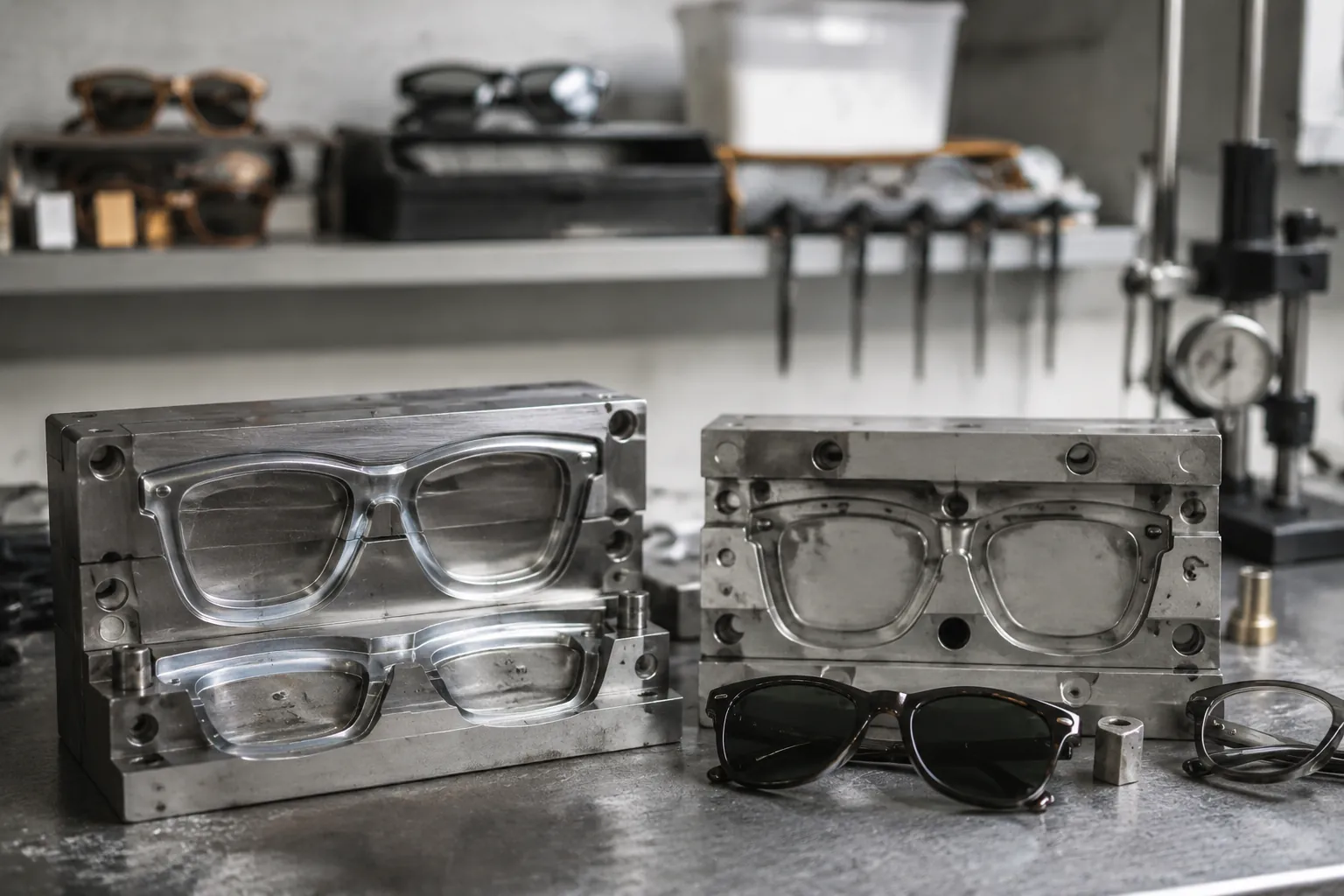
This guide is for brand owners, importers, distributors, and retail buyers choosing between new frame tooling and an existing sunglass mold. The goal is practical: reduce sampling loops, protect launch dates, and know when shape ownership is worth the cost. The guidance reflects common factory decision logic for custom eyewear projects, including injection-molded plastic frames, acetate frames, metal frames, lens tinting, logo decoration, assembly, packaging, QC, and market-specific compliance review.
The Basic Decision: Speed, Control, or Ownership
Existing molds are the fastest route to market. The frame geometry has already been made, tested, and run in production. The buyer chooses a proven shape, then customizes the visible and commercial details: frame color, lens tint, logo method, hardware finish, pouch, box, barcode label, and carton mark. For promotional buyers, seasonal retailers, first test orders, and distributor programs, that is often enough.
New tooling is a different decision. You are paying to create a frame shape or component that is not already available for your order. For injection frames, that may mean a new steel or aluminum mold for PC, TR90-type material, TPEE, or another plastic. For acetate, it may mean new CAD drawings, CNC cutting files, fixtures, lamination choices, and polishing trials. For metal or hybrid sunglasses, it may include custom bridges, hinges, nose-pad arms, logo plates, temple cores, or decorative trim.
The rule is simple. Use an existing mold when the frame is mainly a carrier for color, logo, packaging, or promotion. Invest in tooling when the shape, fit, temple profile, bridge geometry, lens outline, or visible brand identity must be controlled by your brand.
Cost, MOQ, and Lead-Time Trade-Offs
Tooling is not just a one-time mold charge. It changes the sampling plan, engineering workload, MOQ logic, and risk profile. Existing molds allow a supplier to quote from known cycle times, known shrinkage behavior, known hinge performance, and known packing dimensions. New molds need technical validation before bulk production. Gate position, shrink rate, lens groove depth, temple opening angle, hinge screw bite, parting line, ejection marks, and surface finish all need review.
| Route | Typical MOQ Logic | Sample Timing | Cost Behavior | Main Risk |
|---|---|---|---|---|
| Existing mold, basic logo and color | Suitable for smaller test orders when the supplier has the frame, material, and color available | Usually the shortest route because frame engineering is already proven | Lowest development cost; unit price usually improves as order volume increases | Limited shape exclusivity |
| Existing mold with heavier customization | Better suited to higher quantities when custom tint, plating, coating, or multi-position logo work is involved | Longer if decoration trials, color matching, or lens trials are required | Moderate setup cost for films, pads, jigs, fixtures, color matching, or coating tests | Logo durability, color consistency, or lens-tint repeatability |
| New injection mold | Best planned for repeat orders or larger programs where tooling cost can be spread across real volume | Requires CAD review, mold cutting, T1 samples, possible revisions, and golden sample approval | Tooling charge plus engineering time, sample rounds, and possible mold adjustment cost | Shrinkage, warpage, hinge alignment, lens fit, and wearing comfort changes |
| Custom acetate shape | Best when SKU count is controlled and the target price supports hand finishing | Longer if new CNC files, sheet selections, lamination choices, or polishing trials are required | Higher labor content; waste depends on sheet thickness, cutting layout, and color pattern | Polishing consistency, temple balance, fit adjustment, and acetate sheet variation |
As volume rises, the math changes. A small first order rarely absorbs tooling sensibly unless exclusivity is the main value of the product. A larger multi-color program with repeat demand can justify development because the mold cost is spread across more units. Before approving tooling, ask the supplier to quote the existing-mold route and the new-tool route separately. Include sample cost, tooling cost, expected revision cost, unit price at each order quantity, and estimated lead time after sample approval.
Use Existing Molds When the Frame Is Not the Asset
A stock mold does not mean a weak product. Many private-label sunglasses programs are built from existing frames because the buyer puts the budget where consumers can see and feel it: lens quality, hinge feel, color control, logo placement, temple artwork, surface finish, and packaging. For distributors supplying events, resorts, breweries, gyms, sports clubs, museums, value retail, or gift programs, this is often the practical route.
- Use existing molds when timing is fixed. If the sunglasses must arrive before summer, a festival, a product launch, or a retail reset, speed may matter more than shape ownership.
- Use existing molds when testing a market. For a first run, the better investment is often sell-through data, customer feedback, and channel testing rather than tooling.
- Use existing molds for common silhouettes. Wayfarer-style, round, aviator-inspired, kids, shield, and sports-wrap shapes often do not need to be exclusive to sell.
- Use existing molds when decoration is the real customization. Pad printing, laser engraving, hot stamping, metal logo plates, custom pouch printing, and lens tint can create real differentiation.
- Use existing molds when stable QC matters most. A proven mold has known assembly behavior, known lens fit, and fewer engineering unknowns during final inspection.
The limitation is clear: another brand may use a similar frame. You can reduce that risk with distinctive color blocking, translucent material, matte or rubberized finish, gradient lenses, temple printing, metal badges, and retail packaging. Do not claim exclusive frame ownership unless the mold is reserved for your use, substantially modified under a clear agreement, or developed specifically for your project.
Invest in Tooling When Fit, Function, or Identity Matters
New tooling makes sense when the frame itself carries the product. Examples include a signature temple profile, a special keyhole bridge, a wider-fit front, an oversized fashion lens outline, a kids frame with specific proportions, or a sports frame that must grip securely without pressure points. If the sunglasses lose their reason to exist on a generic mold, consider tooling.
There is also a technical case. Existing molds lock in many dimensions: lens base curve, front curvature, bridge width, temple length, hinge position, nose-pad geometry, frame thickness, and lens groove design. If your buyer needs a different pantoscopic angle, wider bridge, deeper lens groove, thicker temple for a logo plate, or flatter front for a fashion look, a stock mold may force poor compromises.
For injection frames, engineering must control shrinkage and repeatability. Agree dimensional tolerances in writing before production, especially around lens fit, hinge alignment, bridge width, and temple symmetry. The lens groove must hold the lens without stress whitening, popping, or rattling. Temple opening angle should remain consistent between left and right sides. Hinge screws need enough material engagement to survive repeated opening and closing.
Acetate behaves differently. Thicker acetate can look premium, but it takes longer to cut, tumble, polish, and adjust. Patterned acetate sheets vary by batch and cutting position, so color placement cannot be controlled like a printed plastic part. CNC path, hand-sanding time, tumbling media, heat adjustment, and temple core alignment all affect the final wearing feel.
Material and Decoration Choices Can Change the Decision
Material selection affects tooling cost, MOQ, durability, weight, and appearance. PC is common for economical promotional frames, but it can feel stiff compared with higher-flexibility materials. TR90-type materials are often used where light weight and flexibility matter, but molding parameters must be controlled. Acetate offers richer color depth and a hand-polished appearance, but it is more labor-intensive and usually less suitable for very low-cost programs. Metal frames add soldering, plating, nose-pad, screw-control, and corrosion-resistance requirements.
Decoration is often what makes an existing mold commercially strong. Pad printing is economical for simple logos, but adhesion and abrasion resistance should be checked, especially on curved temples. Laser engraving is durable on suitable surfaces, but contrast depends on the material and finish. Hot stamping and foil logos can look premium, but they require flat enough logo zones and stable pressure control. Metal logo plates add stamping or tooling cost, adhesive or pin-fit checks, and corrosion review. Lens logos can be printed, etched, or laser-marked, but they must not interfere with vision, required markings, or compliance information.
Lens choices also affect the sourcing route. Standard tinted lenses are usually faster than specialty lenses. Polarized lenses require axis control so left and right lenses align consistently and do not create visual imbalance. Mirror coatings should be checked for adhesion and scratch resistance. Gradient lenses require repeatable transition height, not just a strong approval sample. If the frame uses a strong wrap, test lens curvature and optical distortion together with the frame.
The Sampling and Approval Path for a New Frame
A serious tooling project needs a controlled path. Skip steps and you invite rework, missed shipment dates, and rejected inspection lots.
- Lock the commercial brief. Define target market, expected order volume, target FOB range, frame material, lens category, fit requirements, packaging, certification markets, and launch date before CAD begins.
- Approve reference dimensions. Confirm lens width, bridge, temple length, front width, frame thickness, hinge type, nose fit, and lens base curve. Small bridge or temple changes can noticeably change fit.
- Review CAD or technical drawings. Check logo areas, screw positions, lens groove, hinge pocket, temple curve, parting line, and visible ejection locations before cutting metal or preparing fixtures.
- Build tooling or CNC setup. Injection projects move into mold making; acetate projects move into cutting files, jigs, sheet planning, and polishing trials.
- Run T1 samples. First trial samples are for engineering review, not final sales photography. Check sink marks, warpage, lens seating, hinge alignment, temple symmetry, surface defects, and actual dimensions.
- Revise to T2 if needed. Mold polishing, gate adjustment, lens groove correction, hinge pocket changes, or surface-finish corrections may be required. Plan time and budget for at least one technical revision when the design is new.
- Approve the golden sample. Bulk production should match this signed sample for color, finish, lens tint, logo size, hardware, fitting, packaging, labeling, and carton marks.
- Run production QC. Use incoming material checks, in-process inspection, and final inspection covering lens transmittance, dimensions, hinge function, screw tightness, logo durability, packing, barcode, and carton marks.
If the supplier keeps molding, acetate cutting, CNC work, lens tinting, decoration, assembly, and QC under one management system, communication is usually simpler. That does not remove the buyer's responsibility to approve drawings, samples, labeling, packaging, and compliance documents on time.
Compliance Cannot Be Added at the End
Buyers often treat compliance as paperwork. That is a mistake. Lens tint, optical quality, frame coverage, impact behavior, chemical limits, warning labels, and user instructions should be considered while the product is being specified. Relevant documents may include CE EN ISO 12312-1 for the EU, ANSI Z80.3 for the US, AS/NZS 1067 for Australia and New Zealand, REACH for chemical compliance where applicable, FDA registration where relevant, ISO 9001 for quality management, and BSCI for social compliance. Ask for documents that match your actual market and product type.
Lens category is a major issue. A very dark lens may be suitable for bright sun but unsuitable for driving in some markets. A fashion tint may photograph well but fail the required visible light transmittance range. Polarized lenses need checks for axis consistency and visual distortion. Mirror coatings need adhesion and scratch-resistance review. Kids sunglasses may require extra attention to material safety, fit, labeling, and small-part risks.
New tooling can change compliance performance. A flatter fashion frame may allow more side light leakage. A narrow kids frame may require different fit assumptions. A sports wrap can increase peripheral optical distortion if lens geometry is not controlled. Decide the target markets first: EU, US, Australia/New Zealand, or mixed distribution. Then build the frame and lens specification around the applicable standard.
Run a Breakeven Test Before Paying for Tooling
Before approving new tooling, run a simple commercial test. Add the tooling cost, engineering charges, extra sample freight, testing cost, and likely mold-revision cost. Divide that total by the realistic reorder quantity, not the best-case forecast. Then compare the landed cost of a stock-mold version with the new-tool version. If the added cost per pair still fits your wholesale and retail margin, the project may work.
For example, if development adds several thousand dollars and the first order is small, the cost per unit can become hard to recover. If the same frame is expected to run across multiple colors, channels, or seasons, tooling becomes more rational. Ask the supplier for price breaks by quantity so you can model the real unit cost instead of relying on a single quote.
Also count soft costs: extra sample rounds, delayed photography, late packaging approval, compliance retesting, and the risk of missing a retail delivery window. New development depends on fast buyer feedback. A factory cannot protect a production schedule if artwork, lens tint, barcode files, warning labels, or compliance wording remain unapproved.
The most controlled sourcing path is often staged: launch with existing molds, identify the winning silhouette and price band, then invest in tooling once reorder volume is proven. It is less dramatic than creating a proprietary frame on day one. It usually gives buyers better evidence before they commit development budget.
Have a custom sunglasses project in mind?
Send us your styles, target market and quantities and we will return a detailed quote with MOQ, lead time and a sample plan.
Get a QuoteWhy source this from Wenzhou with LumiShades
Wenzhou in Zhejiang Province is widely regarded as China’s eyewear manufacturing capital, producing a large share of the world’s sunglasses. That concentration matters to buyers: a deep local supply chain for acetate sheet, hinges, lens blanks, plating and packaging means shorter component lead times, easier color and material matching, and a workforce with decades of eyewear-specific skill. LumiShades has manufactured in this ecosystem since 2009, and our vertical integration — in-house injection molding, acetate cutting, CNC milling, lens tinting, decoration and quality control — means no part of your order is quietly subcontracted to a workshop you cannot audit.
For international buyers, that vertical control translates into accountability. When a single factory owns every step, defects are traced and fixed at source rather than bounced between vendors, and your specifications survive intact from first sample to bulk. We back this with 15+ years of experience, shipments to 60+ countries, more than 5 million pairs produced per year and a 98.5% on-time delivery rate. Our certifications — CE EN ISO 12312-1, FDA registration, ANSI Z80.3, AS/NZS 1067, REACH, ISO 9001 and BSCI audit — mean the compliance documentation your market requires already exists. Explore our manufacturing capabilities and quality control process to see how this works in practice.
Frequently asked questions
What order volume usually justifies new sunglasses tooling? There is no universal cutoff. Tooling is hard to justify for a small test order unless exclusive shape ownership is essential to the product. It becomes more practical when you have credible repeat demand, multiple colorways using the same frame, or a retail program large enough to spread tooling cost across many units. Ask your supplier to separate tooling cost, sample cost, unit price, and revision cost so you can calculate the added cost per pair.
Can I make an existing mold look exclusive? You can make an existing mold look more distinctive with custom colors, lens tint, laser engraving, pad printing, hot stamping, metal logo plates, temple artwork, hardware finishes, and packaging. However, do not claim exclusive frame shape ownership unless the mold is contractually reserved for you, substantially modified under an agreed scope, or developed specifically for your project. Put any mold-use rights in writing before paying deposits.
Will new tooling delay my bulk order? Yes. New tooling adds work before normal bulk production can begin: commercial brief, CAD or drawing review, mold or CNC preparation, T1 samples, possible T2 revisions, golden sample approval, and compliance review where required. Build this development time into your launch calendar. Do not book retail delivery dates from the bulk production estimate alone.
Which compliance documents should I ask for? Ask for documents that match your sales market and product type. Common requests include CE EN ISO 12312-1 for the EU, ANSI Z80.3 for the US, AS/NZS 1067 for Australia and New Zealand, REACH where chemical compliance applies, FDA registration where relevant, ISO 9001 for the supplier's quality management system, and BSCI where social compliance is required by the buyer. Check that reports apply to the correct lens type, material, model, and production period.
Can I start with an existing mold and later move to new tooling? Yes. This is often the most controlled path. Use an existing mold to test shape, color, lens choice, price point, packaging, and channel response. If reorder data shows that one frame deserves long-term support, use those sales results to define the new-tool brief: fit changes, design features, logo zones, lens category, target cost, and compliance markets.
Ready to start?
Explore our sport wrap sunglasses or request a quote — our sales team replies within 12 hours.
Request a Quote