
How to Vet an ODM Sunglasses Factory for Exclusivity
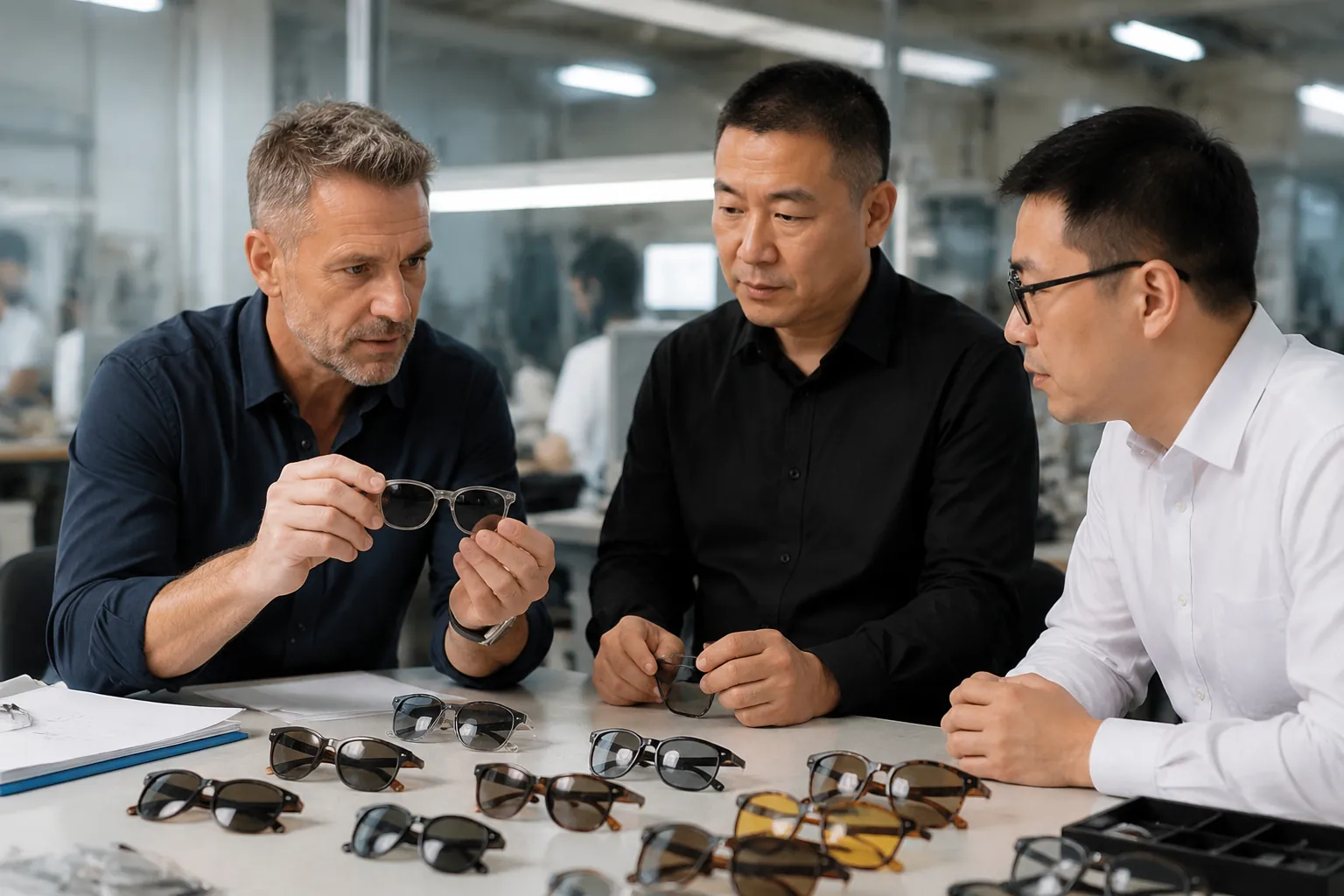
This guide is for buyers funding a new sunglass frame who need more than a polished sample. It shows how to qualify an ODM factory before you commit to development fees, tooling, and launch inventory. The aim is simple: reduce avoidable risk around tooling ownership, sample drift, compliance, and weak exclusivity terms. If you are comparing factories in Wenzhou or elsewhere, use this as a working checklist with process questions, approval gates, and documents you can verify.
Start with the real question: adaptation or a custom frame?
Many sourcing problems start with a basic definition error. A factory says it can do ODM, but the offer is really a stock frame with minor changes such as lens tint, temple logo, packaging, or a different acetate color. That is not exclusive frame development.
Before you pay any deposit, ask the factory to define exactly what is custom and what still depends on existing tools, standard parts, or an existing frame platform. Break it down into four layers:
- Cosmetic customization: logo plate, laser mark, pad print, engraving, packaging, stock color changes.
- Component customization: temple shape, wire-core pattern, nose pad geometry, hinge model, lens tint, mirror coating.
- Structural customization: new front curve, eye size, bridge width, end-piece angle, temple cross-section, lens cut shape.
- Tooling-level customization: new injection mold, new acetate cutting fixture, new CNC program, new logo die, or new metal forming tool.
If the supplier cannot explain which changes require new tooling, new programming, or new fixtures, stop. You do not have enough definition yet.
A credible ODM partner should also explain the development route by material:
- Injection TR90 or PC: a new shape usually requires a new mold, a new mold insert, or another mold modification.
- Acetate: development may start with CNC programming and cutting fixtures, but mass-production repeatability depends on control during machining, tumbling, polishing, and assembly.
- Metal: exclusivity may depend on custom dies, forming tools, custom hardware, hinge parts, and branded metal components rather than a single mold.
Ask for a one-page development map before sample stage one. It should identify the frame material, tooling or fixture needs by part, sample stages, compliance route, and the path from development to bulk production. If the factory cannot produce that document, do not fund an exclusive program yet.
Check engineering support, not just styling support
Buyers often overvalue sketches and renderings. The real test is engineering support.
A capable ODM factory does more than turn a mood board into a nice-looking sample. It should challenge dimensions or details that may cause fit issues, weak hinge placement, unstable lens seating, warpage, or preventable production variation.
Check these design-support points in detail:
- 2D-to-3D engineering: Can the team convert sketches into production-ready CAD with hinge location, draft angle where relevant, lens groove or rim details, bevel profile, and assembly allowances?
- Fit logic: Do they discuss pantoscopic angle, front wrap, bridge fit, temple spread, and overall width in measurable terms rather than trend language?
- Material behavior: Can they explain where dimension or finish variation commonly appears in injection, acetate, or metal construction?
- Lens-seat compatibility: Can they explain how lens thickness, base curve, edge profile, and groove or rim design must work together for secure assembly?
- Revision control: Is every sample round logged with changed dimensions, material notes, decoration notes, and approval comments?
Ask for one anonymized development file with revision history. You are not asking for another buyer's design. You are checking whether the factory runs development through controlled records rather than scattered chat messages.
Then ask how the factory identifies and controls critical dimensions. You do not need a full tolerance table at quotation stage. You do need a clear answer on which dimensions are critical, how they are measured, and when they are frozen for production. If the answer is only "we will follow the sample," push harder. Samples are references. Controlled dimensions are what make bulk repeatable.
Define tooling ownership and exclusivity before money moves
Exclusive frame development often fails on one point: tooling ownership. Buyers assume that paying a development fee means they own the mold or fixture. Factories may treat that same fee as a non-refundable engineering charge. Clear this up early. Not after sample approval.
| Issue | What to ask | Strong answer | Risk if vague |
|---|---|---|---|
| Tooling type | Which tools are new: injection mold, acetate cutting fixture, CNC program, lens fixture, logo die? | Each tool listed by part, function, and cost | You pay "development" without knowing what was created |
| Ownership | Who legally owns each tool after payment? | Written ownership by tool category, with transfer terms | Factory later blocks release, reuse, or relocation |
| Storage and maintenance | How are tools tagged, stored, and maintained? | Internal ID, maintenance log, service intervals | Repeat orders degrade due to worn tools |
| Exclusivity scope | Does exclusivity cover full frame, front only, temple only, colorway, or decoration? | Exact protected elements and term defined | Near-copy sold to others with minor edits |
For injection sunglasses, a dedicated mold often creates a clearer exclusivity boundary than an acetate frame developed through programming, machining, and finishing controls. That does not mean acetate cannot be exclusive. It means the protected geometry must be defined more carefully through approved CAD, a dimensional drawing, and a signed sample reference.
At minimum, the agreement should state:
- what the buyer paid for: development work, tooling, or both
- who owns each mold, fixture, CNC file, and logo die after payment
- how long exclusivity lasts
- what counts as a conflicting design: same front, same temple, same lens cut, or another clearly defined derivative standard
- whether the factory can sell similar versions in other territories or channels
- what happens if orders pause for an agreed period
If the factory refuses to separate these points, treat that as a sourcing risk. It is not a minor legal detail.
Use staged samples to catch drift before bulk
Do not approve a project based on one attractive prototype. Exclusive frame work needs sample stages with approval gates. That is how you reduce sample drift, where bulk gradually moves away from the approved unit in fit, weight, color, logo execution, or lens performance.
A controlled sample path usually looks like this:
- CAD review: dimensions, lens coverage, base curve, hinge position, target weight, logo area.
- First prototype: checks proportion, face fit, and assembly logic. Finish may still be rough.
- Revised sample: corrects dimensions, temple spread, logo placement, lens groove, and fit comments.
- Pre-production sample: made with intended material, actual lens specification, final finish, final decoration method, and retail packing.
- Golden sample: signed and dated by both sides, stored by buyer and factory for QC comparison.
The exact number of rounds varies by construction and complexity. New hardware, revised fit, special coatings, or multiple internal approvers usually add another cycle. Speed matters, but control matters more. Every round should tie back to a clear record of what changed and what was approved.
Every approved sample should record measurable checkpoints, including:
- front width, eye size, bridge, and temple length
- frame weight if weight matters to the product brief
- hinge type and opening feel standard if relevant
- lens category or transmission target where applicable to the market claim
- logo method and position
- color standard for frame, temple tips, lens, and hardware
For color, use a physical master whenever possible. Screen captures are not enough for translucent acetate, clear injection colors, gradient tints, or mirrored lenses. If the factory will not retain a signed golden sample in QC, do not assume bulk consistency will hold.
Match exclusivity terms to MOQ, price, and replenishment
Exclusivity sounds simple until economics get involved. A factory taking on a new shape wants proof of commercial intent. A buyer wants protection without overcommitting too early. The practical approach is to tie exclusivity to paid tooling, defined design scope, order volume, reorder timing, and territory or channel limits.
| Order level | Typical buyer use | Commercial reality | Practical exclusivity approach |
|---|---|---|---|
| 50 pairs | Concept test or sales samples | Low production commitment from the factory | Short conditional hold, if any |
| 300 pairs | Pilot launch | Better signal, but still limited long-term commitment | Exclusivity may begin if tooling is paid and design is clearly defined |
| 1000 pairs | Launch with channel plan | Stronger basis for reserving shape or capacity | More realistic basis for channel or territory exclusivity |
| 5000+ pairs | Scaled program | Factory can plan repeat production and capacity around the item | Stronger leverage for longer terms and tighter derivative limits |
Low MOQ can be useful for market testing, but do not confuse it with strong exclusivity leverage. If a factory offers very small runs on an existing line, that does not mean it will reserve a commercially useful new shape for a long period without conditions.
Good exclusivity terms are measurable. A practical clause links protection to the approved drawing and golden sample, specifies the duration, defines the protected territories or channels, and states whether renewal depends on reorder timing or cumulative purchases. Without that detail, you may be "exclusive" on paper while the supplier remains free to sell a close variant elsewhere.
Tie compliance to the exact frame-lens build
Buyers often ask whether the factory has certificates. Necessary, yes. Sufficient, no.
What matters is whether your exact frame and lens combination can be produced to the target market requirement and whether the compliance route is defined before bulk starts.
Common sunglasses standards and registrations include CE EN ISO 12312-1, ANSI Z80.3, AS/NZS 1067, REACH, and FDA registration in the U.S. context. Management-system or audit credentials such as ISO 9001 and BSCI can indicate process or social-compliance structure, but they do not certify your specific frame.
- CE EN ISO 12312-1: Ask how the factory controls lens category, UV performance, markings, and user information for the shipped model.
- ANSI Z80.3: Confirm that the lens and frame build match the U.S. performance claims you intend to make.
- AS/NZS 1067: Important for Australia and New Zealand, where classification and labeling must match the final product.
- REACH: Ask which materials or finishes are covered by declarations or test reports, including paints, coatings, inks, plastics, and metal finishes where relevant.
- FDA registration: Treat this as establishment status, not product approval.
For exclusive development, ask one more question: does any design feature add compliance risk? Common examples include a mirror coating that affects transmission, a decorative finish that changes the material stack, or a supplier change in lenses or coatings after sample approval.
Also ask when compliance review happens. Best practice is to align the target standard during development, confirm the pre-production build, and avoid changing lens source, coating stack, frame material, or decorative chemistry after validation without reviewing compliance impact again.
Audit process control, not the showroom sample
You do not need a full social audit to judge technical capability, but you do need process visibility. Exclusive frames usually perform better when the factory controls critical steps directly or can clearly show how outsourced steps are managed.
Whether a supplier handles injection molding, acetate machining, lens tinting, decoration, and QC in-house or through approved subcontractors, the control plan matters more than the sales pitch.
Ask process questions tied to your frame type:
- Injection molding: How is mold maintenance tracked? What are the known warp, sink-mark, or weld-line risks on this frame geometry? How is resin handling controlled?
- Acetate cutting: How is sheet variation managed? How is dimensional change through machining and polishing monitored? How is left-right symmetry checked?
- CNC milling: How are programs version-controlled after revisions? How does the factory ensure repeat runs match the approved geometry?
- Lens tinting: How are tint recipes recorded and matched to an approved standard?
- Decoration: At what stage are laser engraving, hot stamping, pad printing, foil transfer, or metal logo plates applied? How are adhesion and placement checked?
- QC: Is there incoming inspection, inline inspection, final inspection, and comparison against the golden sample?
Ask for real process detail. If a logo plate is applied late in the process, ask how placement is verified and how handling avoids scratches. If a mirror coating is used, ask how the coated lens is protected during packing and transport. These are common claim areas. They should be discussed before production, not after returns appear.
The strongest supplier answers with a process flow, control points, and reject criteria. The weakest answer is still "no problem." That is not a control system.
Final buyer checklist before funding an exclusive frame program
Before placing money on an exclusive sunglass development program, confirm these points in writing:
- Custom scope is separated into cosmetic, component, structural, and tooling-level changes.
- Development path by material is defined, with sample stages and approval gates.
- Tooling list, cost, and ownership terms are itemized by part and function.
- Exclusivity scope is clear: exact protected design elements, territory, channel, duration, and renewal condition.
- Golden sample control is built into bulk QC.
- Compliance route matches your actual frame-lens build and destination market.
- MOQ, price breaks, and reorder thresholds support your launch and replenishment plan.
- Critical processes are identified as in-house or outsourced, with known control points.
If most answers are still verbal, you are not ready to place the project. A serious ODM program needs a short but clear documentation trail: CAD or drawings, revision logs, approved sample records, a tooling list, compliance notes, and a plain-language exclusivity clause.
The factory does not need to be perfect. It does need to be specific. In custom eyewear, that is the real qualification test.
Have a custom sunglasses project in mind?
Send us your styles, target market and quantities and we will return a detailed quote with MOQ, lead time and a sample plan.
Get a QuoteWhy source this from Wenzhou with LumiShades
Wenzhou in Zhejiang Province is widely regarded as China’s eyewear manufacturing capital, producing a large share of the world’s sunglasses. That concentration matters to buyers: a deep local supply chain for acetate sheet, hinges, lens blanks, plating and packaging means shorter component lead times, easier color and material matching, and a workforce with decades of eyewear-specific skill. LumiShades has manufactured in this ecosystem since 2009, and our vertical integration — in-house injection molding, acetate cutting, CNC milling, lens tinting, decoration and quality control — means no part of your order is quietly subcontracted to a workshop you cannot audit.
For international buyers, that vertical control translates into accountability. When a single factory owns every step, defects are traced and fixed at source rather than bounced between vendors, and your specifications survive intact from first sample to bulk. We back this with 15+ years of experience, shipments to 60+ countries, more than 5 million pairs produced per year and a 98.5% on-time delivery rate. Our certifications — CE EN ISO 12312-1, FDA registration, ANSI Z80.3, AS/NZS 1067, REACH, ISO 9001 and BSCI audit — mean the compliance documentation your market requires already exists. Explore our manufacturing capabilities and quality control process to see how this works in practice.
Frequently asked questions
What is the first document I should ask for before paying a development deposit? Ask for a written development map. At minimum, it should identify the frame material, which parts require new tooling or fixtures, planned sample stages, who approves each stage, the intended compliance route for the destination market, and the conditions for moving to bulk production. If the factory cannot define the route in writing, do not pay a development deposit yet.
Does paying a mold or development fee automatically give me ownership of the tool? No. Ownership is only what the written agreement says it is. Ask the factory to separate engineering charges from tooling charges and list each item individually: mold, cutting fixture, CNC program, forming die, logo die, or other custom device. The agreement should also state where the tool is stored, how it is identified, who may use it, and what happens if production stops or you want to move the project.
How many sample rounds are normal for a new exclusive frame? A practical sequence is first prototype, revised sample, pre-production sample, and golden sample. Some projects need fewer rounds; others need more if fit changes, custom hardware is added, or lens and decoration details are still being validated. The better question is not just how many rounds, but whether each round has a written revision record and a clear approval decision.
Can I get exclusivity with a low MOQ order? Sometimes, but usually only as a limited and conditional arrangement. If your order is small, ask for a written hold period tied to the approved design and specify whether the hold covers the full frame, only certain parts, or only a territory or channel. Stronger exclusivity usually requires paid tooling, a defined design package, and a credible reorder plan.
What is the practical difference between factory certifications and my product compliance? Factory credentials such as ISO 9001 or BSCI relate to management systems or audit status. Product compliance relates to the actual sunglasses you will sell. Ask the factory to show how your exact frame, lens, coating, labeling, and user information will align with the target requirement, such as CE EN ISO 12312-1, ANSI Z80.3, AS/NZS 1067, or REACH. Also confirm whether any later material or supplier change would require a new review.
Ready to start?
Explore our aviator sunglasses or request a quote — our sales team replies within 12 hours.
Request a Quote