
ODM vs OEM Sunglasses: MOQ, Lead Time, and Risk
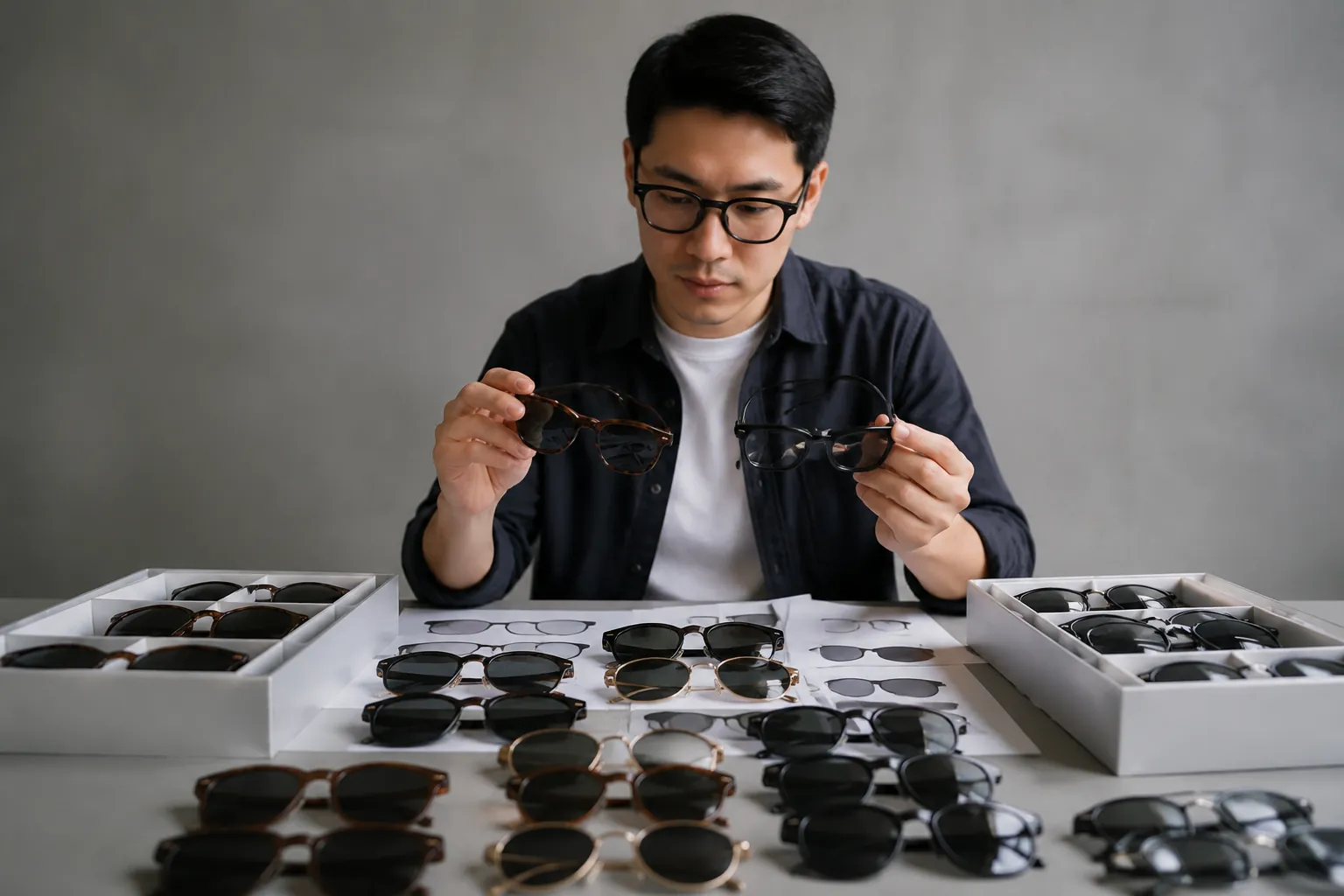
This guide is for brand owners, importers, distributors, and retailers choosing how to launch sunglasses with the right mix of speed, customization, and risk control. Most projects are not a simple ODM-versus-OEM choice. In practice, buyers usually pick from three routes: a ready-made factory style, a modified existing style, or a new model built from scratch. Each route changes the likely MOQ, tooling cost, sample process, compliance work, and chance of delay or rework. The sections below compare those tradeoffs in plain sourcing terms so you can choose a route that fits your budget, launch window, and reorder potential.
Start with three buying routes, not two labels
Buyers often frame sunglasses sourcing as ODM versus OEM. That is too broad. In real factory discussions, there are usually three buying routes, and each one carries a different mix of cost, speed, and development risk.
- Ready-developed ODM: you select an existing frame and lens configuration from the factory's current range, then add branding, labels, or packaging. The mold, assembly method, and production flow already exist.
- Modified private-label ODM: you start from an existing style and adjust selected visible or limited functional elements, such as frame color, temple logo, lens tint, polarization option, finish, or packaging.
- Full OEM custom build: you provide a new concept, drawing, CAD file, or reference sample, and the factory develops the structure, prototypes, tooling, and production setup for that model.
Ready-developed ODM is usually the fastest route. The factory already knows how to make it. Modified ODM can still move quickly if the requested changes stay within the design's manufacturing limits. Full OEM gives you the most control, but it also creates the most engineering work and the most chances for revision.
The real decision is not just MOQ. It is design dependence. If most of the product value already exists in a factory style, ODM may be enough. If frame geometry, fit, hardware, or branded details are central to the product, OEM may be worth the extra time and cost.
Decision table: speed, cost, control, and development burden
Before you request samples, compare your project against the three routes below. Rule out the options that do not fit your timing or budget.
| Buying route | Best for | Typical MOQ | Development cost | Sample timing | First bulk timing | Main risk |
|---|---|---|---|---|---|---|
| Ready-developed ODM | Seasonal launches, promotions, retailer trials, low-risk line extensions | Factory dependent; often lower than full OEM | Usually limited to branding, labels, and packaging setup | Often the fastest option | Usually shorter than OEM if materials are available | Lower exclusivity; similar core shapes may also be sold to other buyers |
| Modified private-label ODM | Brands that want visible differentiation without full custom development | Factory dependent; commonly above stock-only programs but below full custom economics | Low to moderate; depends on logo method, color matching, lens upgrades, packaging, and any fit-related changes | Often moderate if changes are cosmetic | Can remain close to stock timing if no structural rework is needed | Small changes can stack up and create hidden fit, yield, or approval delays |
| Full OEM custom build | Signature models, fit-specific lines, protected concepts, long-term core SKUs | Usually higher or project dependent | Higher; new tooling, engineering, and multiple prototype rounds are common | Usually the longest | Longest first-cycle timeline due to development and validation | Schedule slippage if specifications, tolerances, or compliance scope are incomplete |
Do not judge quotes by unit price alone. Break the cost into four parts:
- Unit price: the price per finished pair
- Setup cost: logo screens, color matching, packaging setup, labels, and carton marks
- Development cost: sample rounds, engineering review, tooling, and prototype corrections
- Risk cost: the commercial impact of defects, delays, test failures, or rework
A cheap pair price can still lead to an expensive project if the approval process is unstable or the product needs repeated correction before bulk production.
If speed matters, choose the route with the fewest new variables
Most launch delays do not come from one big failure. They come from too many small changes at once.
A stock frame can stop being a fast project if you also add a new lens specification, special packaging, revised branding placement, and fit-related changes. That is how lead time slips.
Ready-developed ODM is typically the fastest option because the factory already has a proven production sequence for that style. Materials, assembly order, and quality checks are usually already set. Fewer unknowns. Fewer surprises.
Modified ODM can still move fast if the changes do not alter the frame structure. Common examples include:
- Temple pad printing or laser engraving
- Lens tint changes using an existing compatible lens format
- Switching between polarized and non-polarized lens options where the frame construction already supports both
- Color changes using approved materials or finishes already in use
- Packaging, barcode labels, inserts, and carton marks
Lead time usually expands when the change affects fit, assembly, or tooling. That includes changes to lens shape, bridge geometry, front curve, hinge type, or temple dimensions. These requests may need new drawings, revised prototypes, fixture changes, or new tooling. A sample may still be made quickly. Bulk production is the real test.
If you are working toward a fixed retail season, keep the rule simple: the fewer new variables introduced before bulk approval, the more predictable the launch.
Where cost really moves: tooling, material, decoration, packaging, and yield
In eyewear manufacturing, the quoted pair price is only part of the picture. Final economics usually shift because of labor time, scrap risk, and repeatability.
Five cost drivers matter most:
- Base construction: injection-molded plastic styles are generally more efficient for repeat volume once tooling is in place, while acetate and metal styles often need more manual or multi-step processing.
- Lens specification: standard tinted lenses are usually simpler than polarized, mirrored, gradient, coated, or other upgraded lens options.
- Decoration method: pad printing, laser engraving, hot stamping, and applied metal logos each carry different setup, labor, and durability implications.
- Packaging: pouches, folded boxes, cases, labels, inserts, and barcode requirements add both material cost and packing labor.
- Yield and rework: highly visible cosmetic finishes and more complex assemblies can push up rejection or correction rates.
Material choice affects more than appearance and feel. It changes process behavior too. Acetate, injection plastics, and metal all require different handling, finishing, and quality checks. That is why two styles that look similar can have very different manufacturing costs and development difficulty.
Practical rule: on a first order, spend first on the features customers will notice right away in photos or at the shelf. Delay expensive structural customization until demand is proven.
What can usually be changed on an existing model, and what triggers retooling
Many buyers assume an existing frame can be changed easily because the base style already exists. Not always. Some changes are cosmetic. Others change how the product is made.
Changes that are often possible without new core tooling, subject to factory confirmation:
- Frame and temple color changes
- Lens tint, gradient, mirror, or polarization options using compatible existing lens formats
- Logo application by pad print, laser engraving, hot stamp, or approved hardware application
- Retail packaging, polybag labels, barcode labels, inserts, and carton marks
- Minor surface finish or texture changes where the original construction allows it
Changes that usually need technical review before timing or price should be confirmed:
- Lens width, bridge width, or temple length changes
- Front curve or base curve changes that affect lens fit and appearance
- Hinge changes, including a move to spring hinges
- Temple cross-section or thickness changes
- Nose shape or fit changes that may affect comfort, assembly, or tooling
Ask one blunt question early: can this modified design be produced consistently in bulk with acceptable quality, fit, and yield?
That matters more than whether the factory can make one good sample. A sample proves possibility. It does not prove process stability.
Compliance is not optional, and your route changes the workload
Sunglasses are not just fashion items. In many markets, they sit under optical or protective-product requirements. Your sourcing route affects how much validation work you need to do.
Buyers often ask suppliers about standards and systems such as CE EN ISO 12312-1, ANSI Z80.3, AS/NZS 1067, REACH, FDA registration, ISO 9001, and BSCI. These are not interchangeable. Product standards and chemical requirements are different from quality-management and social-audit systems. Review each one for its actual role in your destination market.
| Change type | Compliance impact | Buyer action |
|---|---|---|
| Logo, packaging, barcode only | Usually low impact on optical performance | Confirm labels, warnings, and supporting documents still match the exact product being sold |
| Lens tint, mirror, or polarization change | May affect visible light transmission, product category, claims, or report applicability | Verify that available test evidence covers the exact lens specification to be shipped |
| Frame material or structural geometry change | May affect mechanical performance or require updated review | Ask whether prior reports still apply or whether new testing is needed |
| Full OEM new model | Highest documentation and validation burden | Build testing, report review, and any claim substantiation into the development plan before bulk booking |
The key early question is simple: Do the available documents apply to this exact frame-and-lens configuration, or only to a similar product?
That distinction matters. A report for one lens version may not automatically support another if the specification changes.
Also keep product credentials separate from system credentials. ISO 9001 and BSCI may help you assess factory management and audit status, but they do not replace product-specific compliance evidence. If your sales claims include terms such as polarized, UV protection level, or market-specific labeling language, confirm the support before placing the order.
A practical path for first orders and repeat orders
If demand is uncertain, treat the first order as a controlled market test. Not the final version. That usually lowers cash exposure and development risk.
- Define the use case: fashion retail, resort, promo, sports-inspired, kids, or optical-store add-on. This sets expectations for fit, lens level, packaging, and compliance scope.
- Choose the route: ready-developed ODM for speed, modified ODM for differentiation, OEM for signature products with realistic reorder potential.
- Freeze the non-negotiables: target price range, destination market, logo method, lens requirement, packaging level, and required ship window.
- Approve a physical sample: not only photos. Check hinge feel, symmetry, logo placement, lens appearance, finish quality, packaging fit, and labeling details.
- Define production standards: agree on inspection points and defect definitions before bulk production begins.
- Confirm the lead-time trigger: make sure the factory states clearly whether production timing starts from sample approval, packaging approval, deposit receipt, or all approvals combined.
- Use the reorder to optimize: once sell-through is proven, reassess volume, pricing structure, and whether deeper customization now makes commercial sense.
Many delays come from incomplete approvals. The buyer confirms the frame but leaves the final logo artwork, lens version, warning label, or carton mark open. Then production planning stalls.
For many new programs, the lowest-risk route is a controlled modified ODM launch first. Prove demand. Move into deeper OEM development only if reorder potential is real.
Which route fits your launch
Choose ready-developed ODM if your main priority is speed, lower development burden, and simpler execution. It fits trend-led programs, retailer tests, promotions, and short selling windows where exclusivity matters less than getting approved product into market on time.
Choose modified private-label ODM if you want stronger visual differentiation without taking on full custom engineering from the start. For many growing brands, this is the middle path. Faster than OEM. More distinct than stock-only. Easier to manage on a first order.
Choose full OEM custom build if the frame itself is part of the brand value, if fit or hardware must be unique, or if you expect enough repeat volume to justify the development work. OEM works best when the brief is specific, approvals are fast, and the timeline allows room for prototyping and compliance review.
Simple rule: if you are still testing demand, do not pay early for complexity customers have not yet proved they value. If the product is likely to become a repeat-volume style, invest in the details that are hardest for competitors to copy.
That is the real ODM-versus-OEM choice. Not a label issue. A sourcing decision about timing, process control, compliance responsibility, and how much product change your launch can absorb.
Have a custom sunglasses project in mind?
Send us your styles, target market and quantities and we will return a detailed quote with MOQ, lead time and a sample plan.
Get a QuoteWhy source this from Wenzhou with LumiShades
Wenzhou in Zhejiang Province is widely regarded as China’s eyewear manufacturing capital, producing a large share of the world’s sunglasses. That concentration matters to buyers: a deep local supply chain for acetate sheet, hinges, lens blanks, plating and packaging means shorter component lead times, easier color and material matching, and a workforce with decades of eyewear-specific skill. LumiShades has manufactured in this ecosystem since 2009, and our vertical integration — in-house injection molding, acetate cutting, CNC milling, lens tinting, decoration and quality control — means no part of your order is quietly subcontracted to a workshop you cannot audit.
For international buyers, that vertical control translates into accountability. When a single factory owns every step, defects are traced and fixed at source rather than bounced between vendors, and your specifications survive intact from first sample to bulk. We back this with 15+ years of experience, shipments to 60+ countries, more than 5 million pairs produced per year and a 98.5% on-time delivery rate. Our certifications — CE EN ISO 12312-1, FDA registration, ANSI Z80.3, AS/NZS 1067, REACH, ISO 9001 and BSCI audit — mean the compliance documentation your market requires already exists. Explore our manufacturing capabilities and quality control process to see how this works in practice.
Frequently asked questions
Can I start with 50 pairs and still get my logo on the sunglasses? Possibly, but it depends on the factory's MOQ policy and the logo method. Basic branding methods such as pad printing or laser engraving are often easier to apply at lower volumes than metal logo plates or custom hardware. Ask the supplier three direct questions before sampling: the minimum quantity for your chosen logo method, whether logo setup charges apply, and whether the same MOQ also covers custom packaging and labels.
How do I know whether my idea needs OEM instead of a modified ODM frame? Start by separating appearance changes from structural changes. Appearance changes usually include logo, color, lens tint, packaging, and surface finish. Structural changes usually include lens shape, bridge geometry, hinge type, curve, key dimensions, or fit changes. If your requested changes affect how the frame is engineered or assembled, ask the factory for a technical feasibility review in writing. Get confirmation on whether existing tooling can still be used, whether a new prototype is needed, and whether prior compliance documents would still apply.
What lead time should I plan for a normal private-label order? There is no fixed number because timing depends on the factory's schedule, material availability, sampling rounds, packaging complexity, and whether the style is stock, modified, or fully custom. For planning, ask the supplier to break lead time into stages: sample preparation, sample revision if needed, test or document review if required, bulk-material preparation, production, inspection, and packing. Also confirm the exact event that starts the bulk lead-time clock, such as final sample approval, deposit receipt, or packaging approval.
Do I need new compliance documents if I only change the lens color? You may. A lens-color change can affect visible light transmission, category classification, and the applicability of existing test reports or claims. Ask the supplier for the specific report or supporting evidence tied to the exact lens specification you plan to ship, not just the base frame. If the destination market has labeling or category requirements, confirm that the final sold version still matches them before production begins.
Why does the price drop at higher quantities? Higher quantities usually improve manufacturing efficiency because setup time, artwork preparation, packaging preparation, and inspection handling are spread across more units. Larger runs may also make material purchasing and production scheduling more efficient. When comparing price breaks, ask what assumptions are built into them: frame material, lens type, branding method, packaging configuration, and whether the quoted quantity is per color, per design, or total order volume.
Ready to start?
Explore our round sunglasses or request a quote — our sales team replies within 12 hours.
Request a Quote