
Custom Sunglasses Mold Cost: When Tooling Pays Off
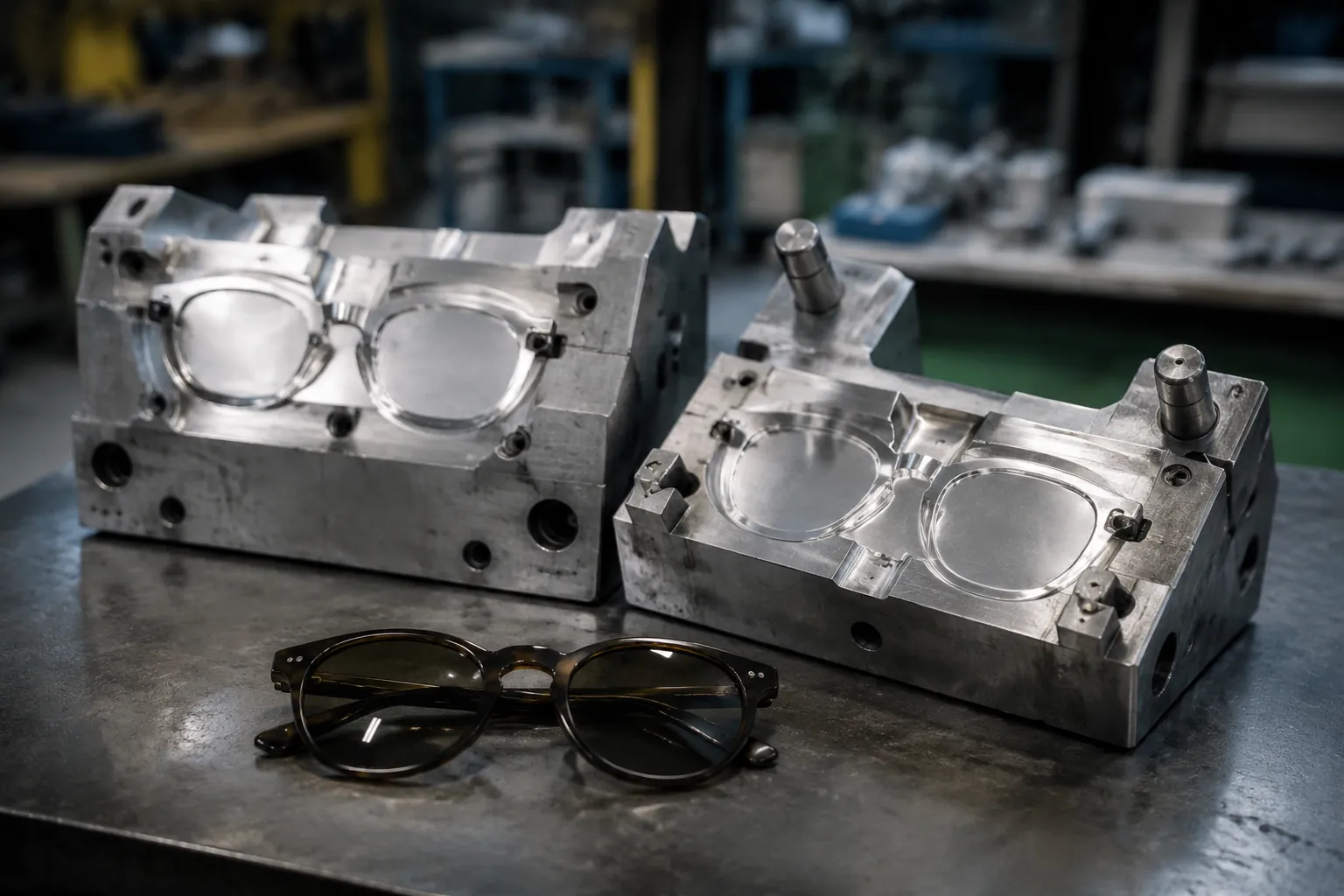
Buyers often frame this as a binary choice: pick a catalog frame or pay for a new mold. That is too simple. Most custom sunglasses programs fall into three routes, each with different cost, risk, and timing: stock-frame customization, limited mold modification, and full new tooling. The right choice depends on what is changing, what volume is realistic, how much exclusivity matters, and whether the requested geometry can run at commercial yield. This guide lays out those trade-offs in plain sourcing terms so brand and purchasing teams can judge when tooling is wasted spend and when it is the cheaper decision over the life of a style.
Start with the real choice: decoration, mold edit, or new tooling
Most custom sunglasses projects fall into three buckets.
- Stock-frame customization: an existing frame with changes to color, lens tint, logo application, packaging, and sometimes minor trim details.
- Existing mold modification: the original tool stays in use, but limited edits are made, such as a logo recess, texture change, small bridge adjustment, temple-end reshaping, or another constrained structural change.
- New tooling: a new front mold, new temple mold, or both, usually to create proprietary geometry or fix fit and production limits that stock options cannot solve.
These are not interchangeable forms of "customization." A stock-frame program is mostly a sourcing and finishing job. A mold edit is a middle path with hard limits. A full-tool project is product development. It affects fit, repeatability, assembly, scrap risk, and what compliance work may need to be checked again.
Start with the product brief, not the lowest quote. If the request is mainly about branding, color, and packaging, stock is often the right path. If the request changes frame geometry, lens seating, bridge position, or temple architecture, treat it as an engineering issue. Not decoration.
A simple screen helps. If demand is unproven and speed matters most, stay close to stock. If the program is likely to repeat, the frame shape matters to brand identity, or stock options keep forcing compromises in fit or appearance, run a real tooling review.
What buyers are actually paying for in eyewear tooling
"Mold cost" is rarely one line item. In sunglasses development, buyers usually pay for several layers of work:
- Design-for-manufacture review: assessment of wall thickness, draft angle, parting line, shrinkage behavior, gate location, ejection points, hinge-seat geometry, and lens groove design.
- Tool creation or tool modification: new cavities, revised inserts, texture work, branding recesses, hinge-area changes, or local geometry edits.
- Trial production and correction: first samples may reveal flash, sink, short shots, warpage, hinge misalignment, lens stress, or assembly issues that need correction.
- Secondary process setup: logo tooling, printing plates, laser files, color matching, packaging artwork, and other application-specific preparation.
- Testing and validation: review of lens performance, lens retention, chemical compliance, and labeling against target-market requirements.
On injection-molded frames, geometry usually creates the biggest cost risk. Decorative details can often be changed later. A front curve, lens groove, or hinge position that causes stress or unstable assembly is far more expensive to fix after tooling is cut. Small dimensional changes matter when they affect hinge alignment, lens seating, or visible left-right symmetry.
Acetate projects run differently. They may not carry a large mold invoice, but they still create development cost through material selection, CNC programming, routing, polishing, and fit refinement. A render can look clean on screen and still need to be softened in production because of polishing loss, edge comfort, or hinge-area strength. No big mold bill does not mean a simple project.
What the buyer is really paying for is repeatability at production scale. That is the point. A cheap tool or cheap development path is not cheap if it leads to repeated corrections, unstable assembly, or too much hand rework in bulk production.
Cost and lead-time by sourcing route
The table below is not a market price sheet. It is a buyer-side framework for comparing common custom sunglasses routes.
| Route | Typical development cost | MOQ logic | Sample timing | Bulk timing | Best use case |
|---|---|---|---|---|---|
| Stock frame with color, lens tint, and logo changes | Low; often sample fees and setup costs for branding or packaging | Best for low-risk launches and demand testing | Often the fastest route because base tooling already exists | Usually shorter than new-tool development once sample is approved | Retail programs, market tests, entry private label, event or promotional use |
| Existing mold with limited structural changes | Moderate; depends on whether inserts or cavity areas must be revised and re-sampled | Useful when visible differentiation is needed without funding a full exclusive frame | Longer than stock because engineering review and correction may be required | Can be similar to stock after final approval if the edit is stable | Bridge refinements, branding recesses, small temple changes, texture updates |
| New mold for front or temples only | Moderate to high; partial new development with partial exclusivity | Often considered when one component carries most of the visual identity | Longer than stock because new tooling and trial validation are involved | Repeat orders are typically more predictable after the design is stabilized | Signature temple designs, proprietary fronts, selective customization with controlled spend |
| Full new tooling for complete frame | Highest upfront cost; full design, tooling, trial, correction, and validation path | Best justified when repeat demand, exclusivity, or brand control is strategically important | Usually the longest development path because both geometry and process must be proven | Most efficient for repeat business once the frame is validated for production | Core brand styles, protected silhouettes, long-life programs, difficult-to-copy geometry |
Always review unit price together with development cost. A custom tool can raise upfront spend while lowering per-pair cost, reducing rework, or improving consistency across repeat orders. The reverse also happens. A custom project with weak forecast volume may never earn back its initial investment.
Decoration choices also affect cost and timing. Pad printing is common and efficient, but surface shape and wear expectations matter. Laser engraving is durable, but contrast depends on material and finish. Metal logo plates can look more premium, but they require controlled recess geometry and extra assembly work. Hot stamping can work well in some positions, but curved or textured surfaces may reduce consistency.
Break-even math: when exclusive tooling makes sense
The right way to judge tooling is across the expected life of the style, not just the first PO.
- Estimate realistic total volume, including likely replenishment, not only the opening order.
- Compare landed unit cost for the stock-based route and the custom-tool route at the same forecast volume.
- Add one-time development costs to the custom route, including tooling, sampling, and any required testing or report updates.
- Measure payback against unit-cost savings, improved gross margin, or both.
A simple formula is:
Break-even volume = total added development cost / per-unit savings
Example: if a custom-tool route costs more upfront but lowers landed cost per pair, calculate how many pairs are needed to recover that difference. If the custom route does not reduce unit cost, the business case can still work if it supports a higher selling price, stronger retail positioning, or fewer delays and sample rounds.
There is also a schedule break-even. Some teams avoid tooling to save cash, then burn time trying to force a stock frame into a shape or fit target it was never built to support. The direct tooling bill stays lower. Total program cost does not. Delay, extra freight, missed seasonality, and quality disputes can erase the savings fast.
As a rule, stock routes usually fit projects limited to color, logo, lens tint, packaging, or minor cosmetic details. Tooling becomes a serious option when changes affect front silhouette, wrap, bridge geometry, lens groove, temple architecture, or brand-defining proportions.
Where modified stock frames get expensive later
Stock modification gets costly when buyers push it past what the original geometry can support. Common failure points include:
- Bridge-fit compromise: changing the look of the bridge without properly changing fit geometry can create comfort and fit problems.
- Lens seating stress: using a lens profile that does not match the groove or frame curvature can increase assembly risk and retention issues.
- Temple balance shift: heavier branding parts, thicker tips, or different materials can change wear balance and perceived comfort.
- Warp or twist after material or color changes: a frame that runs well in one specification may behave differently after resin, pigment, or finish changes.
- Decoration limits: the planned logo area may be too curved, too textured, or too small for the selected application method.
For injection styles, visible problems often show up as front warp, temple misalignment, hinge inconsistency, or sink around branding features. For acetate, a common issue is over-design: bevels, edge sharpness, thin sections, or laminated effects that look good in a render but lose clarity or durability after machining and polishing.
These problems change the economics of the project. A stock frame that needs repeated manual correction, fit compromise, or low-yield assembly is no longer the cheap option in real terms. That is often the point where a dedicated custom route becomes easier to justify internally.
Compliance and testing: changes that add cost or delay
Sunglasses are regulated products. Compliance should be treated as specification-specific. A factory may hold prior reports for a similar style, but that does not mean every modified version is covered without review.
Common standards and systems buyers may ask about include CE EN ISO 12312-1, ANSI Z80.3, AS/NZS 1067, REACH, FDA registration where relevant to the program, and factory systems such as ISO 9001 and BSCI. These references are useful, but the real question is simple: does the exact frame-and-lens configuration being ordered fall within existing records, or does it need more review?
Changes most likely to trigger review, retest, or written clarification include:
- Lens tint changes that affect lens category or luminous transmittance
- Polarized lens substitution
- Different lens substrate, thickness, or coating stack
- Frame material changes that affect chemical compliance review
- Geometry changes that could affect lens retention or coverage
- Branding or labeling changes required for traceability or market warnings
Ask two direct questions in writing: What existing reports or records apply to this exact specification? and What items must be rechecked because of the requested changes? Keep it factual. Assumed compliance is expensive.
A practical sourcing framework for choosing the right route
If you need a fast internal decision, use this framework.
| If your situation is this | Usually choose this | Why |
|---|---|---|
| Launch needed quickly, low MOQ, unproven demand | Stock frame modification | Lowest development risk and usually the shortest path to saleable samples |
| Need one strong brand detail but not a fully exclusive silhouette | Partial mold change or custom temples | Focuses spend on the most visible component |
| Repeat demand looks realistic and the style may be replenished | Run a new-tool comparison seriously | Tooling may improve long-term economics and consistency |
| Frame shape is central to brand identity | Full new tooling | Catalog geometry is easier for competitors to match and often less controllable over time |
Then ask the supplier six direct questions:
- What can be changed on the current mold without harming fit, assembly, or production stability?
- Which requested changes require a new front tool, a new temple tool, or both?
- How many sample rounds are normally required for this type of project?
- Where are the main tolerance risks: hinge seat, lens groove, temple alignment, or bridge geometry?
- Which logo method is most durable on this exact material and surface shape?
- Which compliance records already exist for this frame-and-lens combination, and what may need review or retest?
The answers matter as much as the quote. A capable supplier should be able to explain limits, not just say yes to everything.
How to run a custom sunglasses program with less waste
Factories quote faster and more accurately when the brief is clear. A useful starting package includes frame dimensions, material preference, hinge type, logo size and placement, lens requirements, target market, packaging needs, quantity assumptions, and reference images or files that show what is fixed and what is flexible.
If a formal tech pack is not ready, annotated reference images are still better than a broad verbal description. Rank priorities. Be blunt. For example: "front shape is non-negotiable, logo method can change, temple thickness can be adjusted." That helps engineering teams propose the lowest-risk route instead of guessing.
For lower-risk launches, many buyers start with a stock-based sample to test design direction and market response. If sell-through or reorder probability looks strong, they then review whether a custom front, custom temple, or full tool now makes economic sense. This staged approach often handles capital better than opening full tooling before demand is proven.
Use sample approval carefully. Do not approve on appearance alone. Check symmetry, hinge alignment, lens fit, logo placement, color consistency, labeling, packaging, and any market-specific requirements tied to the product. Once the approved sample is signed off, freeze the specification. Late changes are a common cause of delay, extra cost, and compliance confusion.
The core point is simple. New tooling is not automatically the better choice, and stock is not automatically the cheaper one. The right route is the one that meets the design, compliance, and repeat-order economics with the least avoidable risk.
Have a custom sunglasses project in mind?
Send us your styles, target market and quantities and we will return a detailed quote with MOQ, lead time and a sample plan.
Get a QuoteWhy source this from Wenzhou with LumiShades
Wenzhou in Zhejiang Province is widely regarded as China’s eyewear manufacturing capital, producing a large share of the world’s sunglasses. That concentration matters to buyers: a deep local supply chain for acetate sheet, hinges, lens blanks, plating and packaging means shorter component lead times, easier color and material matching, and a workforce with decades of eyewear-specific skill. LumiShades has manufactured in this ecosystem since 2009, and our vertical integration — in-house injection molding, acetate cutting, CNC milling, lens tinting, decoration and quality control — means no part of your order is quietly subcontracted to a workshop you cannot audit.
For international buyers, that vertical control translates into accountability. When a single factory owns every step, defects are traced and fixed at source rather than bounced between vendors, and your specifications survive intact from first sample to bulk. We back this with 15+ years of experience, shipments to 60+ countries, more than 5 million pairs produced per year and a 98.5% on-time delivery rate. Our certifications — CE EN ISO 12312-1, FDA registration, ANSI Z80.3, AS/NZS 1067, REACH, ISO 9001 and BSCI audit — mean the compliance documentation your market requires already exists. Explore our manufacturing capabilities and quality control process to see how this works in practice.
Frequently asked questions
At what order volume should I stop using stock frames and consider new tooling? There is no universal volume threshold. The decision depends on forecast certainty, the amount of geometry change, and the unit-cost difference between routes. Run the math on expected lifetime volume for the style, not just the first order. Ask the factory for two quotes against the same specification target: one based on the closest stock frame and one based on custom tooling. Then compare 1) one-time development cost, 2) landed cost per pair, 3) expected sample rounds, and 4) whether the stock route creates fit or branding compromises. If the style is likely to repeat and stock options are forcing technical compromises, tooling is worth a serious review even before volume gets very high.
Can I get exclusivity without paying for a full new mold? Often yes. Common middle-ground options include a new temple tool, a new front only, or a controlled edit to an existing mold such as a branding recess or local geometry change. The right option depends on what actually creates the frame's visual identity. Ask the supplier to separate the quotation into front tooling, temple tooling, and mold-edit scenarios, then request a clear statement of what remains non-exclusive under each route. That shows whether you are paying for real differentiation or only a cosmetic change.
Does changing only the lens color usually require fresh compliance testing? It can. A lens color change may affect lens category, luminous transmittance, and how the final product is classified for the target market. The same issue applies if the lens material, polarization, coating stack, or thickness changes. The practical step is to send the exact new lens specification to the supplier and ask for written confirmation on whether existing records cover it under the relevant standard, such as CE EN ISO 12312-1, ANSI Z80.3, or AS/NZS 1067, or whether additional review or testing is needed.
What is the fastest route if I need a branded sunglass line quickly? Usually an existing frame customized with your color, lens, logo, and packaging. Because the base geometry and tooling already exist, development is generally faster and lower risk than a new-tool program. To move faster, narrow the brief before sampling: choose one or two frame candidates, define the lens color and branding method, confirm packaging requirements, and ask the supplier what existing compliance documentation applies to the exact configuration. Speed drops fast when a project starts as stock and then shifts into structural changes.
What information should I send a factory before asking for a tooling quote? Send enough detail for engineering to judge whether the request is cosmetic, a mold edit, or a true new-tool project. At minimum include target quantity, target market, frame material, key dimensions, reference images or 3D files, lens specification, logo method, packaging needs, and a note showing what is fixed versus flexible. Also ask the factory to reply in three parts: 1) what can be done with stock, 2) what requires mold modification, and 3) what requires new tooling. That structure usually produces a more useful quotation and fewer revisions later.
Ready to start?
Explore our aviator sunglasses or request a quote — our sales team replies within 12 hours.
Request a Quote