
How to Vet an ODM Sunglasses Supplier Before Design
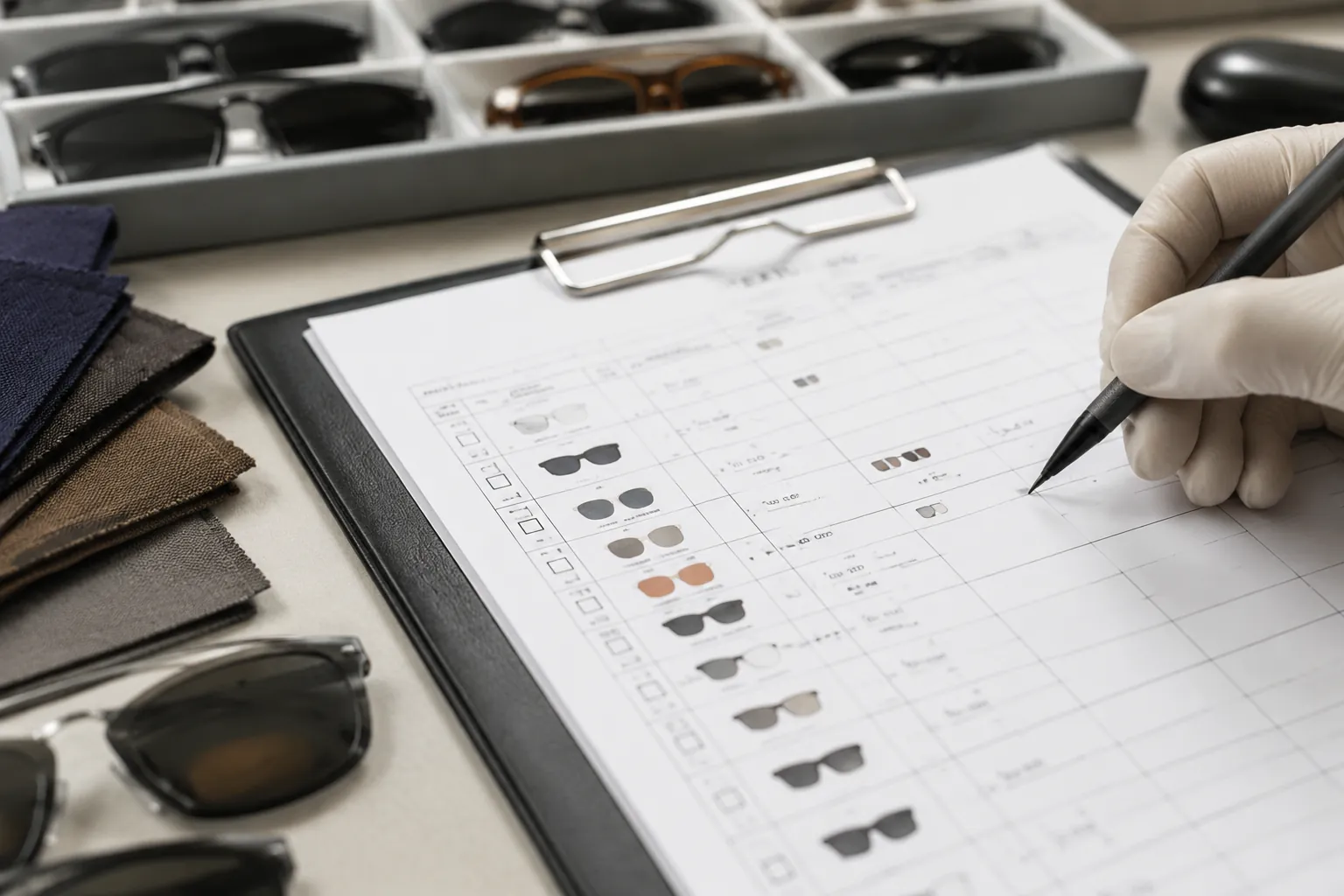
This guide is for brand owners, importers, distributors, and retail buyers preparing to develop sunglasses with an ODM supplier. Qualify the factory before you pay for drawings, tooling, sample rounds, packaging, or testing. A real ODM partner should explain how it will control frame development, mold terms, material behavior, lens specification, decoration durability, sample approval, compliance documents, MOQ logic, pricing assumptions, and production timing before you commit to a new frame.
Start With the ODM Decision, Not the Catalog
Many buyers say ODM when they mean private label. Changing the logo, lens color, pouch, or box on a catalog frame is customization. ODM sunglasses development goes further. The supplier helps turn a design direction into a manufacturable product: front shape, temple profile, hinge structure, bridge fit, lens base curve, decoration method, color system, packaging, and market compliance.
Before you send trend boards or CAD files, ask the supplier to recommend the right development route for your order size, launch date, target price, and selling market. Most projects fall into one of three routes: customize an existing mold, modify an existing mold, or develop a new production mold. Acetate frames need a separate discussion because sheet selection, CNC shaping, hinge insertion, tumbling, and polishing do not follow the same logic as injection molding.
Do not treat MOQ as one simple number. A low MOQ may work for logo, lens, color, and packaging changes. It does not automatically support new tooling, exclusive design rights, custom components, or third-party testing. Ask the supplier to separate the MOQ for each element: frame color, lens color, logo process, packaging, custom mold, and compliance testing. Price must also be tied to a written specification. Hinge type, lens category, coating, decoration method, packaging, inspection level, and test requirements can all change the real cost.
Run the First Call Like a Technical Audit
A serious ODM screening call should become technical quickly. If every answer stays broad, the supplier may be selling catalog access, not development control. You are not only buying sunglasses. You are buying decisions made before mass production, when fit, tooling, color, decoration, and compliance can still be controlled.
- Design input: Ask what the supplier needs before quoting: 2D drawing, reference frame, Pantone target or physical color sample, lens category, lens base curve, hinge type, temple width, logo size, packaging style, and destination market.
- Process control: Confirm which steps are done in-house and which are subcontracted, including injection molding, acetate cutting, CNC milling, lens tinting, laser engraving, pad printing, metal logo plate application, assembly, and QC.
- Fit and tolerance discussion: Ask how the supplier controls lens seating, hinge alignment, temple symmetry, bridge width, frame warpage, and temple opening angle. A useful answer includes measurable checks, not just visual inspection.
- Sample approval: Ask who signs off frame color, lens color, logo placement, hinge tension, packaging, carton marks, and the pre-production sample.
- Revision speed: Separate cosmetic revisions from structural revisions. A print position change is not the same as a bridge, rim, hinge, or lens-fit correction.
- Compliance route: State the selling market at the start. EU, US, Australia, and New Zealand requirements are not interchangeable.
Ask for evidence behind each claim. Useful evidence includes workshop photos or video, process flow, QC checklist, sample approval form, calibration records for measuring tools, recent test reports for comparable products, and a written lead-time schedule. A supplier profile is not enough. Match the claimed capability to the exact product you plan to buy.
Compare Development Routes Before You Pay
The wrong development route can burn budget fast. It can also delay a launch by weeks. Some buyers ask for a brand-owned silhouette when the budget only supports catalog customization. Some suppliers recommend a new mold when a modified existing frame would meet the commercial goal faster. Put the options on paper before approving design fees, tooling charges, or sample costs.
| Route | Best For | Typical MOQ Logic | Main Control Point | Typical Risk |
|---|---|---|---|---|
| Existing mold customization | Market tests, seasonal colors, promotional runs, private label programs | Lower MOQ may be possible if materials, lenses, and packaging are standard | Frame color, lens specification, logo method, packaging | Other buyers may be able to use the same base shape unless exclusivity is agreed |
| Modified existing mold | Temple change, logo plate, minor bridge adjustment, small profile change | Usually needs higher order volume, a tooling contribution, or both | Change scope, tolerance impact, written exclusivity terms | Small changes can affect lens seating, hinge alignment, or wearing fit |
| New injection mold | Brand-owned shape, repeat programs, volume launches, protected design direction | Usually requires tooling payment and a repeat-order plan | Mold ownership, cavity count, shrinkage control, first-shot evaluation | Higher upfront cost, longer revision cycle, and more responsibility for technical approval |
| Acetate cutting and CNC | Premium colors, laminated sheets, thicker fashion frames, smaller premium runs | Depends on sheet availability, color minimums, labor time, and finishing requirements | Sheet quality, polishing, hinge insertion, symmetry, edge finish | Labor variation, longer finishing time, and possible color-sheet availability limits |
Injection frames are efficient for repeat production when the same shape will run across several colors or seasons. The supplier must control material shrinkage, gate marks, parting lines, warpage, and lens fit. Acetate can offer richer color depth and a heavier hand feel, but it needs careful polishing and hinge setting. If retail value depends on clear lamination, clean edge polishing, or a thick temple profile, treat acetate as its own manufacturing route with its own QC checklist.
Check Materials, Lenses, and Fit Tolerances
ODM qualification must cover material behavior, not just frame shape. PC, TR90, acetate, stainless steel, nickel silver, and alloy components differ in flexibility, weight, finish, heat response, screw retention, and decoration performance. A translucent injection color may show flow marks more easily than an opaque color. A thick acetate temple may look premium but needs enough hinge bite and polishing time. A thin injection temple may not hold a metal logo plate securely.
Ask the supplier to state the inspection points and tolerances used for the parts that affect comfort and assembly. At minimum, discuss bridge width, temple length, lens fit, hinge alignment, frame front symmetry, temple opening angle, and lens retention. The supplier should define the measuring method, acceptable tolerance range, and sample size for inspection. Avoid vague approvals such as "same as sample" unless the approved sample has been measured and recorded.
Lens specification needs the same discipline. Confirm lens material, lens color, filter category, base curve, thickness, UV claim, coating, and whether the lens is solid, gradient, mirrored, polarized, or photochromic. Mirrored coatings need abrasion and packing attention. Polarized lenses need orientation checks. Gradient lenses need consistent top-to-bottom color. Claims for driving, sports, children, high-glare environments, or strong sunlight can affect compliance review, so state the intended use before sampling.
Write Mold Ownership Before Tooling Starts
Mold ownership is where many ODM disputes begin. Buyers often assume that paying a tooling charge means full ownership. Suppliers may treat the payment as a development contribution, not a transfer of exclusive rights. Vague paperwork creates risk for both sides.
Write down four points before tooling starts: who pays for the mold, who owns it, whether the supplier can use it for other customers, and what happens if orders stop. Also specify whether the agreement covers the full front and temples, only a temple insert, only a logo plate, only a surface texture, or only a partial modification. A metal logo plate on an existing temple is not the same as owning the full frame mold.
For injection sunglasses, confirm cavity count, mold material, expected mold life if the supplier is willing to state it, maintenance responsibility, storage location, and whether the first tool is a sample tool or production tool. Shrinkage and tooling adjustment can change lens seating, bridge width, temple spread, hinge alignment, and wearing balance. Ask for first-shot samples and measurement records before approving final color, lens, and decoration.
Blunt rule: if the supplier will not define mold ownership, exclusivity, storage, reuse, and transfer rights in writing, do not build your brand identity around that shape.
Control Decoration and Sample Approval
Sample approval is not a beauty contest. It is the control file for bulk production. A good sample file defines what is acceptable, what is not acceptable, and what must match the approved sample during inspection.
- Approve frame material and color under daylight and indoor retail lighting, not only under factory lighting.
- Record Pantone target, physical color chip, or approved master sample, especially for translucent, matte, and layered finishes.
- Confirm lens color, filter category, coating, polarization if used, and gradient direction if applicable.
- Check hinge tension by opening and closing both temples several times, then record the agreed feel or torque method if available.
- Measure logo position, logo size, print color, engraving depth, metal plate placement, and acceptable placement tolerance.
- Inspect lens fit. Gaps, stress marks, lens movement, edge chipping, or corner popping are warning signs.
- Confirm pouch, case, cleaning cloth, barcode position, polybag warning text if required, carton quantity, carton marks, and retail labeling.
Decoration method should match wear conditions. Pad printing is economical and works for many logos, but it can wear faster on high-touch temple areas unless ink, surface treatment, and curing are controlled. Laser engraving can be durable, but material contrast and depth matter. Metal logo plates can look more premium, but the temple must have enough thickness and a stable fixing method. Hot stamping and foil effects need adhesion and abrasion checks.
Ask for the supplier's recommended decoration method. Then ask what can fail in mass production. Useful checks include tape test, rub test, visual alignment standard, color comparison, and inspection sampling plan. If the supplier cannot define how decoration will be inspected, the approved sample may not protect you when the bulk order arrives.
Match Compliance to the Actual SKU
Do not ask for a generic certificate and assume the product is covered. Sunglasses requirements depend on destination market, lens type, filter category, material, coating, and selling claim. The supplier should connect documents to the actual SKU you will sell, not just send a folder of old files.
For Europe, CE marking should be supported by testing to EN ISO 12312-1 for sunglasses, and REACH may apply to chemical restrictions in materials, coatings, inks, and components. For the United States, buyers commonly ask about FDA registration and ANSI Z80.3 alignment for non-prescription sunglasses. Australia and New Zealand use AS/NZS 1067. ISO 9001 and BSCI relate to management systems and social compliance; they do not prove lens safety by themselves.
Ask whether the test report covers the exact lens category, coating, frame material, and model family. A report for a black lens on one frame does not automatically prove a mirrored, gradient, polarized, photochromic, or children's version. Darker filter categories, mirrored coatings, and polarized lenses can change testing needs. If your sunglasses are for general fashion use, say so. If you want to claim driving suitability, sports use, children's use, outdoor performance, or high-glare protection, state that before sampling and confirm the applicable test route.
The core documents to request, depending on destination market, are CE EN ISO 12312-1, ANSI Z80.3, AS/NZS 1067, REACH, FDA registration, ISO 9001, and BSCI. The next step is not collecting more certificates. It is matching each document to the market, product specification, and claim on your purchase order.
Read Cost and Lead Time Like a Production Manager
A sunglasses quote is not just a unit price. It is a bundle of assumptions about material, hinge type, lens type, filter category, coating, decoration, packaging, carton quantity, inspection level, testing, payment terms, and production risk. If those details are missing, the quote is not ready for comparison.
Ask the supplier to show price breaks by quantity and explain what changes at each level. Low-volume orders carry more setup cost per pair because color mixing, lens preparation, decoration setup, line changeover, packing labor, and inspection time are spread over fewer units. Higher-volume orders may improve material purchasing and production scheduling, but only if the specification is stable and components are available. Do not compare quotes unless they use the same frame material, lens specification, logo process, packaging, inspection level, and compliance requirement.
Lead time should be split into dated stages: artwork freeze, material confirmation, first sample, revision deadline, pre-production sample, test submission if required, material purchase, mass production start, inline QC, final QC, and ship date. Ask which stages can run in parallel and which cannot. New molds, special acetate sheets, custom hinges, metal logo plates, complex packaging, third-party testing, and repeated sample revisions can all extend the calendar.
Before sending new designs, watch for red flags: no named process owner, vague revision promises, no written mold terms, documents not tied to your selling market, decoration chosen only by price, and no discussion of lens fit, hinge alignment, temple symmetry, or color tolerance. A qualified ODM supplier should push back when needed. A thin temple may not hold a logo plate. A deep lens curve may not fit the selected frame. A bright translucent color may show flow marks. You want those objections early, while changing direction is still practical.
Have a custom sunglasses project in mind?
Send us your styles, target market and quantities and we will return a detailed quote with MOQ, lead time and a sample plan.
Get a QuoteWhy source this from Wenzhou with LumiShades
Wenzhou in Zhejiang Province is widely regarded as China’s eyewear manufacturing capital, producing a large share of the world’s sunglasses. That concentration matters to buyers: a deep local supply chain for acetate sheet, hinges, lens blanks, plating and packaging means shorter component lead times, easier color and material matching, and a workforce with decades of eyewear-specific skill. LumiShades has manufactured in this ecosystem since 2009, and our vertical integration — in-house injection molding, acetate cutting, CNC milling, lens tinting, decoration and quality control — means no part of your order is quietly subcontracted to a workshop you cannot audit.
For international buyers, that vertical control translates into accountability. When a single factory owns every step, defects are traced and fixed at source rather than bounced between vendors, and your specifications survive intact from first sample to bulk. We back this with 15+ years of experience, shipments to 60+ countries, more than 5 million pairs produced per year and a 98.5% on-time delivery rate. Our certifications — CE EN ISO 12312-1, FDA registration, ANSI Z80.3, AS/NZS 1067, REACH, ISO 9001 and BSCI audit — mean the compliance documentation your market requires already exists. Explore our manufacturing capabilities and quality control process to see how this works in practice.
Frequently asked questions
What should I send an ODM sunglasses supplier before asking for a new design? Send the destination market, target launch date, expected order quantity, target unit price, reference images, preferred frame material, lens material, lens color, filter category, base curve if known, logo method, packaging requirements, and retail labeling needs. Add fit requirements such as bridge width, temple length, frame width, or lens curve if they matter. Also state whether you need an existing mold, a modified existing mold, or a new exclusive shape.
Is a low MOQ enough for a real ODM sunglasses project? A low MOQ can be enough for private label customization, sample sales, retailer presentations, influencer kits, and color testing. It is usually not enough by itself to justify a new production mold, exclusive design rights, custom components, or third-party testing. For a new shape, ask the supplier to quote tooling separately, define mold ownership in writing, and show the order quantity or repeat-order plan needed to make the project commercially realistic.
How fast should sample revisions take? The supplier should separate revision types before giving a timeline. Logo placement, print color, lens color, or packaging artwork changes may be quick if materials and processes are already available. Structural changes such as bridge width, rim fit, hinge position, temple thickness, lens seating, or frame balance can require tooling adjustment or a new sample build. Ask for a dated revision schedule that states what will be changed, who approves it, and whether the change affects cost, tooling, compliance, or bulk lead time.
How do I verify mold ownership with a sunglasses factory? Put mold terms in the tooling agreement or purchase order before tooling begins. State who pays for the mold, who owns it, whether it is exclusive, whether the supplier may use it for other customers, where it will be stored, who maintains it, and what happens if you stop ordering or move production. Identify exactly what is covered: full frame mold, front only, temples only, insert, logo plate, texture, or modification to an existing mold.
Which compliance documents should I ask for first? Ask based on the destination market and product claim. For Europe, request CE EN ISO 12312-1 support and REACH information where relevant. For the United States, ask about FDA registration and ANSI Z80.3 alignment for non-prescription sunglasses. For Australia and New Zealand, ask for AS/NZS 1067. ISO 9001 and BSCI can support factory qualification, but they do not replace product testing. Match every document to the actual frame, lens category, coating, material, and selling claim.
Ready to start?
Explore our round sunglasses or request a quote — our sales team replies within 12 hours.
Request a Quote