
Stock Molds vs Custom Tooling for Sunglasses
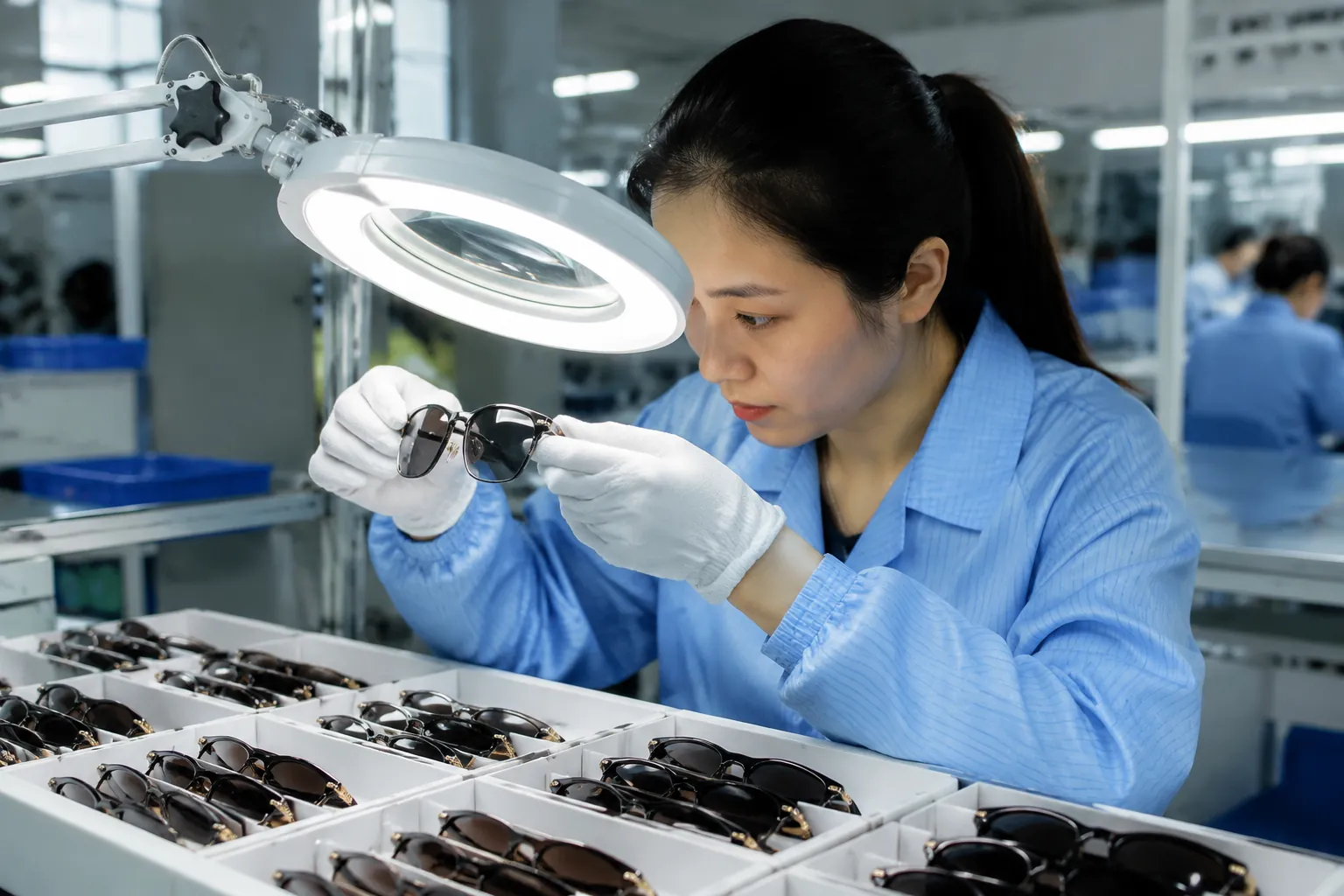
Choosing a stock frame mold, a modified mold, or full custom sunglasses tooling is not just a design choice. It affects MOQ, sample timing, tooling cost, tolerance control, compliance paperwork, and the chance of reordering the same SKU without drift. This guide is for brand owners, importers, distributors, and retail buyers who need a practical sourcing framework based on factory process reality, not concept art. Use it to match the development route to your order volume, launch date, margin target, fit requirements, and need for shape exclusivity.
Start with the commercial target, not the sketch
Many sourcing mistakes start with a rendering. The business case comes later, and that is backwards. A frame that looks simple on screen can become difficult once bridge fit, lens base curve, hinge placement, lens retention, temple thickness, logo method, surface finish, and packaging are defined.
Set the commercial target first. Then choose the mold route that supports it.
| Route | Best use case | Typical MOQ discussion | Sample timing | Bulk timing | Main trade-off |
|---|---|---|---|---|---|
| Existing stock mold | Fast launch, market test, promotions, replenishment | Lowest MOQ route; confirm by style, material, color, and decoration | Usually fastest because the frame structure already exists | Shortest production path after sample and artwork approval | Low shape exclusivity |
| Modified existing mold | Visible differentiation without building a full new frame | Higher than stock if rework, special parts, or extra setup is required | Depends on whether the change is cosmetic or structural | Depends on rework scope and sample approval rounds | Some changes are not safe or economical on an existing tool |
| Fully custom tooling | Brand-owned shape, repeat program, controlled fit and geometry | Best justified by planned repeat volume, not a one-time trial | Longest because tooling, trial parts, and corrections are required | Normal production timing starts only after tool and pre-production sample approval | Highest upfront cost and longest development path |
The mold route is only one part of the finished product. A stock frame can still be differentiated through lens tint, mirror coating, polarization where specified, temple logo, pad print, laser engraving, metal logo plate, case, pouch, barcode label, and retail packaging. Before paying for a new tool, confirm whether the intended market difference can be achieved through these controllable details.
Use stock molds when speed and MOQ matter most
Stock molds are usually the practical route for first launches, seasonal tests, private-label programs, event orders, and replenishment. The main advantage is process maturity. The factory has already produced the frame, checked how it assembles, and learned the common quality-control points for that model.
For injection-molded sunglasses, that matters. Plastic parts can shift during molding and cooling. A proven tool gives the supplier a known starting point for cycle settings, trimming, assembly, and lens fit. For acetate-based styles, an existing model gives the supplier a known reference for cutting, CNC shaping, tumbling, polishing, hinge fitting, and final adjustment.
The commercial upside is simple: less development burden. Sample lead time, MOQ, and bulk lead time still need written quotes for the exact frame, color, lens type, logo method, and packaging specification. A low-MOQ plain-color order is not the same workload as a multi-color order with custom lenses, metal logos, and retail packaging.
- Best for: market tests, private label, promotional programs, fast-turn retail, replacement stock, and buyers who need to reduce launch risk.
- Common customization options: frame color, lens tint, mirror coating, polarized or non-polarized lens specification, pad print, laser engraving, hot stamping, metal logo plate, pouch, case, carton mark, barcode, and retail box.
- Main limitation: the same base silhouette may be available to other buyers unless exclusivity is negotiated and documented.
If demand is uncertain, a stock mold usually protects cash flow better than tooling spend. Test first. Commit later.
Modify molds only when the change is limited
Modified molds sit between stock and full custom. Buyers often underestimate the risk. A small visual change may be affordable. A small-looking structural change can create many of the same problems as a new tool, but with less design control.
Realistic changes often include logo recesses, temple surface texture, branding zones, cosmetic line details, lens color changes, finish changes, and small non-critical dimensional adjustments. Risk rises when the change affects the lens groove, front curvature, bridge shape, wrap angle, endpiece thickness, temple connection, hinge axis, or lens retention.
Sunglasses are a tolerance stack, not a flat drawing. The frame front, lens shape, groove depth, hinge position, temple spread, screw fit, and finish process all interact. If one element shifts, workers may need to hand-fit lenses, adjust hinges, or reject more parts. That adds time. It also weakens repeatability on later orders.
If a proposed minor modification changes lens fit, hinge location, bridge geometry, or front curve, require a technical feasibility review before accepting price, MOQ, or lead time.
Modified molds make sense when the buyer needs visible differentiation and the requested change does not disturb functional geometry. They are a commercial compromise, not a way around engineering review.
Use custom tooling when repeat orders justify control
Custom tooling is not only about originality. Its stronger business value is control over geometry, fit, repeatability, and long-term SKU ownership. If a frame is planned as a core style, multi-season item, licensed product, or brand-defining shape, full custom tooling may be justified despite the higher upfront cost.
- You control fit architecture. Eye size, bridge width, temple length, front wrap, endpiece proportion, pantoscopic angle, lens base curve, and branding zones can be designed around the intended wearer and retail position.
- You get a clearer production reference. Once trial parts are corrected and the approved sample is signed off, the factory has a fixed standard for future runs.
- You improve reorder discipline. A dedicated tool, locked specification, and retained golden sample make it easier to catch drift in later production.
- You reduce substitution risk. A tool-specific frame is harder to replace with a near-equivalent stock model without approval.
The caution is commercial discipline. Evaluate custom tooling against planned volume, repeat probability, tooling ownership terms, storage responsibility, maintenance responsibility, and expected selling life. If the order is a one-time trial, the buyer may be paying for exclusivity that will not earn back its cost.
Compare total program cost, not only unit price
Unit price is only one line in the sourcing decision. Buyers also need to account for tooling charges, sample rounds, artwork revisions, approval delays, testing, packaging setup, rejected parts, inspection requirements, freight timing, and inconsistent reorders. A low piece price can become expensive if the route creates corrections or misses the launch window.
| Decision factor | Existing stock mold | Modified mold | Full custom tooling |
|---|---|---|---|
| Upfront development cost | Lowest | Medium, depending on rework | Highest |
| Small test orders | Usually strongest route | Viable only if changes are simple | Usually weak unless strategically necessary |
| Larger repeat programs | Efficient if the model remains available | Efficient if the modification is stable and documented | Can become strong when tooling cost is spread over repeat orders |
| Lead time risk | Lowest | Medium | Highest during development |
| Shape exclusivity | Low unless contractually restricted | Medium, depending on the change | Highest when ownership and use rights are explicit |
| Reorder control | Good if the stock model, material, and color remain active | Mixed; depends on what changed and how it is controlled | Strongest when drawings, specifications, and golden samples are locked |
The better buying question is not only, What is the unit price? Ask, What is the lowest-risk route to a consistent SKU over the next order cycle? That question forces the supplier and buyer to discuss development cost, approval timing, compliance requirements, and repeatability before production starts.
Lead time usually fails at approval
Late launches often come from slow decisions, unclear artwork, revised packaging, incomplete lens specifications, or late technical signoff. Production gets blamed. Approval is often the real problem.
Stock mold projects are simpler because the frame structure already exists. Modified and custom projects move more risk into the pre-production stage.
- Stock mold: select frame, confirm material and color, set lens specification, confirm logo and packaging, approve sample, then release bulk production.
- Modified mold: confirm whether the change is cosmetic or structural, review feasibility, make revised parts, check lens fit and hinge function, approve sample, then release production.
- Custom tooling: approve drawings or 3D files, confirm material and construction, cut tool, review trial parts, correct fit or appearance issues, approve pre-production sample, then enter normal production.
Technical review should cover lens retention, hinge torque, screw security, front symmetry, temple opening angle, bridge comfort, temple alignment, surface finish, logo placement, packaging fit, and final appearance. For acetate frames, check variation from tumbling, polishing, heat adjustment, and hinge installation. For injection frames, review flash trimming, gate marks, sink marks, warpage, color consistency, and lens seating.
Compliance should follow the final production specification and target sales market. Relevant eyewear standards may include CE EN ISO 12312-1, ANSI Z80.3, and AS/NZS 1067. Chemical compliance such as REACH may also apply. For the U.S. market, confirm whether the supplier or importer needs FDA registration or related device-listing obligations for the product category and business role. Testing a near-equivalent sample is not enough if the production lens tint, coating, thickness, material, or construction changes after testing.
Lock control points before approving the route
Stock, modified, and custom tooling all need documentation. Reorder control depends on it. A chat message is not a specification. A photo is not a tolerance agreement.
If the buyer expects repeat consistency, the control standard must be written, approved, and traceable.
- Material callout: TR90, PC, other injected plastic, acetate, metal insert, or mixed construction, plus gloss, matte, rubberized, crystal, or polished finish standard.
- Key dimensions: eye size, bridge, temple length, front width, lens base curve, wrap, and any fit-critical geometry.
- Tolerance expectation: define the dimensions and functional points that matter, especially lens seating, hinge alignment, temple spread, screw fit, and left-right symmetry.
- Lens specification: tint category, color reference, UV requirement, polarization if used, mirror or anti-reflective coating if used, and target-market standard.
- Decoration method: pad print, laser, foil, hot stamp, metal plate, molded logo, or other method, with exact placement and approved artwork.
- Approved reference: a signed sample or golden sample retained by both buyer and factory.
- Tool status: stock, modified, or custom, plus ownership, storage, maintenance, replacement, and permitted-use terms for any custom tool.
- QC checkpoints: incoming material check, in-process assembly check, lens inspection, logo check, final appearance inspection, functional check, carton marking, and any buyer-required inspection standard.
Many disputes are caused by drift rather than obvious defects. Lens color shifts. Logo placement moves. Hinge tension changes. Temple alignment weakens. Packaging materials get substituted. Written specifications, approved samples, and inspection records give both sides a practical basis for deciding whether a reorder matches the approved product.
Match the route to the buyer scenario
Scenario 1: New brand, fast market test. Use a stock mold. Keep the first order focused and avoid unnecessary tooling. Put budget into the details customers notice immediately: lens presentation, frame color, logo execution, packaging, and retail readiness. The goal is to learn whether the market wants the product before committing to exclusive geometry.
Scenario 2: One style sells, but looks too generic. First check whether the difference can be created without structural change. Temple detailing, texture, custom hardware, stronger color direction, lens treatment, and better packaging may be enough. If the needed difference depends on changing the front shape, bridge, lens geometry, or wrap, quote full custom tooling instead of forcing an existing mold into the wrong job.
Scenario 3: Distributor or chain-retail program with planned repeats. Consider custom tooling when the buyer has a credible reorder plan, clear fit requirements, and a need to reduce shape duplication. At that stage, control over geometry, documentation, and reorder consistency may matter more than minimizing the first order's development cost.
Scenario 4: Regulated-market order with specific lens or labeling claims. Do not approve production until the final lens specification, frame material, labeling, packaging, and test requirements are aligned. Confirm which standards apply to the destination market, such as CE EN ISO 12312-1, ANSI Z80.3, AS/NZS 1067, REACH, and any FDA registration responsibilities for the U.S. market.
There is no universal best route. Fast, low-cost, and exclusive rarely arrive together. The right decision depends on the main risk: uncertain demand, weak margin, late delivery, compliance exposure, or poor control over future reorders.
Have a custom sunglasses project in mind?
Send us your styles, target market and quantities and we will return a detailed quote with MOQ, lead time and a sample plan.
Get a QuoteWhy source this from Wenzhou with LumiShades
Wenzhou in Zhejiang Province is widely regarded as China’s eyewear manufacturing capital, producing a large share of the world’s sunglasses. That concentration matters to buyers: a deep local supply chain for acetate sheet, hinges, lens blanks, plating and packaging means shorter component lead times, easier color and material matching, and a workforce with decades of eyewear-specific skill. LumiShades has manufactured in this ecosystem since 2009, and our vertical integration — in-house injection molding, acetate cutting, CNC milling, lens tinting, decoration and quality control — means no part of your order is quietly subcontracted to a workshop you cannot audit.
For international buyers, that vertical control translates into accountability. When a single factory owns every step, defects are traced and fixed at source rather than bounced between vendors, and your specifications survive intact from first sample to bulk. We back this with 15+ years of experience, shipments to 60+ countries, more than 5 million pairs produced per year and a 98.5% on-time delivery rate. Our certifications — CE EN ISO 12312-1, FDA registration, ANSI Z80.3, AS/NZS 1067, REACH, ISO 9001 and BSCI audit — mean the compliance documentation your market requires already exists. Explore our manufacturing capabilities and quality control process to see how this works in practice.
Frequently asked questions
Can I get exclusivity if I use an existing mold? Usually not for the core frame shape unless the supplier agrees to a written exclusivity restriction. Ask whether the mold is public, semi-exclusive, or reserved. Define the territory, customer channel, duration, and minimum purchase commitment. Also state what happens if the purchase commitment is not met. Even without shape exclusivity, you can still differentiate through color, lens specification, decoration, packaging, labeling, and merchandising.
How do I know if a mold modification is minor or if it needs a new tool? Treat the change as minor only if it does not affect lens fit, groove depth, hinge axis, bridge geometry, front curve, wrap angle, temple attachment, or structural wall thickness. Send the supplier a marked drawing or 3D reference and ask for a written feasibility review covering tooling impact, sample steps, MOQ, cost, lead time, and quality risks. If lens seating or hinge function must be re-engineered, price it as a possible new-tool project.
What order size makes full custom tooling financially sensible? There is no universal threshold. Tooling cost depends on material, construction, number of parts, mold complexity, and correction rounds. Build a simple payback calculation: tooling cost divided by expected lifetime units, plus quoted unit cost, testing cost, packaging cost, and inspection cost. Custom tooling is easier to justify when the style has planned reorders, a stable selling life, and a clear need for proprietary shape or fit control.
Will compliance testing done on a sample cover my bulk order? Only if the bulk goods match the tested sample specification. Before relying on a report, compare the production material, lens tint, UV claim, coating, polarization, lens thickness, frame construction, labeling, and packaging to the tested sample. If any of those change, ask the lab or compliance advisor whether retesting is required for the target market. Relevant requirements may include CE EN ISO 12312-1, ANSI Z80.3, AS/NZS 1067, REACH, and FDA registration obligations where applicable.
What is the fastest route from concept to shipment? A stock mold with standard customization is usually fastest because the frame structure, assembly method, and common QC points are already known. To keep it fast, confirm the frame model, material, color, lens specification, logo artwork, packaging, barcode or carton marks, and inspection requirements before sampling. The most common delays are revised artwork, late packaging decisions, changed lens specifications, and approvals that are not signed off in writing.
Ready to start?
Explore our cat-eye sunglasses or request a quote — our sales team replies within 12 hours.
Request a Quote