
Custom Sunglasses MOQ Pricing by Order Size
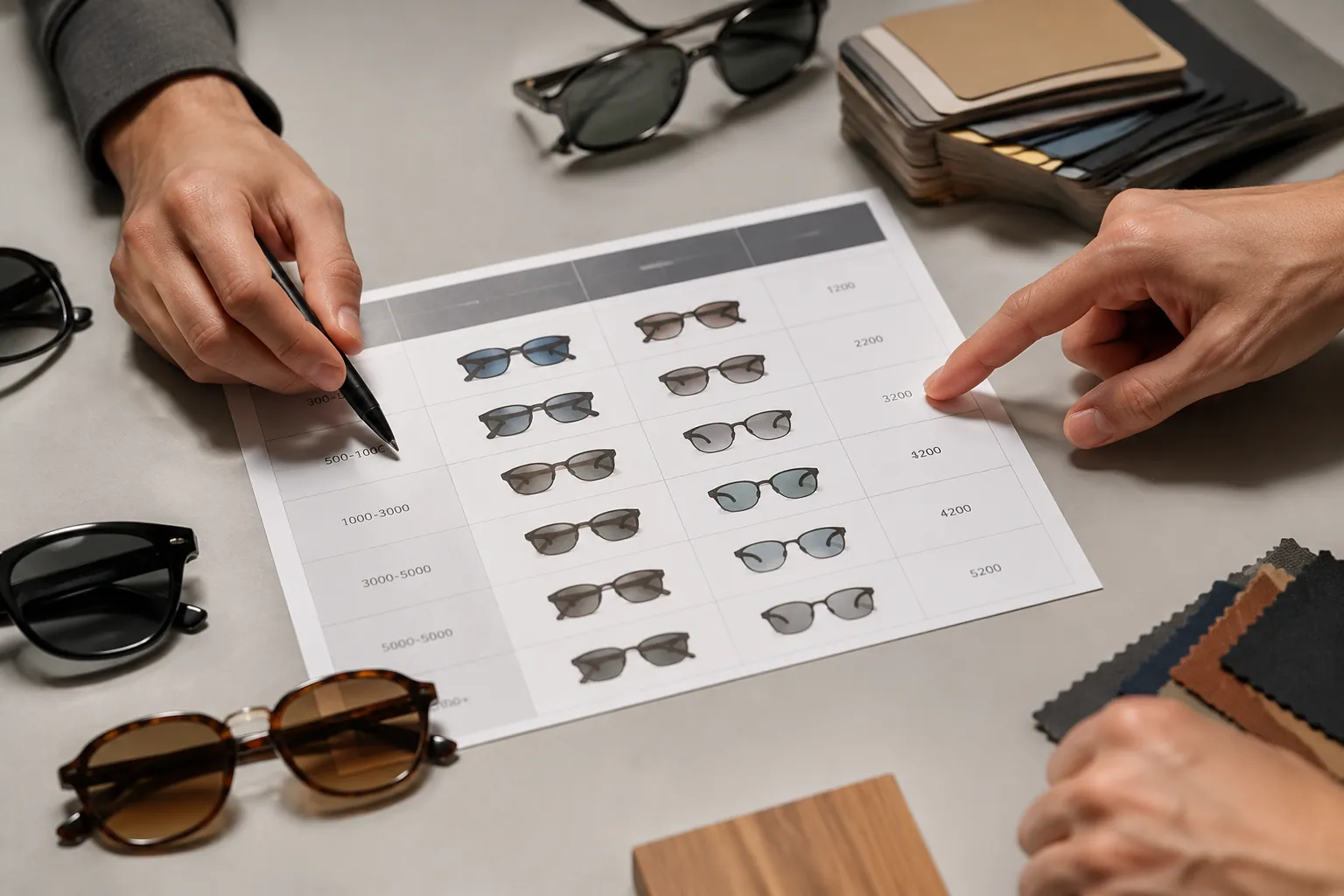
This guide is for overseas brands, importers, distributors, and retailers sourcing custom sunglasses from a factory. It explains what usually changes at 50, 300, 1,000, and 5,000+ pairs: setup work, material buying, decoration, lens spec, packaging, quality control, lead time, and landed cost. The point is not to chase the lowest quoted unit price. It is to find the order size and specification that give you the best cost per sellable, compliant, on-time pair.
The Real Price Break Is Not Just Labor
Many buyers read a wholesale sunglasses price ladder as a simple volume discount. That is too narrow. Labor matters, but fixed work matters more. A 50-pair order still needs artwork review, logo placement checks, frame color confirmation, lens approval, packing instructions, barcode review, and inspection records. Most of that setup work exists whether the order is 50 pairs or 300.
At LumiShades in Wenzhou, MOQ starts at 50 pairs per design. That is useful for pilot launches, corporate gifts, influencer drops, retailer presentation sets, and distributor tests. It is not the most efficient production quantity. At 50 pairs, each unit carries a heavy share of setup cost. At 300, 1,000, and 5,000+ pairs, the factory can usually buy materials in better lots, reduce changeovers, run longer assembly cycles, and pack more consistently.
Ask a better question. Not "What is the cheapest pair?" Ask, "What is the lowest-risk cost per sellable pair?" That includes reject rate, logo accuracy, lens category, carton labeling, shipment timing, freight density, and destination-market compliance. For sunglasses, buyers often need to review CE EN ISO 12312-1 for Europe, ANSI Z80.3 and FDA registration for the United States, AS/NZS 1067 for Australia and New Zealand, and REACH for restricted substances where relevant.
50 Pairs: Small Run, Real Setup Cost
At 50 pairs per design, you are buying a controlled small run. Not mass-production efficiency. This level works for approval samples, retail tests, event orders, small corporate programs, and first runs that need to look close to final production. It also makes sense when the frame shape, colorway, logo direction, or packaging is still unproven and you do not want dead stock.
The pressure point is setup. Laser engraving still needs fixture positioning and test shots. Pad printing still needs film or plate prep, ink matching, curing checks, and adhesion review. A logo placed slightly too low on a narrow temple can look obviously wrong. Lens tint should be checked in real light, not only on screen. A custom injected color may need masterbatch matching, while acetate may require tighter control over sheet selection and cutting direction.
- Best use: sample validation, small retail tests, distributor presentations, promotional runs.
- Typical lead time: sample development is commonly about 7-10 days after artwork and specification confirmation; bulk production is commonly about 25-35 days after sample, artwork, and packaging approval, depending on complexity and material availability.
- Control points: logo size and position tolerance, temple print alignment, lens category, UV400 claim, hinge tightness, packaging artwork, barcode readability, and carton marks.
- Avoid: too many frame colors, mixed lenses, mirror coatings, and multiple decoration methods in one small run.
Keep the test clean. One clear configuration gives better feedback than several tiny mixed batches. Narrow the spec, measure sell-through or buyer response, then scale the version that has proof behind it.
300 Pairs: The First Practical Commercial Break
Around 300 pairs, the order starts to behave like a real commercial batch. Decoration setup hurts less per unit. Material planning gets easier. Operators can repeat the same frame assembly, lens insertion, screw tightening, alignment check, cleaning, bagging, and carton packing steps long enough to gain efficiency.
This is often the best first wholesale level for a retailer colorway, seasonal capsule, resort order, or distributor trial. At 300 pairs, useful branding starts to make sense: laser engraving, one-color temple printing, or a simple pouch print. Packaging also becomes more practical. A microfiber pouch, barcode sticker, SKU label, and export carton marks may be worth the cost. A rigid retail box still needs caution. It can push up landed cost through extra volume, carton count, and handling.
QC also becomes more meaningful here. In a 50-pair run, one defect can swing the defect rate sharply. In a 300-pair run, repeated issues are easier to spot: loose hinge screws, lens edge stress, paint rub near the temple, poor logo adhesion, uneven nose pad position, or inconsistent packing. Useful checks include hinge opening resistance, lens seating, frame symmetry, temple alignment, visible scratch control under standard inspection light, and packaging consistency.
For many overseas buyers, 300 pairs is the first level where landed value starts to look sensible. Unit cost is still higher than larger runs. But you get enough stock to test demand, warehouse handling, retail presentation, supplier response, and inspection results before placing a bigger order.
1,000 Pairs: Spec Decisions Start to Pay Back
At 1,000 pairs, stop thinking like a sample buyer. Start thinking like a product manager. Small specification choices now move real money. A packaging insert, lens upgrade, special coating, or extra decoration step may look cheap per unit, but the total impact is now material. The reverse is also true. A weak hinge, poor lens claim control, or under-cured logo can lead to returns and margin loss that cost more than the original saving.
This is where process control matters. LumiShades handles key steps such as injection molding, acetate cutting, CNC milling, lens tinting, decoration, and QC in-house. That can make review and correction faster because issues can be caught before final assembly and packing. Injected frame color can be checked before full assembly. Acetate edge finishing can be reviewed before decoration. Lens tint and category can be confirmed before the order moves too far.
At 1,000 pairs, quote comparison needs more discipline. Ask what frame material is included: PC, TR90-style flexible material, or acetate. Confirm hinge type, lens material, lens category, UV400 claim, coating, decoration method, pouch, cloth, insert, carton packing, testing documents, and inspection level. If a supplier gives a one-line price, ask what assumptions sit behind it. A lower price that removes testing, changes the hinge, switches lens material, or excludes logo setup is not a lower price for the same product. It is a different product.
Lock compliance planning at this stage. For Europe, ask how CE EN ISO 12312-1 will be supported. For the United States, clarify ANSI Z80.3 expectations and whether FDA registration details are needed for the product and importer workflow. For Australia and New Zealand, AS/NZS 1067 is the key sunglass standard. REACH may apply to restricted substances in materials, coatings, inks, and packaging parts. Do not leave lens testing, labeling, or documentation until the week before shipment.
5,000+ Pairs: Better Buying Power, Less Room for Error
At 5,000 pairs and above, unit pricing often improves because material buying, molding schedules, decoration setup, assembly planning, and carton packing all run more efficiently. But the size of the price break depends on the product. A simple injected frame with standard UV400 lenses and one logo behaves very differently from an acetate frame with CNC shaping, custom lamination, metal trims, polarized lenses, mirror coating, and premium retail packaging.
Large orders are not automatically easier. They are less forgiving. A lens category error, wrong logo position, bad barcode, or incorrect carton label is now multiplied across pallets. Before releasing a 5,000-pair order, freeze the approved sample, logo artwork, Pantone or material reference, lens tint, packaging dieline, barcode data, carton marks, and inspection checklist. Keep a signed golden sample. Photograph it from the front, side, inside temple, lens close-up, logo close-up, and full package layout.
Production planning also changes. The factory can allocate longer line time, prepare materials in fewer lots, reduce changeovers, and pack in a stable carton configuration. Buyers still need to do their part: approve samples fast, send vector logo files, confirm destination standards, lock packaging early, and avoid last-minute changes to color, barcode, or carton marks. Any late change should trigger a written review of cost, timing, and inspection impact.
For 5,000+ pairs, use pre-shipment inspection. AQL inspection is a practical way to define sampling size and acceptance limits before goods leave the factory. Common major defects include wrong lens category, broken hinge, loose screw, severe frame deformation, incorrect logo, missing barcode, and dirty or damaged retail packaging. Minor defects may include small surface marks, slight print variation, or non-critical pouch creasing, depending on the agreed standard.
What Usually Changes by Order Size
| Order size | Best fit | Cost behavior | Spec advice | Main risk |
|---|---|---|---|---|
| 50 pairs/design | Prototype, buyer sample, small promotion | Highest setup cost per pair; limited purchasing leverage | Use one frame, one lens, one decoration method, and simple packaging | Over-customizing a small batch |
| 300 pairs | First commercial batch, retail test, capsule drop | Logo setup, material handling, and QC work spread across more units | Add practical branding; avoid bulky packaging unless required | Comparing quotes without checking inclusions |
| 1000 pairs | Seasonal wholesale order, importer stock program | Better unit economics; BOM decisions clearly affect margin | Lock lens category, compliance path, packaging, carton plan, and QC level | Small spec mistakes become expensive |
| 5000+ pairs | Distributor program, chain retail, repeat SKU | Strongest purchasing, molding, decoration, and packing efficiency | Use golden sample, controlled files, AQL inspection, and carton map | Late changes and multiplied defects |
The point is simple. A price break is not one number. At 50 pairs, you are paying for flexibility. At 300, you are buying the first sellable commercial batch. At 1,000, the factory can optimize production but expects clearer decisions. At 5,000+, the savings are real, and so is the exposure. The best price is attached to the right specification, not the cheapest line on a spreadsheet.
Where the Money Actually Moves
Decoration is a common reason two quotes for "the same sunglasses" are not the same at all. Laser engraving is clean and durable on suitable temples, but contrast depends on material and color. Pad printing works well for logos and small text, but ink adhesion depends on surface treatment, curing time, and abrasion resistance. Metal logo plates can raise perceived value, but they add component cost, placement work, and lead-time risk if the plate is custom. For temple logos, confirm size, distance from hinge, vertical alignment, color, and whether the logo should read from the wearer's view or the retail display view.
Frame material changes both cost and product behavior. Injected PC is efficient for promotional and entry fashion frames, but it usually feels different from higher-end materials. TR90-style flexible materials can improve comfort and resilience, depending on the model and formulation. Acetate allows richer colors and patterns, but cutting, CNC shaping, tumbling, polishing, and hinge insertion add time and cost. Acetate color can also vary by sheet batch, so approval should be tied to a physical material sample, not only a Pantone reference.
Lenses affect compliance, claims, and returns. A dark lens is not automatically protective. UV400 claims should be backed by testing or supplier documentation suitable for the destination market. Category 2 and Category 3 lenses suit different light conditions and should match the intended use and labeling. Polarized lenses cost more, but they may be worth it for fishing, driving, resort, and outdoor programs. Mirror coatings create strong visual appeal, but they are more sensitive to scratches and handling defects. That means packing and inspection standards need to be clear.
Packaging is another cost trap. A microfiber pouch packs efficiently. A rigid box increases volume weight, carton count, and freight cost. Printed inserts, barcode labels, hang tags, polybags, desiccants, and carton marks all need data control. At 50 pairs, keep packaging simple. At 300, add only what supports the sale or warehouse process. At 1,000 and 5,000+, treat packaging like any other production component, with approved artwork, dimensions, material, barcode data, carton marks, and inspection points.
How to Ask for a Quote You Can Actually Compare
A useful RFQ is specific. "Send your best price for custom sunglasses" will produce weak quotes because each factory may be assuming a different product. A comparable RFQ gives the supplier enough detail to price the same item at 50, 300, 1,000, and 5,000+ pairs.
For the frame, state the material and finish: injected PC, TR90-style flexible material, or acetate; matte, gloss, transparent, tortoise, or custom color. For lenses, state standard tint, gradient, mirror, polarized, lens category, UV400 requirement, and target standard. For decoration, include vector logo files, size, position, color, and preferred method: laser engraving, pad printing, hot stamping, or metal plate. For packaging, list pouch, cloth, box, insert, barcode, hang tag, polybag, carton marks, and required carton quantity per case if your warehouse has limits.
Also ask for lead-time logic. A normal flow may include sample development first, then bulk production after approval. Custom packaging, special lenses, custom acetate sheets, metal accessories, third-party testing, or inspection scheduling can add time. If the shipment date is fixed, say so before quoting so the factory can confirm whether the schedule is realistic.
Buyer rule: if a lower price removes lens testing, changes packaging, uses a weaker hinge, downgrades material, or excludes logo setup, it is not a lower price for the same product. It is a different product.
LumiShades supports small MOQs and larger programs because key processes are handled in-house, including injection molding, acetate cutting, CNC milling, lens tinting, decoration, and QC. Use that capacity properly. Send a precise specification. You will get a clearer quote, fewer revisions, and a better read on landed value.
Have a custom sunglasses project in mind?
Send us your styles, target market and quantities and we will return a detailed quote with MOQ, lead time and a sample plan.
Get a QuoteWhy source this from Wenzhou with LumiShades
Wenzhou in Zhejiang Province is widely regarded as China’s eyewear manufacturing capital, producing a large share of the world’s sunglasses. That concentration matters to buyers: a deep local supply chain for acetate sheet, hinges, lens blanks, plating and packaging means shorter component lead times, easier color and material matching, and a workforce with decades of eyewear-specific skill. LumiShades has manufactured in this ecosystem since 2009, and our vertical integration — in-house injection molding, acetate cutting, CNC milling, lens tinting, decoration and quality control — means no part of your order is quietly subcontracted to a workshop you cannot audit.
For international buyers, that vertical control translates into accountability. When a single factory owns every step, defects are traced and fixed at source rather than bounced between vendors, and your specifications survive intact from first sample to bulk. We back this with 15+ years of experience, shipments to 60+ countries, more than 5 million pairs produced per year and a 98.5% on-time delivery rate. Our certifications — CE EN ISO 12312-1, FDA registration, ANSI Z80.3, AS/NZS 1067, REACH, ISO 9001 and BSCI audit — mean the compliance documentation your market requires already exists. Explore our manufacturing capabilities and quality control process to see how this works in practice.
Frequently asked questions
Is 50 pairs enough for a real custom sunglasses order? Yes, if the specification is tightly controlled. Use 50 pairs for approval samples, small promotions, retailer presentations, or a narrow market test. Keep the frame color, lens type, decoration method, and packaging simple. Before scaling, check logo position, lens tint, hinge feel, barcode readability, packaging fit, and whether the sample matches the compliance path for the destination market.
Why does the price drop around 300 pairs? Because fixed work is spread across more units. Logo setup, artwork review, material handling, line changeover, QC preparation, and packing instructions do not shrink in proportion to a small order. At about 300 pairs, the factory can repeat the same steps long enough to cut setup cost per pair and expose repeated quality issues that may not show clearly in a 50-pair run.
Can I mix colors and still keep the same price break? Sometimes, but every split should be approved before quoting. A 1,000-pair order split into five frame colors may behave more like several smaller runs, especially if each color also uses different lenses, logos, or packaging. Ask the factory to quote the exact split by SKU, including any color MOQ, setup charge, material surcharge, and lead-time impact.
Which certifications or standards should I ask for? Match the request to the sales market. For Europe, ask about CE EN ISO 12312-1 support. For the United States, discuss ANSI Z80.3 and FDA registration requirements with your importer or compliance adviser. For Australia and New Zealand, ask about AS/NZS 1067. For restricted substances, ask how REACH is addressed. At the factory level, ISO 9001 and BSCI can support quality management and social compliance review, but they do not replace product testing for sunglasses.
What information should I send to get accurate wholesale sunglasses pricing? Send the frame material, frame finish, lens type, lens category, UV400 or polarized requirement, target market standard, logo file, logo size and position, decoration method, packaging details, barcode needs, carton mark requirements, destination market, order quantities by SKU, inspection requirement, and target delivery date. If you are comparing 50, 300, 1,000, and 5,000+ pairs, ask the factory to keep the same specification across all quantity levels.
How do I avoid surprises in a 5,000-pair order? Approve a signed golden sample before bulk production. Freeze artwork, color references, lens category, packaging files, barcode data, carton marks, and the inspection checklist in writing. Confirm the applicable standards before production starts, not before shipment. Arrange pre-shipment inspection using agreed AQL levels and define major defects such as wrong lens category, broken hinge, incorrect logo, missing barcode, or damaged retail packaging.
Ready to start?
Explore our wayfarer sunglasses or request a quote — our sales team replies within 12 hours.
Request a Quote