
How to Brief a Sunglasses Factory for an Accurate Quote
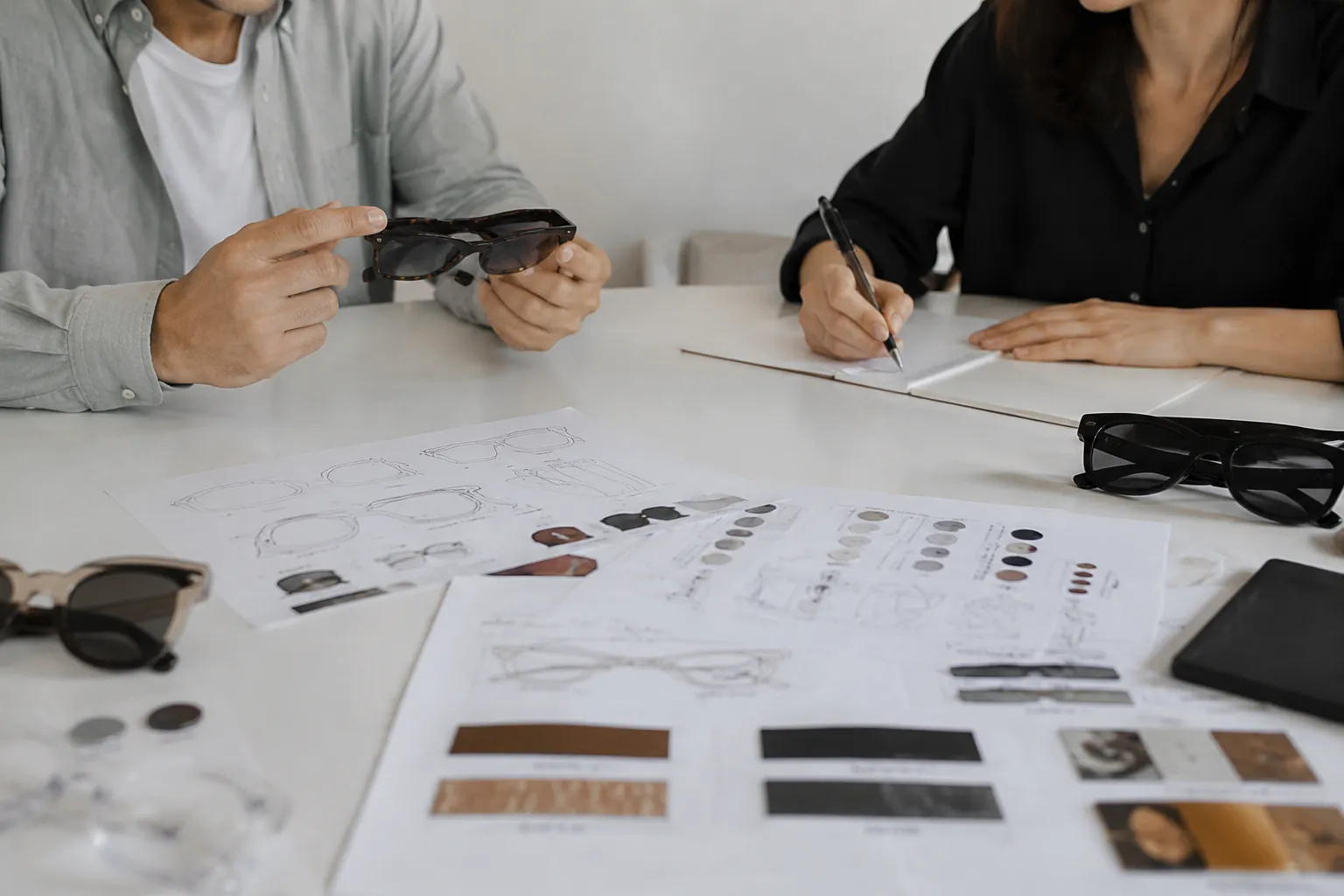
This guide is for brand owners, importers, distributors, and retailers buying custom sunglasses in volume. If your first RFQ is vague, the quote will be vague too. Factories will fill the gaps with assumptions on materials, lenses, branding, packaging, and compliance. That usually leads to rework. A mood board is not enough. A factory needs clear technical and commercial inputs to judge feasibility, choose a process route, and state what is included in the price. The more defined the brief, the more useful the quote. Simple.
Start with the five variables that shape the quote
Most quote delays start the same way: the buyer asks for pricing before the build is defined. For sunglasses, five variables usually drive both the number and the factory's assumptions.
- Frame construction: injection-molded plastic, acetate, metal, or mixed material. If an existing mold or factory shape can be adapted, quoting is usually simpler. If you need a fully custom mold or custom hardware, the factory may need to review tooling feasibility before confirming price and timing.
- Lens specification: for example PC, acrylic, TAC polarized, or nylon, plus tint, gradient, mirror, and coatings if needed. Lens construction and finish can change cost, lead time, and test assumptions in a big way.
- Decoration: one-color temple print is not the same as laser engraving, foil application, metal logo plates, or branding in multiple positions. Decoration affects setup, reject risk, and often MOQ logic.
- Packaging: a simple polybag packout is very different from a pouch, box, barcode application, warning label, insert card, and carton marking program. Put packaging in the RFQ. Do not add it later and expect the first quote to hold.
- Compliance market: EU, US, Australia/New Zealand, or more than one market. This affects the standards the product should be built against and what documentation or testing path may be needed later.
If any of these are undefined, the factory will quote a range or make assumptions. Neither helps if you want fair supplier comparison. A useful quote depends less on how polished the presentation looks and more on whether the brief says exactly what the factory is costing.
What to send in the first RFQ package
Your first RFQ package does not need polished design files. It needs enough detail for costing, technical review, and sample planning. Send one structured email or one file set. Not ten scattered messages.
- Reference images: front, side, top, hinge close-up, temple tip, logo area, and packaging references if available.
- Dimensions: lens width, bridge, temple length, front width, lens height, base curve if relevant, and any fit notes. If you want to match an existing sample, identify it as the control sample and state acceptable tolerance.
- Material request: for example PC, TR90-style injection material, acetate, metal trim, stainless components, or mixed construction.
- Lens request: lens material or construction, tint color, category target or intended appearance, gradient or solid, mirror yes or no, UV400 requirement if requested, and whether color consistency between lots matters.
- Logo method: pad print, screen print, laser engraving, foil print, metal logo plate, inside temple print, or lens logo.
- Colorways and quantity split: state quantity by colorway, not just total volume.
- Packaging: polybag, sleeve, pouch, case, barcode format, warning labels, insert cards, and carton marks.
- Compliance target: whether the product is intended to be built for CE EN ISO 12312-1, ANSI Z80.3, AS/NZS 1067, and whether REACH-related material restrictions apply. If your vendor onboarding asks for ISO 9001, BSCI, or FDA registration details, mention that separately.
- Timeline: sample deadline, target approval date, target ship window, destination country, and whether the timing depends on air or sea shipment.
Keep it consolidated. If the project is confidential, say so up front and state whether an NDA is required before deeper technical sharing.
Specs buyers often skip but factories still need
Two buyers can send the same inspiration image and get very different samples back. Why? The missing details were never written down.
Tolerance and fit: If dimensions matter, state them. If you are replacing an existing SKU, identify the retained sample as the reference standard. If only visual similarity matters, say that. A factory cannot guess your tolerance from a photo.
Lens category and appearance: Do not write only "dark lens." State the intended appearance or market target, such as category 3 smoke appearance, category 2 brown gradient, or a light fashion tint. This affects visible light transmission assumptions and later testing decisions.
Polarization details: "Polarized" is incomplete. Specify the requested construction, such as TAC polarized, and note whether mirror coating is required over the lens. If the retail package needs a polarization demo card, include that in packaging. Do not leave it implied.
Hinge and hardware: State standard hinge or spring hinge, visible hardware color, nickel-free requirement if it applies to your program, and whether you expect a particular opening or closing feel. Hardware changes can affect both appearance and assembly route.
Surface finish: Gloss, matte, rubberized coating, crystal, or laminated acetate appearance should be written clearly. Surface finish affects aesthetics and packout risk.
Decoration placement: "Logo on temple" is not enough. Factories need artwork size, position from hinge or temple tip, print color or plating color, and whether left-right placement must visually match within a defined tolerance.
Commercial basis: If you are comparing quotes, confirm whether you want EXW, FOB, or another term if discussed with the supplier. If freight terms are inconsistent, the quotes are harder to compare. Easy to miss. Costly later.
How material choice changes cost, MOQ, and sampling
Not every design should be quoted in the same material. If you send only a photo and ask for the cheapest option, the result may not match the intended look, weight, finish, or durability target. Material choice affects feasibility, process route, and quote logic.
| Build option | Typical MOQ logic | Unit cost effect | Sample timing | Process detail |
|---|---|---|---|---|
| Injection molded plastic frame + basic PC lens | Often more suitable for lower MOQs when an existing shape or tooling route is available | Usually the most cost-efficient route for simple builds | Generally faster than more complex constructions, subject to color and tooling availability | Often used for promotional or straightforward fashion programs; exact custom shape may require tooling review |
| Injection frame + TAC polarized lens | MOQ efficiency often depends on lens sourcing and color split | Usually higher than a basic non-polarized build because of lens construction | May require added review if custom lens color or mirror finish is requested | Common for retail programs balancing price and perceived value; lens specification should be written precisely |
| Acetate frame + standard sun lens | Often less efficient at very low volume because of material and labor setup | Usually higher due to sheet material and finishing labor | Commonly more involved than basic injection sampling | Can deliver stronger color depth and a premium feel; thickness, bevel, and finish should be specified |
| Mixed material frame + metal logo plate | MOQ depends on hardware, branding method, and assembly complexity | Usually higher due to additional parts and assembly steps | May take longer if hardware or logo plate approval is separate | Brand-forward option with more approval points, including plating color, fixation method, and alignment |
Process capability matters too. A factory that handles more steps in-house may review trade-offs faster, but buyers should still ask which steps are internal and which are subcontracted. Do not rely on vague promises about speed. Ask the supplier to confirm the sample route, whether new tooling is involved, and what could change the lead time after quotation.
Price logic: why the same design gets different quotes
Ask for tier pricing. One flat number is rarely enough.
Sunglasses pricing is sensitive to total volume, quantity per colorway, lens specification, branding method, and packaging scope. A quote for one color in one packout format is not directly comparable with a quote for multiple colors and more finishing steps.
For example, 1,000 pairs in one frame color with one lens color is usually simpler to run than 1,000 pairs split across many colorways. Each colorway can create extra material setup, matching work, and smaller production batches. That is why factories often quote by quantity tier and by color split.
- Low MOQs: feasible only for certain constructions, especially if based on existing shapes or standard materials. Unit pricing is usually less efficient because setup is spread across fewer units.
- Mid-volume orders: often provide a more realistic basis for private label costing because material usage and setup are spread more efficiently.
- Higher-volume orders: may improve efficiency in sourcing, decoration, and packaging conversion, but only if the specification stays stable.
- Complexity effect: a simple build at higher volume can cost less per pair than a lower-volume order with custom hardware, multiple color splits, and more packaging steps.
What usually moves the price most?
- Quantity per colorway
- Lens construction and coatings
- New tooling or custom hardware
- Decoration complexity and number of logo positions
- Packaging set and barcode or labelling work
- Testing cost if quoted separately
Ask the factory to separate at least these lines in the quote: unit price, sample charge, tooling charge, packaging charge, and testing charge. That makes supplier comparison cleaner because you can see what is included and what is still an assumption.
Compliance assumptions to confirm before sampling
Do not leave compliance until after artwork approval. It affects lens selection, markings, material choices, technical documents, and whether the first sample is visual-only or meant to reflect the production build.
For EU business, state that the build should be quoted on assumptions suitable for CE EN ISO 12312-1. For the US market, discuss performance expectations against ANSI Z80.3. For Australia and New Zealand, specify AS/NZS 1067. If your program requires restricted-substance control, state REACH clearly.
If the supplier says it is FDA registered, treat that as a company registration point relevant to US market handling, not as a substitute for product-performance compliance. If your onboarding process requires management-system or social-compliance documentation, mention ISO 9001 and BSCI early so the supplier can confirm availability.
Also define the sample purpose:
- Appearance sample: used to review shape, color, branding location, and general look.
- Sales sample: used for internal presentation or customer review, but it may not always match final production materials.
- Pre-production sample: intended to reflect the approved production specification as closely as possible.
If you need testing tied to the final production build, say so before development starts. A later change in lens construction, coating, finish, or material can change the compliance path and invalidate earlier assumptions.
Useful RFQ wording: Please quote this style with TAC polarized smoke lenses, category 3 sun-use appearance, REACH-compliant materials, and build assumptions suitable for CE EN ISO 12312-1 and ANSI Z80.3.
The approval path that cuts avoidable delays
Factories move faster when approvals happen in the right order. The wrong order creates duplicate work, extra sample rounds, and confusion over which version is current.
- Approve the quote basis: frame material, lens type, decoration method, packaging set, quantity tiers, and commercial basis if discussed.
- Approve artwork files: vector logo, print color callouts, logo size, engraving expectations, and any metal plate finish details.
- Approve sample purpose: appearance sample, sales sample, or pre-production sample.
- Approve packaging layout: pouch artwork, box artwork, barcode rules, warning text, and shipping marks.
- Approve the sample with one consolidated comment sheet: submit all requested changes together, with photos, dimensions, and pass or fail notes.
Buyers often lose time by changing one variable at a time across multiple emails. First the frame color is approved. Then the lens tint changes. Then the logo artwork changes again. At that point the sample may need to be remade or rechecked.
Use one comment sheet. Identify the version reviewed, list all required corrections, and state the deadline for revised confirmation.
Good comments are specific. "Temple logo too close to hinge by 3 mm" is actionable. "Please improve branding" is not. Clear feedback helps the factory confirm whether the change affects only appearance or also cost, tooling, or lead time.
Copy-and-send RFQ template
Use this template as a starting point. It is simple, but it gives a factory enough detail to quote on a defined basis.
Project: Custom sunglasses, private label
Target quantity: 300 pcs black/smoke + 300 pcs crystal brown/brown, 600 pcs total per design
Frame: Injection plastic, gloss finish, front width 145 mm ±1 mm, temple 145 mm ±1 mm, lens height 48 mm ±0.5 mm, standard hinge, no spring hinge
Lens: TAC polarized, smoke category 3 appearance, UV400 requested, no mirror, color consistency required between approved sample and bulk
Branding: 1-color white pad print on outside temple, logo length 22 mm, positioned 8 mm from hinge; inside temple white spec print
Packaging: Individual polybag + microfiber pouch, barcode sticker on pouch, export carton with SKU and quantity marks
Compliance basis: Build suitable for CE EN ISO 12312-1 and ANSI Z80.3; REACH-compliant materials requested
Quote request: Please quote quantity tiers and separate sample charge, tooling, packaging, and testing cost if not included
Timing: Please advise realistic sample lead time and bulk lead time after approval
Attachments: Reference photos, dimension sketch, logo AI file, barcode list, pouch artwork
That is usually enough for the factory to return a usable quote, MOQ logic, sample route, and follow-up questions. It also makes supplier comparison fairer because each factory is costing the same brief, not interpreting a vague idea in different ways.
Have a custom sunglasses project in mind?
Send us your styles, target market and quantities and we will return a detailed quote with MOQ, lead time and a sample plan.
Get a QuoteWhy source this from Wenzhou with LumiShades
Wenzhou in Zhejiang Province is widely regarded as China’s eyewear manufacturing capital, producing a large share of the world’s sunglasses. That concentration matters to buyers: a deep local supply chain for acetate sheet, hinges, lens blanks, plating and packaging means shorter component lead times, easier color and material matching, and a workforce with decades of eyewear-specific skill. LumiShades has manufactured in this ecosystem since 2009, and our vertical integration — in-house injection molding, acetate cutting, CNC milling, lens tinting, decoration and quality control — means no part of your order is quietly subcontracted to a workshop you cannot audit.
For international buyers, that vertical control translates into accountability. When a single factory owns every step, defects are traced and fixed at source rather than bounced between vendors, and your specifications survive intact from first sample to bulk. We back this with 15+ years of experience, shipments to 60+ countries, more than 5 million pairs produced per year and a 98.5% on-time delivery rate. Our certifications — CE EN ISO 12312-1, FDA registration, ANSI Z80.3, AS/NZS 1067, REACH, ISO 9001 and BSCI audit — mean the compliance documentation your market requires already exists. Explore our manufacturing capabilities and quality control process to see how this works in practice.
Frequently asked questions
Can I ask for a quote before I know exact dimensions? Yes, but ask for a preliminary quote and expect the supplier to state its assumptions. To keep that quote useful, send a reference style and say whether the factory may use a similar existing size or whether the final product must match a retained sample. If dimensions are not final, ask which cost items could change later, such as tooling, lens size, or packaging fit.
What is the minimum information needed for a first accurate quote? At minimum, send reference images, target frame material, lens type or construction, branding method, quantity by colorway, packaging requirement, and target market or compliance basis. Also state whether the design should be based on an existing shape or a fully custom shape. Without those points, the supplier has to guess, and quotes will not be comparable.
Should I ask for testing before or after sample approval? State the intended compliance target before sampling starts so the factory can quote and build on the right basis. Then confirm whether the first sample is for appearance only or should follow production-intent materials. Formal testing is usually most useful once the production specification is fixed, because changes to lens construction, coatings, frame material, or finish can affect the result and may require retesting.
How do MOQs work if I need several colors? Do not assume MOQ applies only to the total order. Ask whether MOQ is set per design, per colorway, per lens color, or per material-color combination. Then ask for pricing by quantity split. For example, request a quote for one design at 600 units total split across two colors, and compare that with a four-color split. This will show whether small color runs create a meaningful unit-cost increase or added lead-time risk.
What usually causes sample delays on custom sunglasses? The most common causes are incomplete artwork files, unclear logo placement, unsettled lens color, packaging changes after development starts, and late confirmation of compliance requirements. Delays also happen when the buyer does not define whether the sample is for appearance only or for production intent. To reduce delay, send vector artwork, a dimensioned placement sketch, a consolidated spec sheet, and one comment sheet for each revision round.
Ready to start?
Explore our aviator sunglasses or request a quote — our sales team replies within 12 hours.
Request a Quote