
OEM vs ODM Sunglasses: Which Sourcing Model Fits?
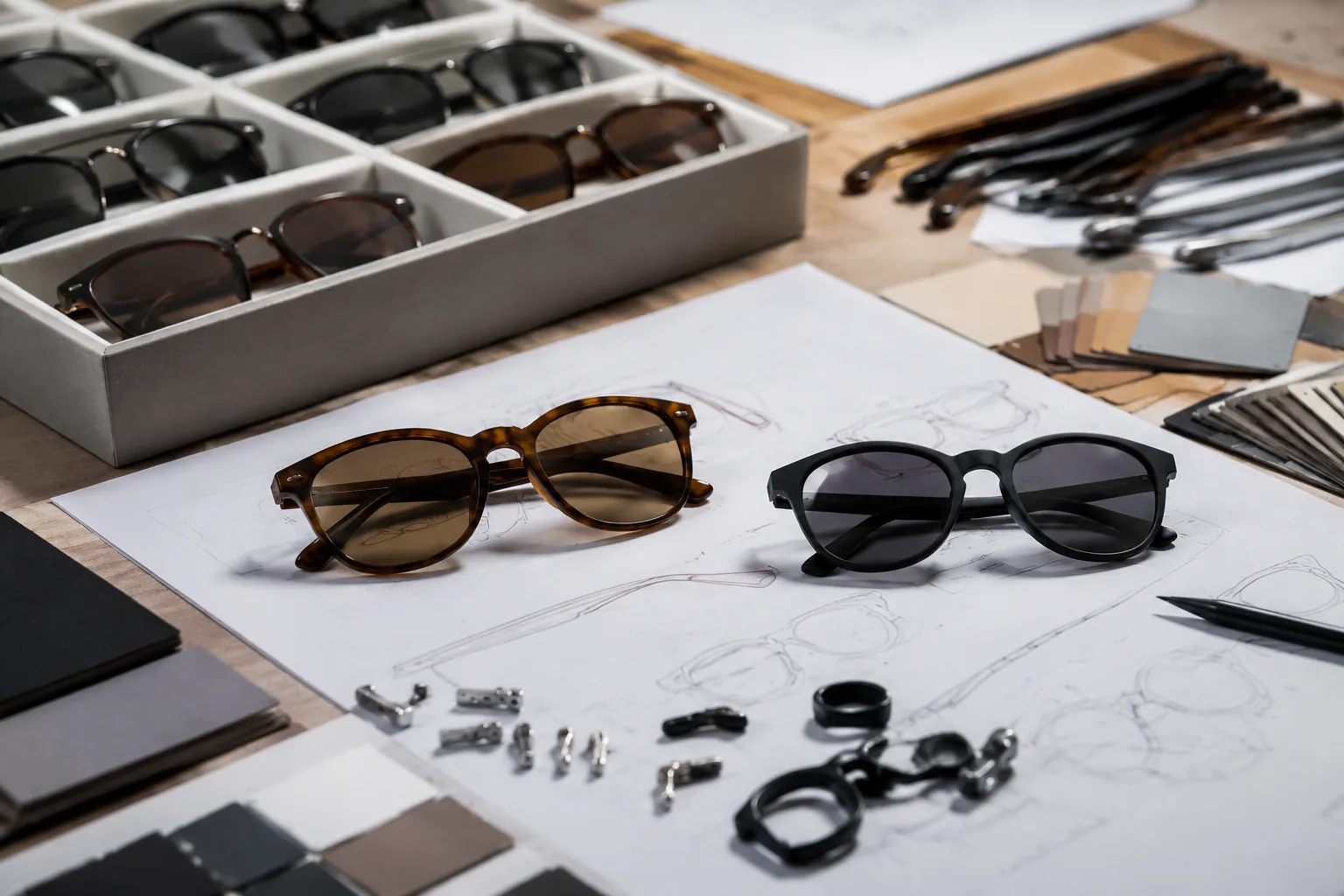
This guide is for brand owners, importers, distributors, and retailers buying sunglasses in volume. In eyewear, the sourcing model shapes development time, cost, compliance work, and reorder consistency. Many first-time buyers underestimate that. The real choice is rarely just OEM versus ODM. Most programs fall into one of three paths: pure ODM, modified ODM, or full OEM. This article explains how each option works, where the risk actually sits, and what to confirm before you ask for samples or pay a deposit.
Start with the three real sourcing options
Buyers often frame eyewear sourcing as a clean OEM-versus-ODM choice. It usually is not. In practice, there are three common paths, and the middle one is often the most practical.
| Model | What you buy | Typical MOQ | Upfront cost | Sample timing | IP control |
|---|---|---|---|---|---|
| Pure ODM | Existing factory mold with your logo, color, lens tint, and packaging | Factory-dependent; often the lowest MOQ option | Low | Usually the fastest | Low to medium |
| Modified ODM | Existing base shape with custom trim, logo plate, finish, lens spec, or packaging upgrades | Higher than pure ODM if added trims or materials require separate setup or sourcing | Low to medium | Fast to moderate | Medium |
| Full OEM | New frame developed from sketch, tech pack, sample, or 3D file, often with new tooling or new CNC program | Usually the highest MOQ for viable costing | Medium to high | Longest | Highest if documented properly |
Pure ODM is the fast route if you need a saleable frame quickly and the core shape is not your differentiator. Modified ODM is common when you want a stronger brand look without paying for a fully new structure. Full OEM makes sense when fit, geometry, exclusive styling, or long-term repeat volume justify more engineering and approval work.
The operational gap matters. With ODM, the front curve, lens groove, hinge position, and temple geometry already exist. Most changes are cosmetic or spec-based. With OEM, the supplier may need to review wall thickness, lens seating, hinge construction, temple spread, and structural feasibility before a development sample can be treated as production-ready.
A blunt framework for choosing fast
If you are unsure which path fits, decide in this order: delivery deadline, target order size, development budget, then required differentiation.
- Choose pure ODM if speed, lower MOQ, and lower cash exposure matter more than unique frame architecture.
- Choose modified ODM if you need faster market entry but still want visible brand signals such as custom temple print, laser engraving, a metal logo plate, upgraded packaging, or a specific lens option.
- Choose full OEM if your design depends on exact lens shape, bridge fit, temple profile, material thickness, or geometry that cannot be achieved from an existing mold family.
The quantity rule is simple. It prevents expensive mismatches. If you are testing a market with a small first order, full OEM is often hard to justify unless the frame is strategically important. If you expect repeat orders across multiple seasons, development cost is easier to spread across future volume, and OEM becomes easier to defend.
Compare total program cost, not just unit price. A quote can look cheap until you add sample charges, tooling, trim development, packaging upgrades, retesting, and schedule risk. That is where many comparisons go wrong.
What changes between ready molds and full development
The gap between ODM and OEM is not only design freedom. It is process control.
With pure ODM styles, the factory already knows how the frame runs in production. The main variables are usually resin color, lens tint, branding method, and packaging. That is why ODM is usually faster and easier to quote.
Modified ODM sounds minor. It often is not. Small changes can create real production variables:
- Metal logo plate: requires artwork, dimensions, attachment method, and durability checks.
- New lens tint: needs a defined visual standard or reference sample. Terms like "smoke gray" are too subjective on their own.
- Rubberized or soft-touch coating: may improve perceived value, but performance depends on coating quality and use conditions.
- Custom acetate pattern: may require new sheet sourcing and can introduce color-lot variation.
Full OEM follows a different path. The supplier first reviews your drawing, sample, or 3D file for feasibility. Then come engineering checks: front thickness, hinge construction, lens groove depth, material behavior, and balance after lens assembly. For acetate, the process may involve sheet selection, CNC work, shaping, polishing, assembly, and heat adjustment. For injection styles, a new mold may be required if the geometry cannot be achieved with an existing tool family.
One hard truth: a sample that looks right is not automatically ready for mass production.
Because tolerances vary by material, design, and manufacturing method, do not rely on vague promises such as "same as sample." Ask the supplier to state the control points that matter for your project, including size marking, logo placement, lens color reference, hinge type, and appearance standard.
Cost and lead time: where quotes get misread
Many quote comparisons are flawed from the start. Buyers compare an ODM unit price with an OEM target price and ignore setup cost, development cost, and schedule risk.
| Cost or timing item | Pure ODM | Modified ODM | Full OEM |
|---|---|---|---|
| Sample timing | Usually shortest | Usually short to moderate | Usually longest |
| Bulk timing | Typically shortest after approval | Can extend if trims, special finishes, or new materials are involved | Usually longest after final approval |
| Development/tooling cost | Minimal | Low to moderate | Highest; may include mold, CNC programming, fixtures, and trial runs |
| Unit price at lower volume | Usually most favorable | Moderate | Usually least favorable |
| Repeatability at higher volume | Good if the specification stays simple | Good if trims and materials are standardized | Often strongest when drawings, sample standards, and QC points are locked |
Three cost drivers shape most sunglasses programs:
- Material family: injection plastic, acetate, and mixed-material constructions have different cost and handling profiles.
- Lens specification: standard tinted lenses are simpler than polarized, mirrored, gradient, or tightly controlled transmittance programs.
- Decoration count: one branding method is easier to control than multiple logos, inserts, prints, and retail-ready packaging elements combined.
Ask the factory to break the quote into frame, lens, decoration, packaging, sample cost, tooling cost, and any compliance-related charge. If the quotation is too blended, you cannot see what is driving cost. And if you cannot see it, you cannot judge it.
Materials, decoration, and the quality details that decide reorders
When buyers ask for "better quality," the supplier still needs measurable instructions. Material and decoration choices affect both appearance and repeatability.
Injection plastic is common for cost-sensitive and fast-turn programs. Acetate usually gives a more premium look and richer color depth, but sheet variation and hand-finishing require tighter approval standards. PC lenses are widely used in sunglasses. Polarized lens constructions can add value, but they also add cost and another layer of specification control.
Decoration method changes the risk profile too:
- Pad print: cost-effective and common for logos, but generally less permanent than embedded or mechanically fixed branding.
- Laser engraving: cleaner and more durable on suitable surfaces, though contrast depends on material and finish.
- Metal logo plate: stronger premium signal, but adds attachment and consistency variables.
- Inside temple print or hot foil: useful for branding and product information, but alignment and abrasion resistance should be checked.
For reorders, turn preferences into written controls. Typical examples include an approved color sample, a lens reference, artwork with dimensions for logo position, hinge specification, packaging specification, and a final inspection checklist. Write it down early. It saves arguments later.
IP, exclusivity, and the ownership gap
Many buyers ask for OEM when what they actually want is exclusivity. Related idea. Different issue.
If you choose an existing factory mold, your branding, colorway, and packaging may be unique while the underlying frame architecture is not. That is normal in private-label sunglasses. Modified ODM can create more distance from a catalog item, but if the core mold family stays the same, similar products may still appear elsewhere in the market.
Full OEM usually gives the strongest exclusivity position if the factory develops new geometry for your project. Even then, ownership has to be written down early. Clarify these points before development goes too far:
- Who pays for tooling, CNC programming, fixtures, and development samples.
- Whether paid-for tooling is exclusive to you or only reserved for a defined period.
- What happens to the tool, CAD data, and approved sample standard if the relationship ends.
- Whether the supplier may produce a similar frame for another customer with modified dimensions or trims.
Without written terms, buyers often assume more control than they have. That assumption gets expensive during repeat production or supplier changes.
Compliance can change the model choice
Sunglasses are regulated products in many markets. That alone can change which sourcing model is most practical.
Factories may show documentation or management certifications such as CE EN ISO 12312-1, ANSI Z80.3, AS/NZS 1067, REACH, FDA registration, ISO 9001, or BSCI. Read them carefully. Product test reports are not the same as factory-management certifications or social-audit records.
The real question is simple: does your exact frame-and-lens combination, labeling, and destination-market requirement already fall within the existing documentation, or do your changes trigger fresh validation?
Examples:
- CE EN ISO 12312-1 relates to sunglasses performance requirements for the relevant market context.
- ANSI Z80.3 is relevant for U.S. sunglass performance requirements.
- AS/NZS 1067 is relevant for Australia and New Zealand market requirements.
- REACH is relevant to restricted substances for applicable markets.
- FDA registration may be part of a U.S. supplier documentation discussion, but buyers should confirm whether it is relevant to the specific product category and sales channel.
- ISO 9001 and BSCI do not replace product compliance testing. They indicate management-system or social-audit status, not product conformity by themselves.
This matters because an existing factory model may already have a known material set and a documented testing path. A custom frame, new lens construction, or revised labeling claim may require new testing or updated documents. Ask at quotation stage which reports are available, which are product-specific, which are factory-level, and what must be redone for your exact version.
Buyer rule: do not approve a program based on a generic line like "we have CE" or "we passed U.S. standard before." Ask for the exact report scope, issuing lab details, product description, and whether your requested changes alter the compliance path.
Build the first order backward from the reorder
Strong buyers do not treat the first PO as a one-off. They use it to build a repeatable production standard.
If the first order is a market test, staying close to an existing mold usually reduces risk. If you are not sure the style will repeat, avoid unnecessary development cost. If you expect stable repeat demand, invest earlier in approval discipline.
For repeatable production, ask both parties to retain the same approved sample and support it with written references: color or finish master, lens reference, logo placement drawing, carton specification, labeling file, and inspection criteria. That documentation matters more than verbal reassurance when the reorder is produced months later.
The simplest rule is still the most useful: low development cost does not guarantee low total cost. If the product cannot be repeated consistently, the hidden cost shows up later in claims, delays, and re-approval work.
Have a custom sunglasses project in mind?
Send us your styles, target market and quantities and we will return a detailed quote with MOQ, lead time and a sample plan.
Get a QuoteWhy source this from Wenzhou with LumiShades
Wenzhou in Zhejiang Province is widely regarded as China’s eyewear manufacturing capital, producing a large share of the world’s sunglasses. That concentration matters to buyers: a deep local supply chain for acetate sheet, hinges, lens blanks, plating and packaging means shorter component lead times, easier color and material matching, and a workforce with decades of eyewear-specific skill. LumiShades has manufactured in this ecosystem since 2009, and our vertical integration — in-house injection molding, acetate cutting, CNC milling, lens tinting, decoration and quality control — means no part of your order is quietly subcontracted to a workshop you cannot audit.
For international buyers, that vertical control translates into accountability. When a single factory owns every step, defects are traced and fixed at source rather than bounced between vendors, and your specifications survive intact from first sample to bulk. We back this with 15+ years of experience, shipments to 60+ countries, more than 5 million pairs produced per year and a 98.5% on-time delivery rate. Our certifications — CE EN ISO 12312-1, FDA registration, ANSI Z80.3, AS/NZS 1067, REACH, ISO 9001 and BSCI audit — mean the compliance documentation your market requires already exists. Explore our manufacturing capabilities and quality control process to see how this works in practice.
Frequently asked questions
What is the safest option for a first order under 300 pairs? Usually pure ODM or light modified ODM, because you are working from an existing production base rather than funding a new structure. Ask the factory for three things before proceeding: the exact MOQ by color and logo method, a pre-production sample that reflects your real specification, and confirmation of what compliance documents already apply to that exact frame-and-lens combination.
Can I make an existing mold look different enough for my brand? Yes, but only within the limits of the existing structure. You can often change colorways, lens tint, polarization option, logo application, temple branding, and packaging. Ask the supplier to show a markup of which parts are cosmetic only and which parts would require new tooling or new material sourcing. That will tell you whether the result is just a branded variation or a genuinely distinct product.
When does full OEM start to make financial sense? It usually makes more sense when the frame shape, fit, or exclusivity is central to your offer and you expect repeat orders large enough to absorb development cost over time. Before approving OEM, ask for a line-by-line quotation covering tooling, sample rounds, materials, compliance work, and bulk production. Then compare that total program cost against a modified ODM alternative, not just the OEM unit price alone.
What should I ask a factory before approving an OEM quote? Ask five direct questions: 1) Which components require new tooling, CNC programming, or custom sourcing? 2) What deliverables will you receive at each sample stage? 3) What written tolerances or inspection points will control the final product? 4) Which compliance documents already exist, and what must be retested for your exact version? 5) Who owns paid-for tooling, development data, and the approved production standard if the project moves or ends?
Do existing certifications automatically cover my custom design? No. A factory may have valid reports or management certifications, but they may apply only to a different frame, lens, material set, or market configuration. Ask for the actual document set and check whether the tested product description matches your version. If you changed the lens construction, transmittance category, materials, or labeling claim, confirm in writing whether fresh testing or updated documentation is required before shipment.
Ready to start?
Explore our rimless sunglasses or request a quote — our sales team replies within 12 hours.
Request a Quote