
ODM Sunglasses Buying Guide: Differentiate Stock Frames
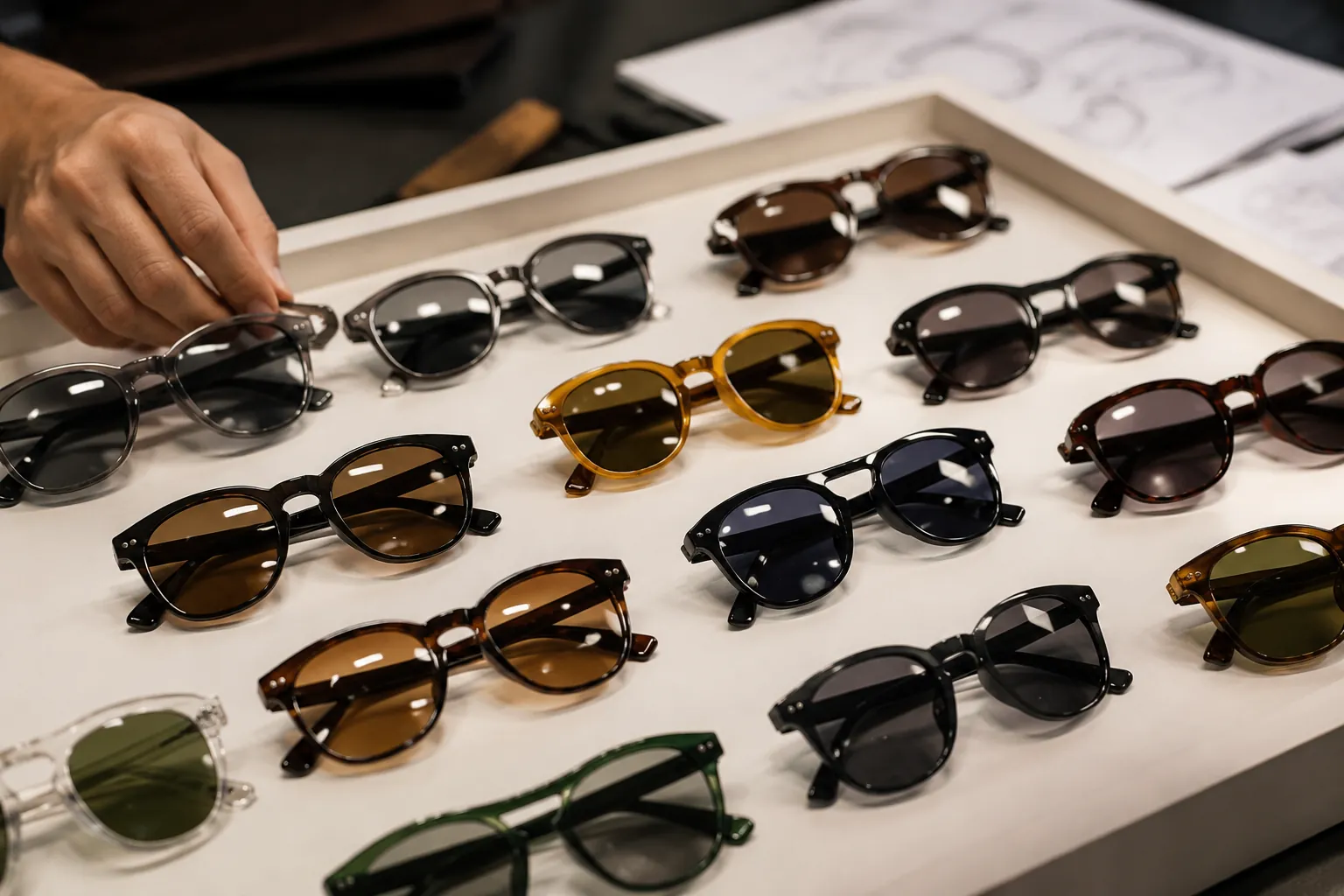
This guide is for brands, importers, distributors, and retailers that want to launch sunglasses fast without paying for a new mold. The goal is not to present a catalog frame as a fully original design. It is to take a factory platform that already exists and control the details customers actually notice: color, lens specification, branding, packaging, quality standards, and compliance. Done well, ODM lowers development complexity and shortens time to market. Done badly, it produces a generic item with avoidable approval and compliance problems. The difference is specification discipline. Buyers need to define what can change, what cannot, and what must be confirmed before sampling starts.
Use ODM for speed, but define what can and cannot change
ODM works best when speed, lower development risk, and more manageable minimums matter more than creating a new frame from scratch. The buyer starts with a frame the factory already makes, then customizes around that platform. In most projects, the fastest route is to change color, lens specification, logo application, and packaging while leaving the core mold geometry alone.
That distinction matters. Different changes affect different parts of the factory process. A stock injection frame may already have stable tooling, trimming standards, and assembly methods. That lets the supplier focus on color matching, lens preparation, decoration, and packing instead of opening a tooling project.
What can often be changed within a standard ODM program:
- Frame color, translucency, crystal effect, matte or gloss finish
- Lens tint, lens category, mirror coating, gradient, polarized option
- Temple branding method such as pad print, laser engraving, hot stamping, or metal logo plate
- Packaging set: pouch, cloth, box, barcode label, hang tag, outer carton marking
- Minor finishing details if the existing structure already supports them
What often pushes the project into redevelopment or new tooling:
- Changing the front silhouette beyond the existing mold cavity
- Moving hinge position or changing structural thickness in critical areas
- Changing the lens cut path outside the original groove geometry
- Altering bridge construction on a molded front
A simple buying rule helps here: if the request affects mold steel, lens groove path, hinge structure, or mechanical strength, it is no longer a simple ODM variation. Costs rise. Risk rises. Lead time usually does too. Ask the supplier to label every requested change as either process customization or tooling/redevelopment before sampling begins.
Differentiate the frame with visible changes, not just a logo
Many ODM programs fail for one reason: the buyer changes only the logo. Customers do not read a product that way. They notice shape and lenses first. Then color and finish. Branding comes later. If the silhouette is commercially common, the lens and color choices have to do more work.
A practical way to make a stock platform look intentional is to stack visible changes:
- Start with channel fit. Fashion boutiques may accept narrower eyesizes, stronger wrap, or more directional fronts. Chain retail, optical side programs, and promotional channels usually need easier fit and broader face compatibility.
- Change the default frame finish. Standard black and basic tortoise are safe. They also make products look interchangeable. Crystal smoke, olive translucent, deep navy, tea crystal, or a more specific acetate pattern can make the same base shape read differently.
- Use lens treatment on purpose. A frame with G15 lenses signals something different from the same frame with brown gradient, blue mirror, or polarized smoke. Lens color often shifts perceived positioning more than a small printed logo.
- Choose branding by price tier. Pad print is flexible and cost-efficient. Laser engraving is quieter and can be more durable on the right surface. Metal logo plates can look more premium, but they add assembly sensitivity and positioning risk.
- Match the packaging to the product. If the packaging level does not fit the frame build, the range feels inconsistent even if the eyewear itself is acceptable.
For many buyers, a solid baseline is three visible changes at once: one non-default frame color or finish, one specific lens treatment, and one controlled branding element. That is often enough. Without it, the product tends to look close to stock.
What really changes cost, MOQ, and lead time
ODM pricing is driven less by front shape than by the process steps added around it. The same frame can land at very different unit costs depending on material, lens treatment, logo method, and packaging complexity. MOQ shifts too. The eyewear factory may accept one minimum for frames, while the packaging supplier applies a different minimum for boxes, pouches, or printed labels.
Do not rely on one advertised MOQ or sample price. Ask for a quotation that breaks out the cost drivers line by line and states whether each minimum applies to the frame, color, lens, logo, or packaging.
| Customization item | Typical MOQ effect | Cost effect | Lead-time effect |
|---|---|---|---|
| Stock frame color already in production | Usually the lowest MOQ risk | Baseline | Usually the fastest option |
| New injection color or acetate sheet pattern | May require a material minimum or supplier confirmation | Low to medium increase | Can add time for material preparation and approval |
| Polarized lenses | Often limited impact if the lens size is standard and material is available | Medium increase | Usually limited if supply is stable |
| Mirror or gradient lens tint | Generally low MOQ impact | Low to medium increase | May add process control time for color consistency |
| Pad printed logo | Low | Low | Usually minor once artwork is approved |
| Laser engraving | Low | Low to medium | Usually minor |
| Metal logo plate | May require a higher quantity for part sourcing efficiency | Medium increase | Can add time for sourcing, fitting, and assembly checks |
| Custom retail box and pouch set | Often separate packaging MOQ | Medium increase | Frequently becomes the critical path |
A common ODM delay has nothing to do with frame production. It is packaging. Frames may be ready while box artwork is still being revised or pouch material is still unapproved. If ship date matters, treat packaging as a parallel workstream from day one.
Another common cost problem is over-splitting quantities. A modest order spread across too many colors or lens combinations creates more setup, more QC sorting, and weaker purchasing leverage. For a first launch, fewer variants with better stock depth is usually the smarter move.
Material, lens, and finish choices affect sell-through and returns
Not all materials behave the same in production or in customer use. If you are customizing an ODM style, material choice should match the channel, target retail price, and actual use case.
Injection-molded plastic is the standard entry point for value and repeatability. It supports efficient production and consistent color control once the material and finish are fixed. It is common in chain retail, promotional programs, and broad private label ranges. Watch for surface marking on soft-touch finishes and visible cosmetic variation if process control is weak.
Acetate usually gives richer color depth and a stronger premium impression. It also opens access to more varied sheet patterns than standard molded colors. But acetate has natural variation. Pattern distribution and tone can shift from sheet to sheet, and polishing and fitting are more labor-intensive. Buyers should define acceptable variation at sample stage. Early.
The table below helps when comparing common ODM platform materials:
| Material | Best use case | Typical advantages | Main cautions |
|---|---|---|---|
| Injection-molded plastic | Value programs, retail chains, promotions | Fast production, lower cost, stable repeatability | Less premium visual depth, some matte finishes can mark |
| Acetate | Mid-tier fashion, boutique private label | Rich color depth, stronger perceived value, broader pattern options | Higher labor content, normal pattern variation, alignment needs tighter control |
| PC or TR sport frames | Outdoor, wrap, active use | Light weight, practical for sport styling | May fit performance positioning better than premium fashion positioning |
Lens choice should follow use case, not trend alone:
- Solid smoke or G15: broad commercial compatibility across frame colors
- Brown or amber: warmer presentation for lifestyle assortments
- Gradient: more fashion-led, but consistency must be monitored batch to batch
- Mirror: visually strong, but coating quality and scratch resistance need review
- Polarized: useful for outdoor programs if the price target supports it
Approve finishes under more than one lighting condition. Crystal colors, tortoise patterns, and lens gradients can look very different in daylight, office light, and phone photography.
Decoration methods and tolerances need more buyer attention
Decoration is where many ODM projects either gain perceived value or create avoidable claims. Buyers often focus on how the logo looks and ignore placement tolerance, adhesion, abrasion exposure, and pair-to-pair consistency. That is a mistake.
Pad printing is the most flexible low-cost option. It works well for simple marks on temples and suits lower-volume projects. But it is still a surface ink process, so wear risk is higher in heavy-contact areas.
Laser engraving gives a subtler effect and can perform better for abrasion resistance on compatible materials, but the visible contrast depends on substrate color and finish.
Hot stamping can produce a sharper premium look on some temple materials, especially with metallic foil, but registration and foil consistency need control.
Metal logo plates can deliver the fastest premium signal, but they also introduce the most assembly sensitivity. Position, edge finish, and fixing method all need close review.
On physical quality, ask the supplier what in-line checks are used for frame symmetry, lens fit, hinge function, and final cleaning. In mass production, eyewear quality depends on defined tolerances and approved references. Not assumptions.
Your approval process should include a signed reference sample and a checklist covering:
- Front symmetry and overall visual balance
- Temple alignment when opened and folded
- Hinge tension consistency
- Lens cleanliness and scratch inspection
- Logo position, readability, and attachment quality
- Packaging print accuracy and barcode correctness
If the buyer approves only photos or chat comments, the factory has to interpret open points on its own. That is where mismatch starts.
Compliance belongs in the spec before production starts
If you are importing sunglasses, compliance must be tied to the exact build you are ordering. A supplier may hold systems or documentation related to CE EN ISO 12312-1, ANSI Z80.3, AS/NZS 1067, REACH, FDA registration, ISO 9001, or BSCI. That does not mean every catalog frame in every lens configuration automatically meets every market requirement.
For practical buying, define compliance in four parts:
- Performance standard: state the destination market and required standard clearly, such as CE EN ISO 12312-1, ANSI Z80.3, or AS/NZS 1067.
- Chemical compliance: confirm whether frame materials, coatings, inks, and contact components need REACH or other applicable review.
- Labeling and warnings: make sure category marking, traceability information, and packaging statements match the destination market and tested build.
- Change control: if you change lens tint, mirror coating, polarization, frame material, or a key supplier input, confirm whether new testing or updated documentation is needed.
The core point is simple: compliance follows configuration, not just model number. Two sunglasses built on the same front mold can need different confirmation if their lens transmission, coating, or labeling differs.
Ask the supplier to specify exactly what they can provide for the proposed build: test report, declaration, material statement, factory registration details, or management-system certificate. Then review the document dates, product references, and market scope before mass production starts.
A buyer workflow that keeps ODM projects under control
Most ODM projects go off track during approval, not manufacturing. A common problem is fragmented signoff: lens approved in chat, frame color approved from a phone screen, logo approved as artwork, packaging still unresolved. Production planning slows because nobody has frozen a complete specification.
- Shortlist 3-5 frames based on target channel, target retail price, fit range, and brand direction.
- Build a one-page specification for each candidate covering frame material, color code or visual reference, finish, lens tint, polarization requirement, logo method, packaging type, compliance market, and quantity by variant.
- Request samples in the real combination, not nearest substitutes where possible.
- Approve against a checklist covering symmetry, alignment, hinge feel, lens appearance, logo position, color match, labeling, and packaging details.
- Freeze the specification before PO release. Avoid ongoing changes to box artwork, pouch color, barcode layout, or lens treatment after production planning starts.
- Confirm lead-time drivers in writing. Ask which item controls the schedule: frame production, lenses, decoration, testing, or packaging.
- Set QC checkpoints for in-process and final inspection, especially if the order includes multiple colors, lens options, or pack-outs.
Buyers who skip the one-page spec usually pay for it later through assumptions, revisions, or claims. ODM moves faster when the brief is tighter.
Common failure points in catalog customization
ODM lines usually become generic or claim-prone for a few repeatable reasons:
- Too many safe choices at once. Black frame, standard smoke lens, minimal logo, basic pouch. Easy to approve. Hard to differentiate.
- Color approved only from a screen. This is especially risky for crystal, translucent, tortoise, and gradient effects.
- Decoration selected without wear logic. A low-cost logo method may be acceptable, but not in a high-rub location.
- Packaging developed too late. Separate packaging lead times often delay shipment more than frame production.
- Compliance not tied to the exact lens build. Lens changes can alter what testing or documentation is needed.
- MOQ split across too many variants. The range looks broad on paper but weak in stock depth and harder to replenish.
For first-time ODM buyers, a disciplined launch structure is usually safer than a broad one. Fewer shapes, colors, and lens options are easier to approve, easier to inspect, and easier to reorder.
A balanced first assortment often includes:
- One broadly commercial shape for wider account coverage
- One more directional fashion shape for merchandising interest
- One sport or outdoor shape if the channel supports polarized demand
Then standardize where customers notice less. Use one pouch format, one cloth size, one outer-carton specification, and limited print positions. Keep variation where it matters most: frame color, lens look, and one clear branding element.
Good ODM buying is not about pretending a stock frame is original development. It is about controlling an existing platform well enough that the finished line feels deliberate, commercially coherent, and compliant in the market where it will be sold.
Have a custom sunglasses project in mind?
Send us your styles, target market and quantities and we will return a detailed quote with MOQ, lead time and a sample plan.
Get a QuoteWhy source this from Wenzhou with LumiShades
Wenzhou in Zhejiang Province is widely regarded as China’s eyewear manufacturing capital, producing a large share of the world’s sunglasses. That concentration matters to buyers: a deep local supply chain for acetate sheet, hinges, lens blanks, plating and packaging means shorter component lead times, easier color and material matching, and a workforce with decades of eyewear-specific skill. LumiShades has manufactured in this ecosystem since 2009, and our vertical integration — in-house injection molding, acetate cutting, CNC milling, lens tinting, decoration and quality control — means no part of your order is quietly subcontracted to a workshop you cannot audit.
For international buyers, that vertical control translates into accountability. When a single factory owns every step, defects are traced and fixed at source rather than bounced between vendors, and your specifications survive intact from first sample to bulk. We back this with 15+ years of experience, shipments to 60+ countries, more than 5 million pairs produced per year and a 98.5% on-time delivery rate. Our certifications — CE EN ISO 12312-1, FDA registration, ANSI Z80.3, AS/NZS 1067, REACH, ISO 9001 and BSCI audit — mean the compliance documentation your market requires already exists. Explore our manufacturing capabilities and quality control process to see how this works in practice.
Frequently asked questions
How many changes do I need to make for an ODM frame to feel private label rather than generic? A practical minimum is three coordinated visible changes: (1) a non-default frame color or finish, (2) a specific lens treatment such as G15, brown gradient, mirror, or polarized, and (3) a branding method chosen for the target price tier. Then check that the packaging level matches the product. Before approval, compare your sample side by side with the supplier's standard catalog version. If the difference is not obvious at a glance, the customization is probably too light.
Is a low MOQ realistic for a fully customized ODM order? It can be, but only if each component supports it. Ask the supplier to confirm MOQ separately for the frame, color, lenses, logo, and packaging. A project may have a low eyewear MOQ and a much higher MOQ for custom boxes or pouches. To judge feasibility, request a quotation table with these columns: item, customization method, MOQ, unit cost effect, setup cost if any, and lead-time effect. That usually shows very quickly whether the order works at your target quantity.
What is the typical timeline from sample request to shipment? There is no single standard timeline because timing depends on material availability, decoration, testing needs, and packaging complexity. Ask for a milestone schedule with separate dates for sample preparation, sample approval, packaging approval, production start, final inspection, and shipment readiness. Also ask which item is on the critical path. In many ODM programs, custom packaging or special decoration causes more delay than frame assembly.
Which logo method is best for durability on sunglasses? For many builds, laser engraving is a strong durability option because it is not a surface ink layer. Pad printing is flexible and cost-efficient but is more exposed to wear, especially in finger-contact areas. Metal logo plates can also be durable if the fixing method is secure, but they require tighter assembly control. To choose well, ask the supplier three direct questions: where the logo will sit, how much wear that location gets, and what test or internal standard they use to assess adhesion or abrasion resistance for that decoration method.
Do I need new compliance confirmation if I only change the lens color? Possibly, yes. Lens color can affect visible light transmission category, and mirror coating or polarization can change the relevant test results or supporting documentation. Do not assume a similar lens is covered. Send the supplier the exact final build and ask them to confirm in writing whether the existing compliance file still applies for your destination market under CE EN ISO 12312-1, ANSI Z80.3, or AS/NZS 1067, as relevant. Also confirm that labeling and warnings still match the final lens category and market requirements.
Ready to start?
Explore our round sunglasses or request a quote — our sales team replies within 12 hours.
Request a Quote