
OEM vs ODM Sunglasses: Cost, Speed, and Risk
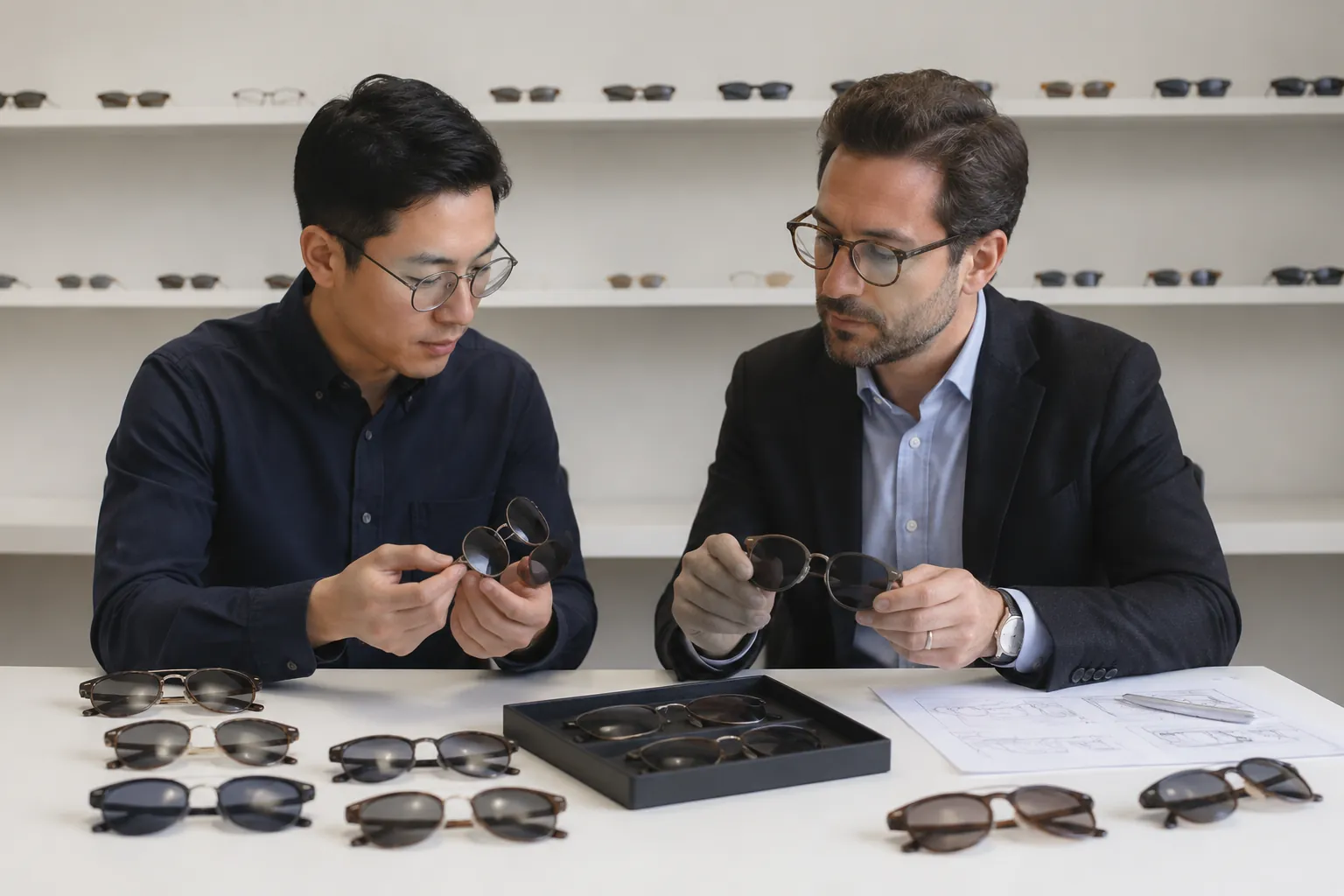
This guide is for brand owners, importers, distributors, and retailers choosing between existing factory sunglasses and a fully custom frame. The wrong model may look fine on quote day. It shows up later as margin pressure, missed launch dates, failed approvals, remake claims, or inventory that looks too similar to everyone else's. The right choice depends on four things: deadline, upfront cash, design control, and how much development risk your team can carry before the selling season.
Start With Four Buyer Questions
Most OEM versus ODM decisions are commercial before they are creative. Buyers get into trouble when they focus on sketches, logos, or color chips and underestimate tooling cost, approval rounds, tolerance control, compliance files, and the order quantity needed to protect margin.
Ask these questions before requesting quotes:
- How fixed is your launch date? If the retail window cannot move, ODM usually carries less schedule risk because the base frame already exists. Still, sampling and production depend on material availability, lens specification, decoration method, packaging, order quantity, and factory capacity. Ask for a written timeline tied to your exact specification.
- How much non-recurring cost can you carry? OEM may involve mold charges, engineering review, prototypes, pre-production samples, and correction rounds before the first sellable unit exists. That cash is committed before demand is proven.
- How different does the product need to be? If your channel mainly needs a logo, frame color, lens tint, branded pouch, and retail box, full OEM may be overkill. ODM can give enough differentiation with lower development risk.
- What happens if the first style underperforms? ODM usually limits exposure because the buyer works from production-proven styles and may be able to test more SKUs. OEM ties up more time and money in development. Opening quantities can also be less flexible once custom parts are involved.
For many overseas buyers, ODM is the safer first step. It works well when testing shapes, selling into several retailers, or validating a new category. OEM makes sense when the target retail price, frame architecture, compliance path, and reorder potential are strong enough to absorb development cost.
Side by Side: Cost, Time, and Control
| Factor | ODM | OEM |
|---|---|---|
| Base product | Existing factory frame customized with approved options such as color, lens, logo, and packaging | New frame developed from drawing, reference sample, CAD file, or technical pack |
| Sample timing | Usually shorter when changes use existing molds, standard colors, and available lenses | Usually longer because design review, engineering, tooling, and corrections may be required |
| Bulk lead time | Often more predictable because the frame has already run in production | First run is less predictable because tooling validation, pilot production, and approval steps come first |
| MOQ logic | Lower practical opening quantity may be possible, depending on decoration, lens, color, and packaging requirements | Higher practical quantity is common once tooling, custom components, or dedicated materials are involved |
| Upfront cost | Lower when no new mold or structural development is required | Higher when molds, engineering, prototypes, and correction rounds are needed |
| Fit risk | Lower when the frame geometry is already production-proven | Higher because bridge fit, lens retention, temple balance, hinge alignment, and wearer comfort must be validated |
| Exclusivity | Limited unless a written agreement reserves a colorway, territory, time period, or style under defined conditions | Stronger when the buyer owns or controls tooling, design files, and agreed intellectual property rights |
| Long-term margin | Can be strong if branding, assortment planning, and packaging create perceived value | Can be stronger if a unique design reduces direct price comparison and supports premium positioning |
The short version: ODM buys speed and lower development exposure. OEM buys design control and stronger potential differentiation.
Neither model automatically protects margin. Margin depends on the channel, retail price, order volume, compliance cost, freight, duty, defect rate, and sell-through.
If you sell seasonal sunglasses, tourist retail, promotional programs, or entry-price private label, ODM often gives better return on cash. If you sell fashion-led collections, optical-adjacent sun frames, or branded assortments where shape recognition matters, OEM may justify the added setup cost.
Where ODM Often Wins
Some buyers treat ODM as a compromise. Often, it is the more reliable first-launch option. It avoids many common development failures: poor bridge fit, hinge instability, warped fronts, uneven temple closing force, and lenses that do not seat consistently.
With a capable eyewear manufacturer, ODM can still allow meaningful customization:
- Frame color changes within the factory's available material and process options
- Acetate sheet substitutions where the existing cut pattern and structure remain unchanged
- Lens options such as solid tint, gradient, mirror coating, or polarized lenses, subject to compliance confirmation
- Pad print logos, laser engraving, hot stamping, or approved metal logo applications
- Retail box, pouch, barcode label, hangtag, and insert customization
- Multi-style assortments built from production-proven shapes in one shipment
ODM also reduces the technical workload on the buyer side. Many teams say they want a custom sunglass line. What they actually need is predictable timing, controlled branding, workable gross margin, compliant documentation, and fewer surprises after sample approval.
Watch the MOQ structure. Small test orders can carry a higher unit cost because decoration setup, material preparation, packing labor, and inspection time are spread over fewer units. Larger orders may improve unit economics, but do not assume all SKUs share the same MOQ. Ask for written price breaks by style, color, lens, logo method, and packaging configuration.
Where OEM Earns Its Keep
OEM pays off when the product itself must carry the sales story. That usually means a signature front shape, recognizable temple profile, custom metal trims, unusual sizing, special hinge structure, or a material mix that existing catalog styles do not offer.
A real OEM sunglass program is more technical than many first-time buyers expect. It often includes:
- Design review from sketch, CAD file, reference sample, or technical pack
- Engineering check for front curve, lens groove depth, hinge position, bridge geometry, and temple balance
- Material and process decision, such as injection molding, acetate CNC cutting, metal components, or mixed construction
- Prototype build
- Fit, function, and cosmetic correction round
- Pre-production sample approval
- Pilot or trial production to verify assembly consistency and QC checkpoints
- Bulk production after written approval
Small geometry changes matter. On acetate, a temple that looks slim on screen may become poorly balanced after core wire and hinge hardware are installed. Acetate can also move during polishing and heat adjustment, so process control affects symmetry and lens seating. On injected styles, draft angle, gate position, material shrinkage, and cooling control affect final dimensions. If the front shrinks unevenly, lens fit may become too tight or too loose after assembly or heat exposure.
Typical control points buyers should discuss include:
- Front width tolerance and how it is measured
- Temple length tolerance and allowable variation between left and right temples
- Lens fit retention, groove consistency, and lens edge quality
- Hinge alignment, screw security, and open-close torque consistency
- Bridge fit, frame wrap, pantoscopic angle, and wearer-test feedback
A frame can look good in a render and still fail at retail. If the bridge fit is wrong or the pantoscopic angle is uncomfortable, shoppers will feel it immediately. Keep OEM for lines where development cost can be spread over credible repeat volume, not one speculative opening order.
Build Compliance Into Development
Compliance affects both sourcing models. The timing is different. With ODM, you may start from a frame platform that has production history and existing test records. With OEM, structural changes, material changes, and lens changes can alter the compliance path.
Buyers should understand the common standards and documents:
- CE EN ISO 12312-1: commonly used for non-prescription sunglasses sold in markets that require CE-related conformity for this product category.
- ANSI Z80.3: important reference for non-prescription sunglasses and fashion eyewear in the United States.
- AS/NZS 1067: relevant for sunglasses sold in Australia and New Zealand.
- REACH: relevant to chemical restrictions for materials, coatings, inks, adhesives, and skin-contact components in the EU.
- FDA registration: may be relevant for US-market eyewear suppliers and import documentation. Buyers should confirm the exact product classification and current regulatory requirements with their compliance advisor or importer of record.
- ISO 9001: a quality management system certification. It supports process confidence but does not replace product testing.
- BSCI: a social compliance audit framework. It is useful for responsible sourcing review but does not certify product performance.
Do not accept a generic certificate sheet without asking whether the test report matches the actual frame-and-lens combination you are buying. If you change visible light transmission, mirror coating, polarized film, lens thickness, coating chemistry, frame material, or paint process, ask whether the existing report still applies.
Simple rule: verify compliance before final sample approval, not during packing week. Keep test reports, declarations where applicable, material declarations, and supplier details in your shipment file so your customs broker, retailer, or compliance team can review them quickly.
Hidden Cost Drivers Buyers Miss
Quoted unit price is only the visible part of program cost. The rest sits in materials, approvals, setup loss, compliance work, packaging complexity, and production risk.
In ODM, the main cost drivers are usually:
- Lens upgrade path: standard tint, mirror coating, polarized construction, or special coating
- Decoration method: pad printing and laser marking are usually simpler than inserted or fitted metal parts
- Packaging complexity: pouch only, retail box, barcode stickers, sleeves, hangtags, inserts, or display-ready packing
- Color count and SKU splitting within small runs
- Inspection level, cosmetic acceptance standard, and retailer-specific packing rules
In OEM, hidden costs stack faster:
- Tooling for fronts, temples, nose pieces, decorative trims, or small hardware parts
- Extra prototype rounds caused by late design changes or incomplete technical packs
- Material waste during color confirmation, especially in acetate programs
- Additional labor for hand polishing, logo fitting, mixed-material assembly, or special finishing
- Longer approval cycles between CAD, prototype, pre-production sample, pilot run, and bulk production
- Possible retesting or documentation updates after material, lens, or coating changes
The math can turn quickly. An OEM quote may look attractive on ex-works unit price while hiding development spend that only makes sense if reorder volume is real. Model the full program at several realistic order quantities. Then add freight, duty, compliance cost, packaging cost, financing cost, expected defect allowance, and retailer margin requirements.
If your opening order is small and forecast uncertainty is high, OEM can make the first season less profitable than it appears on paper.
A Decision Framework by Buyer Type
| Buyer type | Usually better model | Why |
|---|---|---|
| Retailer testing private label | ODM | Lower development exposure, quicker approval path, and less cash tied up before sell-through is proven |
| Importer building volume basics | ODM | Production-proven shapes, easier replenishment planning, and simpler assortment control |
| Brand with strong design identity | OEM | Needs proprietary architecture, distinctive styling, and stronger protection against direct catalog comparison |
| Distributor serving multiple markets | Mixed model | ODM can cover speed and volume items, while OEM can support protected hero styles or market-specific designs |
For many programs, the best answer is not either-or. It is a portfolio decision. Use ODM where speed, testability, and price control matter most. Use OEM only where design ownership, exclusivity, and retail differentiation justify development cost and longer approvals.
That structure lowers risk while still giving the line distinctive products. Put plainly: do not force OEM onto products that only need branding. Do not rely on ODM for the one style your whole brand story depends on.
What to Ask the Factory Before You Commit
Before placing either type of order, get specific answers in writing. Vague sourcing terms create claims later.
- Is the frame an existing production style or a new development?
- Who owns the mold, design files, CAD files, and exclusive selling rights, if any?
- What is included in the sample cost, and how many correction rounds are included before extra charges apply?
- What are the MOQ breaks for frame, lens, frame color, lens color, logo method, and packaging?
- Which processes are handled in-house and which are outsourced?
- What dimensional tolerances apply to front width, temple length, lens fit, hinge alignment, and logo placement?
- Which CE EN ISO 12312-1, ANSI Z80.3, AS/NZS 1067, REACH, FDA registration, ISO 9001, or BSCI documents are available, and which ones apply to your exact order?
- How is QC handled during incoming material inspection, assembly, lens mounting, logo application, final inspection, and packing?
- What buyer changes would reset lead time, change MOQ, affect cost, or require updated testing?
- What happens if pre-shipment inspection finds defects above the agreed acceptance level?
Also ask for a written approval chain. Define who approves artwork, frame color, lens color, logo position, packaging layout, pre-production sample, inspection standard, carton marks, and shipping documents. Many delays come from late artwork, unclear Pantone or material references, incomplete carton marks, missing barcode files, or last-minute packaging changes.
Rule of thumb: If your launch date is fixed and your forecast is still uncertain, start with ODM. If your reorder case is strong and product uniqueness supports price and sell-through, consider OEM.
Have a custom sunglasses project in mind?
Send us your styles, target market and quantities and we will return a detailed quote with MOQ, lead time and a sample plan.
Get a QuoteWhy source this from Wenzhou with LumiShades
Wenzhou in Zhejiang Province is widely regarded as China’s eyewear manufacturing capital, producing a large share of the world’s sunglasses. That concentration matters to buyers: a deep local supply chain for acetate sheet, hinges, lens blanks, plating and packaging means shorter component lead times, easier color and material matching, and a workforce with decades of eyewear-specific skill. LumiShades has manufactured in this ecosystem since 2009, and our vertical integration — in-house injection molding, acetate cutting, CNC milling, lens tinting, decoration and quality control — means no part of your order is quietly subcontracted to a workshop you cannot audit.
For international buyers, that vertical control translates into accountability. When a single factory owns every step, defects are traced and fixed at source rather than bounced between vendors, and your specifications survive intact from first sample to bulk. We back this with 15+ years of experience, shipments to 60+ countries, more than 5 million pairs produced per year and a 98.5% on-time delivery rate. Our certifications — CE EN ISO 12312-1, FDA registration, ANSI Z80.3, AS/NZS 1067, REACH, ISO 9001 and BSCI audit — mean the compliance documentation your market requires already exists. Explore our manufacturing capabilities and quality control process to see how this works in practice.
Frequently asked questions
Can I get exclusivity on an ODM style? Sometimes, but it must be defined in writing. Ask whether exclusivity covers the full frame shape, a specific colorway, a lens-and-frame combination, a sales territory, a customer channel, or a time period. Also ask what minimum annual quantity is required to keep exclusivity. A private label logo on an existing catalog frame does not make the frame exclusive unless the supplier agrees to that restriction in the contract.
What is the realistic first step for a new sunglasses brand? For most new brands, the realistic first step is ODM. Choose a production-proven frame and customize the frame color, lens, logo, and packaging. Before ordering, confirm MOQ by SKU, sample cost, sample timeline, bulk lead time, available compliance reports, and the exact changes included in the quoted price. Use the first order to validate sell-through, returns, fit feedback, and target margin before investing in OEM tooling.
How should I compare MOQ between OEM and ODM quotes? Do not compare only the headline MOQ. Ask for MOQ by frame style, frame color, lens type, lens color, logo method, and packaging type. A supplier may accept a lower total order but still require minimums for a custom color, polarized lens, mirror coating, or printed packaging. Build your costing by SKU and include freight, duty, testing, packaging, inspection, and expected retailer margin before deciding whether the MOQ is workable.
Do I need new compliance testing if I only change the lens tint? Potentially yes. A tint change can affect visible light transmission category and performance results. Ask whether the existing test report covers the exact lens material, tint, coating, thickness, and frame combination you plan to buy. For the target market, check the applicable standard or requirement, such as CE EN ISO 12312-1, ANSI Z80.3, AS/NZS 1067, REACH, or FDA-related documentation where relevant.
How much longer does OEM usually take than ODM? OEM is usually longer because design review, engineering, tooling, prototype correction, pre-production sample approval, and pilot validation may happen before bulk production. ODM can move faster because the base frame already exists, but timing still depends on material availability, order quantity, decoration, packaging, compliance checks, and factory capacity. Ask the factory for a dated timeline with approval milestones and make clear which buyer-side delays will reset the schedule.
Ready to start?
Explore our round sunglasses or request a quote — our sales team replies within 12 hours.
Request a Quote