
Split 50/300/1000-Pair Sunglasses Orders Without Waste
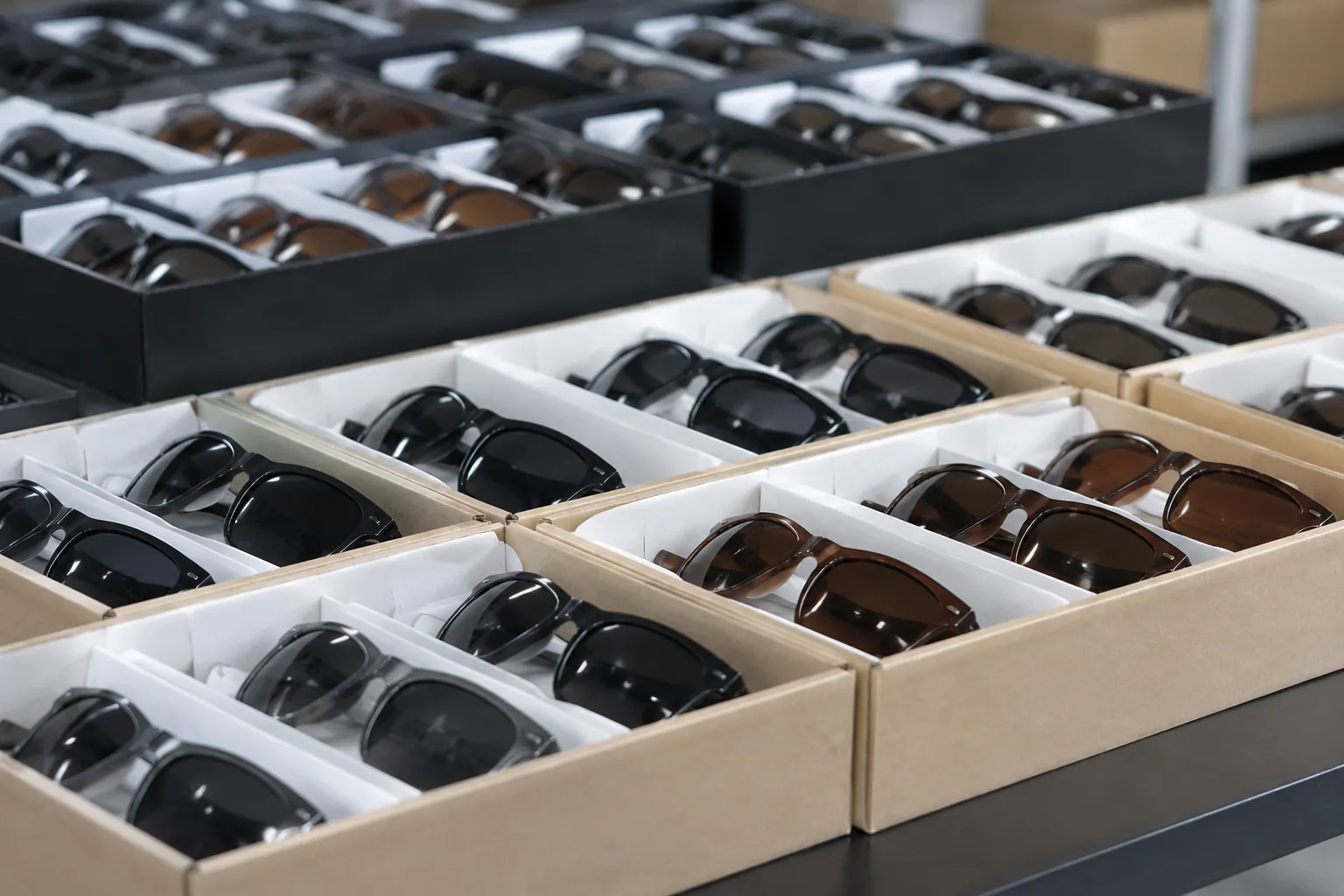
Mixed sunglasses orders work when each quantity tier has a clear job and a tight technical scope. They get expensive when a buyer treats many small variations like one bulk run. They are not the same. This guide shows how to combine 50, 300, and 1000-pair sunglasses SKUs while controlling tooling, lenses, decoration, packaging, QC, compliance, and factory changeovers. Use it to test new looks, protect margin on proven styles, and give the manufacturer a production plan that can be quoted, sampled, inspected, and shipped with fewer surprises.
Start With the Job of Each Quantity Tier
A mixed sunglasses order only works when every SKU has a purpose. Do not choose 50, 300, and 1000 pairs because the spreadsheet looks balanced. Each tier carries a different level of inventory risk, setup cost, and production efficiency.
| Quantity per SKU | Best use | Typical cost behavior | Factory concern |
|---|---|---|---|
| 50 pairs | Color test, influencer drop, retailer sample set, new lens trial | Usually the highest unit cost because setup, QC, labels, and packing are spread over very few units | Too many unique details can create more setup time than production time |
| 300 pairs | Small wholesale run, regional launch, proven frame in a new finish | More efficient than a very small test run when tooling, lens route, decoration, and packaging are shared | Works best if the frame platform, lens base curve, and packaging format are common |
| 1000 pairs | Main stock SKU, distributor replenishment, retail program | Normally absorbs setup, inspection, and packing work better than small runs, subject to material and specification | Efficient if specs are frozen before production and materials are purchased against one clear plan |
| 5000+ pairs | Large retail program, seasonal replenishment, private-label core item | Can improve purchasing and process efficiency, but only when forecasting, compliance, and packaging are controlled | Requires tighter planning for material supply, carton configuration, inspection, and delivery windows |
The point is simple. Use 50-pair SKUs for learning, not for maximum margin. A 50-pair test can answer a sales question: Will this color sell? Does this lens tint fit the channel? Does a retailer want this look? The 1000-pair SKUs should carry the commercial load. They give the manufacturer enough volume to stabilize material buying, color control, lens fitting, decoration, and packing.
Use One Frame Platform, Then Vary What Buyers See
The fastest way to wreck mixed-order economics is to combine unrelated sunglasses under one purchase order: different molds, different temple lengths, different hinge systems, different lens base curves, different materials, and different packaging. That is not one efficient mixed order. It is several small orders sharing a PO number.
Use a platform instead. Keep the engineering common and vary the visible details that affect sell-through. For injection frames, shared tooling is critical. Opening a new mold for a 50-pair test rarely makes sense unless the buyer is funding product development on purpose. Acetate allows more flexibility because of CNC cutting, but it is not free of constraints. Sheet availability, yield, tumbling, polishing, and hand finishing still affect cost and lead time. A rare acetate sheet used for a tiny run can create leftover material, color risk, or a surcharge.
- Keep common: frame mold or cutting program, lens shape, lens base curve, hinge type, screw size, temple core, nose fit, case format, carton size, and retail packaging structure.
- Vary carefully: frame color, lens tint, mirror color, logo print color, pouch color, barcode label, hangtag, and channel-specific insert.
- Avoid on 50-pair tests: new molds, new hardware, custom metal logo plates, one-off acetate sheets, unique retail boxes, mixed polarized and non-polarized claims without separate labels, and special compliance marking layouts.
Make the frame family common. Make the shelf appearance different. Customers notice matte black versus transparent honey, smoke lens versus brown gradient, and logo position. They usually do not notice a different screw size. The factory does. It affects components, assembly, inspection, and spare-parts control.
Plan Around Real Factory Changeovers
Production cost is not only plastic, acetate, lenses, hinges, screws, and packaging. It is also changeover time. On the floor, a changeover can mean workers stop, components are cleared, color references are checked, lens trays are matched, decoration fixtures are adjusted, QC samples are updated, and first pieces are approved. Too many small changes increase the risk of wrong lenses, wrong logos, mixed labels, and carton errors.
A clean mixed order is grouped by process, not by the order of SKUs in a sales forecast. Run all matte black injected frames together before changing to transparent amber. Check and stage all smoke Category 3 lenses before moving to another tint category. Run laser engraving with one fixture setup before switching to pad printing.
- Group by frame material first: injected PC, injected TR90, acetate, metal, or mixed material.
- Within each material, group by frame color, acetate sheet, plating finish, or coating finish.
- Then group by lens type: non-polarized, polarized, gradient, mirrored, Category 2, Category 3, or another declared filter category.
- Then group by decoration: laser engraving, pad printing, hot stamping, metal logo plate, or no logo.
- Pack last, using SKU labels, barcode checks, packing lists, and carton marks to separate finished goods.
Give the supplier a disciplined spec matrix before quotation and sampling. If the matrix is unclear, the cost still appears somewhere: higher unit price, longer lead time, extra inspection work, rework, or repeated emails. Confusion is never free.
Example Split: 2700 Pairs Across Six SKUs
A practical first launch can use two main SKUs at 1000 pairs, two support SKUs at 300 pairs, and two test SKUs at 50 pairs. Total: 2700 pairs. This gives the factory enough volume to run the core items efficiently while leaving room to test color, lens, or channel-specific ideas.
| SKU role | Qty | Recommended variation | Do not change |
|---|---|---|---|
| Main stock A | 1000 | Core frame color, standard UV400 lens claim if supported by test results, proven logo method | Lens base curve, hinge, packaging size |
| Main stock B | 1000 | Same frame in a second commercial color | Mold, temple length, compliance text |
| Support SKU C | 300 | Same tooling with different lens tint or mirror color | Retail box structure, screw type |
| Support SKU D | 300 | Same lens category with different logo color | Lens claim, barcode format |
| Test SKU E | 50 | Color trial using available material | New acetate sheet, custom case |
| Test SKU F | 50 | Retailer sample variant or influencer colorway | Unique warning text, new hardware |
This structure keeps the manufacturer from treating every SKU as a new product. It also gives the buyer usable sell-through data. If a 50-pair color performs well, move it to 300 or 1000 pairs on the next PO. If it fails, the brand has not locked too much cash into slow inventory.
Be blunt about the trade-off. Do not ask for the best bulk price on a 50-pair SKU with different lenses, different logo placement, a different case, and separate labeling. That is a different job. If the small SKU shares the frame platform, lens route, decoration method, and packaging, the quote can usually improve. If it does not, the order may be technically possible but commercially weak.
Specify Materials, Lenses, and Decoration Before Sampling
Sunglasses look simple on a line sheet. The factory reality is not simple. Small technical choices affect cost, lead time, QC, and compliance.
Injected PC can be economical and impact-resistant, but transparent colors may show flow lines or gate marks depending on mold design and processing. TR90 is often selected for lightweight and flexible styles, but color matching and dimensional control still matter. Acetate can deliver a premium look and richer color depth, but cutting, tumbling, polishing, and hand finishing add labor. Metal frames add plating, soldering or welding, nose-pad, screw, and alignment checks.
Lenses need the same discipline. Before sampling, specify the sales market, UV claim, lens filter category, visible light transmittance target or range, polarization, mirror coating, gradient direction, and acceptable shade range. If the product will claim UV400, the claim should be backed by appropriate test evidence. During assembly, check lens fit for rattling, stress whitening, edge chips, uneven gaps, and excessive pressure in the eyewire or rim.
Decoration choices also behave differently:
- Laser engraving: clean and durable when the material and surface allow readable contrast. Confirm placement, size, and appearance on the actual frame color.
- Pad printing: flexible for colors and logos. Requires stable fixtures and ink adhesion checks, especially on curved, coated, or textured temples.
- Hot stamping: useful for metallic effects. Appearance can vary on uneven surfaces and requires pressure, temperature, and foil control.
- Metal logo plates: premium in appearance but add component sourcing, placement labor, adhesive or mechanical fixing control, and extra inspection points.
Use more complex decoration on 300 or 1000-pair SKUs unless the test is specifically measuring that feature. For 50-pair tests, keep decoration simple. Otherwise, the test may measure production difficulty instead of market demand.
Lock Compliance and QC Standards Early
Confirm compliance before sampling, not after bulk production starts. For sunglasses, buyers often need to consider CE EN ISO 12312-1 for the European market, ANSI Z80.3 for non-prescription sunglasses and fashion eyewear in the United States, AS/NZS 1067 for Australia and New Zealand, and REACH for restricted substances in the EU. FDA registration may be relevant for U.S. eyewear import handling, but it should not be treated as a product performance certification. ISO 9001 and BSCI, where available, relate to factory management systems and social compliance practices. They do not replace product testing.
These requirements are not interchangeable labels. The right standard depends on the destination market, product type, lens category, claims, warnings, and importer requirements. Tell the manufacturer where the sunglasses will be sold. Then request the applicable test reports, declarations, markings, and packaging information before approving bulk production.
Keep the compliance path consistent across SKUs where possible. If one 50-pair SKU uses a very dark Category 3 lens and another uses a pale fashion tint, QC must verify filter category and transmittance separately. That is manageable when planned. It becomes expensive when discovered during packing or after shipment.
For a mixed PO, define AQL and defect classifications before production. Common critical defects include sharp edges, cracked lenses, incorrect UV claim, failed polarization claim where polarization is advertised, incorrect warning label, or unsafe broken parts. Major defects can include visible logo misplacement, lens scratches, loose hinges, color mismatch outside the approved range, wrong barcode, poor lens fit, or incorrect lens category marking. Minor defects can include small cosmetic marks within agreed limits, slight pouch variation, or non-critical carton scuffs.
Run first-article checks at the start of each process group: frame color, lens fit, decoration, assembly, and final packing. Do not wait until the full order is packed to discover that one lens tint, temple logo, or barcode is wrong.
Control Packaging and Freight Before They Cut Margin
Packaging is where many mixed sunglasses orders lose margin. A custom rigid box for every 50-pair SKU is usually a bad use of budget unless the packaging itself is being tested. A shared microfiber pouch, common retail box, common outer carton, and SKU-specific barcode label will usually pack faster and reduce errors. If retail packaging must differ by channel, separate that requirement from product development and price it clearly.
Sunglasses are light, but packaging volume matters. Oversized cases increase carton size, shipping volume, warehouse space, and sometimes retail handling cost. Before confirming packaging, ask the supplier for carton dimensions, gross weight, net weight, pairs per carton, packaging materials, and whether the same carton format can cover all SKUs. One small change in case thickness across six SKUs can create poor carton loading.
Protect margin by spending on details that affect performance and sell-through: stable tooling, consistent lens quality, hinge feel, verified UV and compliance claims, clean logo placement, accurate barcode labels, and durable retail packaging. Say no to low-volume cosmetic exceptions unless they answer a real sales question. A 50-pair SKU should prove demand. It should not become a miniature packaging project.
Lead-Time Logic for Mixed 50/300/1000-Pair Orders
Lead time should be quoted against the actual specification, not assumed from a generic MOQ. Existing molds, available materials, standard lenses, and established decoration methods are usually faster than new molds, special acetate sheets, unusual mirror coatings, custom hardware, or unresolved artwork. Packaging readiness also affects delivery. Finished sunglasses can sit if retail boxes, inserts, labels, or barcode files are late.
A realistic sequence is: final spec confirmation, material and component availability check, sample making, physical sample review, written approval, deposit or payment milestone, bulk material preparation, production, in-line QC, final inspection, packing, and shipment booking. For mixed orders, ask the manufacturer to show which SKUs share processes and which SKUs require separate setup.
Rule of thumb: freeze specs before bulk, group production by process, approve the riskiest samples, and inspect first finished units from every SKU tier. Small SKUs can create large delays when nobody owns the details.
The best mixed orders are not the ones with the most variations. They are the ones where variation is intentional: enough difference for the market to respond, and enough commonality for the factory to produce cleanly.
Have a custom sunglasses project in mind?
Send us your styles, target market and quantities and we will return a detailed quote with MOQ, lead time and a sample plan.
Get a QuoteWhy source this from Wenzhou with LumiShades
Wenzhou in Zhejiang Province is widely regarded as China’s eyewear manufacturing capital, producing a large share of the world’s sunglasses. That concentration matters to buyers: a deep local supply chain for acetate sheet, hinges, lens blanks, plating and packaging means shorter component lead times, easier color and material matching, and a workforce with decades of eyewear-specific skill. LumiShades has manufactured in this ecosystem since 2009, and our vertical integration — in-house injection molding, acetate cutting, CNC milling, lens tinting, decoration and quality control — means no part of your order is quietly subcontracted to a workshop you cannot audit.
For international buyers, that vertical control translates into accountability. When a single factory owns every step, defects are traced and fixed at source rather than bounced between vendors, and your specifications survive intact from first sample to bulk. We back this with 15+ years of experience, shipments to 60+ countries, more than 5 million pairs produced per year and a 98.5% on-time delivery rate. Our certifications — CE EN ISO 12312-1, FDA registration, ANSI Z80.3, AS/NZS 1067, REACH, ISO 9001 and BSCI audit — mean the compliance documentation your market requires already exists. Explore our manufacturing capabilities and quality control process to see how this works in practice.
Frequently asked questions
Can I combine several 50-pair SKUs to get 1000-pair pricing? Not automatically. Pricing depends on shared tooling, materials, lens setup, decoration, packaging, inspection, and changeover efficiency. Ten unrelated 50-pair SKUs will not quote like one 500 or 1000-pair SKU. To improve the quote, ask the supplier to price the order two ways: first as separate SKUs, then as a grouped platform using the same frame mold, lens base curve, logo method, packaging format, and carton plan.
What is the safest way to test a new color at 50 pairs? Use an existing frame platform, available material, an approved lens type, standard packaging, and a proven logo method. Change only one or two visible elements, such as frame color, lens tint, mirror color, or logo color. Before approving the test, confirm whether the material is in stock, whether the color has a reference sample, whether the lens category and UV claim stay the same, and whether the barcode and packaging artwork remain controlled.
Should polarized lenses be used across all mixed SKUs? Use polarized lenses only when the channel, price point, and product claim justify the added cost and QC work. Mixing polarized and non-polarized SKUs is possible, but the spec sheet, inspection checklist, labels, hangtags, and retail packaging must clearly separate them. If a SKU claims polarization, require a polarization check during incoming lens inspection, assembly inspection, and final QC.
How early should compliance requirements be confirmed? Confirm compliance before sampling. Tell the manufacturer the sales markets and required standards, such as CE EN ISO 12312-1, ANSI Z80.3, AS/NZS 1067, REACH, or FDA registration-related import requirements. Also confirm lens filter category, UV claim, warning text, markings, labeling language, and whether the buyer needs test reports, declarations, or factory documents such as ISO 9001 or BSCI.
What order size gives the best balance for a first launch? A balanced first launch often uses a platform strategy: two core SKUs at higher volume, two support SKUs at medium volume, and one or two small test SKUs. For example, 1000/1000/300/300/50/50 pairs lets the buyer protect the main commercial styles while testing controlled variations. The exact split should be based on forecast, sales channel, cash position, and how many technical changes each SKU requires.
How should I evaluate a supplier's lead-time quote? Ask what the lead time includes and what it excludes. Confirm whether it starts after sample approval, deposit, material arrival, artwork approval, or packaging approval. Request a timeline for sampling, material preparation, production, in-line QC, final inspection, packing, and shipment booking. For mixed orders, ask which SKUs can run together and which require separate tooling, lens, decoration, or packaging setup.
Ready to start?
Explore our square sunglasses or request a quote — our sales team replies within 12 hours.
Request a Quote