
ODM vs OEM Sunglasses: Safer First-Order Option
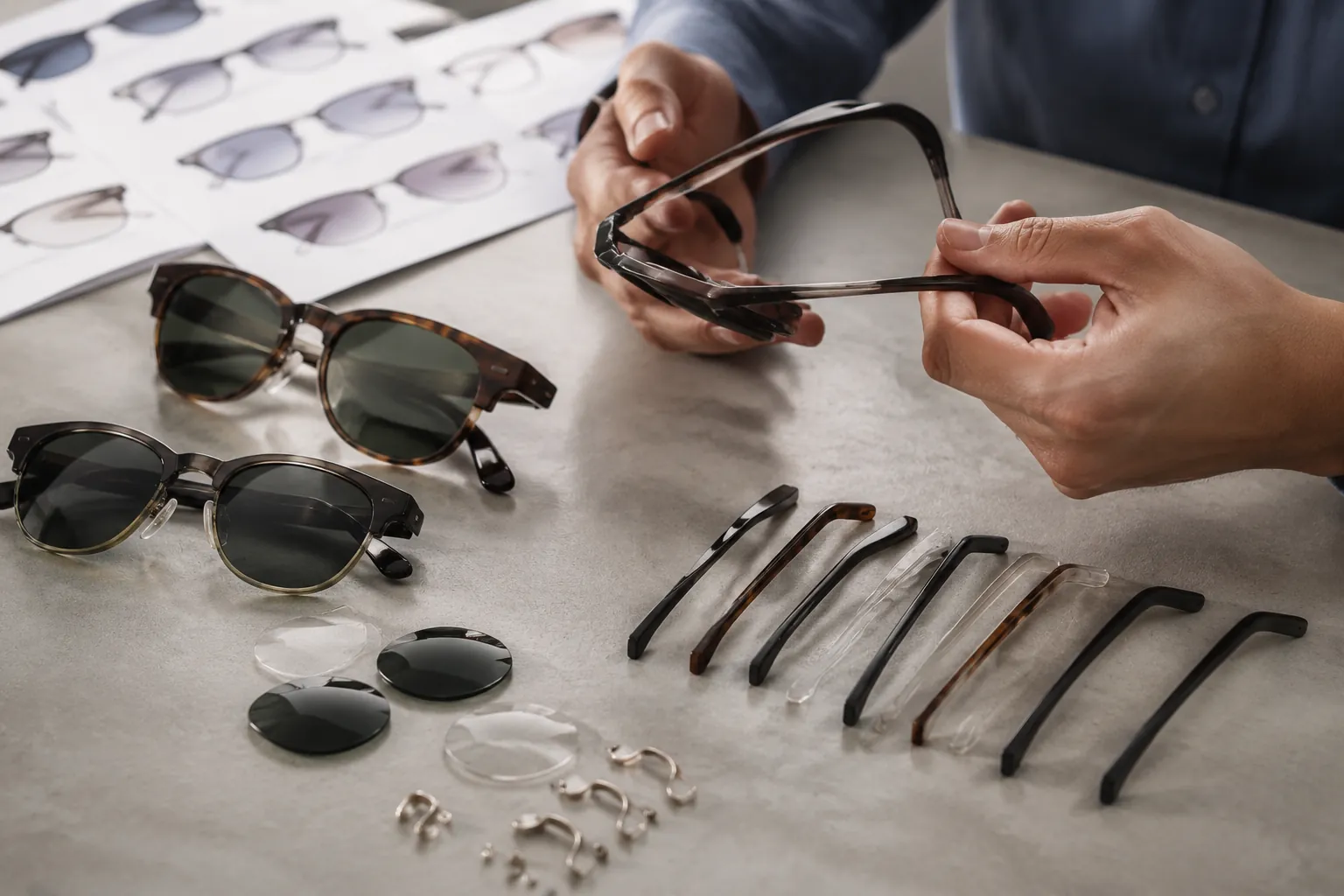
This guide is for brand owners, importers, distributors, and retailers placing a first sunglasses order with an overseas factory. The real question is not which model sounds more premium. It is which model gives you the best chance of launching on time, protecting margin, and avoiding preventable compliance or production mistakes. ODM and OEM can both work. They do not carry the same risk on a first order. Match the sourcing model to your order size, approval speed, and tolerance for revisions, and the project gets easier before production even starts.
Start With Launch Risk, Not the Design Dream
Many first-time buyers start with the wrong question: "Can you make my design?" Ask a better one: "What is the lowest-risk path to a saleable first order?" In overseas sunglasses sourcing, risk usually shows up in five places: sample approval, compliance, unit economics, revision cycles, and whether bulk production ships inside your selling window.
ODM usually means starting from a factory-developed frame platform. Depending on the supplier, you may be able to change lens tint, frame color, logo application, temple print, pouch, box, and care card without changing the core frame structure. OEM usually means a new frame design, a major structural change to an existing frame, or a custom combination of front, temple, hardware, and lens specifications that requires development work.
That difference matters. Proven molds and proven assemblies remove variables. On an ODM style, the factory generally already knows how the frame is assembled, how the lenses fit, and where production problems tend to appear. On OEM, those points may still need to be proven. A bridge can look right in a drawing and still fit badly in wear. A lens groove can work in CAD and still create stress during lens insertion. A custom logo plate or hardware detail can add assembly steps and tighter tolerances.
First orders often fail because buyers add too many unknowns at once. If your immediate goal is to test demand, ODM is usually the safer path. If you need a frame architecture that stock options cannot provide, OEM can make sense. But be honest about the tradeoff. It usually means a longer development cycle and more upfront complexity.
ODM vs OEM: Cost, Speed, and Failure Points
| Factor | ODM | OEM |
|---|---|---|
| Starting point | Existing frame platform with known construction | New frame design or major structural modification |
| Best first-order volume fit | Usually better suited to smaller trial orders | Usually better suited to programs with repeat-volume potential |
| Sample lead time | Often shorter because the frame structure already exists | Usually longer because development, corrections, and approvals may be required |
| Tooling exposure | Usually none or limited | May include mold, fixture, prototype, or custom hardware cost |
| Revision risk | Lower because fit and assembly are already proven | Higher because geometry, alignment, tension, and appearance may need multiple rounds |
| Compliance risk | Often lower when using established frame and lens combinations | Often higher when materials, structure, lens category, or dimensions change |
| Unit price behavior | Can be practical for low-volume launches, but cost still depends on materials and decoration | Can become more efficient over repeat volume once development cost is spread across future orders |
| Best use case | Market test, private label launch, retailer program, seasonal drop | Signature product, long-term core style, differentiated frame design |
The tradeoff is simple. OEM gives you more control. It also creates more chances for delays, corrections, and added cost. On a first purchase order, every new variable has to be approved, documented, and reproduced in bulk. If you are still learning what your customer will buy, keep the moving parts under control.
When ODM Is the Better First Order
ODM is usually the practical choice when speed, lower cash exposure, and repeatable production matter more than owning a unique mold. That is common for retailers testing a seasonal assortment, distributors serving mixed channels, and younger brands that want private label control without early-stage development risk.
- You need a sample quickly. On an existing frame platform, the sample process is often limited to finish, lens color, logo method, and packaging details.
- Your order is relatively small. Existing frames are usually easier to quote and schedule than a fully custom tool set.
- You are unsure which silhouette will sell. Testing several proven shapes is often less risky than committing early to one custom frame.
- You need lower technical risk. Existing molds generally already have known lens fit, hinge alignment, and assembly workflow.
- You have a fixed launch window. A straightforward private label ODM order is usually easier to bring to market on time.
This matters on the factory floor more than many buyers expect. Injection-molded frames, acetate frames, and mixed-material constructions all have production tolerances that affect fit, appearance, and repeatability. Small dimensional changes can influence lens insertion, alignment, polish results, hinge feel, or final assembly stability. A frame that looks right in a rendering is not automatically a frame that runs cleanly in production.
For many first launches, differentiation comes from execution rather than structure. Common ODM customization can include lens tint selection, polarized or non-polarized lens options, temple branding, packaging graphics, microfiber pouch branding, and retail labeling changes. For a trial order, that is often enough. You can test the market without paying for extra development risk.
When OEM Earns Its Extra Cost
OEM makes sense when the frame itself is the product, not just the branding on it. If your sell-through depends on a specific front shape, a custom temple profile, a distinctive hardware feature, or a mixed-material construction that does not exist in a factory's current range, ODM may not be enough.
Be clear about what OEM usually includes. Development may require CAD review, prototype sampling, fit correction, hinge placement adjustment, lens curve review, hardware approval, color matching across materials, and packaging sign-off before bulk production can be scheduled. The exact process varies by factory and construction. The main point does not. OEM adds development steps that do not exist, or do not exist to the same degree, in a standard ODM program.
OEM usually becomes more rational under these conditions:
- You have a repeat forecast that can justify development and tooling cost.
- Your brand needs a recognizable frame architecture that stock catalogs cannot supply.
- You can accept a slower approval and launch cycle.
- You have someone on your side who can review fit, finish, hardware, labeling, and compliance details quickly and clearly.
OEM is not the wrong choice. It is the wrong choice for the wrong reason. Select it because custom frame design will support pricing, brand recognition, or long-term repeat sales. If not, it may just add friction to a first order.
MOQ, Price Bands, and Why Small Orders Get Expensive Fast
MOQ is not just a sales threshold. It reflects how efficiently a factory can allocate materials, setup time, decoration, inspection, and packing to your job. Low-volume orders are possible in many factories. They usually cost more per unit because fixed setup work is spread across fewer pieces.
First-time buyers often assume a small order will stay simple. Not always. It gets expensive fast when the order is split across too many colors, too many logo treatments, or too many packaging variations. A factory may be able to produce the total quantity, but each changeover adds handling, checking, and opportunities for mistakes.
For example, one frame style in one color is usually easier to run than the same total quantity divided across multiple colors with different logo positions and mixed inserts. The second version may look stronger on paper. It also creates more setup points and more chances for packing errors or approval confusion.
Use a blunt rule on a first order: if the commercial question is still "Will this style sell?" do not build the PO as if demand is already proven. Choose a proven frame platform, limit decoration complexity, and keep the SKU count disciplined. Also confirm whether MOQ applies per design, per color, or per total order. That detail changes the cost structure in a real way.
Sampling and Compliance: Where First Orders Slip
Most buyers focus on how the sample looks. Factories also have to focus on whether the same product can be repeated at scale and whether it meets the destination market's requirements. Those are related issues. They are not the same issue.
For sunglasses sold into export markets, confirm the compliance path early, before final sample approval. The standards and systems commonly discussed in this category include CE EN ISO 12312-1, ANSI Z80.3, AS/NZS 1067, REACH, FDA registration, ISO 9001, and BSCI. Each serves a different purpose. Do not treat them as interchangeable.
- CE EN ISO 12312-1 is a product standard commonly referenced for sunglasses in applicable markets.
- ANSI Z80.3 is a product standard commonly used as a benchmark for sunglasses in the US market.
- AS/NZS 1067 is relevant for Australia and New Zealand programs.
- REACH relates to chemical compliance and restricted substances where applicable.
- FDA registration should be described carefully and specifically; it does not replace product-standard review.
- ISO 9001 relates to quality management systems, not product certification.
- BSCI relates to social compliance auditing, not product certification.
On the production side, approve more than appearance. Lock the lens category, UV claim, frame material, logo method, labeling, and packaging structure before bulk sign-off. A sample that looks acceptable does not by itself confirm that bulk product will meet the same performance or documentation requirements. If the logo method changes, if the lens specification changes, or if the material changes, the compliance review may need to change too.
ODM approval is often faster because the frame geometry is already fixed. OEM is different. Sample rounds may reveal lens stress, color mismatch between materials, alignment drift, or hardware fit problems. That is normal in development. It still adds time. Price and plan for that reality at quotation stage.
Buyer Scenarios: Match the Model to the Order
| Buyer situation | Safer model | Reason |
|---|---|---|
| New brand launching a small first order across a few styles | ODM | Lower cash risk, faster sample cycle, easier revisions, and less development exposure |
| Retailer running a seasonal promotion with store branding | ODM | Stock frames plus private label branding usually reach market faster and more predictably |
| Distributor building a value line for several markets | ODM first, OEM later | Start with tested shapes, then custom-build proven top sellers after reorder data exists |
| Established brand with a signature frame concept and repeat forecast | OEM | Custom architecture can justify a slower development cycle when repeat volume is credible |
If you are undecided, take a staged approach. Start with ODM. Review reorder rates, returns, and customer feedback. Move a validated style into OEM only after the market confirms demand. That keeps the first order commercial instead of theoretical.
A first order should teach you what customers buy, what price they accept, and which quality issues they actually notice. It should not try to test every design, packaging, and branding idea at the same time.
Use This Checklist Before You Approve the First PO
- Confirm in writing whether the program is ODM or OEM. Do not leave the word "custom" undefined.
- Freeze the approved sample specification: frame material, color reference, lens specification, logo position, decoration method, packaging, and carton mark.
- Check MOQ by design, by color, and by packaging version before splitting the order into multiple variants.
- Verify sample lead time and bulk lead time against your real selling window, and ask what events would extend that timing.
- Confirm which compliance standard applies to your destination market: CE EN ISO 12312-1, ANSI Z80.3, or AS/NZS 1067, plus REACH where relevant.
- Ask the factory to separate product compliance documents from factory-system documents so there is no confusion between product testing, ISO 9001, and BSCI.
- Request the QC checkpoints that matter most for sunglasses: lens scratches, alignment, logo position, color consistency, hinge function, and packing accuracy.
- For OEM, confirm who owns tooling, how revision rounds are handled, what is included in development cost, and what happens if the first prototype needs structural correction.
The last point is simple. Build the first PO around what you can reorder successfully, not what looks most impressive in a presentation. A sensible first order is one you can repeat without friction if it sells faster than expected.
Have a custom sunglasses project in mind?
Send us your styles, target market and quantities and we will return a detailed quote with MOQ, lead time and a sample plan.
Get a QuoteWhy source this from Wenzhou with LumiShades
Wenzhou in Zhejiang Province is widely regarded as China’s eyewear manufacturing capital, producing a large share of the world’s sunglasses. That concentration matters to buyers: a deep local supply chain for acetate sheet, hinges, lens blanks, plating and packaging means shorter component lead times, easier color and material matching, and a workforce with decades of eyewear-specific skill. LumiShades has manufactured in this ecosystem since 2009, and our vertical integration — in-house injection molding, acetate cutting, CNC milling, lens tinting, decoration and quality control — means no part of your order is quietly subcontracted to a workshop you cannot audit.
For international buyers, that vertical control translates into accountability. When a single factory owns every step, defects are traced and fixed at source rather than bounced between vendors, and your specifications survive intact from first sample to bulk. We back this with 15+ years of experience, shipments to 60+ countries, more than 5 million pairs produced per year and a 98.5% on-time delivery rate. Our certifications — CE EN ISO 12312-1, FDA registration, ANSI Z80.3, AS/NZS 1067, REACH, ISO 9001 and BSCI audit — mean the compliance documentation your market requires already exists. Explore our manufacturing capabilities and quality control process to see how this works in practice.
Frequently asked questions
Can I still have a private label product if I choose ODM? Yes. In most cases, ODM still allows meaningful private label customization, such as logo printing or engraving, lens tint selection, packaging artwork, pouch branding, and retail labeling. The key distinction is that you are customizing an existing frame platform rather than developing a new frame structure. Before approving the order, ask the factory for a written customization scope that lists exactly what can change and what cannot, including logo method, color options, packaging components, and any MOQ tied to those changes.
At what order size does OEM usually start to make financial sense? There is no universal threshold because the answer depends on tooling, materials, hardware, and expected reorder volume. OEM usually makes more sense when the order is not only a trial run, but part of a repeat program that can absorb development cost over time. The practical way to evaluate it is to ask for a side-by-side comparison: ODM unit price, OEM development cost, OEM unit price at your target volume, and projected unit price at a likely reorder volume. That comparison is more useful than chasing a single industry number.
Is a short sample timeline realistic for every project? No. A short timeline is more realistic for ODM when changes are limited to finish, lens specification, branding, and packaging details on an existing frame. It is usually not realistic for OEM, where prototype development, fit correction, hardware confirmation, and repeated approvals may be required. Ask the supplier to break the timeline into stages: sample preparation, buyer review, revision rounds if needed, compliance testing if needed, and bulk production after final approval.
What compliance documents should I ask about for sunglasses? Start with the product standard relevant to your destination market: CE EN ISO 12312-1, ANSI Z80.3, or AS/NZS 1067 as applicable. Then confirm REACH if chemical compliance is relevant to your market or materials. Ask the supplier to provide documents in separate categories: product test reports, chemical compliance declarations or reports where applicable, FDA registration details if they are claiming them, and factory-system or audit records such as ISO 9001 and BSCI. Also verify that the documents match the actual product configuration you are buying, including lens type, frame material, and any special coatings or claims.
What is the biggest mistake in a first sunglasses PO? Adding too many variables at once. Buyers often combine low volume, multiple colorways, special packaging, hardware changes, and a tight ship date, then create cost and delay at the same time. The practical fix is to reduce the approval surface: keep the first PO to proven frame platforms, a controlled number of SKUs, one clear compliance path, and a written final specification that matches the approved sample exactly.
Ready to start?
Explore our cat-eye sunglasses or request a quote — our sales team replies within 12 hours.
Request a Quote