
How to Split Custom Sunglasses Orders by MOQ
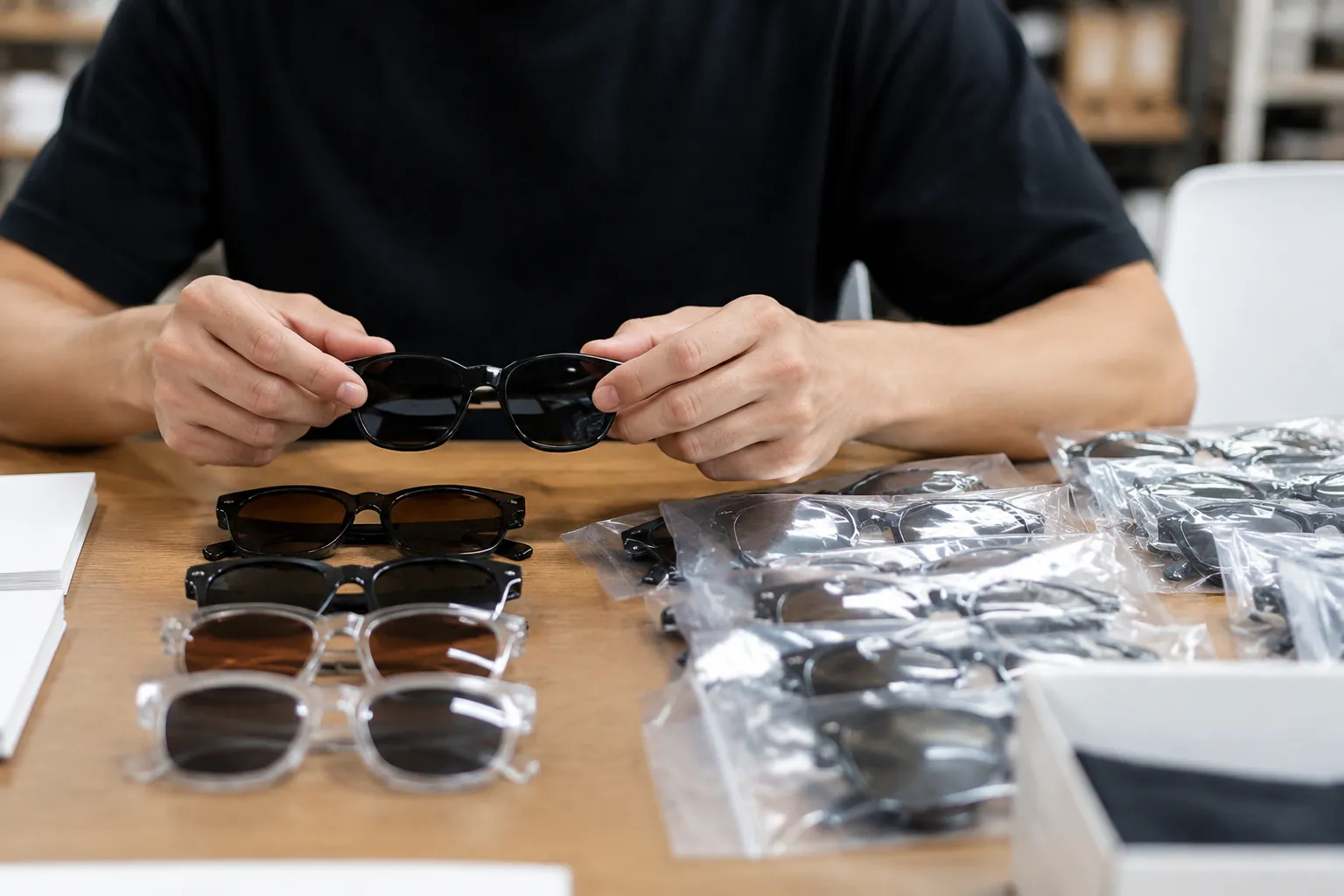
This guide is for buyers who need range without wrecking production economics. Sales teams want more styles, colors, and test SKUs. The factory wants repeatable runs, stable setups, and clear QC. Both are rational. The problem is that MOQ alone does not tell you what the order will actually cost to produce. The real limit is how often production has to stop, switch materials, change lens batches, relabel, reinspect, and repack. Split the order well and you can test demand while keeping price, compliance, and lead time under control. Split it badly and a 300-pair buy starts acting like several inefficient micro-runs.
Start with process cost, not style preference
Most weak eyewear assortments start with the mood board. Start with operations instead. Group first by manufacturing method, then by frame material, then by lens program, then by decoration method, and only then by colorway. Reverse that order and cost usually climbs fast.
In practice, a 300-pair order across three injection-molded frames with one shared lens tint and one shared logo process is usually easier to quote and schedule than the same 300 pairs split across an injection frame, an acetate frame, and a mixed-material build. Same quantity. Different workload.
Treat quantity bands as operating ranges, not price promises. Many suppliers will discuss custom programs from around 50 pairs per design, but real feasibility depends on construction, decoration, packaging, and whether the factory is using stock parts or making custom components. Around 300 pairs, buyers usually get more room to balance variety with efficiency. At 1000 pairs, setup cost is spread across enough units to support a broader mix, but only if the specifications stay tight.
Before approving any split, ask four direct questions:
- How many distinct frame constructions are involved: injection, acetate, metal, or mixed-material/CNC-based builds?
- How many lens colors, coatings, or polarized options require separate batching or separate approval?
- How many logo applications differ by SKU, including position, artwork size, and method?
- Can the pouch, case, carton pack, barcode, and insert remain standardized?
If those answers add too many variables, the stated MOQ stops being the real threshold. The supplier may still accept the order. That does not mean the order is efficient. The inefficiency usually comes back as a higher unit price, extra approval rounds, tighter defect discussions, or a longer shipping window.
A practical split for 50, 300, 1000, and 5000+ pairs
Each quantity tier supports a different sourcing goal. The safest split changes with the volume because setup cost only gets diluted when enough pairs share the same production flow.
| Total Order | Best Use | Recommended Split | Main Cost Risk | What To Standardize |
|---|---|---|---|---|
| 50 pairs | Market test, event program, sales sample sell-in | 1 style x 1 colorway x 50 | Every extra variant behaves like a separate short run | Lens tint, logo method, pouch/case, carton marks |
| 300 pairs | First launch, capsule assortment, retailer trial | 2 styles x 150 or 3 closely related SKUs x 100 | Too many tints or decoration changes increase setup loss | Material family, lens spec, packaging, barcode format |
| 1000 pairs | Seasonal buy, distributor program, proven replenishment base | 2 to 4 SKUs, usually 250 to 500 each | Weak test SKUs consume handling time without sales proof | Decoration method, lens family, carton ratios, inspection plan |
| 5000+ pairs | Repeat program, chain retail, scale pricing discussions | Broader mix only with proven sell-through data | Inventory drag on fringe colors and packaging complexity | Everything possible, including master packaging logic |
At 50 pairs, do not treat the order like a collection. It is one idea under test. One frame, one lens color, one branding method is the lowest-friction structure. Split 50 pairs across multiple frame colors and multiple lens tints, and you create several tiny sub-runs that each need sorting, inspection, and packing control.
At 300 pairs, you get some room to add choice. Not much. Two styles at 150 pairs each is usually safer than a 150/100/50 split, unless the 50-pair SKU is nearly identical in material, lens, decoration, and packaging. Three closely related SKUs at 100/100/100 can also work if they stay in one process family.
At 1000 pairs, you can support a base-core-test structure. A common mix is one proven hero SKU, one adjacent safe seller, and one controlled test SKU. The larger base quantity helps absorb setup, scrap allowance, and packaging overhead, but only if the assortment still makes operational sense.
Where margin disappears on mixed orders
The biggest margin leaks on small and mid-volume sunglass programs are usually not obvious. They come from changeovers, handling loss, and fragmented QC.
- Material switching: Injection molding, acetate processing, metal fabrication, and CNC-supported mixed-material builds do not run on the same labor profile or inspection rhythm. A mixed order across these methods is harder to schedule and control than a single-family order.
- Lens program fragmentation: Smoke, brown, green, mirrored, gradient, and polarized lenses may require different sourcing, batching, visual approval, and traceability. Even when lens dimensions match, the handling path may not.
- Decoration changes: Laser engraving, pad printing, foil printing, and applied metal logo plates each create different setup and QC requirements. If the method changes by SKU, approvals and in-line checks multiply.
- Packaging variation: A custom pouch, hard case, retail box, hangtag, insert, and barcode set per SKU can turn a simple order into a kitting exercise. At low volume, packaging variation often creates more friction than buyers expect.
Take a simple case. A buyer places 300 pairs across three styles. On paper, that looks manageable. If each style also uses a different lens tint, a different temple logo treatment, and different retail packaging artwork, the factory sees several nested short runs. That means separate artwork confirmation, separate material staging, separate pack sorting, and more final inspection by SKU.
In-house capability can reduce handoff risk. A supplier that controls more of the process internally may coordinate timing and corrective action more effectively than one relying on multiple outside workshops. But the basic economics do not change. More variables mean more control points, more approval dependency, and more chances for delay.
Add variety in the cheapest operational order
If sales wants more choice, add it in the order that creates the least disruption on the line. Production logic should drive the ranking. Not merchandising preference.
- Same frame, different temple laser mark or printed artwork
- Same frame, different frame color within the same material family
- Same frame, different lens tint
- Different frame shape within the same material family
- Different construction, such as switching from injection to acetate or mixed material
The reason is simple. A logo artwork change may require only artwork confirmation and location verification. A color change in the same frame family is more involved, but the fit standard, hinge geometry, and assembly flow may stay stable. A lens tint change can trigger separate material approval and visual inspection. A material change can alter polishing time, assembly handling, cosmetic expectations, and defect risk.
For small orders, one shape in two colors is often easier to manage than two unrelated shapes in one color each. One shape means one dimensional standard, one fit review, and one core QC checklist. That matters when the total order is still close to the minimum volume under discussion.
Be careful with acetate at low volume. It can support a more premium retail position, but it usually involves more manual processing and tighter cosmetic control than a basic injection frame. It may still be the right choice. Just make sure the reason is channel fit and price architecture, not casual assortment expansion.
Build the split around compliance and QC
Every SKU split still has to pass the compliance path for the destination market. Buyers often treat compliance as paperwork only. It is also a production-control issue.
For sunglasses, commonly referenced standards include CE EN ISO 12312-1 for many EU programs, ANSI Z80.3 for the US market, and AS/NZS 1067 for Australia and New Zealand. Material and chemical compliance may also require REACH depending on the market and materials used. Some US buyers ask the supplier to clarify whether FDA registration is relevant to the product and supply chain documentation. Factory-level credentials such as ISO 9001 and BSCI can matter during supplier qualification, but they are not substitutes for product-level compliance.
The practical risk is clear: if one colorway uses a different lens construction, mirror coating, or polarized lens, do not assume another SKU's test report or declaration covers it in the way your customer expects. Confirm what is shared, what is materially equivalent, and what needs separate verification.
QC should follow the actual split. Ask the supplier to align inspection points with the assortment structure:
- Lens color consistency checked by batch, not just by style code
- Hinge torque and opening symmetry checked by frame construction
- Logo location checked by decoration method and artwork size
- Cosmetic inspection sorted by SKU before final packout
Also define the approval reference clearly: approved sample, approved lens reference, approved logo artwork, approved packaging file. As the order gets more fragmented, those references matter more. There is less room to fix ambiguity once production starts.
Use a base-core-test allocation model
If you are planning a mixed order, use a structure the factory can actually run. Base-core-test is one of the most practical models.
Base: the SKU that carries the economics. It should usually take the largest share of units because it absorbs setup and simplifies scheduling. This is the proven shape and colorway with the lowest replenishment risk.
Core: one or two adjacent SKUs that stay commercially safe. These broaden the range without forcing a full reset in materials or process.
Test: the smallest controlled portion of the order. This is where you put a trend lens, a seasonal frame color, or a fit extension for selected accounts.
Example for 300 pairs:
- 150 pairs matte black square frame with smoke lenses
- 100 pairs tortoise square frame with brown lenses
- 50 pairs crystal gray square frame with green lenses
This works because the style architecture stays tight: one family, limited color variation, a manageable lens program, and controlled packaging change.
Example for 1000 pairs:
- 500 pairs best-selling square frame in black
- 250 pairs same shape in tortoise
- 150 pairs smaller-fit version in black
- 100 pairs trend color reserved for selected accounts
This gives distributors enough breadth to sell without forcing the supplier into excessive changeovers. It also protects margin because the base SKU carries more of the order overhead and supports a cleaner production sequence.
Write the RFQ so the quote reflects reality
A weak RFQ creates fake savings. The first quote looks attractive because key variables are still open. Then the revisions start, and the economics get worse.
For a split custom sunglasses order, send one consolidated sheet with the commercial and technical fields locked before the supplier prices it.
- Style count and exact quantity per SKU
- Frame construction per SKU: injection, acetate, metal, or mixed-material/CNC-based
- Lens specification: tint, category, polarized or non-polarized, mirror or non-mirror
- Decoration method: laser engraving, pad printing, foil print, or metal logo plate
- Packaging components: pouch, case, box, insert, barcode label, carton mark
- Destination market and required compliance documents
- Sample deadline, approval date, and bulk shipment window
Then ask the supplier to separate three things in the quote: unit price, any tooling or setup-related charge, and any lead-time impact caused by the split. Buyers who compare only ex-works unit price often miss the real cost structure.
Ask one direct question on every mixed order: Which part of this assortment creates the most production inefficiency, and what quantity or specification change would reduce it?
A capable supplier should answer that specifically. In many cases, moving one SKU from a token quantity into a viable quantity band, or merging two similar lens tints into one approved tint, improves the order more than negotiating a small unit-price reduction.
When to consolidate and when to cut extra variety
Not every assortment survives serious sourcing review. That is usually a good sign. Consolidation is often the rational choice when a low-volume SKU creates a disproportionate process burden.
Cut back the split if any of these conditions apply:
- The smallest SKU is a minor share of the order and requires its own production process or material family
- One colorway needs unique packaging artwork for very limited volume
- The test SKU uses a more expensive construction without sales history
- The launch date is tight and samples are still not fully approved
- The order already includes multiple lens tints and multiple decoration methods
Cut extra variety entirely when the purpose of the first production is to establish a repeatable program. The first run should tell you which shapes sell, which colors reorder, and where QC issues appear. It should not be used to satisfy every internal preference in one PO.
For first orders, the practical advice is simple: fewer styles, cleaner specifications, faster learning. Use the sample stage to confirm fit, color, logo placement, and packaging references. Once approved, protect the timeline by resisting post-approval changes that introduce new materials, new artwork, or new pack configurations.
Have a custom sunglasses project in mind?
Send us your styles, target market and quantities and we will return a detailed quote with MOQ, lead time and a sample plan.
Get a QuoteWhy source this from Wenzhou with LumiShades
Wenzhou in Zhejiang Province is widely regarded as China’s eyewear manufacturing capital, producing a large share of the world’s sunglasses. That concentration matters to buyers: a deep local supply chain for acetate sheet, hinges, lens blanks, plating and packaging means shorter component lead times, easier color and material matching, and a workforce with decades of eyewear-specific skill. LumiShades has manufactured in this ecosystem since 2009, and our vertical integration — in-house injection molding, acetate cutting, CNC milling, lens tinting, decoration and quality control — means no part of your order is quietly subcontracted to a workshop you cannot audit.
For international buyers, that vertical control translates into accountability. When a single factory owns every step, defects are traced and fixed at source rather than bounced between vendors, and your specifications survive intact from first sample to bulk. We back this with 15+ years of experience, shipments to 60+ countries, more than 5 million pairs produced per year and a 98.5% on-time delivery rate. Our certifications — CE EN ISO 12312-1, FDA registration, ANSI Z80.3, AS/NZS 1067, REACH, ISO 9001 and BSCI audit — mean the compliance documentation your market requires already exists. Explore our manufacturing capabilities and quality control process to see how this works in practice.
Frequently asked questions
Can I split a 50-pair MOQ into multiple colors? You can ask, but first confirm how the supplier defines MOQ: per style, per color, or per combined design family. At 50 pairs, the lowest-risk structure is usually one style in one colorway. If you want more than one color, ask the supplier to quote both options side by side: one-color 50 pairs versus a split such as 25/25. Then compare more than unit price. Check any extra setup charge, packaging complexity, and lead-time impact. If the split colorways also change lens tint or logo treatment, request a revised inspection plan before approving the order.
What is the safest split for a 300-pair first order? Usually two styles at 150 pairs each, or three closely related SKUs at 100 pairs each. Keep the same material family, the same lens family where possible, one decoration method, and standardized packaging. To make that useful, send the supplier a quantity matrix by SKU and ask three questions before placing the PO: which SKU is hardest to run, whether any SKU needs separate compliance confirmation, and whether the split changes the sample or production timeline. If one SKU creates a disproportionate burden, consolidate before approval.
Does changing lens tint really matter on a small run? Yes. Lens tint changes often affect sourcing, batching, visual approval, and inspection. Ask the supplier whether each tint comes from the same lens program, whether polarized and non-polarized versions are mixed, and whether the change affects the compliance file for your target market. For control, require an approved lens reference for each tint and ask QC to record lens color by batch during inspection, not only by style code. That reduces the risk of mixed or inconsistent packout on fragmented orders.
How should I use the 1000-pair level? Use it to build a disciplined assortment, not an unrestricted collection. Put the largest share into one proven SKU, add one or two adjacent safe sellers, and keep the smallest share for genuine test items. Before issuing the PO, ask the supplier to confirm carton ratios, SKU-level packaging logic, and whether any test SKU introduces a new material, new decoration method, or separate compliance requirement. If it does, decide whether the test value justifies the added operational cost.
Which decoration method is safest for low-volume custom sunglasses? There is no universal answer, but laser engraving is often one of the easier low-volume methods to control when the frame material supports it, because it avoids some of the plate, ink, and drying variables associated with pad printing. The right choice depends on frame material, the visual effect required, and logo position. Ask the supplier to show the actual decoration method on the same material family you plan to buy, then confirm three things in writing: artwork size, placement reference, and inspection tolerance. If the method adds separate components, such as a metal logo plate, request a clear QC checkpoint for alignment and attachment security.
Ready to start?
Explore our rimless sunglasses or request a quote — our sales team replies within 12 hours.
Request a Quote