
OEM vs ODM Sunglasses: Speed, Margin, or Product Fit?
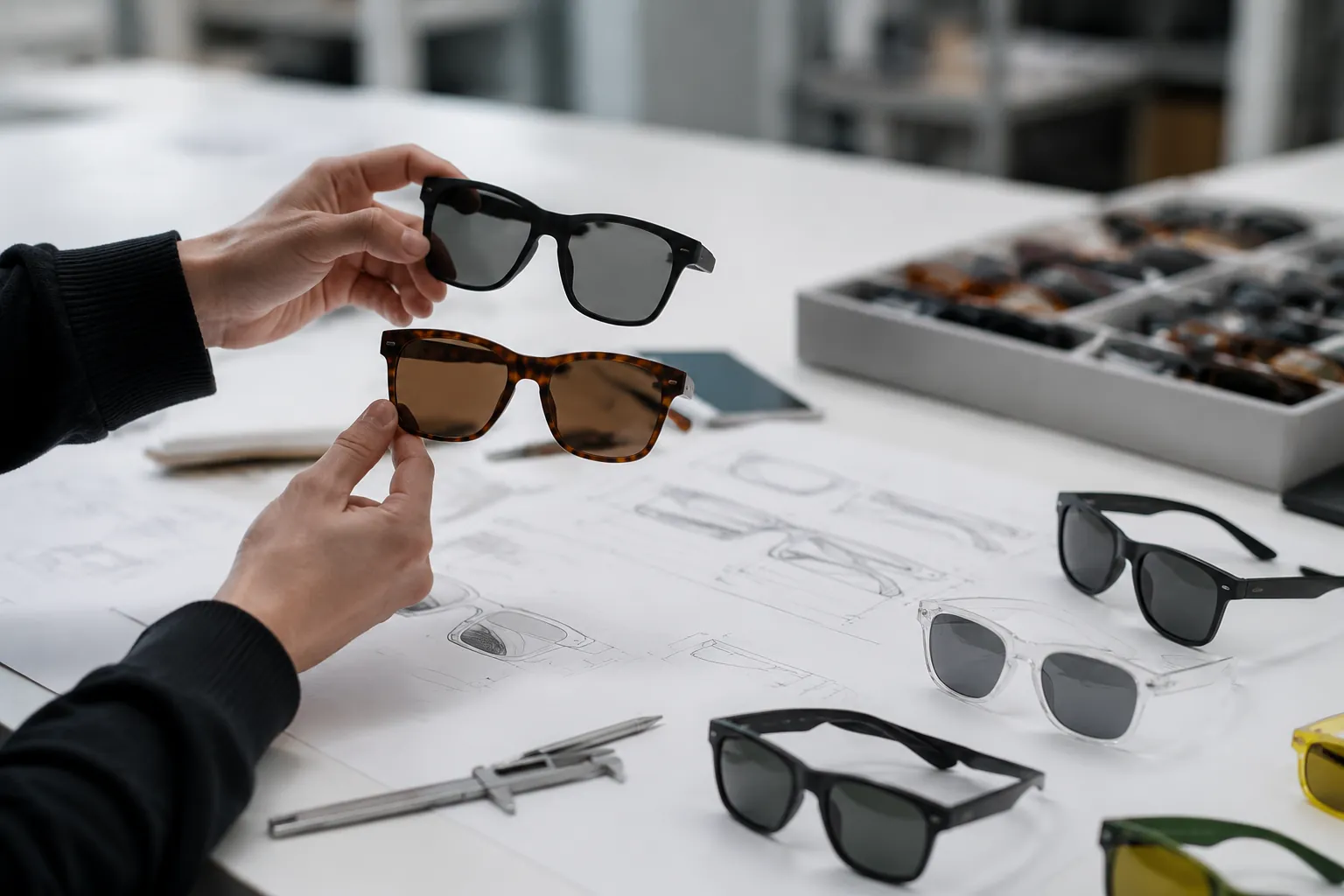
This guide is for brand owners, importers, distributors, and retailers buying sunglasses in volume. In eyewear, OEM and ODM are not just sourcing labels. They are different operating models. The choice affects tooling cost, sample rounds, approval workload, compliance documents, and reorder speed. Choose the wrong model and problems show up fast: a stock frame that cannot deliver the fit you need, or a custom program that burns time and margin. This article compares OEM and ODM in practical buying terms so you can judge speed, customization range, project risk, and cost recovery before placing a bulk order.
Start With the Real Decision: Speed, Geometry Control, or Risk
Buyers often talk about OEM and ODM as if the terms are simple. They are not. In sunglasses, each model changes how the project is built, quoted, approved, and repeated.
ODM starts from an existing factory frame platform. The frame structure, lens groove, hinge position, and assembly route already exist. The buyer usually customizes visible commercial elements: frame color, lens tint, logo application, and packaging. Depending on the factory and the model, minor cosmetic edits may also be possible without new tooling.
OEM starts from the buyer's design intent. That may be a sketch, CAD file, tech pack, or physical reference sample. The factory then has to convert that idea into a manufacturable frame and prove that dimensions, lens fit, alignment, finish, and assembly performance will hold in production.
The practical split is straightforward. If your priority is speed, lower upfront cost, and a simpler first order, ODM is usually the better route. If your brand needs a specific silhouette, fit architecture, or construction detail that existing platforms cannot deliver, OEM is the right path.
The trouble starts in the middle. A buyer expects ODM timing and MOQ, then asks for changes to front curve, bridge fit, lens shape, hinge placement, or temple construction. That is no longer standard ODM, even if the quote still says so. That mismatch causes delays. It also eats margin.
Head-to-Head: What Actually Changes Between ODM and OEM
| Factor | ODM | OEM |
|---|---|---|
| Starting point | Existing frame and lens platform already in factory development or production | New design based on buyer drawing, CAD, tech pack, or reference sample |
| Tooling cost | Often limited to logos, packaging tools, or special decoration setup if the base style already exists | Usually higher because development may require new molds, CNC programs, fixtures, and engineering work |
| Sample timing | Typically shorter because the base frame already exists and changes focus on finish, lens, logo, or packaging | Typically longer because structure, fit, and appearance may need multiple review rounds |
| Bulk lead time | Usually more predictable once the sample is approved because the production route is already established | Usually less predictable at the start because development and production readiness must be confirmed first |
| MOQ logic | Easier to support at lower opening quantities because there is less development cost to recover | More difficult to justify at low volume because setup cost is spread over fewer units |
| Customization range | Best for color, lens options, logo treatment, and packaging | Best for full control over shape, dimensions, material choice, hardware, and construction details |
| Process risk | Lower because the platform has already been built and assembled before | Higher because manufacturability and tolerance stability must be proven during development |
| Margin logic | Usually stronger for market testing and first orders | Usually stronger only when repeat volume or retail positioning can recover development cost |
The key commercial question is cost recovery. If you are testing a new style, sales channel, or customer segment, ODM usually protects cash flow better because it limits sunk development cost. If you expect repeat orders and need differentiation that stock platforms cannot provide, OEM is easier to justify.
That is the real tradeoff. Faster launch and lower exposure, or more control and more development work.
Where the Money Actually Goes
Do not compare only the ex-factory unit price. That is too narrow. The real cost of an eyewear program also sits in development time, documentation, defect risk, and reorder speed.
- Development: OEM needs more engineering input. A new frame may need revisions to improve lens fit, hinge alignment, temple balance, surface finish, or dimensional consistency before it is ready for bulk production.
- Compliance and documentation: A stock ODM platform with established records is often easier to document than a new construction using different materials, coatings, or lenses. For export programs, buyers should confirm what applies in the destination market. Common references include CE EN ISO 12312-1, ANSI Z80.3, AS/NZS 1067, REACH, FDA registration where relevant to the company and market, and factory-system documents such as ISO 9001 or social compliance audits such as BSCI.
- Scrap and rework: New designs usually carry more first-run risk. If tolerances are too tight or assembly points vary too much, production may need more manual adjustment, slower inspection, or added rework.
- Reorder efficiency: Proven ODM platforms are often easier to repeat because the bill of materials, process route, and inspection points are already familiar to the factory. That matters when an in-season reorder has to move quickly.
MOQ also needs to be read correctly. A low MOQ can still be expensive if the project includes custom development, new tooling, extra sample rounds, or market-specific compliance work. The better comparison is total landed project cost plus project risk. Not unit price alone.
Lead Time Breakdown, Step by Step
Most avoidable delay does not happen during final assembly. It happens earlier, while the specification is still moving.
- Style confirmation: Buyer and factory confirm frame platform or design route, material, lens specification, colorway, logo method, packaging, and destination-market requirements.
- Sample build: For standard ODM customization, this usually means applying agreed changes to an existing style. For OEM, it means building a first sample that proves the design can actually be manufactured.
- Approval loop: This is where many projects lose time. Common causes are late color revisions, logo position changes, packaging artwork edits, and missing labeling details.
- Pre-production confirmation: Before bulk starts, the factory should lock the bill of materials, artwork, lens specification, carton marks, and inspection criteria. If this file stays open, bulk production inherits the risk.
- Bulk production: Once specifications are frozen, the factory moves through material preparation, frame production, lens work, decoration, assembly, and in-process inspection.
- Final inspection and shipment: Carton count, labeling, logo execution, lens appearance, and document consistency should be checked before balance payment and loading.
OEM adds more decision gates before bulk. Depending on the design and material, that may include engineering review, tooling, first-sample evaluation, structural correction, and revised-sample approval. Buyers working to a seasonal launch date need to price that into the calendar early. Otherwise the launch window slips.
Customization Limits: What ODM Can Do, and Where It Stops
Many buyers underestimate ODM at the start. Then they overestimate it once they begin asking for structural changes.
On an existing frame platform, factories can often customize:
- frame color and finish, subject to the material and the factory's process
- lens tint and common lens options available for that base style
- logo application by methods the factory already supports for the model
- packaging such as pouch, cloth, paper box, barcode label, hangtag, and carton marking
What ODM usually cannot change efficiently is core geometry: overall front shape, wrap, eye size, bridge fit, lens groove structure, hinge anchor location, or temple construction. Once those requests show up, the project is moving into OEM in practical terms, even if it began from a stock style.
This matters most for fit and brand positioning. If the target customer needs a specific bridge fit, lens coverage, fashion proportion, or sport geometry, an existing platform may simply be the wrong base. Visible customization will not fix a weak product fit.
Material choice matters too. Injection programs can be efficient and repeatable at scale. Acetate may deliver a more premium visual result, but it often needs tighter control over appearance and finishing. Ask one blunt question early: is this change cosmetic, or does it alter the product architecture?
Compliance and QC: The Part Buyers Ignore Until Claims or Customs
OEM versus ODM is also a documentation and quality-control decision. A proven platform with existing records is usually easier to support than a new frame-lens construction built from fresh materials or altered specifications.
For export sunglasses, buyers should confirm which standards and documents apply to the destination market and whether the tested sample matches the production configuration being ordered. Relevant references may include CE EN ISO 12312-1, ANSI Z80.3, AS/NZS 1067, REACH, and FDA registration where applicable. At the factory level, ISO 9001 and BSCI can help indicate management systems and audit status, but they do not replace product-specific compliance evidence.
Ask direct questions:
- Does the test report match the same frame and lens construction being ordered?
- Do the frame material, lens type, and coatings align with the compliance file?
- Are labeling and packaging requirements confirmed for the destination market?
- Can the factory provide current records rather than generic examples from a different style?
QC should match the manufacturing route. Injection styles need checks on alignment, lens seating, hinge function, and visual finish. Acetate styles need close review of lamination appearance, polishing consistency, dimensional balance, and post-assembly symmetry. Decoration also needs scrutiny. Logo placement, print adhesion, and marking clarity can fail even when the frame itself is acceptable.
Review these points during sampling and again before shipment. Late discovery is expensive.
A Practical Decision Framework for Buyers
Use this before requesting a quote or approving samples.
- Choose ODM first if fast launch, lower development exposure, and simpler repeat ordering matter more than exclusive frame geometry.
- Choose OEM first if frame shape, fit architecture, or construction details are central to the product strategy and expected repeat volume can justify the setup cost.
- Avoid the middle zone where you request structural changes but still expect stock-style timing and pricing. That is where projects become hard to quote and harder to execute cleanly.
- Match material to the selling logic: use the material and construction that fit the target retail position, not just the lowest opening quote.
- Freeze the approval file early: lock lens specification, frame color, logo size and position, packaging artwork, barcode data, carton marks, and required market documents before bulk begins.
For many buyers, the practical sequence is to start with ODM, track sell-through and reorder behavior, and move selected proven styles into OEM only when the business case is clear. That approach preserves capital and reduces avoidable development risk on the first order.
What a Low-Risk First Order Looks Like
A disciplined first order is usually not the most customized brief. It is the order most likely to ship on time, match the approved sample, and repeat without another development cycle.
A practical opening program often uses existing frame platforms, limited logo variation, clear packaging requirements, and a specification file that is fully approved before bulk starts. That gives the factory a better chance to execute consistently. It also gives the buyer a cleaner basis for inspection.
A high-risk first order looks different: a new custom shape, unfinished artwork, multiple decoration methods, packaging still under revision, and compliance questions raised after samples are already in progress. Each request may look manageable on its own. Together, they stack risk.
The strongest first orders are controlled, not ambitious. Choose a stable platform when speed matters. Limit variables that do not improve the sale. Use early orders to validate demand, fit acceptance, and repeat potential. Then invest in deeper OEM development only where the commercial upside is proven.
Have a custom sunglasses project in mind?
Send us your styles, target market and quantities and we will return a detailed quote with MOQ, lead time and a sample plan.
Get a QuoteWhy source this from Wenzhou with LumiShades
Wenzhou in Zhejiang Province is widely regarded as China’s eyewear manufacturing capital, producing a large share of the world’s sunglasses. That concentration matters to buyers: a deep local supply chain for acetate sheet, hinges, lens blanks, plating and packaging means shorter component lead times, easier color and material matching, and a workforce with decades of eyewear-specific skill. LumiShades has manufactured in this ecosystem since 2009, and our vertical integration — in-house injection molding, acetate cutting, CNC milling, lens tinting, decoration and quality control — means no part of your order is quietly subcontracted to a workshop you cannot audit.
For international buyers, that vertical control translates into accountability. When a single factory owns every step, defects are traced and fixed at source rather than bounced between vendors, and your specifications survive intact from first sample to bulk. We back this with 15+ years of experience, shipments to 60+ countries, more than 5 million pairs produced per year and a 98.5% on-time delivery rate. Our certifications — CE EN ISO 12312-1, FDA registration, ANSI Z80.3, AS/NZS 1067, REACH, ISO 9001 and BSCI audit — mean the compliance documentation your market requires already exists. Explore our manufacturing capabilities and quality control process to see how this works in practice.
Frequently asked questions
Can I start with ODM and switch to OEM later? Yes. That is a common and practical sequence. Start with ODM when you want to test demand, price acceptance, fit feedback, and reorder speed with lower development exposure. If a style performs well, then assess whether OEM adds enough value through a distinct shape, better fit architecture, or stronger brand protection. Before switching, compare expected repeat volume against the added cost of development, tooling, new samples, and fresh compliance review for the final construction.
Is 50 pairs per design realistic for custom sunglasses? It can be realistic for ODM or light customization on an existing frame platform, especially when changes are limited to logo, lens option, color, or packaging. For OEM, the real question is not just whether the factory will accept the quantity. It is whether the project makes financial sense. A low-volume OEM order can carry disproportionate cost because development, tooling, and sample corrections are spread across too few units. Ask the factory to separate unit price, tooling cost, sample charges, and any packaging setup cost so you can judge the true opening-order economics.
How much faster is ODM than OEM in practice? ODM is usually faster because the base frame already exists and the factory is not starting from a new structure. OEM usually takes longer because the design must be engineered, sampled, reviewed, and sometimes corrected before it is ready for production. The exact gap depends on complexity, material, factory capacity, and how quickly the buyer approves samples and artwork. A better buying question is not just 'How many days?' It is 'What approval gates sit before bulk production, and which ones can trigger another sample round?'
What certifications or test documents should I ask about for export markets? Ask for documents that match the destination market and the actual product specification. Depending on where the sunglasses will be sold, relevant references may include CE EN ISO 12312-1, ANSI Z80.3, AS/NZS 1067, REACH, and FDA registration where applicable. Also ask whether the factory holds ISO 9001 and whether it has a current BSCI audit if social compliance matters to your supply chain. Most important, confirm that any product test report matches the same frame material, lens type, and configuration you are ordering, not a similar style used only as a sales reference.
What are the most common reasons custom sunglass orders get delayed? The most common causes are specification changes after sampling starts, incomplete artwork, packaging text revisions, labeling changes, and compliance questions raised too late. On OEM projects, extra delay often comes from development issues such as fit correction, tooling revision, or another approval round after the first sample. To reduce delay, send one complete approval file covering frame details, lens specification, logo artwork, packaging, barcode data, carton marks, and destination-market requirements before the factory commits to bulk materials.
Ready to start?
Explore our shield & oversized sunglasses or request a quote — our sales team replies within 12 hours.
Request a Quote