
How to Split Sunglasses Orders by Volume
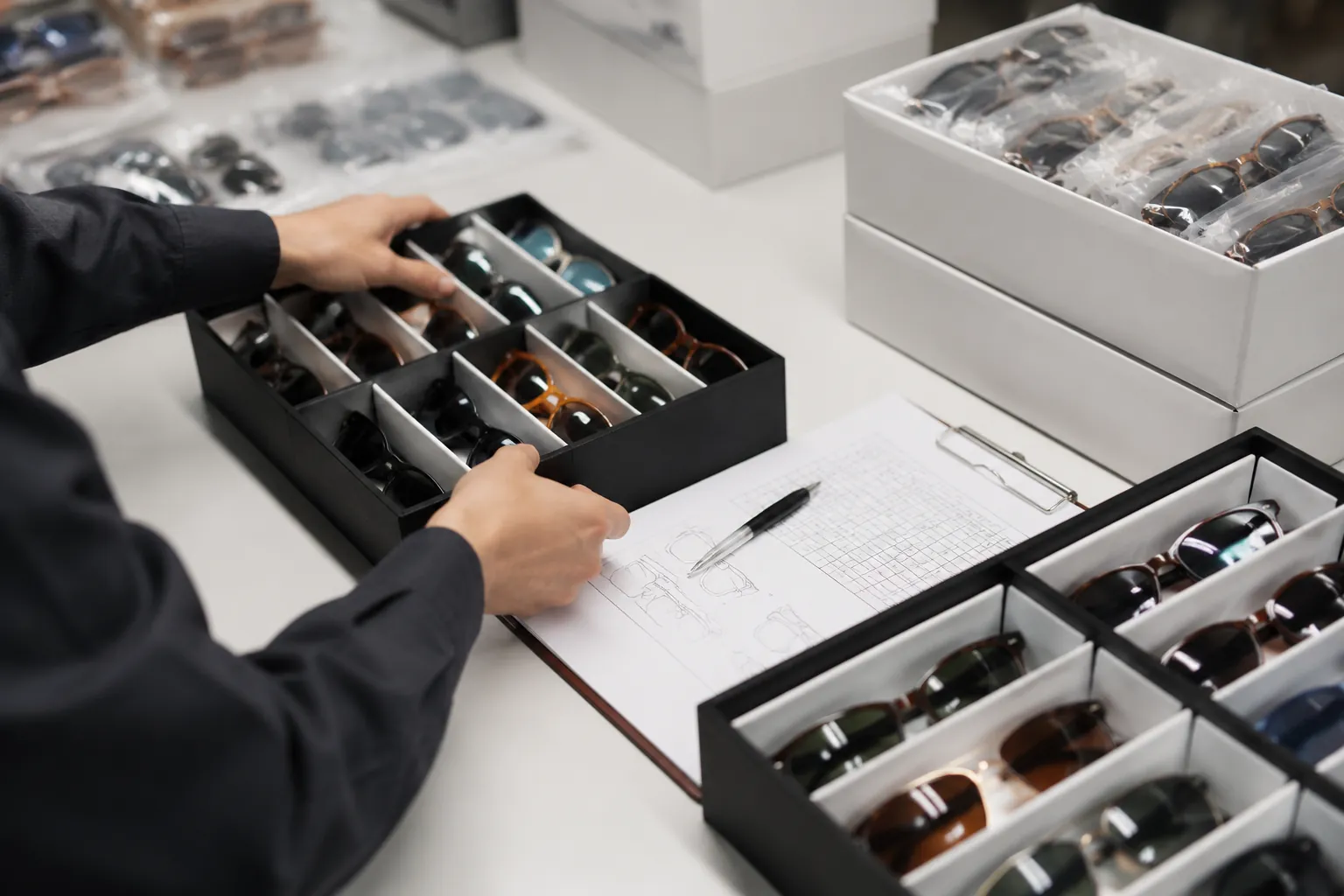
This guide is for brand owners, importers, distributors, and retail buyers planning custom sunglasses orders without tying up cash in the wrong quantity. The decision is not just about ex-factory price per pair. Order size affects which branding methods make sense, how fixed setup costs are spread, how packaging changes landed cost, how QC should be handled, and how much inventory risk sits on each SKU. The framework below shows what to evaluate at 50, 300, 1000, and 5000 pairs. Use it before sample approval, deposit payment, and bulk production release.
Start with the real question: are you testing, launching, scaling, or replenishing?
Bad buying decisions usually start with a mismatch between product stage and order size. A 50-pair order is usually a market test. A 300-pair order is often a controlled launch. A 1000-pair order is commonly the point where cost structure starts to work for established wholesale or direct-to-consumer pricing. A 5000-pair order is typically a scale or replenishment buy. It should be reserved for repeat styles, stable specs, and demand backed by sales history.
The usual mistake is chasing the lowest quoted unit price before the product is proven. That is weak logic. A lower ex-factory cost does not protect margin if the style stalls, returns increase, or the finish misses the approved sample. In sunglasses, fit, lens appearance, hinge feel, logo execution, and packaging all affect sell-through and claim rate. Stage first. Quantity second.
- 50 pairs: demand test, content creation, influencer seeding, or small retail trial.
- 300 pairs: first structured launch across selected channels or stores.
- 1000 pairs: proven SKU with tighter costing and more standardized packaging.
- 5000 pairs: replenishment, chain-store program, or broad distribution with validated demand.
Before discussing quantity with any supplier, define four basics in writing: target market, frame material, lens type, and branding method. Those four points decide whether quotes are actually comparable across factories.
What really changes at 50, 300, 1000, and 5000 pairs
Quantity changes more than price. It changes how setup work is absorbed, which custom options are commercially reasonable, how stable production planning becomes, and how costly a spec error will be if the approved sample was incomplete.
| Order size | Typical use case | Typical cost behavior | Lead-time behavior | Main operational risk |
|---|---|---|---|---|
| 50 pairs | Market test or limited drop | Highest unit cost; fixed setup and packing costs are spread over very few pairs | Can move quickly if based on an existing frame and standard components | Thin margin and over-customization |
| 300 pairs | Controlled launch | Moderate cost improvement; some branding and packaging options become more practical | Often a workable balance between speed and control | Splitting volume across too many colors or SKUs |
| 1000 pairs | Core style rollout | Better cost absorption across materials, decoration, QC, and packaging | More stable material planning and line scheduling | Cash tied in slow-moving inventory |
| 5000 pairs | Scale or replenishment | Best production efficiency when specification is already proven | Most efficient for bulk planning, but approvals must be disciplined | One incorrect spec multiplied across the full run |
At low volume, the same basic production tasks still exist: material prep, logo setup, assembly checks, carton planning, and final inspection. Small orders do not remove fixed work. They just spread it over fewer pairs. At higher volume, those costs are diluted.
For most buyers, the real shift is not a vague promise of a lower unit price. It is the point where decoration, packaging, freight, and QC become proportionate to the selling model. That is why volume should be judged through total landed cost and risk exposure, not just the line-item pair price.
Use a split-order framework instead of forcing one flat quantity
Many buyers should not place one flat quantity across all styles. A better approach is to split the buy by certainty level: put the largest share into proven SKUs, a moderate share into close variants, and the smallest share into unproven designs.
A practical buying model is to sort styles into three buckets:
- Proven seller: repeat shape or repeat color with documented sell-through, acceptable returns, and stable QC history.
- Close variant: same frame family with a different lens tint, temple print, or packaging treatment.
- New test: unproven fit, geometry, frame color, material, or trend direction.
Example for a 1600-pair seasonal buy:
- 1000 pairs of the proven style to support cost control and stock continuity.
- 300 pairs of a close variant to test an extension with limited exposure.
- 300 pairs total reserved for new tests, split only if the supplier confirms MOQ, component compatibility, and branding setup in writing.
This structure protects margin in two ways. First, more units sit in the quantity band that usually supports better cost absorption. Second, speculative inventory stays contained. If a new colorway underperforms, the exposure is limited.
Rule of thumb: do not use an unproven style to justify a high-volume buy.
When requesting mixed quantities, ask the supplier to state clearly whether MOQ applies per style, per color, per lens combination, or per logo setup. Those are different cost drivers. Confusion here leads to quoting disputes later.
Where margin is actually won or lost: materials, decoration, and packaging
Buyers often focus too narrowly on ex-factory price. In practice, margin is often lost through decoration choices, bulky packaging, avoidable rejects, and fragmented color splits.
At 50 pairs, every add-on matters more. A simple one-color pad print on the temple is often the most practical branding method for low MOQ. Laser marking can also work if the frame material and surface finish create enough contrast. A metal logo plate may look more premium, but it can add tooling, extra placement labor, and a tighter cosmetic acceptance standard.
Typical branding logic by volume:
- Pad printing: often suitable for low to mid volume and relatively simple artwork.
- Laser marking: durable on compatible surfaces, but visibility depends on material and finish.
- Metal logo plate: usually easier to justify when volume is high enough to absorb tooling and assembly complexity.
- Printed pouch or case: generally becomes more practical once the order is large enough to spread artwork and packing setup.
Lens options also change the economics. Standard tinted lenses are usually simpler to control than mirrored coatings, gradient tints, or polarized upgrades. Any requirement for strict color matching should be defined against an approved physical standard, because lens appearance can shift under different lighting conditions.
Packaging matters too. A microfiber pouch has a different cost and freight profile from an EVA hard case or rigid gift box. Freight is part of landed cost. Review packaging volume before confirming final pack-out.
Low-volume margin killers: complex packaging, too many lens or frame color splits, metal trim, and late artwork changes.
High-volume margin killers: forecast error, compliance mismatch, and packing errors repeated across the run.
How factory process should guide your quantity choice
Quantity should fit the production method. Buyers who understand the process usually ask better questions and get fewer surprises.
For injection-molded PC or TR90 styles, the process generally includes raw material prep, injection molding, trimming, lens fitting, logo application, assembly, alignment, and QC. Once machine settings, color standard, and logo position are approved, repeat production is usually easier to control. That is one reason higher volumes are often more workable for stable molded styles.
For acetate, the process is slower and more variable: sheet selection, cutting, CNC milling or routing, tumbling, polishing, hinge setting, lens fitting, branding, and final inspection. Acetate can deliver a more premium appearance and hand feel, but sheet-to-sheet color variation is normal. Buyers expecting exact visual matching should define tolerance early and approve against the actual material standard where possible.
Useful control points to request before bulk production:
- logo placement tolerance referenced to approved artwork position
- left-right lens appearance consistency checked under an agreed light condition
- hinge function and screw security check during assembly
- frame front alignment and temple symmetry criteria
- packing method and carton protection standard for shipment
These points are more useful than broad claims such as "good quality" or "strict QC." If a factory holds ISO 9001 certification, ask how that system shows up in actual inspection records, corrective-action handling, and traceability for your order. If the supplier presents BSCI, treat it as a social compliance reference, not a substitute for product testing or shipment inspection.
A practical buying plan for each quantity tier
Use this as a working framework.
| Tier | Best practice | Avoid | Why |
|---|---|---|---|
| 50 pairs | One existing shape, one lens option, simple logo method | Custom mold changes, metal trim, complex case pack | Keeps setup cost and reject exposure under control |
| 300 pairs | One core color and one secondary color if justified by channel plan | Splitting into too many colorways | Supports launch volume without weakening each SKU |
| 1000 pairs | Best-selling style with locked artwork and stable packaging | Changing lens specification after sample approval | Usually a stronger level for cost absorption and repeatability |
| 5000 pairs | Repeat order with defined QC standard and confirmed compliance route | First-time style, untested fit, or unresolved labeling questions | Highest efficiency, but errors scale quickly |
If landed margin is too tight, consolidate volume into fewer SKUs before pushing for a lower quote. Suppliers can usually plan production more effectively on a cleaner quantity structure than on a fragmented order with many small splits.
At any tier, ask for a written quotation that separates at least these items where relevant: unit price, logo charge, packaging cost, sample cost, testing cost if applicable, and carton or labeling extras. Otherwise you are not comparing suppliers on a like-for-like basis.
Compliance and QC checks to lock before bulk production
Before releasing a 1000- or 5000-pair order, lock the file completely: approved sample, approved artwork, approved packaging, destination market, and compliance route.
- Confirm the target-market standards and documents required for the shipment. Common references include CE EN ISO 12312-1 for the EU market, ANSI Z80.3 for the US market, AS/NZS 1067 for Australia and New Zealand, and REACH where chemical compliance applies.
- Confirm lens category, UV performance, tint appearance, and any labeling or warning requirements against the approved sample.
- Approve the branding method and placement: for example, pad print, laser marking, or metal logo plate.
- Set inspection criteria for alignment, surface defects, logo position, hinge function, and packing accuracy.
- Check carton marks, barcode format, inner-pack count, and shipping labels before production is finished.
For US-bound orders, clarify early whether FDA registration or importer-side documentation is relevant to your product type and channel. Do not assume the factory will define that requirement for you. The importer should verify destination-market obligations with its compliance partner, test lab, or customs advisor.
In-process QC matters because final inspection only catches defects after most of the value has already been added. For higher-volume buys, ask the supplier when first-off approval happens, when assembly checks are recorded, and when packaging accuracy is confirmed. Request photos or inspection records tied to those checkpoints if the order value justifies it.
A conservative buying ladder is still the safest one: test at 50, launch at 300, move to 1000 after the style proves itself, and scale to 5000 only when both the spec and demand are stable.
Have a custom sunglasses project in mind?
Send us your styles, target market and quantities and we will return a detailed quote with MOQ, lead time and a sample plan.
Get a QuoteWhy source this from Wenzhou with LumiShades
Wenzhou in Zhejiang Province is widely regarded as China’s eyewear manufacturing capital, producing a large share of the world’s sunglasses. That concentration matters to buyers: a deep local supply chain for acetate sheet, hinges, lens blanks, plating and packaging means shorter component lead times, easier color and material matching, and a workforce with decades of eyewear-specific skill. LumiShades has manufactured in this ecosystem since 2009, and our vertical integration — in-house injection molding, acetate cutting, CNC milling, lens tinting, decoration and quality control — means no part of your order is quietly subcontracted to a workshop you cannot audit.
For international buyers, that vertical control translates into accountability. When a single factory owns every step, defects are traced and fixed at source rather than bounced between vendors, and your specifications survive intact from first sample to bulk. We back this with 15+ years of experience, shipments to 60+ countries, more than 5 million pairs produced per year and a 98.5% on-time delivery rate. Our certifications — CE EN ISO 12312-1, FDA registration, ANSI Z80.3, AS/NZS 1067, REACH, ISO 9001 and BSCI audit — mean the compliance documentation your market requires already exists. Explore our manufacturing capabilities and quality control process to see how this works in practice.
Frequently asked questions
Can I mix colors within the 50-pair MOQ? Sometimes, but the supplier needs to define the rule clearly before sampling or payment. Ask whether MOQ applies per frame color, per lens color, per style, or per logo setup. A factory may allow a split if the base frame, lens spec, and branding method stay the same, but small-volume splits can still raise setup cost, QC complexity, and delivery risk. The practical step is to send your exact color split request in a table and ask the supplier to confirm unit price, MOQ basis, and lead time against that table.
At what quantity does custom packaging start to make financial sense? Usually once the order is large enough that artwork setup, printing, and extra packing labor do not distort landed cost per pair. In practice, many buyers first assess printed pouches, barcode labels, or custom inserts at around 300 pairs and review broader packaging changes more seriously at 1000 pairs and above. The right call depends on your selling price, channel requirements, and freight mode. Ask the supplier for two quotations side by side: one with standard packaging and one with the exact custom packaging spec, including carton dimensions and gross weight.
Should I choose acetate or injection-molded frames for a first order? For a first order, injection-molded styles are usually the lower-risk option because they are often easier to control on cost, consistency, and repeatability. Acetate makes more sense when your retail position supports a higher price point and you are prepared to manage appearance tolerance more carefully. Before deciding, ask the supplier for the material spec, sample lead time, and the cosmetic tolerance they apply to each option. Then compare that with your target selling price and expected claim risk.
What compliance documents should I discuss before placing bulk? Start with the destination market and ask for the test and compliance route that matches it. Common references are CE EN ISO 12312-1, ANSI Z80.3, AS/NZS 1067, and REACH where applicable. For some US import scenarios, FDA registration or related importer documentation may also need review. The key step is to align the final approved sample, labeling, and any test report to the exact product being shipped. If the factory provides existing reports, verify that the frame material, lens type, and construction match your order rather than accepting a generic document.
How do I reduce the risk of a 5000-pair order going wrong? Do not scale an unproven style. First lock the approved sample, lens spec, artwork, packaging, barcode format, and inspection standard in writing. Then confirm the compliance route for the destination market and require in-process QC checkpoints for first-off approval, logo placement, assembly, and packing. Before deposit release, ask for a production schedule, defect criteria, and who signs off any change request. Before balance payment, confirm what inspection evidence you will receive and whether a pre-shipment inspection is required on your side.
Ready to start?
Explore our rimless sunglasses or request a quote — our sales team replies within 12 hours.
Request a Quote