
Reduce First-Order Risk With a New Sunglasses Factory
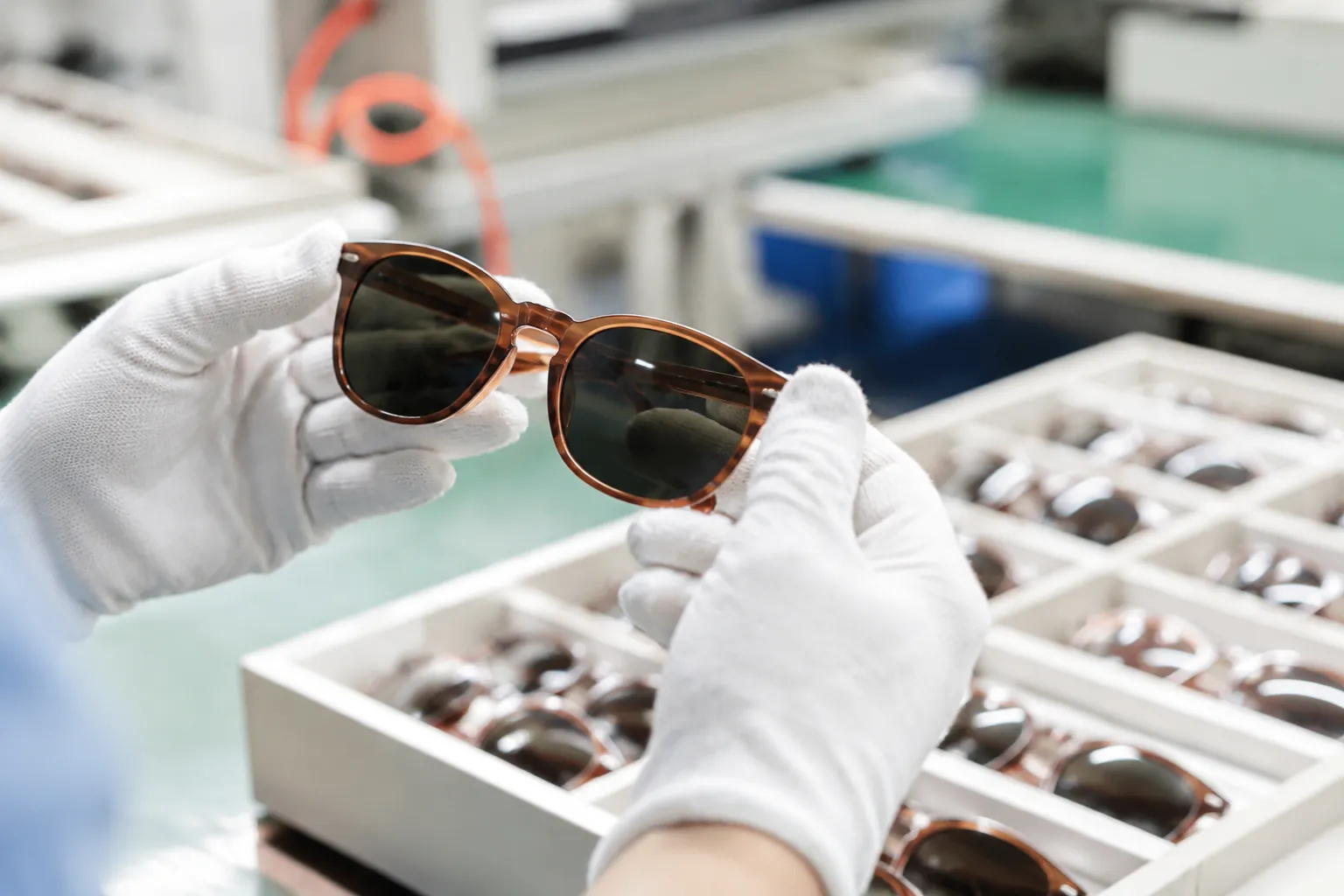
This guide is for brand owners, importers, distributors, and retailers placing a first order with a new sunglasses factory. The aim is simple: reduce avoidable failures on order one. The usual problems are not dramatic. They are expensive, ordinary mistakes like color mismatch, logo errors, lens-performance mismatch, packaging errors, and compliance issues found too late. The fix is also straightforward. Lock specifications in stages, tie payment to approval points, and check production before all goods are packed. Treat the first order as a controlled trial. That makes the second order easier to quote, approve, and repeat.
Start With a Risk Map, Not a Price Quote
Most first orders go wrong for ordinary reasons. The approved sample used one black logo color, but the bulk pad print came out lighter. The sample-room lens tint looked acceptable, but the delivered batch did not match the approved reference. The buyer approved the pouch late, so the carton size changed after freight planning. Price matters. But first-order risk usually sits in weak specifications and weak checkpoints.
Before you ask for a final quote, break the project into five control areas: frame construction, lens specification, decoration, packaging, and compliance. Each area needs detail. "Black acetate frame" is not a usable production standard. You need the material, finish, hinge type, key dimensions, lens requirements, logo method, packaging configuration, and destination-market compliance path. If any of that is still open, treat the quote as provisional even if the factory calls it confirmed.
Put the risk map in writing before deposit. A short control sheet is often enough: front width tolerance, temple length tolerance, logo position tolerance, lens tint reference, and cosmetic standards. Keep one current version. Do not rely on a long email chain.
A factory with more in-house capability may answer technical questions faster because fewer steps are outsourced. That helps traceability and response time. It does not replace buyer control. You still need named approval gates, version control, and a clear record of what was approved.
- Frame construction: material, hinge type, dimensions, finish, symmetry standard
- Lens specification: color, category or VLT target, coating, polarization if required
- Decoration: pad print, laser, hot foil, metal plate, inside-arm marks, packaging logos
- Packaging: pouch, box, barcode label, carton marks, master carton quantity
- Compliance: target market, test basis, labeling, document timing before shipment
Use a Phased Approval Sequence
Do not jump from rendering to bulk production. Split the order into stages. Problems found early are cheap. Problems found after thousands of pairs are packed are not.
- Stage 1: Tech pack and quote lock. Confirm model, material, color reference, hinge, lens specification, decoration method, packaging, quantity, and ship window. Also confirm what the quoted price includes.
- Stage 2: Counter sample. Check shape, fit, front curve, temple movement, branding position, and overall appearance. This stage is for structure and look, not final process consistency.
- Stage 3: Pre-production sample. Make this as close to bulk process as possible, using the intended decoration method, target lens tint, and final packaging components where practical.
- Stage 4: Golden sample sign-off. One approved sample becomes the QC comparison standard. Label it clearly and keep dated photos of the front, side, inside arm, logo, and packaging.
- Stage 5: Inline production check. Review photos, video, or a third-party inspection during production, ideally when about 20% to 40% of units are complete.
- Stage 6: Final random inspection. Inspect packed goods against the approved standard before releasing the balance payment.
Lead times vary by factory, product complexity, material availability, decoration, and packaging. Sample development may take days or weeks. Bulk production should be counted from the point when all approvals are locked, not from the first inquiry or the first rough sample. Rush early review, and the argument often returns later as a bulk-defect dispute.
For first orders with several custom elements, add one clear rule to the purchase terms: no mass production until the pre-production sample is approved in writing, and no packaging print run until the final artwork layout is approved in writing. That closes a lot of avoidable gaps.
Control Cash Exposure With Smarter Deposit Terms
First orders should run on documented milestones, not assumptions. A standard payment structure can work, but only if approvals, revision handling, and inspection rights are clear. A low MOQ reduces quantity exposure. It does not protect you from a poor sample-to-bulk match.
| Approach | Typical Payment Shape | Risk Level | Best Use |
|---|---|---|---|
| Simple standard | 30% deposit, 70% before shipment | Medium to high if specs are still loose | Repeat styles with minimal customization |
| Approval-based first order | Sample fee first, then 30% deposit after PP sample approval, 70% after final inspection | Lower | New factory, moderate customization, branded packaging |
| Phased development plus bulk | Prototype fee, tooling or mold fee if needed, bulk deposit only after spec lock | Lower on complex projects | New mold, acetate development, multi-trim programs |
| Rush production | 50% deposit or more before full approval | High | Only when launch timing clearly outweighs process risk |
Also ask what the deposit activates. Does the factory buy custom materials, lenses, logo tooling, pouches, boxes, or labels as soon as payment lands? If yes, post-approval changes may add cost and delay because custom components may already be committed. Get that in writing before you pay.
Price comparisons only mean something once the specification is stable. Unit pricing often changes at higher quantities because setup cost, material purchasing, and labor allocation are spread differently across the run. Compare prices only after material, lens type, decoration count, and packaging are fixed.
Know Which Sample Actually Predicts Bulk
Buyers often trust the first good-looking sample too much. That is a mistake. Not every sample is made with the same process, tooling, material lot, or finishing controls used in production.
An early prototype may confirm silhouette and dimensions. It may tell you very little about lens tint consistency, hinge repeatability, pad-print adhesion, or metal-logo alignment in handling. For injection styles, hand-finished samples may not show production issues such as gate-mark visibility, cavity variation, sink marks, or mold-line appearance. For acetate, an early sample may not represent final polishing consistency, wire-core centering, bevel quality, or pattern appearance across a broader sheet lot.
- Injection models: confirm resin grade, color reference, cavity consistency, hinge fixing method, and visible mold-mark standard
- Acetate models: confirm sheet reference, pattern repeat, polishing level, bevel consistency, temple symmetry, and wire-core alignment
- CNC-milled parts: confirm edge radius, decorative pocket depth, machining marks, and repeatability across multiple pieces
- Decorated parts: check pad-print adhesion, laser engraving depth, foil clarity, and metal plate position after handling and cleaning
Ask a direct question: which sample is closest to bulk output, and which details may still vary in production? A capable supplier should answer plainly. If the reply stays vague, slow the project down until the production method and likely variation points are clear.
Write Tolerances Into the Approval
Photos help. They are not enough. A photo does not define acceptable variation, and that is where first-order disputes start.
Put tolerances on the points most likely to fail. Keep it short. Keep it usable. Typical examples include overall frame width tolerance of plus or minus 1.0 mm, temple length tolerance of plus or minus 1.0 mm, and logo placement tolerance of plus or minus 0.5 mm for printed marks, with tighter control where small alignment errors are highly visible. Lens color should be approved against a named reference under neutral lighting, and cosmetic limits should distinguish between front-facing and hidden areas. A minor polishing inconsistency inside the temple may be acceptable. A visible front-rim asymmetry is not.
For decorated parts, specify the process because each one behaves differently. Pad printing can shift or fail adhesion. Laser engraving is more durable, but its visual contrast depends on substrate color and depth. Metal logo plates need tight alignment because small errors are easy to spot. Hot foil can give strong contrast, but edge sharpness depends on process settings and surface finish.
| Control Point | Practical First-Order Standard | Why It Matters |
|---|---|---|
| Logo placement | +/- 0.5 mm for print or laser; tighter for visible metal plates | Branding errors are obvious at retail and expensive to rework |
| Overall width / temple length | +/- 1.0 mm | Protects fit consistency and sample-to-bulk match |
| Lens tint match | Approve against a named reference under neutral light | Prevents category drift and mismatched left/right appearance |
| Hinge feel | Consistent opening resistance across a checked sample set | Loose or uneven temples read as poor quality immediately |
Ask for production photos with a ruler or fixture visible. Ask for lens confirmation under neutral, non-warm lighting. Ask for a brief hinge-consistency check across a defined sample set. This is not bureaucracy. It is dispute prevention.
Treat Compliance as a Pre-Shipment Gate
Do not assume a factory certificate covers your exact style. Usually it does not. A factory may hold relevant certifications or registrations, but your order still needs the right compliance path for the destination market, the lens category, and the frame-lens configuration being shipped.
The certifications and registrations commonly referenced in this category include CE EN ISO 12312-1, ANSI Z80.3, AS/NZS 1067, REACH, FDA registration, ISO 9001, and BSCI. These are not interchangeable. ISO 9001 relates to quality-management systems. BSCI relates to social-compliance auditing. REACH addresses chemical compliance obligations in applicable markets. FDA registration should be understood for what it specifically covers and should not be treated as a substitute for performance testing. Product-performance and labeling requirements must match the market and the style being sold.
- CE EN ISO 12312-1: confirm that the supplied style is assessed against the applicable requirements, including lens category and labeling where relevant
- ANSI Z80.3: confirm that the documentation matches the ordered lens and frame configuration for the US market
- AS/NZS 1067: confirm applicability if the goods are intended for Australia or New Zealand
- REACH: confirm material and component compliance where required by the destination market
- FDA registration: verify what registration exists and what it does and does not demonstrate for the product being purchased
- ISO 9001 and BSCI: treat these as factory-level system signals, not proof that the exact sunglasses style meets product requirements
The working rule is simple: ask for the document list before bulk production is finished, not after the goods are packed. At minimum, confirm which documents will be provided, whether they are style-specific or factory-level, and whether product, packaging, and carton labeling match destination-market requirements.
Get Production Visibility Before Goods Are Fully Packed
A final inspection alone is too late for some failures. If lens tint is drifting, logo plates are misaligned, or hinge tension is inconsistent, you want to know while production is still running.
Set one inline checkpoint at about 20% to 40% completion. That can be timestamped photos, a live video review, or a third-party inspection. Timing matters most. At this stage, enough goods exist to show whether the process is holding, but not so many that rework becomes unmanageable.
| Checkpoint | What to Review | What It Catches | Best Timing |
|---|---|---|---|
| Raw material confirmation | Frame color, acetate sheet, lenses, logos, packaging | Wrong material lot, wrong color, missing trims | Before mass assembly |
| Inline assembly check | Lens fit, hinge alignment, logo application, finish quality | Process drift, assembly defects, decoration issues | 20% to 40% of order complete |
| Final random inspection | AQL sample, labeling, carton marks, packing count | Shipment-level defects and packing errors | After 100% packed, before balance payment |
Review three stages, not one: components, assembly, and packed goods. Component review shows whether the correct materials and trims were prepared. Assembly review shows whether production control is stable. Packed-goods review catches carton count, barcode, assortment, and labeling errors before release.
Build the First Order So the Second Order Is Easier
The best first order is not always the biggest one. It is the one that gives you useful operating data for the next purchase. Treat order one as a controlled trial of repeatability, not just a test of sales demand.
Keep the SKU count tight. Do not launch too many lens colors, logo treatments, and packaging variants at once unless the market test truly requires them. Use one approved packaging format. Keep one golden sample. Record every revision in one approval sheet so the buyer, factory, and inspector are working from the same version.
A practical first-order structure can look like this: a limited number of designs; a quantity chosen to limit exposure while still testing real production; sample review before bulk booking; one inline visibility point during production; and final inspection before balance payment. If later orders scale up, the gains should come from more stable purchasing, lower setup burden per unit, and better process familiarity, not weaker technical control.
If a factory resists written checkpoints, a clear sample hierarchy, or inspection timing on order one, treat that as a process warning. The issue is not paperwork. It is whether the supplier can produce repeatable output against an agreed standard.
That is the rule. Buy the first order as a controlled trial. Once the factory proves it can hit the same specification repeatedly, then push harder on price, lead time, and SKU expansion.
Have a custom sunglasses project in mind?
Send us your styles, target market and quantities and we will return a detailed quote with MOQ, lead time and a sample plan.
Get a QuoteWhy source this from Wenzhou with LumiShades
Wenzhou in Zhejiang Province is widely regarded as China’s eyewear manufacturing capital, producing a large share of the world’s sunglasses. That concentration matters to buyers: a deep local supply chain for acetate sheet, hinges, lens blanks, plating and packaging means shorter component lead times, easier color and material matching, and a workforce with decades of eyewear-specific skill. LumiShades has manufactured in this ecosystem since 2009, and our vertical integration — in-house injection molding, acetate cutting, CNC milling, lens tinting, decoration and quality control — means no part of your order is quietly subcontracted to a workshop you cannot audit.
For international buyers, that vertical control translates into accountability. When a single factory owns every step, defects are traced and fixed at source rather than bounced between vendors, and your specifications survive intact from first sample to bulk. We back this with 15+ years of experience, shipments to 60+ countries, more than 5 million pairs produced per year and a 98.5% on-time delivery rate. Our certifications — CE EN ISO 12312-1, FDA registration, ANSI Z80.3, AS/NZS 1067, REACH, ISO 9001 and BSCI audit — mean the compliance documentation your market requires already exists. Explore our manufacturing capabilities and quality control process to see how this works in practice.
Frequently asked questions
What is the safest MOQ for a first order with a new sunglasses factory? Use a quantity that limits financial exposure but still tests the real production process. A very small MOQ can reduce cash risk, but it may not show how consistently the factory handles materials, decoration, packaging, and inspection across a broader run. Ask the factory for its MOQ by material and customization level, then choose a quantity that lets you judge sample-to-bulk consistency, packaging accuracy, and defect handling before you commit to larger volume.
Should I pay deposit before or after approving the pre-production sample? For a first custom order, the lower-risk structure is usually sample fee first and bulk deposit after written approval of the pre-production sample. If the factory requires a deposit earlier, clarify exactly what that payment authorizes, such as material purchasing, logo tooling, or packaging procurement. Put in writing that mass production cannot begin until the approved specification, artwork, and pre-production sample are signed off.
What documents should I ask for before shipment? Ask for the final invoice, packing list, carton-mark details, inspection report, and the compliance documents required for your destination market and product configuration. Confirm whether each document is style-specific or factory-level. If your market requires product-performance or labeling compliance, verify that the documentation matches the exact sunglasses style, lens specification, and labeling being shipped rather than relying only on general factory certificates.
How long should first-order sunglasses production take? There is no single reliable timeline for every project. Production time depends on material, tooling status, sample revisions, decoration complexity, packaging development, and whether compliance documents are prepared in parallel. The practical control point is this: count bulk lead time only after the specification, artwork, sample approval, and purchasing scope are fully locked. Ask the factory to break the schedule into sampling, material preparation, production, inspection, and packing so you can see where delays are most likely.
What defects are most common on first orders? Common first-order problems include frame-color mismatch, lens tint inconsistency, left-right asymmetry, weak or misaligned logo decoration, uneven hinge tension, packaging errors, and labeling mistakes. Reduce those risks by approving one golden sample, defining measurable tolerances, confirming packaging artwork separately, setting an inline production checkpoint, and holding final inspection before releasing the balance payment. Also ask the factory how it checks lens appearance, decoration adhesion, hinge consistency, and packing accuracy during production.
Ready to start?
Explore our shield & oversized sunglasses or request a quote — our sales team replies within 12 hours.
Request a Quote