
ODM vs OEM Sunglasses: Margin, MOQ, and Speed
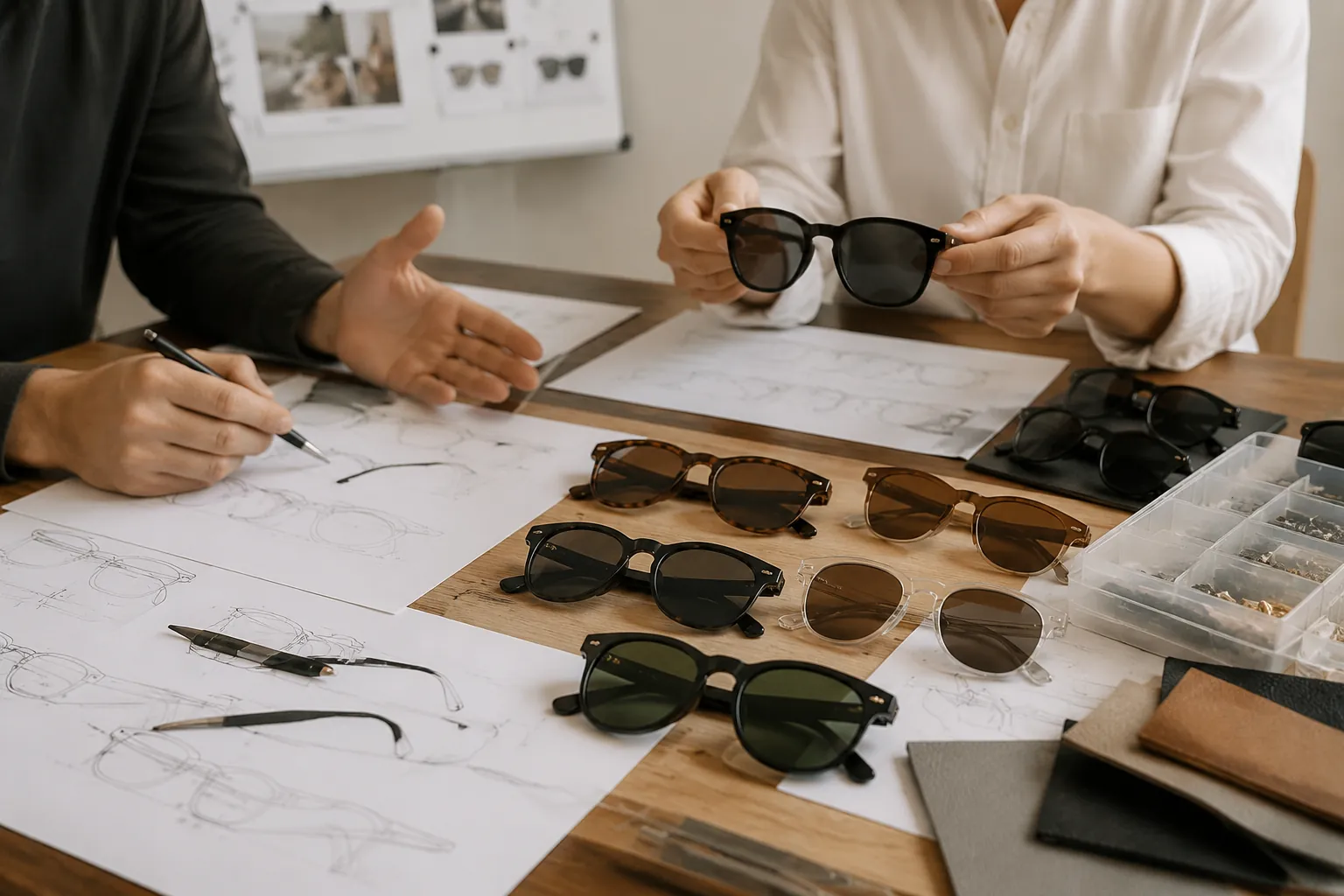
If you are sourcing sunglasses from China, decide on ODM or OEM before you discuss colors, logos, or design sketches. That choice drives upfront cash exposure, sample timing, workable MOQ by color, development risk, and how fast you can reach production. Many avoidable delays start here: a full custom program opened for a small first order, or a long-term signature frame forced onto a stock platform. This guide compares ODM and OEM in buyer terms: tooling, sample rounds, production lead time, compliance, and the order volume needed for custom development to pay off.
Start with the business case, not the design file
Buyers often start with aesthetics. Fair enough. But it is usually the wrong first move.
Start with operating facts: what ship window you need, what opening quantity is realistic per SKU and per color, and whether the frame structure itself creates brand value.
ODM sunglasses start from an existing factory frame platform. Buyers can usually customize lens tint, logo, color, finish, packaging, and some trim details without opening a new mold. Depending on the model and material, there may also be room for controlled changes such as temple-tip shape, logo plate placement, or limited dimensional edits through inserts or machining adjustments.
OEM custom sunglasses start from your sketch, reference sample, or CAD file. The factory must convert that concept into production geometry: eye size, bridge width, front curve, lens groove dimensions, hinge position, wall thickness, draft angle, and assembly tolerances. That takes engineering work, prototype rounds, and often new tooling or dedicated machining programs.
A factory with in-house injection molding, acetate cutting, CNC milling, lens tinting, decoration, and QC can usually control development more tightly. Even so, in-house capability does not remove development risk. A new frame still needs prototype review, fit correction, and confirmation that lenses seat correctly without excessive stress or looseness.
Use a simple rule set:
- Choose ODM when speed, lower upfront spend, and lower MOQ matter most.
- Choose OEM when frame geometry is central to the product and repeat volume is large enough to justify development cost.
- If demand is still unproven, launch in ODM first and move a validated concept into OEM later.
Buyer-side comparison: cost, lead time, and risk
| Factor | ODM sunglasses | OEM custom sunglasses |
|---|---|---|
| Starting point | Existing frame platform | New design from sketch, sample, or CAD |
| Typical MOQ | Often lower than OEM, but actual MOQ depends on model, material, decoration, and packaging | Usually higher in practical terms once tooling, trial production, and per-color quantity are considered |
| Tooling spend | Often none for standard changes; added cost may apply for logo plates, special packaging, or non-standard components | New mold, jigs, fixtures, or machining programs are commonly required; cost depends on material and structure |
| Sample timing | Usually faster because the base frame already exists | Usually slower because engineering, prototyping, and corrections are required |
| Bulk lead time | Usually shorter after approval if components are standard | Usually longer if tooling correction, retesting, or custom components are involved |
| Upfront cash risk | Lower; spend is concentrated in inventory, decoration, and packaging | Higher; spend includes development before saleable stock exists |
| Margin path | Usually more predictable at lower volume | Can improve over time if repeat volume absorbs development cost |
| Best fit | Fast launch, market testing, line extensions, seasonal programs | Signature frames, exclusive fit, long-life core styles, proprietary silhouettes |
The economics are not complicated. If you are ordering near the minimum practical quantity, ODM usually gives a better first-order result because you are not spreading engineering and tooling cost across a small number of units. OEM becomes easier to justify when annual repeat volume is clear enough to dilute those costs over time.
So do not compare unit price alone. Compare development cost, approval time, reorder likelihood, and quantity per color. An OEM frame with a lower quoted unit price can still produce a weaker commercial result if the order is split across several colorways or if custom development makes you miss the selling season.
Use this margin and timeline filter before you request samples
You can make a practical sourcing decision with four checkpoints: selling season, first-order quantity, landed-cost target, and whether the custom feature is visible to the customer.
- If you need market-ready product within one selling season, start with ODM. The base frame already exists, so sampling and production are usually faster than a full custom program.
- If your opening order is small, do not default to OEM. Full custom development gets expensive fast when quantity is split across several colors or channels.
- If your retail model depends on a strict landed-cost target, ask for quantity breaks early. Compare pricing by total order quantity, color split, lens option, decoration method, and packaging level before approving development.
- If customers mainly notice color, lens effect, and branding, stay with ODM. Budget may be better spent on polarized lenses, mirror coatings, finish quality, logo execution, or packaging than on hidden structural changes.
- If fit, silhouette, or construction is your signature, fund OEM. Custom eye size, bridge geometry, temple section, wrap angle, or a unique brow architecture are valid reasons to build from scratch.
Margins often erode in the middle of the process, not at the quoted factory price. Extra approval rounds, late packaging changes, missed compliance assumptions, and a delayed ship window do real damage. Sometimes more than a small unit-cost gap.
Where OEM starts costing real money
OEM cost is not just the mold. It is the full development chain behind it.
- Engineering conversion: a sketch must be turned into producible dimensions, including hinge seat, lens groove depth, draft, wall thickness, and assembly allowances.
- Prototype correction: early samples often expose issues with temple opening angle, frame balance, bridge fit, or lens retention.
- Tooling adjustment: even a workable first sample may need steel correction, insert tuning, or polishing changes before mass production.
- Yield loss: if decoration, lens fitting, or finishing is done before the design is stable, some output may become rework or scrap.
In sunglasses, small dimensional errors matter. A lens groove that is too tight can raise lens stress during assembly. Too loose, and retention suffers. Hinge alignment, left-right balance, and temple bend also affect fit consistency and perceived quality.
Material choice adds another layer:
- Injection plastic is efficient at scale, but the design must respect molding rules. Thin sections, sharp transitions, and difficult undercuts can create sink, warp, or ejection problems.
- Acetate supports a premium story and richer visual depth, but sheet variation, CNC processing, tumbling, and polishing all affect cost and consistency.
- Metal trim or logo plates can raise perceived value, but they also add assembly steps, adhesive validation, and plating or finish-control requirements.
Ask one blunt question: is the custom feature visible and commercially meaningful at retail, or is it mostly adding cost inside production? If it is the second one, OEM may be the wrong opening move.
How far ODM can still go
ODM is not just a stock frame with a printed logo. On a capable platform, buyers can still change the details that customers actually notice without taking on full development risk.
- Lens specification: category, solid tint, gradient, flash mirror, polarized upgrade, and coating options
- Frame finish: solid, crystal, matte, soft-touch, translucent, or layered visual effects depending on material and process capability
- Branding method: pad print, silk print, laser engraving, hot foil, or attached metal logo plate
- Packaging: microfiber pouch, EVA case, folding carton, barcode label, carton mark, insert card, and retailer-specific pack-out
- Controlled dimension edits: limited temple length or fit adjustments where the base tooling allows inserts or light machining
Decoration methods also carry different cost and durability profiles. Pad printing is efficient for logos and small graphics but may wear faster under abrasion than engraved or embedded branding. Laser engraving is durable on suitable surfaces, but it gives a different visual result than ink or foil. Metal logo plates can improve premium perception, yet they add cost, assembly time, and attachment-control requirements.
For many private-label and fast-launch programs, these are the changes that matter most. A buyer testing multiple colorways across more than one market will often get a better result by starting with a proven ODM shape and investing in lens appearance, finish quality, and packaging accuracy than by opening a complex custom frame program too early.
Compliance and testing: specify early or lose time later
Compliance belongs in the first product brief, not in a document request at the end. For sunglasses, the required standards depend on the selling market, but commonly referenced frameworks include CE EN ISO 12312-1, ANSI Z80.3, AS/NZS 1067, and REACH for material-related restricted substances where applicable. Buyers may also request supplier documentation such as FDA registration for certain US import workflows, along with factory-management credentials such as ISO 9001 or social compliance audits such as BSCI where relevant to vendor approval.
What matters in practice:
- CE EN ISO 12312-1: a key reference for general sunglasses performance in relevant markets.
- ANSI Z80.3: commonly referenced for non-prescription sunglasses in the US market.
- AS/NZS 1067: relevant for Australia and New Zealand requirements.
- REACH: relevant for materials and chemicals such as coatings, inks, plastics, and adhesives where restricted substances may be a concern.
- FDA registration: may be requested as supplier documentation in some US workflows, but it is not a blanket product-approval claim for fashion sunglasses.
- ISO 9001: indicates a documented quality-management system, not product certification.
- BSCI: relates to social compliance auditing, not technical product performance.
OEM usually carries more compliance risk because the structure, material mix, and lens specification are less proven. If you change lens transmittance, mirror coating, paint, soft-touch coating, or adhesive, the testing basis may need review. ODM can move faster when the underlying frame and lens construction have already been produced and documented, but buyers should still verify that the exact final specification matches the target market requirements.
Ask for the test basis before placing the order. If you plan to sell in the US, EU, and Australia at the same time, say so in the sample brief from the start.
Supplier due diligence before you commit
Choosing between ODM and OEM is only part of the sourcing decision. You also need to verify that the supplier can execute the program consistently.
- Factory capability: confirm which processes are in-house and which are outsourced, especially molding, acetate processing, lens production, decoration, and final QC.
- Quality system: if the supplier claims ISO 9001, ask for the current certificate and confirm that the scope is relevant.
- Social compliance: if your retail channel requires it, ask whether the factory has a current BSCI audit or equivalent approved by your buyer.
- Compliance files: request test reports or declarations that match the exact product type, lens category, and market, not generic company documents.
- Sampling discipline: confirm who approves artwork, fit, packaging, and carton marks, and whether changes after approval affect lead time or cost.
- MOQ logic: ask for MOQ by frame color, lens color, logo method, and packaging type so you understand the real production split.
Precise documentation matters. A supplier may have valid factory certifications and still lack the right test basis for your exact frame, lens, or market. Compare documents against the product you are actually ordering. Do not assume one report covers every variation.
Common sourcing scenarios and the staged route
Scenario 1: seasonal retail capsule. A buyer needs several SKUs for a defined season, wants private-label branding, and does not want to hold unnecessary inventory after the season. ODM is usually the practical choice. Start with proven shapes, keep the first order manageable, and focus on sell-through variables such as color, lens look, and packaging presentation.
Scenario 2: brand built around one hero frame. A brand wants a recognizable silhouette that will stay in line over multiple seasons. OEM can make sense here because the frame geometry itself carries part of the brand identity. Extra development time and tooling cost are easier to justify when repeat volume is expected and the style life is longer.
Scenario 3: staged sourcing. This is often the strongest commercial route. Launch with ODM to validate channel response, target price, and best-selling colorway. Once reorders are established, convert the winning concept into OEM with clearer data on volume, fit, and market expectations.
That staged approach avoids a common buyer mistake: funding a custom frame before demand is proven at the intended price point. It also improves the eventual OEM brief because the second-step design is informed by actual sales and returns data rather than assumptions.
Before you commit, use this checklist:
- What is your real first-order quantity per color?
- Do you need shelf-ready product within a fixed seasonal window?
- Is your landed-cost target workable at each likely quantity break?
- Is the custom element structural, or could finish and decoration create the same commercial effect?
- Which exact standards must the product meet in each selling market?
- Are packaging specs, labels, and carton marks already fixed?
- Can your team approve artwork and fit quickly, or will decisions drift?
If those answers are still uncertain, ODM usually gives you more flexibility. If they are quantified, approved internally, and backed by repeat volume, OEM becomes the stronger business case.
Have a custom sunglasses project in mind?
Send us your styles, target market and quantities and we will return a detailed quote with MOQ, lead time and a sample plan.
Get a QuoteWhy source this from Wenzhou with LumiShades
Wenzhou in Zhejiang Province is widely regarded as China’s eyewear manufacturing capital, producing a large share of the world’s sunglasses. That concentration matters to buyers: a deep local supply chain for acetate sheet, hinges, lens blanks, plating and packaging means shorter component lead times, easier color and material matching, and a workforce with decades of eyewear-specific skill. LumiShades has manufactured in this ecosystem since 2009, and our vertical integration — in-house injection molding, acetate cutting, CNC milling, lens tinting, decoration and quality control — means no part of your order is quietly subcontracted to a workshop you cannot audit.
For international buyers, that vertical control translates into accountability. When a single factory owns every step, defects are traced and fixed at source rather than bounced between vendors, and your specifications survive intact from first sample to bulk. We back this with 15+ years of experience, shipments to 60+ countries, more than 5 million pairs produced per year and a 98.5% on-time delivery rate. Our certifications — CE EN ISO 12312-1, FDA registration, ANSI Z80.3, AS/NZS 1067, REACH, ISO 9001 and BSCI audit — mean the compliance documentation your market requires already exists. Explore our manufacturing capabilities and quality control process to see how this works in practice.
Frequently asked questions
At what volume does OEM usually start to make sense? There is no universal threshold because it depends on tooling cost, material, color splits, packaging complexity, and expected reorder volume. A practical way to judge it is to calculate total first-year demand, then spread all development cost across that volume, not just the first PO. Ask the supplier for three comparisons: an ODM quote, an OEM unit quote, and the separate tooling or development charges. Then compare gross margin under realistic quantities and reorder timing. If first-year demand is still uncertain, ODM is usually the safer starting point.
Can I still get a private-label look with ODM sunglasses? Yes. In most ODM programs you can customize visible commercial elements such as frame color, lens tint, mirror or polarized options, logo application, finish, pouch, case, carton, barcode labels, and retailer pack-out. Ask the supplier to show which changes are available on the selected platform without new tooling and which would trigger added cost or longer lead time. That tells you how far you can differentiate without moving into OEM.
Does lower MOQ always mean lower risk? No. Lower MOQ reduces inventory exposure, but it does not remove execution risk. Risk can still come from too many color splits, unclear artwork approval, late packaging decisions, missing compliance requirements, or unrealistic launch timing. To reduce risk, confirm MOQ by color and component, lock the specification before sampling, state the target market standards in writing, and ask the supplier to identify which changes after approval will affect cost or lead time.
How fast can a modified ODM program move? Timing varies by supplier and by the amount of customization. A simple logo and color update on an existing model is usually faster than a program with custom packaging, metal logo plates, polarized lenses, or retailer-specific labeling. Do not rely on a generic timeline. Ask the supplier for a stage-by-stage schedule covering sample preparation, artwork approval, packaging confirmation, test-document review if needed, production, and final inspection. That schedule should also state which inputs are required from your side to avoid delays.
What compliance documents should I ask for first? Start with documents that match your selling market and your exact product specification. For sunglasses, that may include CE EN ISO 12312-1, ANSI Z80.3, AS/NZS 1067, and REACH-related material information where applicable. If your vendor-approval process requires it, also request factory documents such as ISO 9001, BSCI, or supplier FDA registration for relevant US workflows. Ask the supplier to identify which documents are product test reports, which are factory-management certificates, and which are supplier registrations. They are not interchangeable.
Ready to start?
Explore our cat-eye sunglasses or request a quote — our sales team replies within 12 hours.
Request a Quote