
Sunglasses Tooling Costs: Molds, CNC, ROI
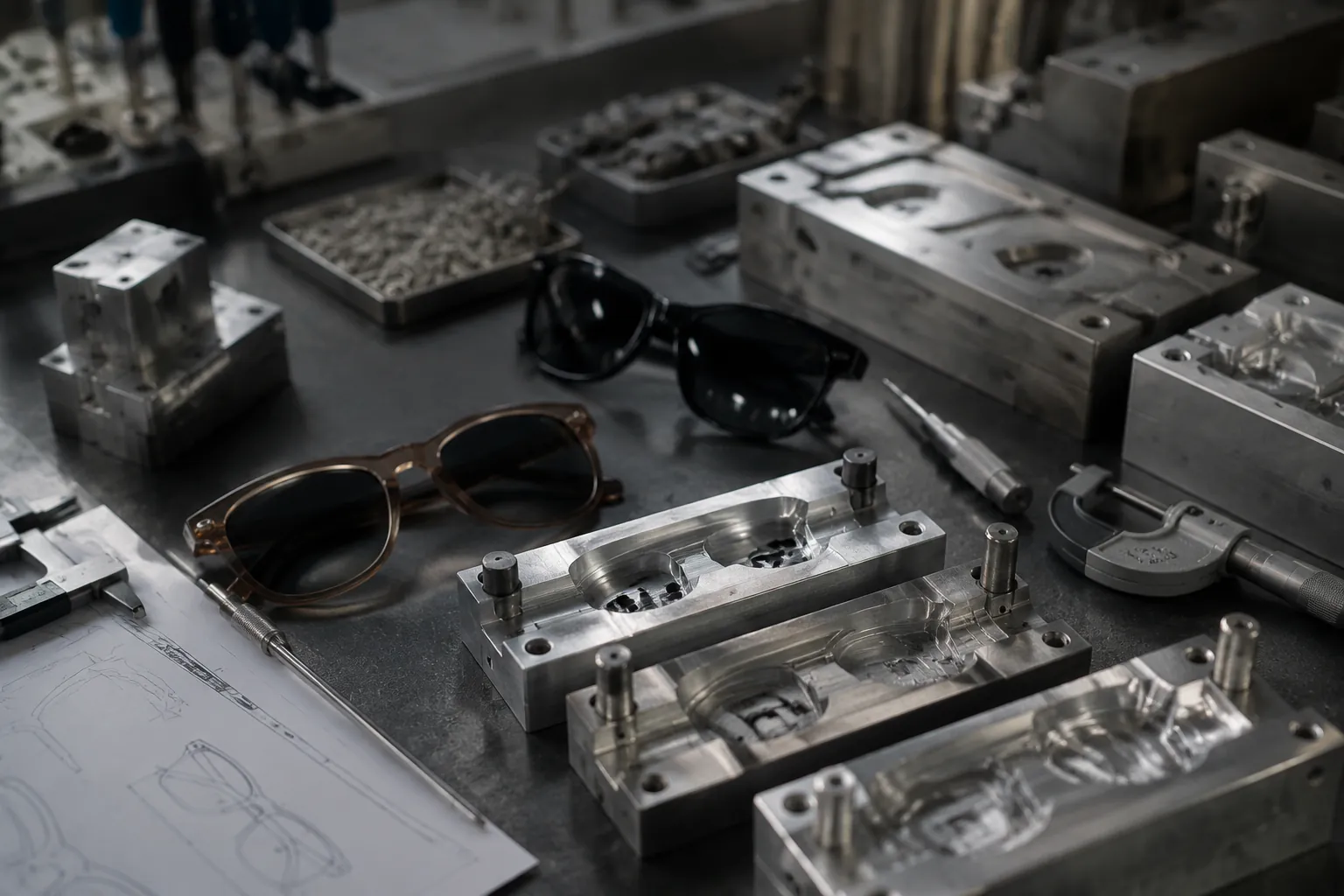
Buyers often talk about stock frames, tool edits, and full custom molds as if the choice is mostly about styling. It is not. It is a sourcing decision that affects upfront spend, MOQ logic, sample rounds, testing scope, and launch timing. A small change on a rendering can still trigger insert work, new samples, lens-fit checks, extra finishing labor, or another compliance review. This guide breaks down the tradeoffs so buyers can choose the lowest-risk path that still creates real product differentiation.
Start with the three tooling paths buyers actually use
Most custom sunglasses projects follow one of three routes: use an existing stock frame, modify an existing factory tool, or build a fully custom frame through new mold or pattern development. These are not just design choices. They carry different technical and commercial risks.
Stock frame development is usually the fastest route because the core architecture already exists. The front curve, lens groove, hinge position, and temple pattern have typically been run before, even if the buyer changes color, lens tint, logo method, or packaging. Risk is lower here. The factory is working inside a known structure.
Modified tooling sits in the middle. The factory keeps the base frame architecture but changes selected features through inserts, machining, or secondary operations. Typical edits include temple thickness, bevel profile, logo recesses, hinge-cover geometry, or trim details. This path can create visible differentiation without taking on the full cost and timing burden of a brand-new mold.
Full custom development is the right route when geometry is the product. That includes a distinct front silhouette, custom bridge fit, unusual lens aperture, heavy acetate build, or a signature carryover style. In that case, the buyer is paying for more than a new shape. The factory also has to prove the shape can be produced consistently. For injection, that means mold design, resin flow, cooling, ejection, and shrink compensation. For acetate, it usually means CNC development, pattern refinement, hand-finishing standards, and a repeatable production setup.
A simple rule helps: if the end customer would barely notice the shape difference at retail distance, new tooling is usually hard to justify unless repeat volume is real.
What buyers usually pay, and why quotes vary so much
Tooling cost is not one market number. It moves with frame material, hinge construction, part complexity, wall thickness, lens shape, finish standard, and how far the project sits outside the factory's normal process. Early quotes are useful, but only as a starting point. Buyers need to ask what assumptions sit behind them.
| Development route | Typical upfront cost | Sample timing | Bulk timing | Common MOQ logic |
|---|---|---|---|---|
| Existing stock frame | Usually limited to sample, logo, color, and packaging charges rather than a new mold fee | Often the shortest route because the base frame already exists | Depends on confirmed materials, decoration, and factory schedule after approval | Common choice for lower-volume programs and line testing |
| Modified existing tool | Varies with insert count, machining scope, and whether structural areas are affected | Usually longer than stock because revised samples must be made and checked | Depends on modification complexity and whether approval requires more than one revision round | Often used when buyers want some exclusivity without fully custom development |
| Full custom injection mold | Can range from moderate to high upfront cost depending on mold complexity, cavity strategy, and hinge area design | Typically includes CAD review, prototyping or mockup review, tool making, and trial samples | Depends on successful tool trials, sample approval, and final testing path | Best justified when repeat volume or multi-season use is realistic |
| Full custom acetate development | Usually includes CNC development, pattern work, sample revisions, and production setup rather than only a mold fee | Often requires iterative review because fit, bevel depth, and finish details are visible quickly on acetate | Depends on sample approval, polishing standard, hardware fitting, and production capacity | Commonly used for premium programs where material appearance is part of the value proposition |
Quote gaps usually come from hidden process differences. A black frame with a standard printed logo does not carry the same manufacturing load as a laminated acetate style with wire-core temples, custom metal trim, special lens coatings, and retail labeling by SKU. Those are not small differences. They change labor, yield, and QC.
The useful buying question is not whether one quote is lower. It is whether the quote reflects the same frame architecture, decoration method, lens specification, packaging, and compliance burden.
Where CNC prototypes fit before you commit to molds
CNC prototypes are a practical checkpoint between concept art and expensive tooling, especially for acetate styles or any frame where proportion carries the design. The factory machines the front and temples from acetate sheet or another machinable material so the buyer can review eye size, bridge stance, temple balance, face coverage, and overall silhouette in real dimensions rather than on screen.
That matters because sunglasses are sensitive to small dimensional changes. A minor shift in bridge width, eye size, or temple flare can change fit, comfort, and visual balance fast. Before approving the next stage, buyers should review at least these checkpoints:
- Front width and eye size against the intended fit group
- Bridge shape and likely nose contact behavior
- Temple opening angle and expected head pressure
- Lens groove position and retention margin
- Overall weight impression, especially on thicker acetate concepts
A CNC sample also has limits. It does not fully predict injection shrink behavior, polishing consistency in production, final assembly balance, or long-run hinge durability. Surface finish can look better or worse than the final product depending on how much hand work goes into the sample. Still, it answers the key early question: does the design work in three dimensions, or only in a rendering?
For injection projects, factories may also use CNC or 3D-assisted mockups to validate geometry before mold steel is cut. This is especially useful on high-wrap fronts, unusual lens apertures, or temples with nonstandard cross-sections. Buyers should ask a direct question here: is the prototype only for shape review, or is it also being used to check lens fit and basic assembly feasibility?
How geometry changes drive cost faster than buyers expect
Not every change affects cost in the same way. Some requests are mostly cosmetic. Others change the manufacturing logic of the frame and push the project into a different cost bracket.
- Low-impact changes: frame color, lens tint, mirror coating, pad print logo, laser engraving, and standard packaging changes.
- Medium-impact changes: temple thickness adjustments, custom logo recesses, exposed wire-core details, hinge-position changes, end-tip profile revisions, and minor curvature changes that stay inside the existing design envelope.
- High-impact changes: new lens aperture geometry, aggressive front wrap, oversized fronts with uneven wall thickness, unusual bridge architecture, custom hinge housings, deep relief surfaces, or any change that affects ejection, cooling, polishing, or lens retention.
Injection-molded sunglasses are especially sensitive to wall thickness distribution. If one area is much thicker than another, cooling can become uneven. That raises the risk of sink marks, warpage, or stress around the lens groove. Factories review more than nominal thickness. They also look at how abruptly the section changes across the front.
Acetate behaves differently. It gives stronger material depth and color presentation, but deep bevels, sharp inside corners, and heavy laminations add machining time, tumbling time, polishing labor, and quality variation risk. A thick temple with an inset logo plate may require CNC pocketing, metal-part fitting, adhesive cure time, protective handling during polish, and extra QC for alignment.
Decoration method matters too. Pad print is usually simpler than embedded metal logos, rivets, custom plaques, or inlaid trim. Once a low-volume project adds several premium details, it may stop behaving commercially like a minor stock-frame variation even if the silhouette still looks familiar.
The break-even test: when a new mold pays off
The right question is not whether a mold fee looks high by itself. The useful question is whether total development cost, spread across realistic sellable volume, still leaves enough margin and price positioning to justify the investment.
- Estimate realistic year-one volume by colorway and channel, not only the total target.
- Add all development cost, including tooling, CNC samples, revised samples, test samples, freight for approvals, and any special trim development.
- Divide that total by expected sellable units rather than factory output units.
- Compare the resulting development burden per pair with your expected gross margin and any price premium the custom shape is meant to support.
- Ask whether the style is likely to repeat for another season, another region, or another reorder cycle.
This exercise usually makes the answer obvious. Development cost spread across a short test run can wreck unit economics. The same cost spread across repeat orders, multiple colorways, or a carryover style may be reasonable.
There is also a strategic factor that simple costing can miss: copy risk. In channels where similar stock shapes are already easy to find, a custom mold may reduce direct comparability and make the line easier to defend. That benefit is real. So are the tradeoffs: slower development, higher upfront cash use, and the chance that the style never reorders.
Disciplined buyers treat tooling as an amortized commercial asset, not as an isolated factory charge.
Compliance and validation change with the development path
Every route still requires product compliance. The shortcut is only in development speed, not in product responsibility.
For sunglasses, buyers commonly review applicable requirements such as CE EN ISO 12312-1, ANSI Z80.3, AS/NZS 1067, REACH, FDA registration, ISO 9001, and BSCI, depending on the product scope and market. The point is not to collect certificates for show. The point is to match the final product specification, destination market, and supplier documentation to the product that will actually ship.
Tooling choices affect validation because geometry changes can alter lens retention, coverage area, mechanical stress, and optical performance. A proven stock frame with an established lens construction may need less development checking than a revised wrap angle, thinner eye rim, different lens thickness, or new aperture shape.
Buyers should pay close attention to these process-specific risk points:
- Lens retention: groove depth, groove width, front curvature, and lens thickness must match the final production lens, not just the original drawing.
- Coverage and category: tint programs, mirror layers, and gradient designs can change light-transmission results and category classification.
- Chemical review: new pigments, coatings, adhesives, metal trims, or decorative inlays can require updated REACH review based on the final bill of materials.
- Mechanical durability: hinge-area edits and temple-thickness reductions can change opening-closing performance and structural reliability.
A common buyer mistake is relying on an older report from a similar model. Once lens tint, lens thickness, hinge construction, frame material, or geometry changes, the tested product may no longer be the same. Technical review and any required testing should be tied to the final approved sample and final production specification. Nothing else is reliable enough.
How to control development cost without killing the design
The cheapest cost reduction is usually fewer avoidable revisions. Projects lose time and money when the styling direction is approved but the core geometry keeps shifting from round to round.
A disciplined development brief should specify front width, bridge size, eye size, temple length, target fit, material, hinge type, lens performance target, decoration method, finish level, and expected order bands. If the frame is custom, reference images should clearly separate non-negotiable features from flexible ones. Vague instructions such as "make it more premium" usually create more sampling, not a better result.
Buyers should also decide where uniqueness actually matters. Many programs save money by keeping a standard hinge, standard temple core, or standard lens base while concentrating budget on the front shape, visible acetate effect, or brand-marking detail the customer will notice first.
That is the real sourcing objective. Not maximum customization. The goal is the lowest-cost level of differentiation that still supports the intended selling price, target channel, and reorder plan.
A practical sourcing rule for each buyer type
If you are a retailer testing a private-label line, stock frames are often the most practical starting point because they limit cash exposure and shorten development. If you are an importer supplying multiple accounts, modified tooling can be a useful middle ground because it creates some separation without fully committing to new molds. If you are a brand owner building a signature frame intended to stay in line, full custom development becomes easier to justify once repeat volume is based on real demand rather than forecast optimism.
As a practical rule:
- Under 300 pairs: stay close to stock unless the frame has strategic value beyond immediate unit economics.
- Roughly 300 to 1000 pairs: consider tool modifications if visible shape differentiation is likely to affect sell-through or account acceptance.
- At 1000 to 5000+ pairs: full custom molds become easier to justify when development cost can be spread over repeat orders, multiple colorways, or carryover seasons.
There is little value in paying for mold work too early. There is also little value in presenting a standard catalog frame as proprietary when it is not. Good sourcing means choosing the minimum level of customization needed to win commercially, then making sure the process, testing path, and volume assumptions are strong enough to support that choice.
Have a custom sunglasses project in mind?
Send us your styles, target market and quantities and we will return a detailed quote with MOQ, lead time and a sample plan.
Get a QuoteWhy source this from Wenzhou with LumiShades
Wenzhou in Zhejiang Province is widely regarded as China’s eyewear manufacturing capital, producing a large share of the world’s sunglasses. That concentration matters to buyers: a deep local supply chain for acetate sheet, hinges, lens blanks, plating and packaging means shorter component lead times, easier color and material matching, and a workforce with decades of eyewear-specific skill. LumiShades has manufactured in this ecosystem since 2009, and our vertical integration — in-house injection molding, acetate cutting, CNC milling, lens tinting, decoration and quality control — means no part of your order is quietly subcontracted to a workshop you cannot audit.
For international buyers, that vertical control translates into accountability. When a single factory owns every step, defects are traced and fixed at source rather than bounced between vendors, and your specifications survive intact from first sample to bulk. We back this with 15+ years of experience, shipments to 60+ countries, more than 5 million pairs produced per year and a 98.5% on-time delivery rate. Our certifications — CE EN ISO 12312-1, FDA registration, ANSI Z80.3, AS/NZS 1067, REACH, ISO 9001 and BSCI audit — mean the compliance documentation your market requires already exists. Explore our manufacturing capabilities and quality control process to see how this works in practice.
Frequently asked questions
Can I get exclusive rights to a modified existing frame tool? Sometimes, but buyers should assume exclusivity is limited unless the contract says otherwise. Ask the supplier to define in writing whether exclusivity applies to the full tool, only to custom inserts, only to branding features, or only to a specific market or customer segment. The agreement should also state the term, territory, ownership of tooling modifications, what happens if reorder volume falls below a threshold, and whether the supplier may sell similar frames with cosmetic changes to other buyers.
Is a CNC prototype enough to approve for bulk production? No. A CNC prototype is useful for confirming shape direction, fit intent, and major visual proportions. Bulk approval should be based on a final production sample that reflects the actual material, finishing method, decoration, lens specification, assembly method, and packaging. Before approving bulk, buyers should confirm that the sample matches the final bill of materials and is the version used for any required technical review or testing.
How many sample rounds are normal on a custom frame? Two to three rounds is common on a genuinely custom frame. A first round usually checks shape and fit. A second confirms corrections plus finish and branding details. A third may serve as the pre-production sample. To control timing, buyers should record each round against a written comment sheet with measured dimensional changes, clear photo markup, and a decision on whether each item is critical, preferred, or optional.
What usually causes new mold projects to miss launch dates? The most common causes are late geometry changes, incomplete logo artwork, hinge changes after sample approval, unresolved lens specifications, delayed color confirmation, and leaving compliance review until the end. Buyers can reduce delay by freezing critical dimensions early, approving artwork files in production format, defining the final lens construction before tool release, and assigning a decision owner who can approve revisions quickly.
Should I choose acetate or injection for a custom shape? Choose based on positioning, geometry, and expected volume. Injection is often the stronger option when repeatability, scale, and unit economics matter most. Acetate is often stronger when the design depends on visible material depth, laminated color effects, polished bevels, and a more premium hand-finished appearance. A practical buying test is to ask whether the customer is mainly paying for shape and brand, or for material appearance and perceived craft as well.
Ready to start?
Explore our sport wrap sunglasses or request a quote — our sales team replies within 12 hours.
Request a Quote