
Sunglasses Payment Terms with China Factories
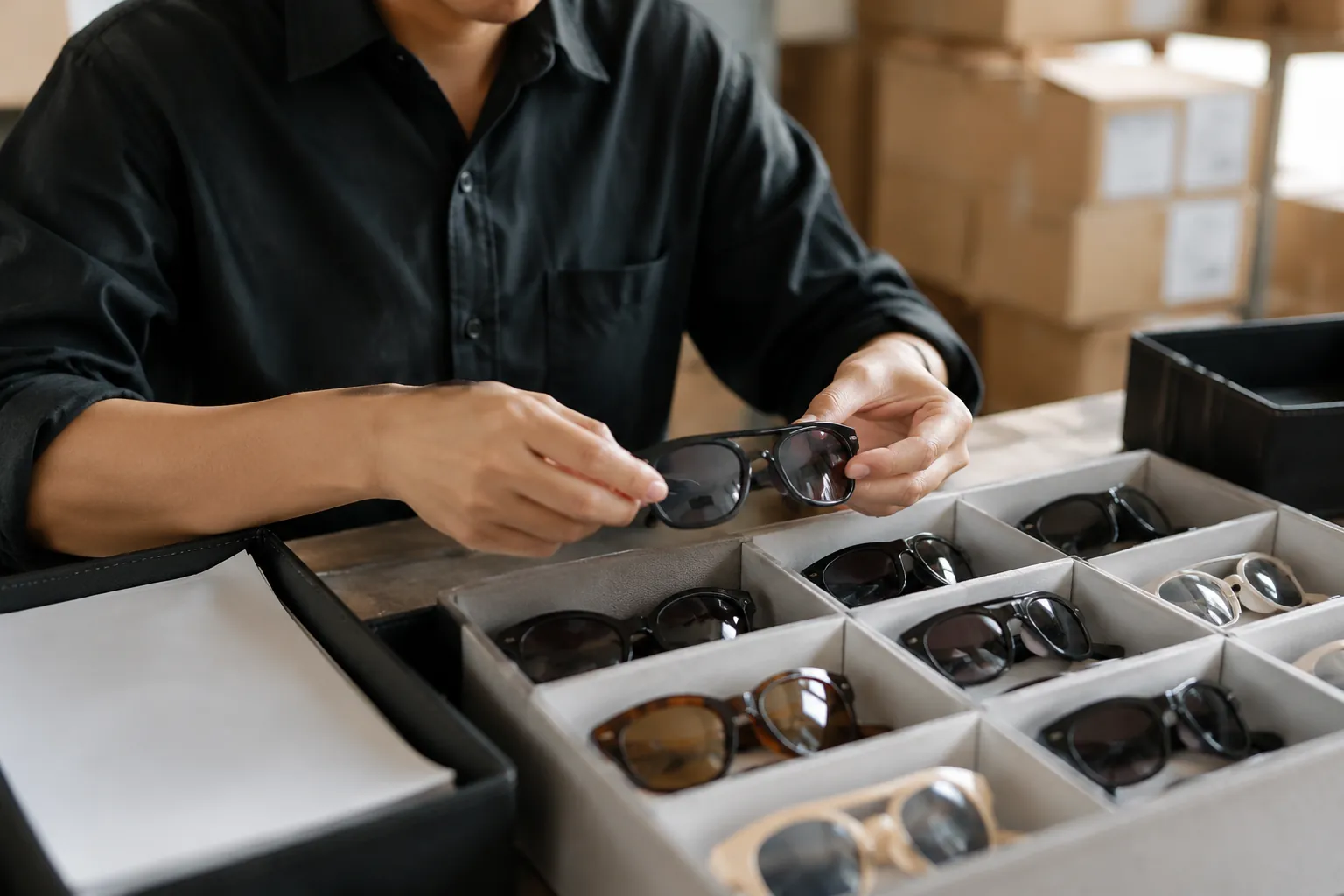
This guide is for brand owners, importers, distributors, promotional buyers, and retail teams placing custom sunglasses orders with Chinese factories. It explains how to handle sample fees, deposits, tooling charges, inspection milestones, and balance payments without losing control of the order. The aim is not just to push for a lower deposit. The real goal is to tie each payment to a clear proof point: approved sample, locked specification, controlled production, finished-goods inspection, document review, and shipment release.
The Payment Structure Most Sunglasses Factories Expect
For custom sunglasses from China, the most common factory term is 30% deposit and 70% balance before shipment. It is normal. It is not automatically safe.
The right structure depends on order value, material risk, tooling cost, decoration complexity, packaging requirements, compliance documents, and your history with the supplier. A repeat logo order using an existing mold is not the same risk as a new acetate frame with custom lenses and retail packaging.
A sunglasses order may involve injection molding, acetate cutting, CNC milling, lens tinting, hinge assembly, pad printing, laser engraving, packaging production, final assembly, and quality control. Once the factory buys resin, acetate sheets, lenses, hinges, screws, metal trims, pouches, printed boxes, labels, and export cartons for your order, some costs cannot be recovered. The deposit protects the factory's material and labor exposure. The balance protects the factory from releasing finished goods without payment.
A practical first-order structure is simple: pay the sample fee before sampling, pay tooling before mold or fixture work if needed, pay the deposit after sample and proforma invoice approval, and pay the balance after finished-goods inspection but before shipment release.
For small custom runs or orders with many colors and logo versions, suppliers may ask for a higher deposit because setup labor is high compared with order value. For repeat orders with stable specifications and a clean payment history, 30/70 is often realistic.
Buyer rule: a generous payment term without inspection rights is not low risk. It only delays the risk until the goods are harder to fix.
Sample Fees: Small Money, Big Control Point
Many buyer-factory disputes start with samples. The buyer may see the sample as a rough prototype. The factory may treat it as the production reference. That gap causes trouble.
Define what the sample proves before you approve it: frame shape, fit, lens color, logo position, material, finish, packaging, labeling, and any compliance target. Do not leave this to memory or chat history.
For custom sunglasses, the supplier should quote sample timing in writing. Samples using existing molds and available materials are usually faster than samples requiring new frame tooling, custom lens tint, a metal emblem, rubber insert, or retail packaging. If a new injection mold is required, first-shot samples should not be scheduled like simple logo samples. Put the confirmed sample date on the proforma invoice or production schedule.
- Use paid samples for serious projects. Paid samples create a formal work order and make it easier to demand the right material, decoration, and packaging.
- Confirm the build in writing. List frame material, lens type, UV requirement, hinge type, screw color, temple length, bridge width, logo method, pouch, box, barcode, and carton mark.
- Keep a retained sample. Ask the factory to keep one approved sample and send one approved sample to you. Final QC should compare bulk production against the approved sample and written specification.
- Do not approve new designs by photo only. Photos can hide lens tint variation, hinge tightness, polishing marks, frame twist, lens seating, and nose bridge comfort.
- Define acceptable variation before production. Control visual color against an approved sample or limit sample, logo placement against a drawing, and frame alignment against the approved sample. Use numeric tolerances only where they can be measured consistently.
If sample fees are refundable after bulk order placement, state the refund trigger on the proforma invoice. Also state whether the amount is deducted from the deposit, deducted from the balance, or refunded after shipment. Vague refund promises create avoidable arguments.
Tooling, Mold Ownership, and Setup Charges
Tooling is not a production deposit. Keep the two separate.
A production deposit funds materials and bulk manufacturing. Tooling pays for a mold, fixture, logo plate, pad-print cliché, CNC program, cutting template, metal trim die, packaging knife mold, or another setup item needed to make the design.
For injection frames, tooling cost depends on frame size, number of cavities, slider structure, hinge design, surface finish, and expected mold life. For acetate frames, hard tooling may be lighter, but CNC programming, cutting templates, bending fixtures, and polishing setup still take time and money.
Do not hide tooling inside the unit price unless the order is large enough and ownership is clear. Hidden tooling often leads to later disputes: who owns the mold, who pays maintenance, whether the factory can use it for other customers, and whether it can be transferred if the relationship ends.
| Payment item | Typical trigger | Timing to confirm | Buyer control |
|---|---|---|---|
| Prototype sample fee | Before sample making | Supplier-quoted sample schedule | Written sample specification and approval comments |
| New injection mold | Before mold cutting | Supplier-quoted tooling and first-shot schedule | 3D drawing approval, first-shot review, ownership and exclusivity clause |
| Pad-print cliché or logo plate | Before decoration setup | Supplier-quoted setup schedule | AI/PDF artwork, Pantone or approved color reference, placement drawing |
| Retail box or pouch setup | Before packaging production | Supplier-quoted packaging schedule | Dieline approval, material specification, barcode proof |
| Bulk production deposit | After PI, specification, and sample approval | Starts the agreed production clock | Approved material list, artwork, packaging file, and production schedule |
| Balance payment | After inspection pass and document check | Before shipment release unless credit terms are agreed | AQL inspection, approved sample comparison, invoice and packing list review |
If a mold is exclusive to your brand, say so in the PI or tooling agreement. State that it is buyer-paid, exclusive to the buyer, stored by the factory, and not available for third-party production. Also state the storage period, maintenance responsibility, transfer conditions, and what happens if there is no reorder for a set period.
Settle this before paying tooling charges. Not when the second season is already late.
Deposit Percentages by Order Type and Material Risk
The deposit should match the unrecoverable cost the factory carries before shipment. A standard black PC promotional sunglass using an existing mold is low complexity. A custom acetate frame with polarized lenses, metal logo plates, gradient lens tinting, printed microfiber pouch, retail box, and market-specific labeling is not.
Material choice affects both production risk and payment negotiation. PC is often used for cost-sensitive and promotional styles, but surface finish, burrs, and lens-frame fit need control. TR90 is valued for flexibility and low weight, but color consistency and injection shrinkage require attention. Acetate can give a premium look, but sheet color varies by batch and polishing is labor-intensive. Metal frames require plating control, solder-point checks, screw and hinge inspection, and attention to market-specific chemical or coating requirements.
| Order type | MOQ logic to verify | Common deposit approach | Payment advice |
|---|---|---|---|
| Existing PC or TR90 style with logo | Lower MOQ may be possible if mold, material, and color are available | 30%–40% depending on order value and setup work | Approve logo sample and inspect packed goods before balance |
| Custom lens color or polarized upgrade | MOQ depends on lens supplier, tint process, and color consistency requirement | 30%–40% or higher if special materials are purchased only for the order | Confirm lens category, tint reference, polarization requirement, and test method |
| Custom acetate style | MOQ depends on acetate sheet availability, color selection, and finishing workload | Tooling/setup paid separately plus production deposit, or higher deposit if material is order-specific | Control sheet batch, polishing quality, hinge alignment, and frame adjustment |
| New injection mold | Tooling is normally justified by repeat demand or protected design value | Tooling paid separately plus production deposit | Separate mold ownership, storage, maintenance, and exclusivity from unit price |
| Large repeat order | Stable specification and payment history improve negotiating position | 30% deposit is commonly discussed; credit terms require supplier approval | Consider lot-based shipment, but keep inspection before each balance release |
Low quantities usually mean higher unit costs. Artwork setup, lens tint adjustment, logo machine setup, carton labeling, documentation, and QC reporting do not shrink in proportion to volume.
For larger orders, ask for clear price breaks by quantity, material, lens type, packaging, and Incoterm. Do not rely on one headline unit price.
Link Balance Payments to Finished-Goods Inspection
The balance payment is the highest-risk payment moment. Most Chinese factories require balance before shipment because collection risk rises once goods are loaded or documents are released. That is a normal commercial position.
Your protection is also normal: inspect finished goods before paying the balance.
Inspection should happen after assembly, lens cleaning, decoration, retail packing, barcode labeling, and carton marking are complete. Inspecting loose semi-finished frames is not enough. You need to see saleable units in export cartons, with the same packaging and labels that will be shipped.
A practical sunglasses inspection checks:
- Frame color, surface gloss, burrs, sink marks, polishing quality, visible deformation, and sharp edges.
- Lens tint, gradient consistency, polarization if ordered, UV or category marking where applicable, lens seating, and visible scratches.
- Hinge tension, screw tightness, temple opening angle, frame balance, nose pad fit where applicable, and general wearing symmetry.
- Logo size, position, adhesion, engraving depth, foil quality, metal plate placement, and consistency across SKUs.
- Packaging count, pouch and box quality, barcode scan, carton mark, warning text, country-of-origin label, and retailer labeling if required.
- Quantity by SKU, color ratio, spare parts if agreed, master carton condition, and export packing method.
Many B2B buyers use final random inspection based on ANSI/ASQ Z1.4 or ISO 2859-1 sampling logic, with an agreed AQL before production starts. Defects are usually classified as critical, major, and minor, with acceptance levels for each. The exact AQL levels are the buyer's decision and should match product risk, sales channel, and market requirements.
Use direct payment wording: Balance payable after finished-goods inspection passes against the approved sample, purchase order, proforma invoice, and agreed inspection standard, before shipment release.
Short. Clear. Familiar to serious suppliers.
Milestones That Fit a Bulk Production Schedule
Bulk production timing for custom sunglasses must be confirmed order by order. The schedule depends on material availability, tooling, lens type, decoration method, packaging, factory capacity, holiday periods, and whether all approvals are complete.
Payment milestones should not create dead time. If your finance team needs several working days to release an international payment, build that into the calendar.
| Production stage | Timing basis | Buyer action | Payment link |
|---|---|---|---|
| Sample approval and PI signing | Day 0 of agreed schedule | Approve physical sample, spec sheet, artwork, packaging file, and carton mark | Release deposit or tooling payment as agreed |
| Material preparation | After deposit and final approvals | Confirm frame color, lens color, packaging files, barcode data, and label text | No extra payment unless special materials require separate payment |
| Frame forming and processing | Per supplier production plan | Request dated production photos or inline update if useful | Do not pay balance at this stage |
| Lens processing, logo decoration, assembly | Per supplier production plan | Check logo and lens pre-alert photos, especially for new decoration | Hold balance until finished goods are ready |
| Final QC and packing | After assembly and packing are complete | Arrange final inspection on packed goods | Pay balance only after pass and document check |
| Shipment release | After balance receipt unless credit terms exist | Confirm booking, cartons, invoice, packing list, and shipping documents | Factory releases goods according to agreed Incoterm |
For urgent launches, buyers sometimes ask the factory to start bulk production before final sample approval. This can save time only if the open points are minor and documented. If lens tint, temple logo position, bridge fit, frame color, or packaging barcode is wrong, rework can be slow, costly, or impossible without replacing components.
Decoration, Compliance, and Documents Affect Release
Decoration methods carry different risks. Payment controls should reflect that.
Pad printing is common for temple logos, but adhesion, edge sharpness, and color accuracy must be checked. Laser engraving is durable, but the result depends on material contrast and engraving depth. Metal plates can look premium, but placement consistency and adhesive or rivet strength matter. Hot stamping works for pouches and cases, but foil transfer can break on textured material.
Do not rely only on finished-goods photos when decoration is important. Ask for a decoration approval sample or close-up pre-production photos before the full batch is decorated. For visible color, use a Pantone reference, approved sample, or approved limit sample. Avoid loose words such as gold, smoke, brown, or champagne. For placement, use an artwork drawing with measurement points from stable frame features.
Compliance should match the destination market and product type. Relevant eyewear-related references may include CE EN ISO 12312-1, ANSI Z80.3, AS/NZS 1067, REACH, FDA registration, ISO 9001, and BSCI, depending on the supplier, product, and market.
Do not ask a supplier simply to print a mark on the product unless the lens category, labeling, user information, and test basis are correct. Unsupported marks can cause customs delays, retailer rejection, relabeling cost, or recall exposure.
If compliance documents are required, make them part of the payment checklist. The balance release package can include the final inspection report, commercial invoice, packing list, product photos, relevant test report or certificate copy, FDA registration confirmation if applicable, and shipping mark confirmation. Check that documents match the supplier, product description, lens category, model, and order date as closely as possible.
Risk Controls to Put in the Proforma Invoice
The proforma invoice is often treated as a payment request. It should also be a control document.
It does not need to be long. It does need enough detail to resolve disputes without guessing.
For sunglasses, include these points:
- Buyer name, supplier name, item code, design name, revision number, and approved sample reference.
- Quantity per design and color, including lens type, polarized or non-polarized status, and UV requirement.
- Frame material: PC, TR90, acetate, metal, or mixed material.
- Key dimensions or approved size reference, such as lens width, bridge, temple length, and frame front width.
- Logo method: laser engraving, pad printing, metal plate, hot stamping, or no logo.
- Packaging components, barcode requirement, inner box count, master carton quantity, and carton mark.
- Certification or document requirement where applicable: CE EN ISO 12312-1, ANSI Z80.3, AS/NZS 1067, REACH, FDA registration, ISO 9001, BSCI, or buyer-specific document requirement.
- Production lead time counted from both deposit receipt and final sample, artwork, packaging, and label approval.
- Inspection standard, defect classification, AQL level if used, and exact balance payment trigger.
- Responsibility for bank fees, late artwork, buyer changes, failed inspection, rework, re-inspection cost, and shipment delay caused by missing approvals.
Bank fees cause small but real problems. State whether the buyer pays only sending bank charges or also intermediary and receiving bank charges. If the factory receives a short deposit, production may stop until the missing amount arrives.
For a first order, use a clear framework: pay samples and tooling separately, approve a physical sample, sign a detailed PI, pay a deposit that reflects customization risk, inspect packed finished goods, review required documents, then pay the balance before shipment release. This respects the factory's cost exposure while keeping your strongest control point active until the sunglasses are actually finished.
Have a custom sunglasses project in mind?
Send us your styles, target market and quantities and we will return a detailed quote with MOQ, lead time and a sample plan.
Get a QuoteWhy source this from Wenzhou with LumiShades
Wenzhou in Zhejiang Province is widely regarded as China’s eyewear manufacturing capital, producing a large share of the world’s sunglasses. That concentration matters to buyers: a deep local supply chain for acetate sheet, hinges, lens blanks, plating and packaging means shorter component lead times, easier color and material matching, and a workforce with decades of eyewear-specific skill. LumiShades has manufactured in this ecosystem since 2009, and our vertical integration — in-house injection molding, acetate cutting, CNC milling, lens tinting, decoration and quality control — means no part of your order is quietly subcontracted to a workshop you cannot audit.
For international buyers, that vertical control translates into accountability. When a single factory owns every step, defects are traced and fixed at source rather than bounced between vendors, and your specifications survive intact from first sample to bulk. We back this with 15+ years of experience, shipments to 60+ countries, more than 5 million pairs produced per year and a 98.5% on-time delivery rate. Our certifications — CE EN ISO 12312-1, FDA registration, ANSI Z80.3, AS/NZS 1067, REACH, ISO 9001 and BSCI audit — mean the compliance documentation your market requires already exists. Explore our manufacturing capabilities and quality control process to see how this works in practice.
Frequently asked questions
Should I pay 100% upfront for a small sunglasses order? Avoid 100% upfront for a first order unless the amount is low enough that you can accept the full risk. A safer process is: pay for a sample, approve the physical sample and written specification, pay a deposit, inspect finished packed goods or review detailed finished-goods evidence, then pay the balance before shipment. Full prepayment is more reasonable for low-value repeat orders with a supplier that has already delivered acceptable goods.
Can the 70% balance be paid after goods arrive in my country? Most Chinese factories will not accept payment after arrival for new buyers. Once goods are shipped or documents are released, the factory loses control. A realistic compromise is balance after passed pre-shipment inspection and document review, before shipment release. If you want better terms later, build payment history first, keep orders consistent, and discuss credit terms after several successful shipments.
What inspection tolerance should I use for custom sunglasses? Use a written inspection standard before production starts. Define critical, major, and minor defects. State the sampling method if using AQL. Add product-specific checks for lens scratches, lens seating, hinge function, screw tightness, frame symmetry, logo placement, packaging, barcode scanning, and labeling. Use the approved physical sample and approved artwork as the main reference. Use numeric tolerances only for points the inspector can measure consistently.
Who should pay for a failed inspection? State this in the PI or purchase order. If goods fail because they do not match the approved sample, specification, artwork, packaging requirement, or agreed inspection standard, the factory should correct the goods and usually absorb production rework cost. Re-inspection cost should also be agreed in advance. Many buyers pay the third-party inspection company directly so the report remains independent, then decide re-inspection cost responsibility based on the cause of failure.
How do I protect custom mold ownership? List the mold or tooling as a separate paid item on the PI. State whether it is exclusive to your company, whether the factory may use it for other customers, how long it will be stored, who maintains it, and whether it can be transferred to another factory. Ask for mold identification photos or records after completion. Do not rely on the phrase "mold fee included" if exclusivity matters.
What payment term is fair for a repeat 1,000-pair order? For a stable repeat style with an established supplier, 30% deposit and 70% after passed inspection before shipment is a common starting point. If the supplier has a strong history with you, you can discuss staged shipments, a lower deposit, or limited credit terms. Keep the inspection trigger before each balance release, especially if the order includes multiple colors, new packaging, or changed lenses.
Should compliance documents affect payment release? Yes. If your market or retailer requires CE EN ISO 12312-1, ANSI Z80.3, AS/NZS 1067, REACH, FDA registration, ISO 9001, BSCI, or other agreed documentation, list the exact documents in the PI and require copies before balance payment or shipment release. Check that the document applies to the relevant product, lens category, supplier, and market. Do not accept unsupported marks or generic certificates without verifying relevance.
Ready to start?
Explore our shield & oversized sunglasses or request a quote — our sales team replies within 12 hours.
Request a Quote