
OEM vs ODM Sunglasses: Ready Mold, Modified ODM, or OEM?
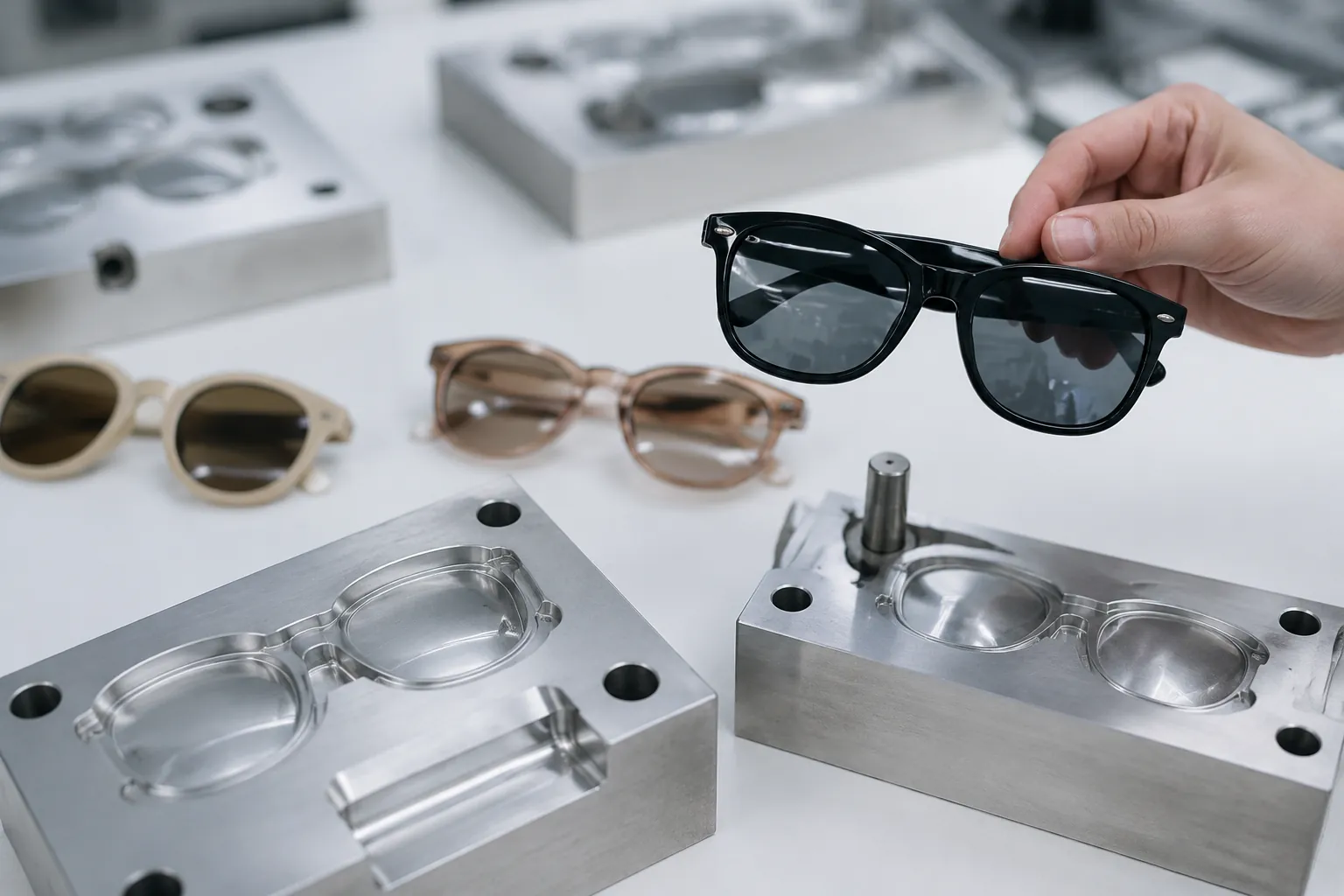
This guide is for brands, importers, distributors, and retailers choosing how much sunglass development to buy before placing an order. It compares three sourcing routes: factory-developed ODM styles, modified ready molds, and full OEM tooling. The point is simple: pick the route that fits your quantity, launch date, exclusivity needs, compliance market, and margin. Do not pay for development you do not need.
The Three Routes Buyers Often Confuse
In sunglass sourcing, buyers often use OEM and ODM as if they mean the same thing. They do not. That leads to vague quotes, slow sampling, and arguments over ownership. Before asking for a price, decide whether you are buying an existing factory product, changing a ready mold, or starting from scratch.
| Route | What it means in practice | Typical MOQ logic | Main risk |
|---|---|---|---|
| Factory-developed ODM | You pick an existing frame shape and combine it with available material colors, lens options, logo methods, and packaging. | Can start from 50 pairs/design at LumiShades; higher quantities usually improve pricing and production efficiency. | Low exclusivity. Another buyer may order the same frame unless limits are written down. |
| Modified ODM | You keep the base mold or construction but change visible details such as color, lens tint, mirror coating, temple logo, pouch, case, barcode, or trim parts. | Often starts from 50 pairs/design, but custom colors, special lenses, plated parts, or dedicated packaging may need higher minimums. | Buyers may think a change is minor when it actually needs tooling, new fixtures, or extra engineering checks. |
| Full OEM tooling | You provide drawings, CAD, reference samples, or a design brief; the factory develops new molds, CNC programs, fixtures, lens cutting data, or special components. | Usually hard to justify for very small orders; more sensible when the SKU will repeat or carry larger annual volume. | Higher upfront cost, longer development time, and more sample rounds before mass production can start. |
LumiShades supports ODM, modified ODM, and OEM sunglass development in Wenzhou. One technical point matters: changing lens curve, bridge width, temple thickness, hinge seat, or nose-pad geometry is not just a drawing edit. It can affect mold flow, lens fit, screw torque, comfort, and the tests needed for the target market.
Use Ready ODM Frames for Speed
Ready ODM frames work best when the selling window is close and the product does not need a protected silhouette. If you choose from existing frame molds, current material colors, standard lenses, and known decoration methods, sampling is usually faster than custom development. LumiShades quotes sample timing based on the exact frame, lens, logo, and packaging mix requested.
The MOQ at LumiShades starts at 50 pairs per design. That can suit test orders, influencer drops, boutique retail, distributor pitches, or early sell-through checks. Small orders do not get the same economics as larger runs, though. Setup work such as lens cutting, fixture changes, pad-print plate prep, color matching, mirror-coating control, carton marking, and AQL inspection is spread across fewer units. Ask for price breaks at realistic quantities, not only at the minimum.
Ready ODM also reduces risk if demand is not proven. You can test frame shapes, lens colors, and retail price points without paying for new tooling. The trade-off is direct. You buy speed and lower development risk, not design protection.
- Best fit: beach retail, festival merchandise, entry-price private label, pharmacy, supermarket, travel retail, and seasonal programs.
- Fast decoration options: laser logo, pad printing, hot-stamp pouch logo, or a simple temple mark using an existing process.
- Common delay triggers: non-stock lens tint, custom mirror coating, new barcode format, retailer packaging, or late artwork approval.
- Ask first: is the exact frame open to all buyers, restricted by region, or already committed to another customer?
Use Modified ODM for a Private-Label Look
Modified ODM is often the best middle route. You keep the existing mold or base construction but make the sunglasses look like part of your line. For many private-label programs, that gives a workable balance of price, speed, and differentiation.
Common changes include frame color, transparent or solid material appearance, lens category, lens tint, gradient lens, TAC polarized lens, mirror coating, temple print, laser logo, metal logo plate, pouch, hard case, microfiber cloth, barcode sticker, hang tag, instruction leaflet, and shipping carton marks. Small component changes may also be possible, such as screw color, hinge finish, or decorative temple parts. But do not assume the bridge, lens size, temple cross-section, hinge pocket, or nose area can change without tooling work.
For injected PC, TR90-style, or other thermoplastic frames, the mold defines the geometry. If you change the front shape, lens opening, bridge, or hinge area, the lens groove, shrinkage, ejection, fit pressure, and assembly method may change. Even small dimensional changes can affect comfort or lens retention. For acetate, styling is more flexible because sheet material is cut and milled, but a new front shape still needs CNC programming, fixtures, tumbling, hand polishing, bending trials, and process control.
A useful modified ODM brief should include Pantone references or physical color chips, lens category target, UV protection requirement, logo size in millimeters, logo position drawing, packaging artwork, barcode rules, destination market, and target delivery date. Compliance should be stated by market: Europe commonly requires CE marking based on EN ISO 12312-1 and attention to REACH; the United States commonly references ANSI Z80.3 and FDA registration where applicable; Australia and New Zealand use AS/NZS 1067.
Choose Full OEM Only for a Real Business Case
Full OEM tooling makes sense when the frame shape itself creates value. If sales depend on a distinctive lens outline, thick sculpted temple, unusual bridge, custom hinge seat, proprietary front curve, or brand-owned design language, ready molds may not be enough.
OEM development should start with a clear design package. The strongest package includes front view, side view, top view, temple open and closed positions, lens base curve, frame measurements, hinge type, material request, logo treatment, target retail price, and destination market. CAD files or a physical reference sample reduce guesswork. If you send only mood-board images, the factory can still help, but sampling will take longer because curves, thicknesses, and fit points must be translated into buildable details.
Expect controlled sampling. A first prototype checks shape and fit. A correction sample may adjust temple pressure, pantoscopic angle, lens seating, nose-bridge comfort, hinge movement, or surface finish. A final pre-production sample should lock the approved color, polish, logo scale, lens specification, packaging, and markings. Rushing this stage creates problems. A sunglass can look fine in a render and still pinch behind the ear, sit too close to the eyelashes, show stress whitening near the hinge, or fail internal lens-retention checks.
Tooling changes inventory risk and cash flow too. New injection molds, mold changes, acetate CNC fixtures, special trim parts, or dedicated lens-cutting files must be paid for and recovered through future orders. For a one-time small run, full OEM is usually inefficient. For a style expected to repeat, tooling may be worth it because it can create a frame competitors cannot copy quickly.
Practical rule: if you cannot forecast repeat orders, start with modified ODM. Put budget into sell-through testing, lens quality, packaging, photography, retail presentation, and compliance documents before committing to full custom tooling.
Cost, MOQ, and Lead Time: Compare the Full Program
Quotations are not just unit price. A low pair price can hide tooling, packaging, inspection, sampling, or delay risk. Compare the full program before choosing ODM, modified ODM, or full OEM.
| Item | Ready ODM | Modified ODM | Full OEM tooling |
|---|---|---|---|
| Typical MOQ | From 50 pairs/design at LumiShades, subject to the selected frame, lens, and packaging. | From 50 pairs/design for light customization; higher MOQs may apply for custom colors, special lenses, plated parts, or dedicated packaging materials. | More practical when the buyer expects repeat demand or larger volume because tooling and development costs must be recovered. |
| Sample lead time | Usually shortest when using available frame, lens, color, and logo processes. | Depends on color matching, lens coating, logo process, packaging mockup, and material availability. | Requires design review, engineering, tooling or fixture prep, prototype review, correction samples, and final approval. |
| Bulk lead time after approval | Quoted after sample approval, artwork approval, deposit, and material confirmation. | Quoted after the approved sample, confirmed materials, confirmed decoration method, and approved packaging files. | Mass production lead time starts only after the final sample and all specifications are approved; tooling development time is separate. |
| Cost drivers | Frame material, lens type, hinge, standard logo method, pouch or case, and order quantity. | Custom color, mirror coating, polarized lens, metal logo plate, retail packaging, labeling, and extra inspection. | Mold or fixture cost, engineering time, sampling rounds, special hardware, compliance testing, and production validation. |
| Exclusivity | Low unless written restrictions are agreed. | Medium; the finished look may be different, but the base frame may still be available to others. | High only if design ownership, mold ownership, use restrictions, and reorder rights are defined in writing. |
Ask for price breaks at 300, 1,000, and 5,000 pairs if those quantities are realistic for your business. That helps you decide whether to run one color or several, choose a microfiber pouch or hard case, specify standard tinted lenses or TAC polarized lenses, and ship in plain export cartons or retail-ready packaging.
Spec Choices That Change the Sourcing Route
The OEM versus ODM decision often turns on technical choices. A buyer who defines these early gets cleaner quotes and fewer sample surprises.
- Frame material: injected plastic is efficient for repeatable shapes and volume production. Acetate gives richer color depth, polish, and a more premium feel, but it needs cutting, milling, tumbling, hand polishing, heat adjustment, and process control.
- Lens type: standard tinted lenses are simpler. TAC polarized lenses add value but require correct polarization-axis control and inspection. Mirror coatings can look strong at retail but may show scratches, fingerprints, and handling marks more easily.
- Lens category: category choice affects visible light transmission and allowed use. Do not approve a dark fashion tint without confirming the selling market, intended use, and required markings.
- Decoration method: laser engraving is durable and clean; pad printing supports color but needs adhesion control; hot stamping works well on packaging; metal logo plates can look premium but need plating, bonding, riveting, or fitting control.
- Fit dimensions: lens width, bridge, temple length, temple opening width, pantoscopic angle, and front curvature affect comfort. Changes in these areas may move the project from modified ODM into tooling work.
- Packaging: pouch, hard case, microfiber cloth, retail box, barcode, instruction leaflet, and carton marks affect unit cost, carton volume, freight efficiency, retailer acceptance, and compliance labeling.
Every custom detail should be approved on a physical sample or a clearly documented pre-production sample. A screen color is not enough for production approval. A small logo shift can look wrong on a narrow temple. A lens that looks fine under office light may appear too light or too dark outdoors.
Build QC and Compliance Into the First RFQ
Compliance should be part of the first quote request, not a document chase after production. Different markets need different evidence. LumiShades can work with recognized eyewear and factory requirements including CE EN ISO 12312-1, ANSI Z80.3, AS/NZS 1067, REACH, FDA registration, ISO 9001, and BSCI where applicable. Buyers should confirm which requirements apply to the product, selling country, retailer, and channel.
For sunglasses, the key questions are practical. Do the lenses meet the optical and UV protection requirements for the destination market? Is visible light transmission consistent with the stated lens category? Are frame materials, coatings, and plated parts controlled for restricted substances under REACH if selling into Europe? Are markings, warnings, and user information correct for the retail country? Are children's styles being checked for fit, small parts, sharp edges, and labeling?
Production QC should cover incoming material checks, frame dimension checks, lens color and category verification, polarization checks where needed, logo position, hinge movement, screw tightness, surface defects, lens retention, packaging accuracy, carton marks, and final AQL inspection when required by the buyer. Common eyewear defects include scratches, bubbles, color difference, poor polish, loose hinges, uneven temple opening, lens gaps, print misalignment, and dirty packaging.
Ask for the test basis before sample approval. Keep a signed golden sample, approved packaging artwork, lens specification, inspection report, and final production photos. That protects both sides if a distributor, customs broker, online marketplace, or retailer asks for proof later.
Decision Checklist Before You Pay for Samples
Before you send a deposit, answer these questions. They will tell you which route fits your project.
- Launch date: If the goods must ship soon, ready ODM or light modified ODM is safer than new tooling.
- Order size: If you are testing demand with a small quantity, avoid heavy customization unless the retail margin can absorb it.
- Repeat potential: If the SKU can repeat, OEM tooling becomes easier to justify. If it is a one-time program, modified ODM is usually safer.
- Brand protection: If the silhouette is part of your brand identity, do not rely on open molds without a written exclusivity agreement.
- Retail price: If the product sells at an entry price, spend carefully on hard cases, metal logos, special coatings, and extra packaging.
- Compliance market: Confirm CE EN ISO 12312-1, ANSI Z80.3, AS/NZS 1067, FDA registration, or REACH requirements before confirming specifications.
- Approval speed: If your team takes two weeks to approve artwork, color, or samples, include that time in the schedule.
A strong RFQ is short but complete: target quantity by design, destination market, frame material, lens type, lens category, logo method, packaging, required standards, target ship date, and reference price. Attach drawings, CAD, or reference samples if the shape matters. Then ask the factory to recommend ready ODM, modified ODM, or full OEM tooling. The right answer should cover cost, timing, tooling, QC, compliance, and risk. Not just a unit price.
Have a custom sunglasses project in mind?
Send us your styles, target market and quantities and we will return a detailed quote with MOQ, lead time and a sample plan.
Get a QuoteWhy source this from Wenzhou with LumiShades
Wenzhou in Zhejiang Province is widely regarded as China’s eyewear manufacturing capital, producing a large share of the world’s sunglasses. That concentration matters to buyers: a deep local supply chain for acetate sheet, hinges, lens blanks, plating and packaging means shorter component lead times, easier color and material matching, and a workforce with decades of eyewear-specific skill. LumiShades has manufactured in this ecosystem since 2009, and our vertical integration — in-house injection molding, acetate cutting, CNC milling, lens tinting, decoration and quality control — means no part of your order is quietly subcontracted to a workshop you cannot audit.
For international buyers, that vertical control translates into accountability. When a single factory owns every step, defects are traced and fixed at source rather than bounced between vendors, and your specifications survive intact from first sample to bulk. We back this with 15+ years of experience, shipments to 60+ countries, more than 5 million pairs produced per year and a 98.5% on-time delivery rate. Our certifications — CE EN ISO 12312-1, FDA registration, ANSI Z80.3, AS/NZS 1067, REACH, ISO 9001 and BSCI audit — mean the compliance documentation your market requires already exists. Explore our manufacturing capabilities and quality control process to see how this works in practice.
Frequently asked questions
Can I get exclusivity on an ODM sunglass frame? Sometimes, but only if it is agreed in writing. Ask the supplier whether the mold is open, regionally restricted, or already used by other customers. If exclusivity is possible, define the market, time period, minimum order or annual volume, colorway restrictions, and what happens if the volume commitment is not met. Do not rely on verbal promises.
Is 50 pairs enough for a custom OEM frame? Usually no. LumiShades can start some ODM orders from 50 pairs per design, but full OEM needs design work, tooling or fixtures, prototypes, corrections, and validation. For a 50-pair test, use ready ODM or modified ODM. Choose full OEM only when you expect repeat orders or enough volume to recover the development cost.
What should I send for an OEM sunglass quote? Send drawings or CAD if available, reference samples, target measurements, frame material, lens type, lens category, hinge preference, logo method, packaging details, destination market, required standards, order quantity, and target delivery date. If you need exclusivity or mold ownership, say so in the RFQ. The more complete the brief, the fewer assumptions the factory must make.
How long should I plan from sample to bulk shipment? For ready or lightly modified ODM, timing depends on the availability of the selected frame, lens, decoration process, and packaging materials. Bulk production should be scheduled only after the physical sample, artwork, materials, and deposit are confirmed. For full OEM, add time for design review, tooling or fixture work, prototypes, correction samples, and final approval before the normal bulk-production clock starts.
Which compliance standards should I mention in my RFQ? State the selling market first. For Europe, mention CE EN ISO 12312-1 and REACH. For the United States, mention ANSI Z80.3 and FDA registration where applicable. For Australia and New Zealand, mention AS/NZS 1067. Also tell the supplier whether the product is for adults or children, because labeling and safety review may differ.
What is the fastest way to make an ODM style look less generic? Keep the mold unchanged and customize visible elements: frame color, lens tint, lens category, logo method, pouch, microfiber cloth, retail box, barcode label, and carton marks. This avoids new tooling while giving the product a private-label look. Approve the logo position, lens color, packaging artwork, and markings on a physical sample before bulk production.
Ready to start?
Explore our shield & oversized sunglasses or request a quote — our sales team replies within 12 hours.
Request a Quote