
Open-Mold vs Private-Mold Sunglasses: MOQ, Cost, Risk
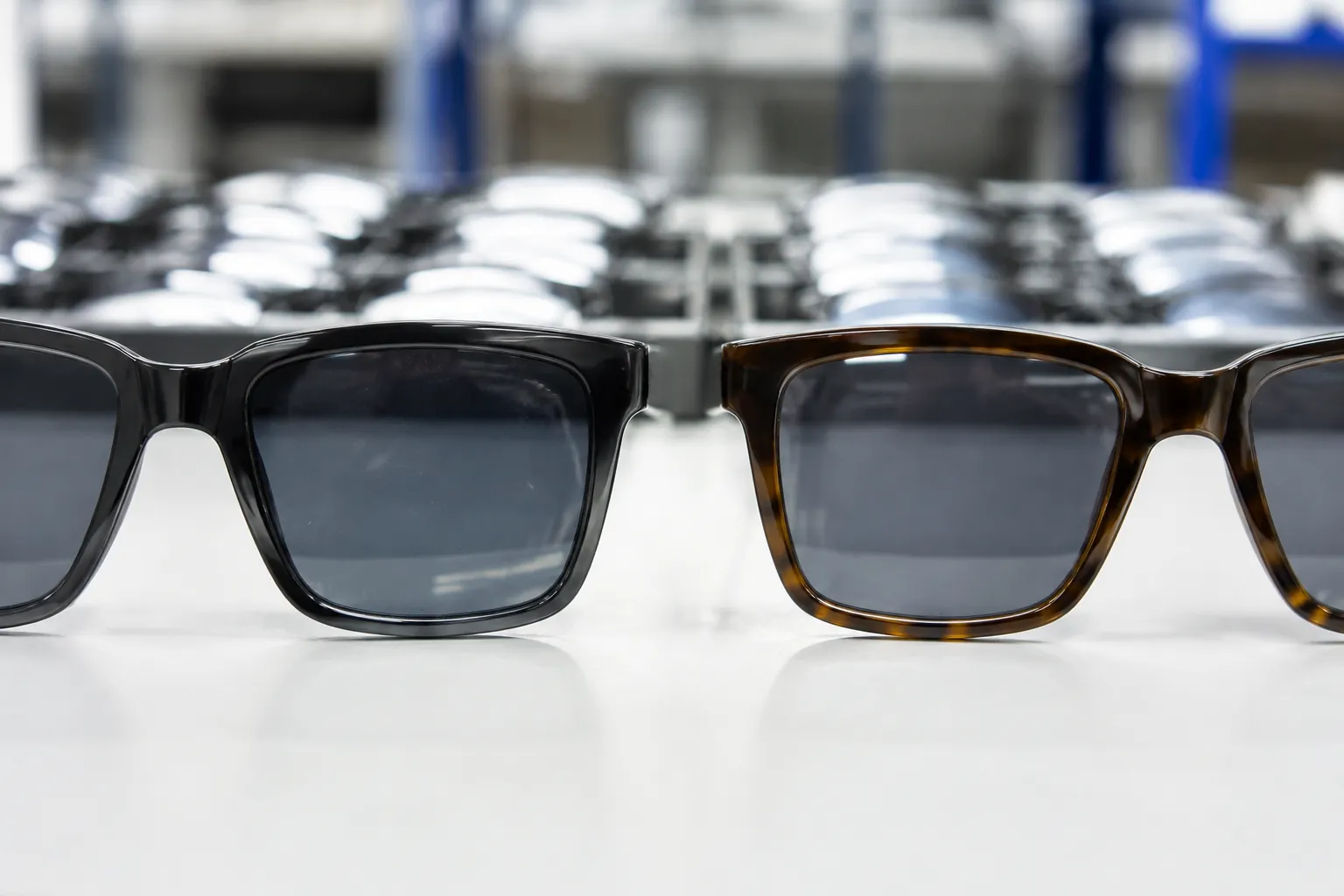
For sunglasses brands, importers, distributors, and retailers, the first OEM choice is not lens color or logo placement. It is control. How much of the frame structure do you need to own? Open-mold sunglasses are faster and easier to start because the tooling already exists. Modified-mold sunglasses add visible difference without taking on a full tooling project. Private-mold sunglasses give the strongest control over shape, fit, and channel exclusivity, but they also require tooling investment, engineering review, sampling discipline, and written ownership terms. This guide compares the three routes by MOQ, lead time, tooling cost, unit price, exclusivity, material limits, decoration options, tolerances, QC, and compliance planning so buyers can choose the right path before sending an RFQ.
The Three OEM Routes, Defined Clearly
Most custom sunglasses programs follow one of three OEM routes: open mold, modified mold, or private mold. The terms are often used loosely in quotations. Define them before comparing price, MOQ, or lead time.
A supplier may call a product "custom" because the logo, color, lens, or packaging changes. That is customization, but it is not the same as changing frame geometry or building dedicated tooling.
| Route | What changes | Typical MOQ logic | Typical lead time | Main risk |
|---|---|---|---|---|
| Open-mold / catalog frame | Existing frame shape and tooling; custom frame color, lens option, logo method, and packaging may be selected | Can start from low quantities because the tool already exists; at LumiShades, open-mold projects can start from 50 pairs per design, with better cost efficiency at higher quantities such as 300, 1000, and 5000+ pairs | Samples are commonly about 7-10 days when materials and decoration are available; bulk production is commonly about 25-35 days after all approvals, deposit, artwork, and packing details are confirmed | The same base frame may be available to other buyers unless written restrictions are agreed |
| Modified-mold frame | Existing base frame with limited changes such as temple detail, logo recess, surface texture, hinge decoration, lens specification, or accessory part | Usually needs more volume than open mold because engineering, trial work, and setup must be absorbed | Often longer than open mold; development samples commonly require additional engineering review and trial time depending on the change | The original mold geometry still limits fit, bridge width, lens curve, wall thickness, and overall frame proportions |
| Private-mold frame | New frame design with dedicated tooling for the front, temples, nose pads, decorative parts, or other components as required | Best justified by repeat orders, larger programs, protected frame shapes, or defined retail/channel requirements | Tooling, trials, corrections, and approval rounds can add significant time before bulk production | Higher upfront cost, multiple sampling rounds, tool correction risk, and the need for clear written ownership and use terms |
Open-mold orders fit market tests, seasonal distributor lines, resort retail, promotional programs, and e-commerce launches where speed and entry cost matter. The low MOQ helps. The cost logic still matters.
At very low quantities, color setup, lens preparation, logo alignment, packing, and QC handling are spread across fewer units. As quantity rises, material purchasing, lens batching, decoration setup, line scheduling, and export packing usually become more efficient. Ask for price breaks by quantity. Do not assume one unit price applies to every order size.
Lead Time: Where the Calendar Goes
Open-mold production is usually fastest because the slowest step is already done: building and correcting the tool. If the buyer confirms frame color, lens tint, logo file, packaging, compliance claims, and shipping details early, sampling can move quickly.
LumiShades commonly quotes open-mold physical samples at about 7 to 10 days and bulk production at about 25 to 35 days after sample approval, deposit, final artwork, and packing instructions. Confirm the timing for each project. Material availability, lens treatment, packaging, holidays, testing, and inspection can all change the schedule.
Modified-mold timing depends on the change. Pad printing a temple logo, changing lens color, adding a pouch, or applying a standard logo plate may stay close to open-mold timing. Changing a temple insert, hinge position, bridge detail, logo recess, lens groove, or surface texture requires engineering review and at least one trial. Small dimensional changes can create real fit problems. A bridge change can affect nose contact. A temple opening-angle change can make the frame feel tight, loose, or uneven.
Private-mold development needs a controlled sequence:
- Review 2D drawings, 3D files, reference samples, target dimensions, lens base curve, frame thickness, bridge width, pantoscopic angle, and temple length.
- Confirm material and process, such as PC injection, nylon-based injection material, acetate, metal combination, or mixed construction.
- Design tools for the front, temples, tips, inserts, or nose-pad parts as needed.
- Machine the mold and run first trial injection, CNC, or acetate samples depending on construction.
- Check assembly, lens retention, hinge torque, screw fit, temple closing symmetry, warpage, surface finish, and logo area.
- Correct issues such as shrinkage, sink marks, parting lines, lens-groove tightness, hinge alignment, or surface defects before pre-production approval.
A private-mold launch is not a color change. Tool correction is normal. Skipping it can lead to loose lenses, uneven temple closing, stress marks around hinges, frame warpage, poor comfort, or products that look fine in photos but fail in use.
Cost and MOQ: Unit Price Is Not the Whole Story
Buyers often ask for the lowest unit price first. That is understandable. It is also incomplete.
Sunglasses cost includes frame material, lens material and treatment, color matching, decoration, packaging, QC labor, reject allowance, testing, inland handling, export packing, and documentation. The tooling route changes how those costs are spread.
For open molds, the factory already has the frame tool. The buyer mainly pays for production and customization. A 50-pair order may be useful for a test launch, but setup cost per unit will be high. At higher quantities, logo setup, packing setup, lens preparation, and material handling are spread over more units. Larger quantities also make lens batching, material purchasing, and production planning more efficient. Request quantity-based quotations instead of using a sample-order price as the benchmark.
Private tooling adds non-recurring engineering and tooling cost. Tooling cost depends on component count, frame size, material shrinkage, number of cavities, hinge design, polishing requirement, surface texture, and whether separate tools are needed for temples, tips, decorative inserts, or nose pads. A simple injected frame does not carry the same tooling burden as a multi-part frame with metal trim, custom hinge geometry, and separate decorative components.
Ask the supplier to separate:
- unit price for the finished sunglasses;
- sample cost and courier cost;
- tooling, engineering, or development cost;
- packaging cost for pouch, case, cloth, box, barcode label, warning card, or insert card;
- testing cost for the target market if testing is not already included;
- mold ownership, storage, maintenance, repair, and transfer terms.
Run a recovery check before approving private tooling. If private tooling costs a fixed amount and the private design reduces unit cost compared with an open-mold option, divide the tooling cost by the per-pair saving. That gives the quantity needed to recover the tooling through savings.
If there is no unit saving, private tooling can still make sense. But the reason should be specific: exclusive frame shape, better fit, brand silhouette, channel protection, retailer requirement, or long-term consistency.
Exclusivity and Tool Ownership: Put It in Writing
Open mold does not automatically mean a copied product. It means the base frame tooling is shared or available from the factory catalog. A buyer can still create a distinct SKU through frame color, lens tint, mirror coating, logo method, packaging, inspection standard, and merchandising.
Still, the core risk is simple. Unless the factory signs a written restriction, another buyer may be able to order the same base frame.
Modified mold gives partial control. A custom temple, logo plate, surface pattern, hinge decoration, color finish, or revised accessory part can make the product harder to match exactly. For many importers and distributors, this is enough. For a brand selling through selective retail or online channels where buyers compare images quickly, it may not be enough.
Private mold is the right route when the frame shape itself has commercial value. The agreement must be written before tooling starts. Paying a tooling charge does not automatically prove that the buyer owns the mold or controls its use. The quotation and contract should state whether the payment is a development fee, a partial tooling contribution, or full mold ownership. They should also state whether the factory may use the mold for domestic sales, export sales, related models, sample displays, or only the buyer's approved purchase orders.
Good tooling terms also cover storage, maintenance, repair, and transfer. Molds can need maintenance after heavy use or long storage. If the buyer wants to move a mold to another factory, there may be inspection, disassembly, crating, transport, and re-installation costs. Clarify access to corrected production files, final drawings, approved samples, and tooling change records. Moving production later is difficult if the mold exists but the corrected technical data is missing.
Materials and Construction: Match the Route to the Product
Material choice affects cost, feel, durability, tolerances, production method, and testing risk. Injection-molded PC is common for lower-cost promotional and fashion sunglasses. It supports efficient production and bright colors, but the feel and flexibility differ from acetate or higher-flexibility nylon-based materials.
Nylon-based injection materials are often used when flexibility and comfort matter. Shrinkage, hinge assembly, and dimensional control need careful management. Acetate offers richer sheet colors, laminated effects, polishing depth, and a heavier retail feel. It is typically cut, CNC-milled, tumbled, polished, and assembled. That makes it slower and usually more expensive than simple injection.
Not every frame shape works well in every material. Thin oversized fronts may warp if wall thickness and material selection are wrong. Deep lens grooves can create assembly stress if lens tolerance is too tight. Heavy temples can cause front-heavy fit or weak hinge feel. Wrap frames need the lens base curve, front curvature, and temple geometry to work together. Changing only the lens can affect fit and comfort.
When evaluating an OEM supplier, confirm which processes are handled in-house and which are outsourced. Relevant processes may include injection molding, acetate cutting, CNC milling, lens tinting, laser engraving, pad printing, metal logo plate application, assembly, and QC. This matters most for mixed-process products. A private acetate front with injected temples, or an injected frame with CNC-finished logo detail, requires accurate handoff between departments. More outsourcing can mean more variation and more communication risk.
For functional checks, focus on practical tolerances. A lens that is slightly too large for a tight groove can crack, pop out, or create stress after temperature change. A lens that is too small can rattle. Hinge alignment should allow both temples to close evenly without crossing. Screw torque should hold movement without making the temple bind. Temple opening angle and bridge shape should be checked on real heads, head forms, or approved fitting samples. A frame that sits flat on a table may still fit badly.
Decoration, Color, and Packaging: Control the Details
Open-mold sunglasses can look basic or premium depending on decoration control. Common customization methods include pad printing, silk printing, laser engraving, hot stamping, metal logo plates, temple inlays, lens logos, mirror coatings, gradient tints, polarized lenses, rubberized finishes, matte spray, gloss spray, and custom packaging.
Each option has limits. Pad printing is efficient for logos, but buyers should check position tolerance, ink adhesion, and color contrast. Laser engraving is durable, but results differ on PC, acetate, metal, and coated surfaces. Metal logo plates can improve perceived value, but they add plating, attachment, corrosion, and chemical-compliance issues. Lens logos should be small and positioned so they do not interfere with vision or retailer rules. Mirror coating improves shelf appeal, but color consistency, coating adhesion, and scratch resistance should be checked during sample approval and inspection.
Approve color physically, not only digitally. Pantone references help, but plastic color changes with material, surface finish, wall thickness, and lighting. A matte black PC frame and a polished black acetate frame will not look identical. For lenses, request lens category targets and visible light transmission requirements instead of describing the lens only as "brown," "smoke," or "fashion tint." The product claim must match the tested lens and the destination-market requirement.
Packaging affects cost, lead time, freight volume, and compliance labeling. A polybag is fast and economical. A microfiber pouch adds perceived value. A hard case increases protection, carton volume, and shipping cost. Retail boxes may require artwork, barcode, warning text, country-of-origin marking, product category information, and retailer-specific labeling. Approve packaging with the sealed sample before bulk production. Do not treat it as an afterthought.
Compliance and QC: Control Risk Before Production
Sunglasses compliance is not just a certificate file. Lens category, UV protection, visible light transmission, polarization, frame safety, nickel release risk on metal parts, and restricted substances can affect customs clearance, retailer approval, and consumer safety.
LumiShades works with certification and compliance references commonly requested by buyers, including CE EN ISO 12312-1, ANSI Z80.3, AS/NZS 1067, REACH, FDA registration, ISO 9001, and BSCI. The applicable requirement depends on destination market, sales channel, product claims, and buyer specification. FDA registration is not the same as product approval. Confirm exactly what document is required for the import and retail program.
Open-mold frames may have lower development risk if the same construction has been produced before. But do not assume a previous test report covers a new SKU. Changing lens tint, mirror coating, polarization, lens supplier, frame material, paint, rubber part, or metal logo plate can change the compliance picture. A category 3 smoke lens and a category 2 brown lens are not the same compliance item. A plated logo part may create chemical testing concerns that a printed logo would not.
Define QC points before production. Check frame color tolerance, lens color, lens category marking, logo position, hinge function, screw tightness, lens retention, temple symmetry, surface scratches, sink marks, warpage, packing count, barcode placement, warning text, and carton markings. For private molds, include fit checks on real heads, head forms, or approved fitting fixtures. Table-flat appearance does not confirm comfort or balance.
Before bulk production, approve a sealed physical sample that includes the final frame, lens, logo, packaging, warning text, and claims such as UV400 or polarized. Do not print claims because they sound attractive. Claims must match the actual lens, test result, and target-market rules. Keep the sealed sample as the reference for factory QC, buyer inspection, and dispute resolution.
Choose the Right Route Before Sending an RFQ
The right route depends on the order purpose. Not ego. A first e-commerce test, resort promotion, distributor seasonal line, and long-term branded collection need different levels of tooling control, sampling time, and compliance planning.
| Buyer scenario | Recommended route | Why it fits | Watch point |
|---|---|---|---|
| 50-300 pairs per design for market testing | Open mold | Low entry cost, faster sampling, and useful for testing colors, lens categories, and packaging | Limit colorways; too many variants increase setup cost and complicate QC |
| 500-2000 pairs for distributor seasonal stock | Open mold or modified mold | Better unit economics and enough volume for stronger branding or limited structural changes | Avoid engineering changes unless reorder potential and approval time are clear |
| 2000-5000+ pairs for a retail program | Modified mold or private mold | More shelf distinction and better control over fit, decoration, packaging, and channel presentation | Allow extra sampling time and define inspection criteria before production |
| Long-term brand frame with repeated reorders | Private mold | Shape protection, consistent fit, and channel control can justify tooling cost | Confirm ownership, use restriction, maintenance, repair, file access, and transfer terms in writing |
A strong RFQ should include route, quantity by color, expected reorder volume, frame material, lens color, lens category, UV400 requirement, polarization requirement, decoration method, destination market, packaging, barcode needs, warning text, inspection standard, sample deadline, and required ship date. Ask the supplier to quote unit price, tooling cost, sample cost, packaging cost, testing cost, and lead time separately.
The practical rule is simple: choose open mold when speed and low MOQ matter most, modified mold when you need visible difference without full tooling risk, and private mold when the frame shape, fit, or channel protection has commercial value.
Have a custom sunglasses project in mind?
Send us your styles, target market and quantities and we will return a detailed quote with MOQ, lead time and a sample plan.
Get a QuoteWhy source this from Wenzhou with LumiShades
Wenzhou in Zhejiang Province is widely regarded as China’s eyewear manufacturing capital, producing a large share of the world’s sunglasses. That concentration matters to buyers: a deep local supply chain for acetate sheet, hinges, lens blanks, plating and packaging means shorter component lead times, easier color and material matching, and a workforce with decades of eyewear-specific skill. LumiShades has manufactured in this ecosystem since 2009, and our vertical integration — in-house injection molding, acetate cutting, CNC milling, lens tinting, decoration and quality control — means no part of your order is quietly subcontracted to a workshop you cannot audit.
For international buyers, that vertical control translates into accountability. When a single factory owns every step, defects are traced and fixed at source rather than bounced between vendors, and your specifications survive intact from first sample to bulk. We back this with 15+ years of experience, shipments to 60+ countries, more than 5 million pairs produced per year and a 98.5% on-time delivery rate. Our certifications — CE EN ISO 12312-1, FDA registration, ANSI Z80.3, AS/NZS 1067, REACH, ISO 9001 and BSCI audit — mean the compliance documentation your market requires already exists. Explore our manufacturing capabilities and quality control process to see how this works in practice.
Frequently asked questions
Can I start with an open mold and later make it private? Usually not for the same shared tool. An open mold is normally part of the supplier's catalog and may remain available to other buyers unless a separate written exclusivity agreement is signed. A practical approach is to use open-mold sales data to identify the best-selling shape, size, color, and lens category, then develop a new private-mold frame with similar commercial direction but distinct geometry.
What MOQ should I expect for custom sunglasses at LumiShades? For open-mold designs, LumiShades can start from 50 pairs per design. Buyers should still ask for price breaks at higher quantities such as 300, 1000, and 5000+ pairs because setup, material purchasing, lens batching, decoration, QC handling, and packing become more efficient as volume increases. Modified-mold and private-mold projects usually require higher quantities or a clear reorder plan because engineering and tooling costs must be recovered.
Do lens color changes require new compliance testing? They can. Different tints, mirror coatings, polarized lenses, and visible light transmission categories may need separate verification under the applicable market standard, such as CE EN ISO 12312-1, ANSI Z80.3, or AS/NZS 1067. Before printing claims such as UV400, polarized, or a lens category, confirm that the exact lens construction, coating, and tint are covered by the test report or buyer-approved compliance file.
What is the fastest route for a retail deadline? Use an existing open-mold frame with available material, a confirmed lens option, simple decoration such as pad printing or laser engraving, and packaging that does not require long artwork or tooling preparation. At LumiShades, open-mold samples are commonly about 7 to 10 days, and bulk production is commonly about 25 to 35 days after sample approval and complete order confirmation. Confirm timing before committing to a retail launch because testing, packaging, inspection, holidays, and shipping can extend the schedule.
When is private tooling worth the cost? Private tooling is worth considering when the frame shape itself has commercial value, when repeat orders are likely, when you need specific fit geometry, or when shared catalog frames weaken your brand position in retail or online channels. Before paying for tooling, get written terms covering mold ownership, factory use restrictions, maintenance, repair responsibility, storage, transfer rights, and access to corrected production files.
What should be approved before bulk production starts? Approve a sealed physical sample that includes the final frame material and color, lens tint and category, UV or polarization claims, logo placement, decoration method, packaging, warning text, barcode or label, hinge function, lens retention, fit, and inspection criteria. Use that sealed sample as the reference for production and final inspection. Do not rely only on renderings, photos, or verbal descriptions.
Ready to start?
Explore our sport wrap sunglasses or request a quote — our sales team replies within 12 hours.
Request a Quote