
Counter Display Sunglasses Sourcing Guide
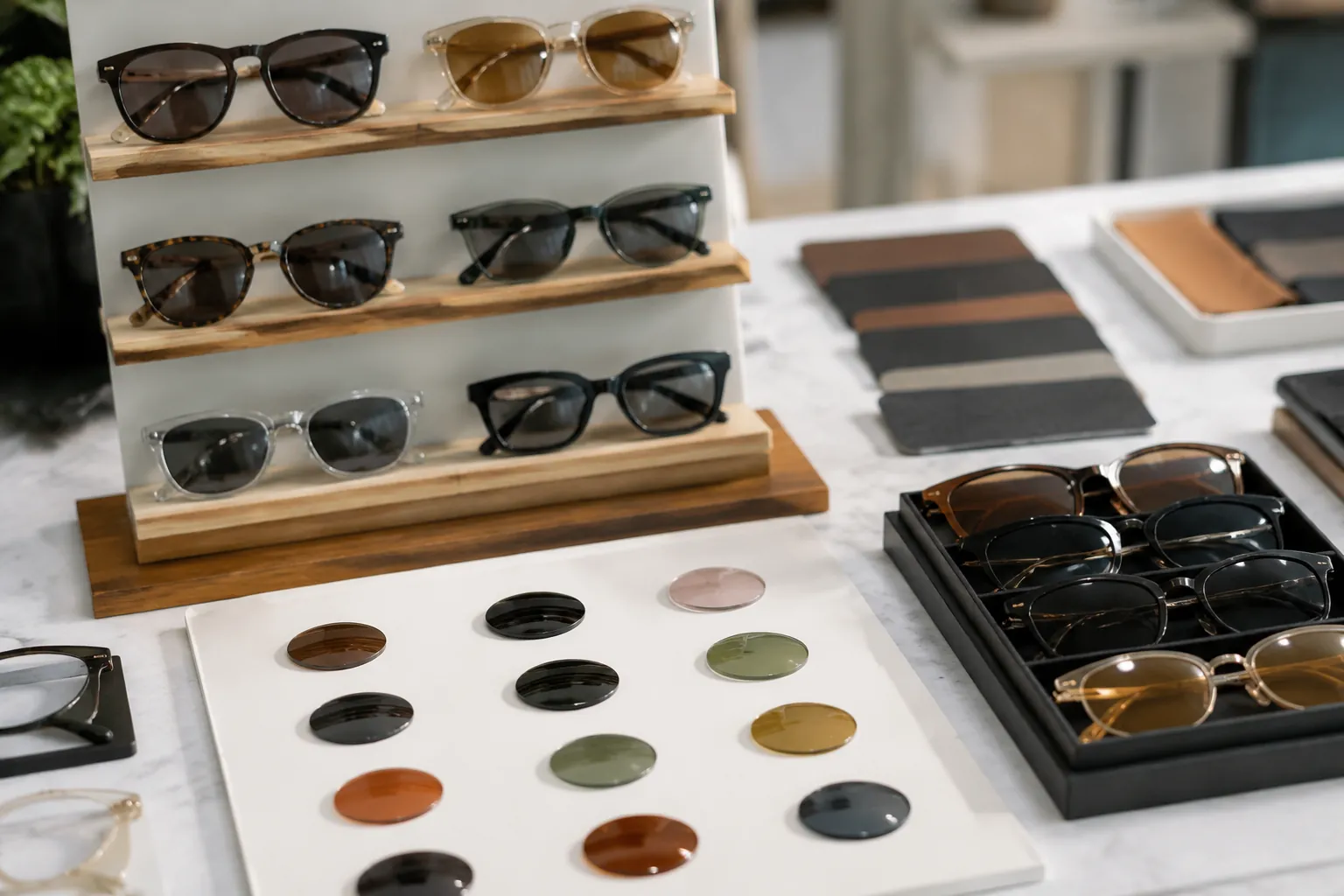
This guide is for importers, distributors, retail brands, and buying offices sourcing sunglasses for countertop displays. A good PDQ program is not just eyewear placed in a printed tray. It is one retail unit: frames, lenses, tags, barcode labels, sleeves or bags, display tray, inserts, inner cartons, master cartons, compliance labels, and inspection rules working together. If these parts are sourced or approved separately, problems follow. Displays crush. Barcodes disappear below the tray lip. Lenses scratch. Cartons waste cube. Responsibility gets pushed between the eyewear factory, packaging supplier, and forwarder. The goal is simple: approve the product in the same condition it will ship, arrive, and sell at retail.
Start With the Retail Unit
A counter display sunglasses order should start with the loaded retail unit, not a frame sketch. The selling unit is the complete PDQ: pair count, frame mix, lens category, hangtags or sleeves, barcode labels, tray pitch, header height, dust cover if needed, inner carton, and master carton. Approve the frame first and design the display later, and predictable failures appear. Folded temples press into lenses. Barcodes sit too low. Oversized frames hide the header. The export carton wastes space because packing was not considered early.
Define the PDQ count first. Common countertop counts include 12, 18, 24, and 36 pairs. Convenience stores, pharmacies, petrol stations, and checkout counters often prefer 12 or 18 pairs because space near the register is tight. Tourist shops, beach stores, and seasonal retailers may use 24 or 36 pairs when sell-through is faster and the counter can support a larger footprint. Final dimensions should come from actual folded frame size, header artwork, retailer space limits, and carton packing. Not a generic display template.
Next, decide how shoppers will handle the product. Loose open-display frames give the best try-on experience, but they need better scratch control, stable tray spacing, secure screws, and a loading sequence that prevents frame-to-frame rubbing. Polybagged frames reduce rubbing during freight, but they can look less premium and slow trial. Header-card sleeves improve barcode control and may support hanging conversion, but they add paper, labor, and carton height. Make these choices before sampling. Each one changes the display structure, loading method, and inspection criteria.
Factory-floor rule: if display count, folded frame width, temple thickness, and barcode position are not fixed before PDQ sampling, the first sample is usually a visual mockup, not an engineering sample.
Choose Materials for Rough Handling
Counter displays are handled roughly. Shoppers pull out two pairs at once, return frames to the wrong slot, drop them on the counter, and flex temples again and again. Material choice should match that environment, not just the target unit price. A frame that works in individual packaging can fail in an open PDQ if the hinge is weak, the lens coating scratches easily, or the folded temple presses against the next pair.
| Frame option | Best use in PDQ programs | Typical behavior | Sourcing note |
|---|---|---|---|
| PC injection | Promotional, value, and seasonal ranges | Lightweight and economical; surface finish and lens protection need attention when packed loose | Confirm mold condition, color standard, hinge quality, and scratch-control packing before bulk approval |
| TR90 | Sport, kids, flexible retail programs | Better flex recovery than basic rigid plastics; useful where customers bend temples frequently | Check material grade, temple recovery, screw retention, and consistency between color batches |
| Acetate | Fashion ranges with premium hand feel | Heavier with richer color depth; requires more finishing and cosmetic control | Review cutting, tumbling, polishing, hinge setting, and surface defects under agreed inspection lighting |
| Metal | Aviators, classic adult styles, optical-look programs | Premium appearance; nose pads, screws, and plating require closer control | Specify screw torque checks, plating requirements, solder joint review, and vibration-resistant packing |
For PDQ planning, real dimensions matter more than catalogue dimensions. A wrap frame with thick folded temples may need more tray depth than a flatter fashion frame with a similar front width. Measure folded frame width, lens height, temple thickness at the hinge, temple thickness at the folded tip, and the highest pressure point after folding. Lens height affects whether the header stays visible after loading. Test the display with production-like frames, not only 3D renderings or empty structural samples.
If the supplier offers several processes, confirm what is made in-house and what is subcontracted. Injection molding, acetate cutting, CNC milling, lens tinting, laser engraving, pad printing, metal logo plates, and packaging assembly all carry different tolerances and lead-time risks. Ask for a process flow, material standard, decoration method, and inspection plan for the exact frame and display combination. Pilot quantities can be useful for market testing, but small multi-color programs rarely price like high-volume single-style production. Setup, color control, inspection, and packing labor are spread across fewer units.
Lock Lens Specs Before Artwork
Many buyers approve logos before confirming whether the lenses meet destination-market rules. That is risky. Sunglasses are regulated consumer products in many markets. Lens category, UV performance, impact expectations, warnings, markings, and test documents should be fixed before decoration and packaging artwork are released.
- European Union: plan around CE marking and EN ISO 12312-1 requirements for non-prescription sunglasses, including performance, category, warnings, and labeling.
- United States: confirm FDA registration responsibilities and align non-prescription sunglasses with ANSI Z80.3 where applicable.
- Australia and New Zealand: use AS/NZS 1067 for lens category, labeling, warnings, and use restrictions.
- Chemical safety: check REACH requirements for restricted substances in frame materials, coatings, inks, nose pads, packaging components, and accessories when selling into the EU.
Lens category affects product use and warning text. Category 2 suits medium sunlight and some fashion programs. Category 3 is common for strong sunlight and outdoor retail. Category 4 needs a clear warning because it is not suitable for driving. Mirror lenses create strong shelf impact, but fine scratches are more visible, so surface protection matters. Gradient lenses need a controlled tint position. Visible variation across a loaded display makes the range look inconsistent, even if each pair functions correctly.
Write measurable QC points. Do not rely on broad phrases such as "good quality." UV claims should be backed by current test data for the relevant lens type and color. Lens color should be checked against an approved physical sample under consistent lighting. Base curve, fitting, temple opening, hinge tension, screw security, lens retention, logo placement, and decoration durability should be defined in the product specification. A signed golden sample, approved artwork, test reports, and defect classification list give inspectors something objective to enforce.
Build the PDQ From Real Dimensions
A PDQ display must survive printing, assembly, loading, export packing, freight, warehouse handling, and store setup. Common structures include E-flute or B-flute corrugated board, greyboard with laminated art paper, and heavier paperboard for smaller displays. For loaded sunglasses PDQs, structure comes before print effects. A glossy dark display may look premium in a sample room and still show rub marks fast if the carton and inserts do not protect it in transit.
Start with a blank structural sample. Measure folded frame width, lens height, temple thickness, and the maximum pressure point after folding. Tray slot pitch should allow finger room. Adult sunglasses often need more space than slim reading glasses. Bulky sport frames may need a wider pitch than fashion frames. Keep clearance between lens surfaces and any board edge, insert, staple, glue point, or divider that could rub during vibration. Check stability by removing front-row frames while back-row frames remain loaded. A narrow display can tip if the base is too shallow or the weight sits too far back.
Then approve the printed sample. Confirm CMYK or Pantone targets, lamination type, barcode position, warning text, country-of-origin marking, retailer item number, recycling marks if used, and assembly marks. Scan-test barcode labels with the display loaded, not only on a flat artwork proof. If the frame, tray lip, or sleeve blocks the code, warehouse and store teams will need workarounds. That creates receiving errors.
Keep artwork practical for low-cost programs. Metallic inks, spot UV, heavy lamination, and wrapped edges increase cost and sample time. For value retail, it is often smarter to spend on stronger board, corner protection, clear warnings, and a simple loading sequence. The display has one main job: arrive square, hold the frames securely, show the brand clearly, and let the shopper remove one pair without damaging the next.
Plan Cartons Before Production
Carton planning decides whether a PDQ program lands cleanly or becomes warehouse rework. A display can look correct on a desk and still fail as an export unit. Loaded PDQs are vulnerable to compression, vibration, side pressure, bent headers, and lens rubbing. Flat-packed PDQs can save space, but they shift assembly labor and error risk to the distributor, retailer, or local repacking team.
| Pack method | Best for | Cost effect | Main risk |
|---|---|---|---|
| Fully loaded PDQ in inner carton | Retailers needing shelf-ready units | Higher cube and protection cost | Crushing, lens rub, bent headers, or shifted frames |
| Flat PDQ plus packed frames | Distributors with reliable repacking labor | Lower freight cube but higher local labor | Wrong assembly, mixed SKUs, missing parts, or slow setup |
| Partially assembled PDQ | Chain programs with controlled DC setup | Balanced but process-heavy | Missing headers, wrong loading order, or inconsistent store presentation |
| Bulk frames, local display sourcing | Buyers with a proven domestic packaging vendor | Lower factory complexity | Fit mismatch, delayed launch, and unclear responsibility for display failure |
Use a packing diagram, not email descriptions. It should show pairs per PDQ, SKU sequence, color sequence, PDQs per inner carton, inner cartons per master carton, carton dimensions, gross and net weight, label position, orientation arrows, stack limits if needed, and whether the carton can be clamp-handled or only hand-stacked. Carton board strength should match the load and shipment route. For loaded PDQs, agree on compression, drop, and vibration expectations before mass packing begins.
If the PDQ ships loaded, request a packed sample and open it the way a store employee would. Check whether the header bends during removal, frames shift, lenses rub, barcode labels face the right direction, the display sits flat after unpacking, and any dust cover or insert can be removed without damage. A packed sample often reveals problems that separate frame samples and display samples miss.
Control Cost, MOQ, and Timing
A counter display sunglasses program has more cost layers than a bulk eyewear order. The full cost stack can include frame material, lenses, hinges, screws, nose pads if used, decoration, hangtags or sleeves, barcode labels, PDQ board, printing, lamination, inserts, dust covers, inner cartons, master cartons, compliance testing, inspection, and packing labor. Buyers who compare only the frame price may approve a cheap style and lose the saving when the display or carton needs redesign.
Sample timing depends on confirmed specifications, artwork readiness, material availability, and whether tooling or special treatments are required. Simple frame color, lens tint, logo, and basic packaging samples often move faster than acetate, metal, custom molds, special mirror coatings, or structural PDQs. Bulk production timing should be counted from written sample approval, artwork approval, document confirmation, and deposit or payment milestone. Not from the first quotation date. Add time for compliance testing, retailer artwork approval, pre-shipment inspection, and corrective action if the first packed sample fails.
Separate MOQ by component. Frame production, lens color, printing, barcode changes, sleeve or tag printing, PDQ board production, and carton setup may each have different minimums and price breaks. A small pilot with several styles may be possible, but labor cost per unit will be higher because the line must control more SKUs, labels, and packing combinations. Larger repeat orders usually improve efficiency because color batching, decoration setup, inspection flow, and packing labor become more stable.
For new buyers, a safer launch uses a limited number of frame styles, one PDQ structure, one or two lens categories, and controlled color options. Test sell-through, returns, scratch performance, barcode scanning, and store handling before expanding the range. Too many SKUs, display sizes, and lens coatings slow sampling, complicate inspection, and increase mispack risk.
Set Approval Samples and QC Gates
Do not approve a PDQ sunglasses program from photos only. Photos can hide hinge tension, lens rattle, tray pressure, carton looseness, barcode scan issues, board recovery after unpacking, and frame movement inside the display. Physical approval should happen at defined gates so problems are caught before mass production.
- Frame sample: confirms material feel, fitting, lens color, temple tension, nose bridge comfort, lens retention, and logo position.
- Blank PDQ sample: confirms tray pitch, header height, stability, board strength, clearance, and assembly method.
- Printed PDQ sample: confirms color, finish, warnings, barcode position, retailer item data, origin marking, and shelf appearance.
- Packed sample: confirms loaded display, inserts, inner carton fit, master carton layout, label placement, opening process, and frame movement after handling.
- Golden sample set: becomes the signed reference for production, inspection, corrective action, and shipment release.
Inspection should separate critical, major, and minor defects. Critical defects include sharp edges, broken lenses, missing required warnings, wrong compliance marks, or unsafe components. Major defects include loose hinges, wrong lens category, visible logo misprint, color outside the approved range, missing barcode labels, carton shortage, or display collapse. Minor defects may include small board scuffs outside the front selling area or tiny cosmetic marks that do not affect use, compliance, or shelf presentation.
On the production floor, QC should cover incoming materials, lens tint consistency, frame assembly, decoration, PDQ printing, loading sequence, and final carton checks. The inspection plan should state the sampling method, AQL levels if used, defect definitions, measurement tools, barcode scan method, and documents required for shipment release. For compliance, the document set may include CE EN ISO 12312-1, FDA registration information, ANSI Z80.3, AS/NZS 1067, REACH documentation, ISO 9001, and BSCI, depending on the destination market, buyer requirement, and supplier qualification.
Use a Controlled Sourcing Sequence
The cleanest sourcing process is structured from the start. It reduces rework and prevents the order from becoming a new negotiation after every sample. The buyer, eyewear factory, packaging team, and freight forwarder should all work from the same project file with version-controlled specifications.
- Define destination markets, retail channel, display count, target retail price, and target landed cost.
- Select a limited number of frame styles that can share one PDQ footprint where possible.
- Confirm lens category, UV requirements, warnings, markings, and compliance documents.
- Approve frame material, colors, logo method, tags, sleeves, barcode rules, and origin labeling.
- Build a blank PDQ using real or production-like frame samples.
- Approve printed PDQ artwork, carton marks, label positions, retailer data, and packaging copy.
- Make a fully packed sample and test opening, scanning, stability, frame movement, and loading sequence.
- Release bulk production with a signed golden sample, QC checklist, packing diagram, and shipment approval standard.
For importers and distributors, sourcing frames and PDQs through a coordinated supplier improves accountability. One project owner can control the fit between frame, tray, label, and carton. If the display is too tight, the issue is not passed between eyewear and packaging teams. If the carton crushes, the root cause can be checked against the agreed packing diagram and carton specification.
A reliable project file should include the technical sheet, approved samples, artwork files, compliance targets, material declarations where required, AQL checklist, carton diagram, barcode rules, and shipment approval standard. Good sourcing is not luck. It is detailed specification work backed by disciplined sampling, production control, and inspection.
Have a custom sunglasses project in mind?
Send us your styles, target market and quantities and we will return a detailed quote with MOQ, lead time and a sample plan.
Get a QuoteWhy source this from Wenzhou with LumiShades
Wenzhou in Zhejiang Province is widely regarded as China’s eyewear manufacturing capital, producing a large share of the world’s sunglasses. That concentration matters to buyers: a deep local supply chain for acetate sheet, hinges, lens blanks, plating and packaging means shorter component lead times, easier color and material matching, and a workforce with decades of eyewear-specific skill. LumiShades has manufactured in this ecosystem since 2009, and our vertical integration — in-house injection molding, acetate cutting, CNC milling, lens tinting, decoration and quality control — means no part of your order is quietly subcontracted to a workshop you cannot audit.
For international buyers, that vertical control translates into accountability. When a single factory owns every step, defects are traced and fixed at source rather than bounced between vendors, and your specifications survive intact from first sample to bulk. For procurement review, buyers can request process records, approved samples, quality checkpoints and project-specific compliance files before placing a bulk order. Required testing and documentation are confirmed against the destination market and product specification rather than assumed from a generic certificate list. Explore our manufacturing capabilities and quality control process to see how this works in practice.
Frequently asked questions
What information should I send before asking for a PDQ sunglasses quote? Send the destination market, order quantity by design, number of pairs per display, frame material, lens category, UV claim, lens color, logo method, tag or sleeve requirement, barcode rules, compliance documents needed, PDQ size limits, carton weight or dimension limits, and whether the PDQ must ship fully loaded, flat-packed, or partially assembled. Include reference photos or drawings, but make sure the quote is based on written specifications, not images alone.
Can I start with a small pilot order and still use a branded display? Yes, but keep the pilot simple. Use one PDQ structure, a limited number of frame styles, and minimal lens or color variation. Ask the supplier to separate the MOQ and cost for frames, lenses, printing, labels, PDQ board, and cartons because each component may have a different minimum. For a pilot, the goal is to test sell-through, handling, scanning, and returns, not to reach the lowest possible unit cost.
Which compliance documents matter for the US, EU, and Australia? For the EU, plan around CE marking and EN ISO 12312-1 for non-prescription sunglasses, plus REACH for restricted substances where applicable. For the US, confirm FDA registration responsibilities and ANSI Z80.3 alignment for non-prescription sunglasses. For Australia and New Zealand, use AS/NZS 1067. Ask for current test reports that match the actual lens type, lens color, and product category being shipped.
Should PDQs ship fully loaded or flat-packed? Choose based on retailer setup capability, freight cost, and damage risk. Fully loaded PDQs are better for shelf-ready retail, but they need stronger inserts, crush protection, and a passed packed-sample review. Flat-packed PDQs reduce cube but require reliable local assembly, SKU control, barcode placement, and labor instructions. If the retailer does not have a controlled setup process, fully loaded or partially assembled packing is usually safer.
How long should I allow for samples and bulk production? Timing depends on artwork readiness, material availability, tooling, lens treatment, display structure, and compliance testing. Ask the supplier for separate dates for the frame sample, blank PDQ, printed PDQ, packed sample, test documents, bulk production, inspection, and shipment booking. Do not count production lead time from quotation. Count it from written approval of samples, artwork, specifications, documents, and payment milestone.
What is the most common failure in counter display programs? The most common failure is approving frames, displays, and cartons separately. Real or production-like frames must be tested in the real PDQ, then packed in the real inner and master carton before bulk production starts. The buyer should approve a packed sample, barcode scan result, loading diagram, defect list, and golden sample set before release.
Ready to start?
Explore our shield & oversized sunglasses or request a quote — our sales team replies within 12 hours.
Request a Quote