
Stop Polarized Lens Drift In Bulk Sunglass Orders
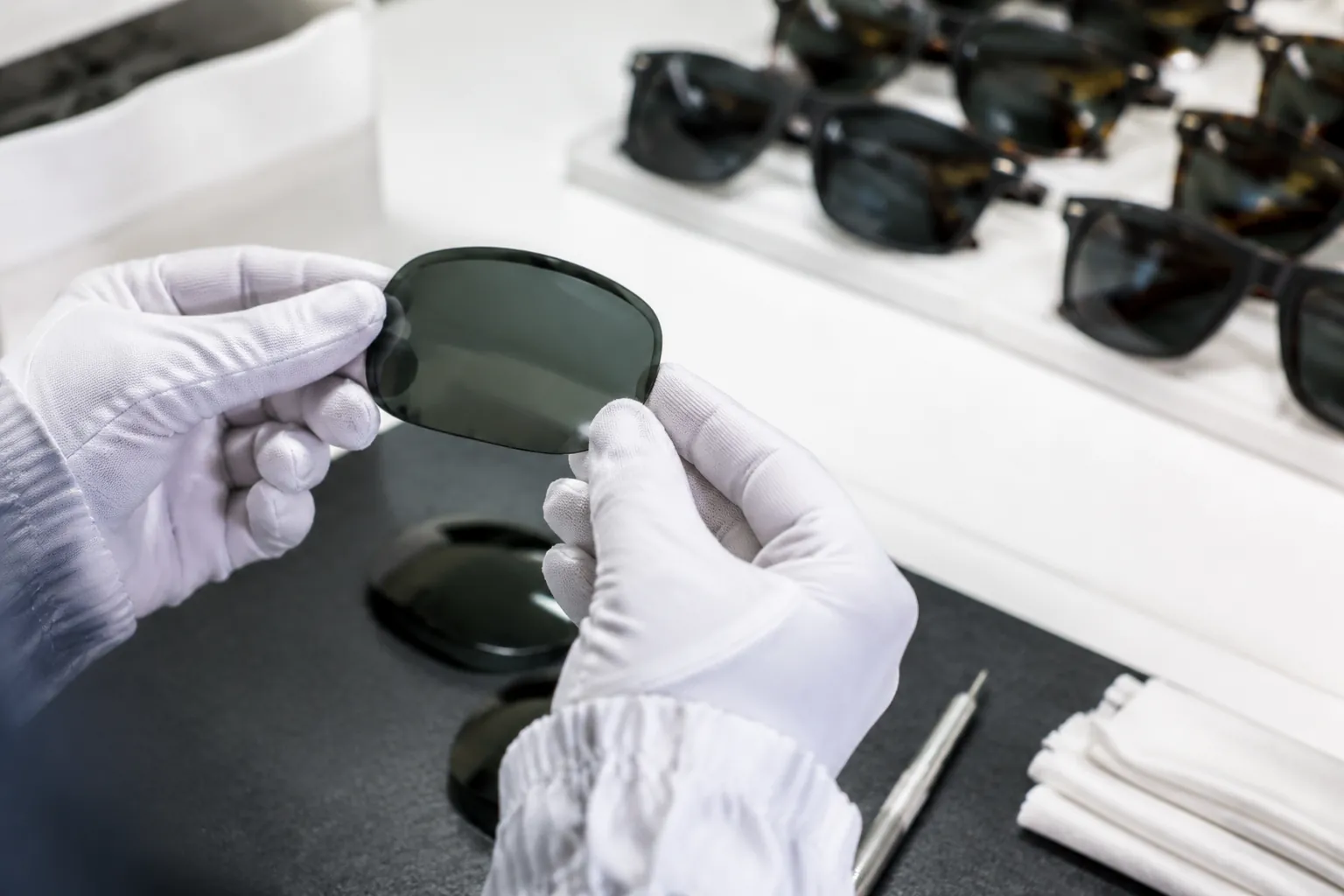
This guide is for brand owners, importers, distributors, and retail buyers ordering polarized sunglasses in volume. A common failure in repeat orders is lens drift: the first run is approved, then the next run looks darker, greener, more mirrored, or performs differently in glare reduction. That problem does not get solved by writing "polarized smoke lens" on a purchase order. Buyers need a control plan that locks the lens construction, base tint target, visible light transmission (VLT) range, coating stack, inspection conditions, and lot traceability before bulk production starts. Write those controls down early. Then QC has a real standard to inspect against, and buyers have a clearer basis for claims, lot isolation, and repeat-order decisions.
Build The Lens Control Plan Before Sampling
Many buyers still treat polarized lenses as a yes-or-no feature. That is too loose for production. You are usually controlling at least three separate variables: polarization function, visible tint color, and visible light transmission (VLT). Add flash mirror, full mirror, hard coat, hydrophobic topcoat, or other surface treatments, and the final appearance can shift again.
The control plan should start before sample approval. For each SKU or lens family, define one approved standard with measurable points. At minimum, the lens spec should state the lens construction, substrate, target hue family, VLT target and tolerance, coating stack, inspection light source, and traceability requirement. A phone photo is not a technical standard. Use a sealed master sample reviewed under a defined light source such as D65 daylight-equivalent lighting.
A workable lens spec usually includes the following points:
- Construction: TAC polarized, PC polarized, nylon-based polarized, or another approved structure.
- Base tint target: for example neutral grey, warm brown, or G15-style green-grey.
- VLT target and tolerance: for example 14% target with an acceptable range of 12% to 16%.
- Polarization requirement: production lots must be checked for polarization function, not development samples only.
- Coating stack: hard coat only, flash mirror, full mirror, hydrophobic topcoat, anti-scratch layer, or approved combinations.
- Visual inspection condition: compare against the sealed master under D65 or equivalent controlled light, on a neutral background.
- Traceability: lens batch, tint lot, coating run, and packing lot must be linked in the factory record.
For repeat programs, ask the factory to retain both a golden sample and the supporting production record. That record should identify the substrate source, polarizer film lot where applicable, tint recipe or process reference, and coating run. This matters because consistency failures usually come from process changes or mixed sourcing. If tinting is subcontracted, coating is done elsewhere, and final assembly happens in a third location, drift gets harder to diagnose. And harder to stop.
Short version: if the purchase order says only "TAC polarized smoke lens," expect variation. If it says "TAC polarized smoke, neutral grey target, VLT 14% +/-2%, no visible green cast, hard coat plus flash mirror, approved against sealed master under D65 light," production and QC have something they can actually use.
Where Polarized Lens Drift Usually Starts
Most buyer complaints do not come from one dramatic failure. They come from small process changes that stack up across materials, tinting, coating, and assembly. A lens can look acceptable by itself and still drift enough to create visible inconsistency against a prior shipment or across one collection.
The main sources of drift are predictable:
- Polarizer film lot variation: different film lots can affect polarization efficiency and can also shift visible hue slightly, especially in grey and brown lenses.
- Dye concentration, temperature, and soak time: small changes in tinting conditions can change both VLT and visible color depth.
- Substrate behavior: TAC, PC, and nylon-based lenses do not absorb tint the same way and do not present color identically after coating.
- Coating stack interaction: hard coat, mirror, flash, and hydrophobic layers can all affect perceived color and front-surface appearance.
- Heat during frame fitting: excess heat during assembly can stress laminated constructions or alter appearance if process control is weak.
- Mixed sourcing: using more than one upstream lens blank or polarized lens supplier within one order raises repeatability risk.
Material choice matters. TAC polarized lenses are common in fashion and mid-market programs because they are widely available and cost-effective, but they still need control of film lot, tint process, and coating sequence. PC polarized lenses are often used in lightweight or sport-oriented styles, yet cross-supplier variation in color presentation and mirror appearance can be wider. Higher-spec laminated polarized lenses can give better repeat consistency, but only if the upstream source stays fixed across orders.
Mixed-SKU collections are harder to manage than single-style orders. One black frame with a smoke lens is relatively simple. Several frame colors sharing one smoke lens tone are not. Surrounding frame color changes how the same lens is perceived. So even if the lens is close to standard, the collection can still look uneven if approval was handled only at the single-style level.
What To Put On The PO And Lens Spec
If you want fewer disputes later, the purchase order and lens specification need enough detail to survive the handoff from sales to engineering, then to production and QC. Lens approval should not live only in message threads and sample photos.
A strong commercial lens spec normally includes:
- Lens construction and substrate: for example 1.1 mm TAC polarized or 1.0 mm PC polarized.
- Target VLT and tolerance: for example 14% target, acceptable 12% to 16%.
- Approved hue family: neutral grey, warm brown, or G15-style green-grey.
- Coating definition: hard coat only, silver flash, blue mirror, hydrophobic topcoat, anti-scratch, and any approved combination.
- Inspection method: sealed master comparison under standard daylight-equivalent lighting.
- Polarization verification on production lots, not only on development samples.
- Traceability requirement from incoming lens batch through final packing.
- Applicable market compliance for the destination market.
Be specific on compliance. CE EN ISO 12312-1, ANSI Z80.3, AS/NZS 1067, REACH, FDA registration, ISO 9001, and BSCI do different jobs. CE EN ISO 12312-1, ANSI Z80.3, and AS/NZS 1067 relate to sunglass performance or market requirements depending on destination. REACH concerns chemical compliance in applicable markets. FDA registration may be relevant for certain U.S. importer or manufacturer obligations. ISO 9001 is a quality management system certification, and BSCI is a social compliance audit framework. None of them replaces a commercial lens color standard. Ask only for the records that apply to the exact product and destination market.
Good buyers also define lot segregation. If you order several colors, require each lens lot to remain traceable through packing cartons. That way, if one lot runs dark or shifts green, you can isolate the affected cartons and judge corrective action on that portion instead of disputing the entire shipment.
MOQ and lead time affect control options too. On low-MOQ programs, upstream material choices are narrower, and the factory may have less flexibility to hold one exact film or blank source. At higher volumes, it becomes easier to reserve one material route and maintain a more stable repeat standard. No guarantee. But the odds improve.
Choose Lens Construction Based On Consistency Risk
Not all polarized lenses behave the same in production. Some are easier to source at low MOQ. Some hold appearance more consistently across repeat orders. Some become much harder to match once mirror and decorative coatings are added. Buyers should match lens construction to channel, claim risk, and reorder strategy.
| Lens type | Typical use case | Consistency risk | Cost direction | Buyer note |
|---|---|---|---|---|
| TAC polarized | Fashion sunglasses, mid-market programs | Medium | Lower | Common in commercial programs; can be stable if film lot, tint timing, and coating sequence are controlled. |
| PC polarized | Sport, youth, lightweight styles | Medium to high | Lower to mid | Useful for lightweight or impact-oriented styles, but color presentation and mirror appearance can vary more between suppliers. |
| Higher-spec laminated polarized lens | Better retail programs, repeat replenishment | Lower | Higher | Often more repeatable for long-running SKUs, but only if the same upstream lens source is maintained. |
| Mirror-coated polarized lens | Trend and sport collections | High | Mid to higher | Buyer is evaluating both front appearance and through-view; the approval should define both separately. |
Decoration and finishing choices matter too. Pad printing, laser engraving, metal logo plates, and foil details do not change lens performance directly, but they raise the perceived quality threshold of the finished product. Once branding looks sharp and premium, lens mismatch is easier to spot. Buyers should respond by tightening lens approval, not relaxing it.
Price follows the same pattern. Lower prices are easier when the factory can use common materials across multiple jobs. Tighter consistency control may require a narrower approved source list, advance material reservation, or rejection of marginal lots. Those controls are easier to support on committed volume than on very small runs.
How To Inspect Batch Consistency Before Shipment
Do not rely on one pre-shipment photo and a verbal confirmation that the lenses are "the same." Use an inspection routine that matches the failures buyers actually see after arrival.
A practical pre-shipment check should cover four layers. First, compare lens color against the approved master under controlled lighting. Not warehouse yellow light. Not uncontrolled sunlight. Use a consistent daylight-equivalent setup. Second, compare left lens to right lens on the same frame against a neutral or white background. Small lens-to-lens mismatches are easier to spot that way.
Third, verify polarization function with a polarizing test card, another polarized reference, or a suitable polarized light source. Rotate the lens and confirm a clear change in transmitted light or image visibility. This is not the same as a laboratory polarization measurement, but it can catch non-polarized substitution, incorrect film orientation, or obviously weak polarized performance. Fourth, review VLT consistency on sampled pieces from each lot or each production day. If the order ran across multiple days, sample across those days rather than only from the last packed cartons.
A usable lot-based inspection routine for a 1,000-pair order often looks like this:
- Check outer cartons by lot code and confirm lot segregation matches the internal production record.
- Pull samples across frame colors and across production dates.
- Photograph each sample next to the sealed master under the same lighting setup.
- Record any lot that appears darker, warmer, greener, or more mirrored than the approval standard.
- Stop release on any lot outside tolerance until the factory isolates root cause and proposes corrective action.
Blunt point: if the factory cannot tell you which lens lot went into which cartons, traceability is weak. And repeat-order control will stay weak.
QC should also confirm that the finished sunglass still meets the applicable market requirement after assembly where relevant. Compliance is not only about a lens blank before production. Finished product condition matters, especially when CE EN ISO 12312-1, ANSI Z80.3, or AS/NZS 1067 forms part of the product file for the destination market.
Control Mixed-SKU Programs And Repeat Orders More Tightly
The hardest jobs are mixed-SKU programs: several frame shapes, several frame colors, and sometimes more than one lens tone that still needs to read as one collection on shelf. Manage these approvals in layers. Do not approve every style in isolation and hope the collection holds together later.
Start by approving one master per lens family, not one isolated master per frame. For example, all smoke polarized styles should share one approved smoke master, and all brown polarized styles should share one approved brown master. Then verify each frame color against that master, because a matte black frame, a transparent champagne frame, and a bright crystal frame will each change how the same lens tone appears.
For repeat orders, ask the factory to maintain or deliberately match the same critical inputs: polarizer film source, substrate type, tint process reference, and coating route. Do not assume a reorder months later can use any equivalent input and still match. Equivalent on paper often looks different on shelf.
Forecasting matters more than many buyers expect. Late and fragmented replenishment orders increase the chance of substitutions because the original film lot, blank source, or coating schedule may no longer be available. If replenishment consistency matters commercially, forecast early enough for the supplier to reserve material and planning capacity.
Keep decoration inside the same control plan. If one style uses laser logo, another uses pad print, and another uses a metal logo plate, the lens still has to support a consistent collection look. Buyers often focus on logo placement during final approval and miss the more obvious point: the lens is usually the first part the end customer notices in outdoor light.
Questions To Ask Before You Approve Bulk Production
Many disputes can be reduced before bulk starts if the buyer asks direct technical questions and expects direct answers. A capable factory should be able to answer the following clearly:
- Is the polarized lens sourced from one upstream supplier or multiple suppliers for this purchase order?
- Will the same film lot, or controlled lots with documented matching, be used across the full order?
- What is the target VLT, and what tolerance is considered acceptable?
- How is lens color checked in production: visual comparison, instrument reading, or both?
- Is tinting done in-house or outsourced, and at what stage relative to lamination and coating?
- What coatings are applied after the base tint, and how do they affect front appearance versus through-view?
- Can the factory retain a sealed golden sample for repeat-order comparison?
- How are lots identified on internal records, work orders, and outer cartons?
- Will QC test polarization during bulk, not only on development samples?
- What is the hold-and-release process if one lot is outside approved tolerance but the rest of the shipment is acceptable?
For low-MOQ projects, stay realistic about the tradeoff. Tight matching across many SKUs and multiple lens colors is harder when upstream material options are limited and the factory is not reserving dedicated lens inputs. If consistency matters more than maximum assortment, reduce lens color complexity, consolidate materials, and avoid mirror variants unless they are commercially necessary.
A Buying Sequence That Produces Fewer Surprises
The sequence below is simple. It prevents many avoidable lens disputes.
- Confirm destination markets and the exact compliance requirements that apply to the finished sunglass.
- Approve frame construction and lens construction before spending time on decoration details.
- Request development samples with the final tint target and full coating stack, not an early approximation.
- Seal one approved master and attach the measurable lens spec to the purchase order.
- Require lot traceability and in-line lens checks during production.
- Before shipment, compare production samples against the sealed master by lot and by lens family.
- For repeats, reference the prior approved lot and require advance notice of any material or process change.
Timing matters. Buyers need enough room for one disciplined approval loop before bulk starts and one structured QC check before goods ship. Skip that discipline, and the argument usually comes later, after arrival, over color names, photos, and subjective judgments.
The rule is simple: a factory can only hold the standard the buyer has clearly defined and documented. If the standard is vague, the shipment will be vague too.
Have a custom sunglasses project in mind?
Send us your styles, target market and quantities and we will return a detailed quote with MOQ, lead time and a sample plan.
Get a QuoteWhy source this from Wenzhou with LumiShades
Wenzhou in Zhejiang Province is widely regarded as China’s eyewear manufacturing capital, producing a large share of the world’s sunglasses. That concentration matters to buyers: a deep local supply chain for acetate sheet, hinges, lens blanks, plating and packaging means shorter component lead times, easier color and material matching, and a workforce with decades of eyewear-specific skill. LumiShades has manufactured in this ecosystem since 2009, and our vertical integration — in-house injection molding, acetate cutting, CNC milling, lens tinting, decoration and quality control — means no part of your order is quietly subcontracted to a workshop you cannot audit.
For international buyers, that vertical control translates into accountability. When a single factory owns every step, defects are traced and fixed at source rather than bounced between vendors, and your specifications survive intact from first sample to bulk. We back this with 15+ years of experience, shipments to 60+ countries, more than 5 million pairs produced per year and a 98.5% on-time delivery rate. Our certifications — CE EN ISO 12312-1, FDA registration, ANSI Z80.3, AS/NZS 1067, REACH, ISO 9001 and BSCI audit — mean the compliance documentation your market requires already exists. Explore our manufacturing capabilities and quality control process to see how this works in practice.
Frequently asked questions
How much lens variation is normal between repeat orders? Some variation can occur between repeat orders because lens appearance is affected by substrate, tint process, coating stack, and polarized film source. The real question is not whether any variation exists. It is whether the shipment stays within the approved standard. Buyers should set that standard in advance with a sealed master, a defined light source for comparison, a target VLT range, and a written coating definition. If those controls are missing, it becomes hard to prove whether the repeat lot is acceptable. Before approving a reorder, ask the supplier to reference the last approved lot and confirm whether any lens source, tint process, or coating route has changed.
Can I match one polarized lens color across several frame colors? Yes, but it should be managed as a lens-family approval and then checked again in each frame color. The same smoke lens can look cooler in a black frame, warmer in a transparent beige frame, and brighter in a crystal frame because surrounding color changes visual perception. A practical approach is to approve one master for the lens family, install that lens in each key frame color, and review the collection together under controlled daylight-equivalent lighting. If one frame color makes the lens look visibly off-standard, adjust the collection plan before bulk rather than arguing after production.
Is TAC polarized lens stable enough for retail programs? Yes. TAC polarized lenses are widely used in retail programs and can perform well when the source and process are controlled. The risk is not TAC by itself. The risk is treating TAC as interchangeable across multiple suppliers, film lots, tint conditions, and coating routes. If a buyer wants repeatability, the purchase order should define the construction, approved hue, VLT range, coating stack, and traceability requirement, and the supplier should confirm whether the same upstream source will be maintained for replenishment orders.
What should I do if one carton lot is darker than the approved sample? First, hold shipment release on that lot. Second, isolate the affected carton numbers and verify whether the cartons can be tied to a specific lens batch, tint lot, coating run, or production date. Third, compare retained samples from that lot against the sealed master under the same controlled lighting used in approval. Fourth, check whether the issue is visual only or also linked to VLT drift or coating variation. Once the scope is clear, ask the factory for a written disposition: sort, rework where feasible, remake the affected lot, or separate the acceptable lots from the nonconforming lot. If the factory cannot trace the affected cartons back to a specific production lot, the commercial risk is much higher because the entire shipment may need broader review.
Do compliance documents guarantee color consistency? No. Compliance documents and certifications do not replace a commercial lens appearance standard. CE EN ISO 12312-1, ANSI Z80.3, and AS/NZS 1067 relate to sunglass performance or market compliance. REACH addresses chemical restrictions where applicable. FDA registration may apply to certain U.S. regulatory obligations. ISO 9001 relates to quality management systems, and BSCI relates to social compliance auditing. None of these documents defines your approved grey, brown, mirror appearance, or VLT tolerance. Buyers still need a sealed master, a written lens spec, controlled inspection conditions, and lot traceability if they want color consistency in bulk orders.
Ready to start?
Explore our shield & oversized sunglasses or request a quote — our sales team replies within 12 hours.
Request a Quote