
Nylon vs Polycarbonate Sunglass Lenses: Buyer Guide
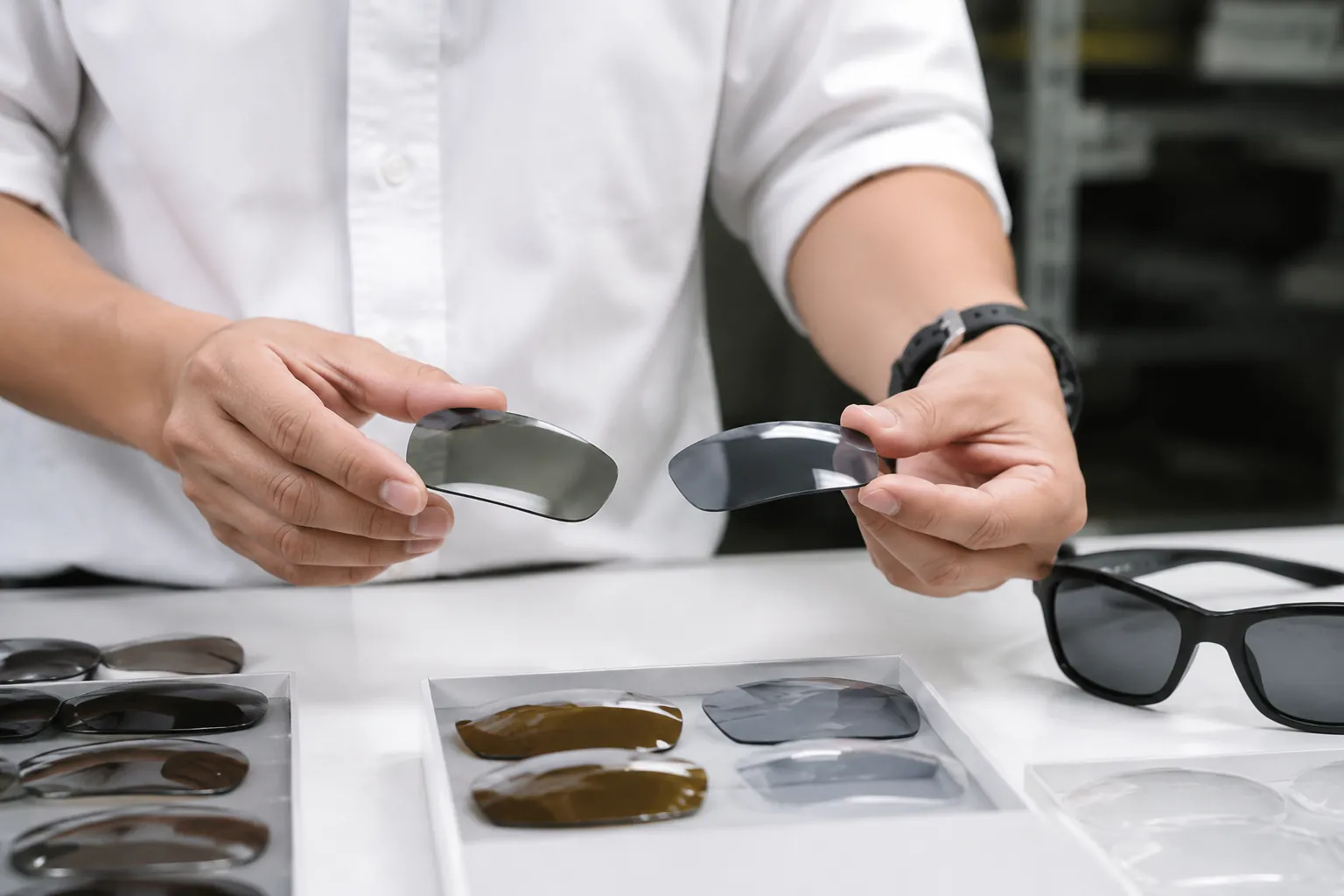
This guide is for brand owners, importers, and retail buyers choosing lens material for custom sunglasses. The question is not which material is better in the abstract. It is which material best fits the frame build, retail target, compliance path, and acceptable defect rate with the least production risk. In many custom sunglass programs, nylon is the safer choice when optical appearance, color consistency, drilled mounting, or higher-wrap geometry matter. Polycarbonate still has a clear role in cost-led, kids, promotional, and impact-priority programs. But buyers should account for its optical and processing limits before approving samples for bulk.
Start With the Product Brief, Not Material Habit
Many eyewear RFQs start with a default request for polarized polycarbonate lenses. It is familiar. It is widely available. It is usually cheaper than nylon. That shortcut breaks down when the same project also calls for a premium acetate frame, a gradient tint, a mirror finish, a higher-wrap lens, or a drilled build. At that point, lens material is no longer a simple line-item cost choice. It is a production-risk choice.
Before choosing between nylon and polycarbonate, define these five points:
- Frame construction: full-rim, semi-rimless, drilled rimless, shield, or wrapped sport frame.
- Lens appearance: solid tint, gradient, mirror, polarized, flash coating, or fashion color such as tea, olive, rose, or smoke.
- Target retail and landed cost: the acceptable lens cost depends on the intended price architecture of the collection.
- Target market and compliance route: confirm whether the product will be evaluated against CE EN ISO 12312-1, ANSI Z80.3, or AS/NZS 1067, and check related chemical or market-entry requirements such as REACH or FDA registration where applicable.
- Rejection tolerance: decide in advance how much left-right tint variation, optical distortion, or sorting effort the program can realistically absorb.
That last point is often missed. A lower lens price does not always mean a lower real cost if the result is more pair matching, more assembly failures, or more buyer complaints after launch. For a branded collection, a modest material upcharge can make sense if it improves visual consistency and lowers rework risk in bulk.
Head-to-Head: Where Nylon Wins
| Decision Point | Nylon Lens | Polycarbonate Lens | Buyer Takeaway |
|---|---|---|---|
| Optical clarity on larger curves | Often preferred for cleaner visual performance on higher-base lenses and larger fashion shapes | More likely to show visible distortion or stress effects when curvature and size increase | Choose nylon when the lens shape is large, wrapped, or visually exposed |
| Tint and gradient consistency | Generally easier to control for even tint appearance and left-right matching in fashion colors and gradients | Works well for basic solid colors, but visual variation can become more obvious in gradients, mirrors, and exact color programs | Nylon is usually safer for color-sensitive branded programs |
| Drillability and mounting stress | Commonly selected for drilled rimless and exposed-hardware builds because it is better suited to localized machining stress when processed correctly | Higher risk of stress cracking or crazing around holes, slots, and notches if the process is not tightly controlled | For drilled builds, nylon usually reduces assembly risk |
| Impact-priority applications | Can perform well, but is not usually chosen solely because impact resistance is the top priority | Widely used where impact resistance is a primary requirement | Polycarbonate remains a practical choice in bluntly functional projects |
| Material and process cost | Usually carries a higher material cost and often requires tighter control in tinting and finishing | Usually lower cost and easier to position in entry-price lines | Use nylon where visual quality or construction justifies the premium |
The short version is simple. Nylon usually performs better in demanding sunglass builds where the lens is a visible quality signal. Polycarbonate usually costs less and still works for simpler full-rim programs. The sourcing mistake is treating polycarbonate as the default when the design brief already points to nylon.
For branded products, buyers usually feel lens-quality problems through rejections, pair-matching issues, or returns, not through the small lens saving on the quote. Judge the choice against total production risk, not only unit cost.
Optics and Geometry: Where the Gap Shows
Optical appearance is where nylon most often earns its premium. On a small, relatively flat, full-rim sunglass with a simple gray or brown tint, the visible difference between nylon and polycarbonate may be limited. On a larger lens, shield style, wrapped sport frame, or fashion shape with stronger base curvature, the gap is easier to see.
In production, risk factors stack up. Polycarbonate becomes less forgiving when several conditions combine: larger eye size, deeper curve, mirror coating, dark tint, and tight edging tolerances. A lens may still pass internal checks and yet look less refined once assembled and viewed under store lighting or in wear.
Typical factory-level issues buyers may see include:
- Slight edge distortion on wrapped polycarbonate lenses, especially in more aggressive curves.
- More visible left-right appearance variation after coating, edging, or assembly.
- Higher sensitivity to processing stress if bevel depth, edging pressure, or lens seating force drifts.
- More noticeable visual compromise when dark tints and mirror finishes are combined.
Nylon is not flawless. Mold quality, blank consistency, coating control, and edging accuracy still decide the final result. Even so, in difficult geometries, nylon usually gives the factory a wider processing window for holding a premium-looking outcome.
When comparing samples, do not look only through the lens center. Check off-axis. Compare left and right under neutral white light. Inspect the outer field on larger curves. That is usually where weak optics show first.
Tint Consistency, Mirror Programs, and Pair Matching
If a collection depends on G15, brown, smoke, tea, olive, rose, gradients, or mirrored fashion lenses, nylon is often easier to manage visually. In many factories, it gives more predictable tint appearance and cleaner pair matching during final QC. That matters because an approved sample does not prove that bulk output will hold the same appearance without extra sorting.
Polycarbonate can still be tinted, mirrored, and polarized successfully, especially for straightforward smoke, gray, or brown programs. The issue is process margin. As the visual target gets tighter, the chance of visible batch-to-batch or left-right variation goes up.
Three recurring problems in color-sensitive polycarbonate programs are:
- Gradient depth or transition can shift between batches.
- Left and right lenses may require more manual sorting to achieve an acceptable match.
- Mirror or flash coatings can make underlying tint variation more visible.
At sampling stage, buyers should ask direct questions. What color tolerance is used for bulk matching? Is the gradient done through a stable internal process? Is mirror coating applied in-house or by an outside partner? Each extra processing step or outside handoff adds delay risk, mismatch risk, or rework risk.
Color also affects compliance. Any change to tint, visible light transmission, or reflective finish can affect the final result under CE EN ISO 12312-1, ANSI Z80.3, or AS/NZS 1067. Freeze the lens color before final testing and before packaging text is approved.
Drilled, Rimless, and CNC-Dependent Builds
Nylon is often the better choice for drilled rimless sunglasses and designs with exposed hardware because the main issue is localized stress. Once the lens is drilled, slotted, or fitted with bushings and screws, the material must tolerate concentrated force during assembly and wear.
Polycarbonate can be used in drilled builds, but the process window is narrower. Risk rises when holes sit close to the edge, when hardware torque is inconsistent, when the frame flexes in use, or when coating stress is already present before assembly.
In sourcing and sampling, buyers should confirm:
- Hole placement tolerance: inaccurate drilling can misalign hardware and increase local stress.
- Edge distance: holes or slots too close to the lens edge increase the chance of cracking.
- Assembly control: screw torque and fitting sequence should be standardized and repeatable.
- Machining capability: confirm whether drilling and CNC operations are controlled internally or subcontracted, because external handoffs can add tolerance variation.
This is where factory capability matters as much as material choice. A failed rimless build is often a combined tolerance problem involving lens machining, hardware specification, and assembly practice. If the design depends on holes in the lens, check manufacturability before cost becomes the main filter.
Cost Logic: What Nylon Changes in the RFQ
Nylon is usually not the low-cost option. Treat that as a planning fact. The real question is whether the added material and process cost changes the target margin more than the expected quality gain improves the commercial result.
Cost differences between nylon and polycarbonate vary by lens size, curvature, coating stack, polarization, color program, supplier capability, and order quantity. Because of that, compare supplier quotations on the exact same lens specification rather than rely on generic market averages.
Typical cost drivers linked to lens choice include:
- Raw material cost: nylon is usually priced above standard polycarbonate.
- Tint and coating complexity: gradients, mirrors, flash coatings, and strict color matching increase process cost and rejection exposure.
- Construction type: drilled, wrap, and shield programs require tighter control and may reduce production yield.
- Decoration and packaging stack: logo application and packaging upgrades can outweigh savings gained by choosing a lower-cost lens material.
A disciplined buying strategy is to split the range. Use nylon on hero SKUs, premium acetate styles, mirrored fashion pieces, and higher-wrap sport shapes where lens quality is commercially visible. Keep polycarbonate on entry-price styles, promotional programs, kids assortments, and simpler full-rim products where the brief does not demand the same visual standard.
Buyers should also ask the factory to quote expected rejection assumptions for difficult lens programs, especially when gradients, mirrors, or drilled constructions are involved. A lower quoted unit price can lose its advantage quickly if actual production yield is unstable.
Compliance, Testing, and Documents to Lock Early
Lens choice affects the testing path because compliance applies to the finished sunglass, not only to the raw lens. Buyers should identify the destination market before approving pre-production samples, since lens tint, visible light transmission, mirror finish, and final construction can all affect test results.
For export sunglasses, the standards most often referenced in buyer discussions are CE EN ISO 12312-1, ANSI Z80.3, and AS/NZS 1067. Depending on the market and transaction structure, buyers may also need to review REACH obligations, FDA registration where applicable, and supplier quality-system or social-audit documents such as ISO 9001 and BSCI. These documents are not interchangeable. They do not all prove product compliance. Match each document request to a real legal, technical, or customer requirement.
Before mass production, confirm at minimum:
- Destination market and the applicable sunglass standard.
- Visible light transmission category for the approved lens color.
- Whether mirror or coating changes alter the final test result.
- Whether the lab sample uses the exact bulk lens and frame construction.
- Chemical and labeling requirements for the destination market.
A common sourcing mistake is approving a sample based only on appearance, fit, and logo placement. That is not enough. Ask for the final lens specification, the intended test standard, and confirmation that the assembled production build sent for testing matches what will actually be manufactured. If the test sample and the shipped product are not the same build, the paperwork may not protect the buyer.
A Practical Buying Rule for Branded Collections
Use nylon when the product needs a more premium visual standard, especially in premium acetate styles, drilled or rimless builds, mirrored or gradient fashion lenses, higher-wrap sport shapes, and collections where optical appearance is part of the brand promise. Use polycarbonate when the brief is driven mainly by lower cost, strong impact resistance, and straightforward manufacturing, such as promotional lines, kids programs, simple full-rim sunglasses, and high-volume entry styles.
A disciplined sourcing sequence looks like this:
- Set the target retail architecture, landed cost ceiling, and destination market.
- Define frame construction and lens color program before requesting final pricing.
- Sample the same shape in both nylon and polycarbonate if the material decision is still open.
- Compare not only FOB price, but also optics, left-right color match, and assembly stability.
- Assign nylon to hero SKUs if the whole range cannot support the premium.
- Lock the tested lens specification before bulk PO release and packaging approval.
This process is basic but effective. It reduces common failures: sample-to-bulk mismatch, rejected gradients, cracked drilled lenses, and compliance surprises after the range has already been sold in. In the right SKU, nylon is not a luxury upgrade. It is the material that better protects the original product brief through production.
Have a custom sunglasses project in mind?
Send us your styles, target market and quantities and we will return a detailed quote with MOQ, lead time and a sample plan.
Get a QuoteWhy source this from Wenzhou with LumiShades
Wenzhou in Zhejiang Province is widely regarded as China’s eyewear manufacturing capital, producing a large share of the world’s sunglasses. That concentration matters to buyers: a deep local supply chain for acetate sheet, hinges, lens blanks, plating and packaging means shorter component lead times, easier color and material matching, and a workforce with decades of eyewear-specific skill. LumiShades has manufactured in this ecosystem since 2009, and our vertical integration — in-house injection molding, acetate cutting, CNC milling, lens tinting, decoration and quality control — means no part of your order is quietly subcontracted to a workshop you cannot audit.
For international buyers, that vertical control translates into accountability. When a single factory owns every step, defects are traced and fixed at source rather than bounced between vendors, and your specifications survive intact from first sample to bulk. We back this with 15+ years of experience, shipments to 60+ countries, more than 5 million pairs produced per year and a 98.5% on-time delivery rate. Our certifications — CE EN ISO 12312-1, FDA registration, ANSI Z80.3, AS/NZS 1067, REACH, ISO 9001 and BSCI audit — mean the compliance documentation your market requires already exists. Explore our manufacturing capabilities and quality control process to see how this works in practice.
Frequently asked questions
Is nylon always better than polycarbonate for sunglasses? No. Nylon is usually the stronger option when you need better optical appearance, more consistent tint matching, or a safer process window for drilled, wrapped, or visually premium builds. Polycarbonate remains a sound choice for simple full-rim styles, kids programs, promotional products, and projects where lower cost or impact resistance is the main priority. The practical test is to compare both materials against the same frame shape, tint, and compliance target before confirming bulk.
How much does nylon lens choice affect MOQ and lead time? There is no universal MOQ or lead-time rule tied only to nylon. These depend on the supplier's lens sourcing method, whether color or mirror coating is standard or custom, whether polarization is required, and how much QC sorting the program needs. Buyers should ask the factory for four points in writing: sample lead time, bulk lead time, MOQ by color and by style, and whether nylon lenses are stocked, cast to order, or processed through an outside supplier. That matters more than a generic timeline estimate.
Should I use nylon for polarized sunglasses? Often yes, especially for premium polarized styles with larger lenses, higher wrap, mirror finishes, gradients, or fashion-led color standards. But polarization alone does not automatically require nylon. If the frame is a simple full-rim style and the target is cost-sensitive, polarized polycarbonate may still be commercially appropriate. Review the full lens stack: base curve, tint, mirror, polarization, edging, and final compliance requirement.
What is the main risk of using polycarbonate in drilled rimless styles? The main risk is stress concentration around drilled holes or machined slots. During assembly or wear, that area can craze, crack, or fail if hole placement, edge distance, coating condition, or screw torque are not tightly controlled. To manage that risk, ask for a drilled sample built with production hardware, request confirmation of hole-to-edge spacing, and inspect the lens again after assembly stress rather than approving only unassembled parts.
Which compliance points should I confirm before ordering bulk? Confirm the destination market, the applicable sunglass standard such as CE EN ISO 12312-1, ANSI Z80.3, or AS/NZS 1067, the visible light transmission category of the approved lens, and whether the final assembled product will be tested in its real production form. Also verify whether REACH, FDA registration, labeling, or packaging statements apply to the market you are shipping to. Ask the supplier to identify exactly which documents relate to product compliance and which relate only to factory systems, such as ISO 9001 or BSCI, so there is no confusion during approval.
Ready to start?
Explore our sport wrap sunglasses or request a quote — our sales team replies within 12 hours.
Request a Quote