
Mirror Lens Failures: What Buyers Must Specify First
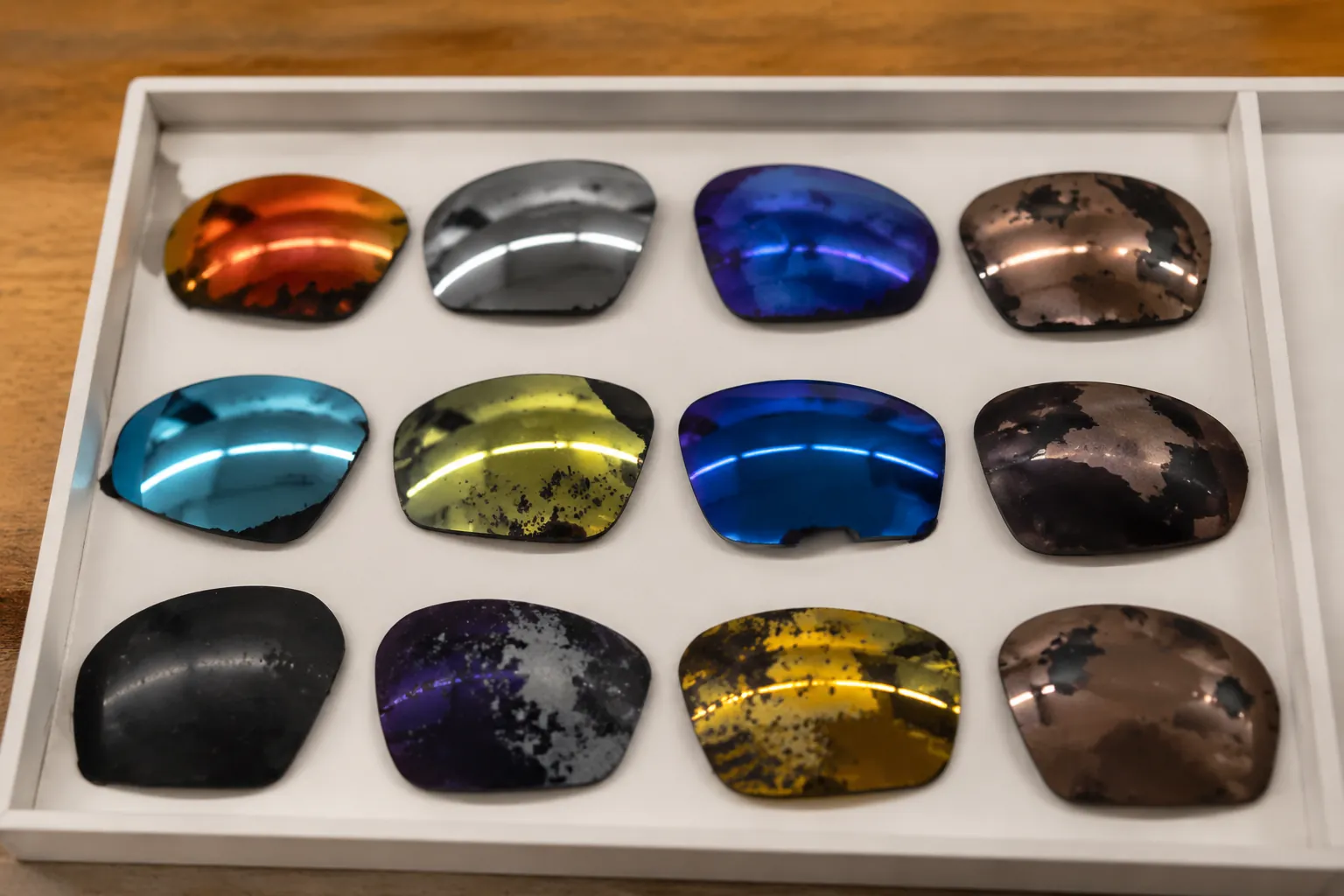
This guide is for brand owners, importers, distributors, and retail buyers sourcing mirrored sunglasses at volume. Most mirror-lens failures do not start in transit or at retail. They start earlier: vague RFQs, sample approvals based on looks alone, or a coating build that does not fit the channel, price point, or frame design. Define the lens structure, approval standard, inspection points, and assembly checks before bulk production. That is how you reduce rework, claims, and color disputes.
Start With Failure Modes, Not The Mirror Color Name
Buyers often begin with the visible finish: silver mirror, blue mirror, red mirror, gold mirror. That is design language, not a technical specification.
A mirror lens is a layered system. In a typical sunglass lens, field performance depends on the substrate, surface preparation, hard coat, mirror deposition, any base tint or polarized construction underneath, and any protective layer over the mirror.
The most common buyer complaints are scratching, peeling or flaking, and color inconsistency. They may look similar in a claim file. They usually come from different causes.
- Scratching: often linked to weak hard-coat performance, limited protection over the mirror, rough pouch or polybag contact, or friction during packing, shipping, store handling, or consumer use.
- Peeling or flaking: commonly tied to poor adhesion, contamination before coating, unstable process control, chemical exposure, or edge stress introduced during lens edging and insertion.
- Color inconsistency: often caused by variation in coating deposition, variation in the base lens tint, left-right mismatch within a pair, or approval against a photo instead of a signed reference sample under defined lighting.
Other defects include pinholes, haze, interference marks, perimeter fade, and visible mismatch between the two lenses. But the control logic is the same. If the buyer sets clear requirements for scratch resistance, adhesion, and color approval, many secondary issues become easier to prevent or sort during inspection.
The practical point is simple. Do not buy a mirror lens by photo alone. Buy against an agreed lens construction, an approved reference standard, and defined release criteria.
Where Mirror Lens Failure Usually Starts
On the factory side, mirror-lens problems usually start in one of five places.
- Lens substrate choice. Polycarbonate, TAC polarized constructions, and nylon do not behave the same way. Polycarbonate is common because it is lightweight and impact resistant, but coating performance still depends on proper surface preparation, hard-coat quality, and curing control. TAC polarized lenses add bonded layers, which improve glare reduction but also add interfaces that must remain stable.
- Cleaning and surface preparation. Mold-release residue, dust, skin oils, static, and humidity can all affect adhesion. A lens can look clean and still perform badly if pre-coating handling is inconsistent.
- Coating recipe and deposition control. Mirror appearance alone tells you very little about durability. Deposition consistency, process control, and any protective top layer all affect abrasion resistance, reflectivity, and shade consistency.
- Edging and frame assembly. If the lens edge is cut too aggressively or inserted into a frame under too much stress, the perimeter can chip, craze, or start lifting at the edge. Curved sport frames and sharp corners are common risk points.
- Packing and shipping. Mirror surfaces are vulnerable to friction. Poor separation, abrasive pouch materials, or front-to-front contact can create marks later reported as coating defects.
That is why pre-production control matters more than post-arrival arguments. If frame processing, lens processing, decoration, assembly, and final QC are coordinated well, coating and fit issues are easier to catch before shipment.
What To Put In Your RFQ And PO
If your RFQ says only blue mirror lens, the supplier still has to make technical assumptions. That is where trouble starts.
A usable purchase order must convert design language into a production target. At minimum, define these points in writing:
- Base lens material: polycarbonate, nylon, TAC polarized, or another agreed construction.
- Lens category and visible light transmittance target: for example, a target category and VLT range aligned to the destination-market requirement.
- Mirror appearance standard: a signed master sample plus reference photos taken under agreed lighting, ideally a consistent daylight-equivalent condition.
- Color tolerance: acceptable left-right match and batch-to-batch visual standard. If no instrument tolerance is agreed, define approval by controlled visual comparison against the signed sample.
- Scratch and adhesion release criteria: require the factory to state the inspection method it will use before packing and shipment.
- Edge condition after assembly: no visible peeling, flaking, cracking, or stress marks at the agreed inspection distance and lighting condition.
- Packing method: pouch or bag material, any interleaving requirement, pieces per inner box, and outer-carton packing standard.
Also state the selling channel. A promotional item, an open-display retail style, and a direct-to-consumer fashion product do not need the same balance of mirror intensity, abrasion resistance, and cosmetic tolerance.
Confirm compliance early. Depending on destination market and product category, buyers commonly review CE EN ISO 12312-1, ANSI Z80.3, AS/NZS 1067, REACH, and FDA registration where applicable. If supplier qualification matters in your sourcing process, ISO 9001 and BSCI may also be part of vendor review. These are not paperwork details. They affect material choice, testing scope, and lead-time planning.
Specify The Coating Stack, Not Just The Color
Many mirror disputes happen because the buyer approved the look but never defined the functional layer build. You do not need the supplier's confidential formulation. You do need a clear description of the performance stack you are buying.
| Spec Item | What Buyer Should State | Typical Range Or Option | Why It Matters In Field Use |
|---|---|---|---|
| Base lens | PC non-polarized, PC polarized, TAC polarized, or nylon | PC is common for fashion; TAC polarized adds layers; nylon is often used for sport | Affects impact behavior, optical stability, coating compatibility, and cost |
| Hard coat | Required before mirror deposition | Standard or upgraded scratch-resistant system | Helps protect the lens surface during normal handling |
| Mirror intensity | Light flash, medium mirror, or full mirror | Lower to higher reflectivity depending on design target | Changes defect visibility, consistency demands, and appearance under store lighting |
| Top protective layer | Required or not required | Basic protective layer or enhanced abrasion-resistant top coat | Can improve resistance to rub marks and handling damage |
| Base tint under mirror | Grey, brown, green, smoke, or custom tone | Selected to match VLT target and visual preference | Controls actual view color, lens category outcome, and compliance result |
Volume also affects how you manage consistency. Small trial runs are fine for market testing, but they still need the same written approval standard as larger orders. For repeat programs, consistency usually improves when the buyer keeps approved references, locks the specification, and avoids changing frame color, base tint, or packing method without re-approval.
Scratch Resistance: Match The Check To The Channel
Buyers often ask whether a mirror lens is scratch-proof. It is not.
The useful question is whether the lens can handle expected use in your channel without creating an unacceptable level of cosmetic complaints. That is the standard that matters.
Your release criteria should be specific and repeatable. A capable supplier should be able to describe its internal routine for cosmetic inspection, wipe or handling checks, adhesion checks where relevant, and review of packed samples before shipment. Bulk should be checked by lot, not judged against one good pre-production sample.
Channel priorities differ:
- Online and DTC brands: prioritize cosmetic condition on arrival. Small rub marks that seem minor in a carton audit can still trigger immediate complaints during unboxing.
- Chain retail: prioritize resistance to repeated handling. Open-display product may be touched, wiped, and tried on many times before sale.
- Promotional programs: cost pressure is high, but weak cosmetic durability can erase any unit-price saving through replacements and complaints.
Ask for retained reference samples from the approved lot. Keep one with your team and one with the factory. That gives both sides a shared physical standard if a claim appears later.
Peeling And Edge Failure Often Start At Assembly
Buyers often describe peeling as a coating problem. The trigger is often mechanical.
A lens can look acceptable before assembly and still fail after edging or insertion if the groove is too tight, the bevel is wrong, or the frame front puts too much stress on the perimeter.
This is especially common on wrapped sport frames, geometric lenses, sharp cat-eye shapes, and thicker fronts where insertion force is higher. Risk also rises when the mirror finish runs very close to the edge and the perimeter flexes during fitting.
Three practical controls should be written into approval:
- Approve the finished frame, not loose lenses only. Loose-lens approval does not show edge stress, insertion marks, or final color balance on the actual frame.
- Inspect the full lens perimeter after assembly. Check nasal corners, high-curve points, and any angle or notch where stress concentrates.
- Run a post-assembly handling check. Some edge failures appear only after light flexing, wiping, or normal handling.
Decoration sequence matters too. If the style includes pad printing, hot stamping, laser marking, metal logos, epoxy logos, or foil details, the production order should limit repeated touching or wiping of the front lens surface after insertion.
Color Control Is Mostly A Sampling Discipline
Most mirror-color disputes begin before bulk production. The buyer and supplier think they approved the same target, but one approved a phone photo, one approved a hand sample under office lighting, and neither recorded the standard clearly enough for repeat production.
Set the color-approval process before sampling. Use one signed master sample, one retained backup sample, and one agreed viewing condition. If the frame comes in multiple colors, approve the mirror against each key frame color because the same mirror can read differently on black, crystal, tortoise, or translucent acetate.
Use the sample stage properly. Do not approve only shape and logos. Approve mirror intensity, base tint, left-right match, edge appearance, and the finished look on the actual frame.
For reorders, do not assume the original result will repeat automatically. Ask the supplier to compare new production to the signed reference under the same lighting and confirm any variation before shipment.
Factory certifications such as ISO 9001 or social-compliance programs such as BSCI may support supplier qualification, but they do not replace style-specific color approval. The physical approved sample still matters most.
Pre-Production Checklist Before You Pay Deposit
Before bulk starts, run a final check against the main commercial and technical risks.
- Material confirmed: frame material, lens substrate, and polarized or non-polarized construction match the approved quote.
- Compliance path confirmed: destination-market requirements such as CE EN ISO 12312-1, ANSI Z80.3, AS/NZS 1067, REACH, and FDA registration where applicable are aligned to the product plan.
- Mirror stack defined: base lens, tint, hard coat, mirror level, and top protective layer are recorded.
- Master sample signed and stored: one with the buyer and one with factory QC, both dated and linked to the PO.
- Assembly approval completed: final frame and inserted lens reviewed for stress, edge condition, and cosmetic balance.
- Decoration sequence approved: logo application and finishing steps do not create avoidable front-lens handling risk.
- Packing approved: pouch, bag, partition, inner-box quantity, and outer-carton standard are confirmed.
- Inspection plan agreed: define lot checks for color, cosmetics, assembly, and packed condition before shipment.
- Timeline realistic: sample approval, production, testing, and shipment booking leave enough time for correction if a mirror issue appears.
Practical rule: if a mirror-lens feature matters enough to mention in a sales meeting, it should be written into the purchase specification.
That is the difference between a stable mirrored-sunglasses program and the usual cycle of attractive samples, inconsistent landed goods, and arguments over what was actually approved.
Have a custom sunglasses project in mind?
Send us your styles, target market and quantities and we will return a detailed quote with MOQ, lead time and a sample plan.
Get a QuoteWhy source this from Wenzhou with LumiShades
Wenzhou in Zhejiang Province is widely regarded as China’s eyewear manufacturing capital, producing a large share of the world’s sunglasses. That concentration matters to buyers: a deep local supply chain for acetate sheet, hinges, lens blanks, plating and packaging means shorter component lead times, easier color and material matching, and a workforce with decades of eyewear-specific skill. LumiShades has manufactured in this ecosystem since 2009, and our vertical integration — in-house injection molding, acetate cutting, CNC milling, lens tinting, decoration and quality control — means no part of your order is quietly subcontracted to a workshop you cannot audit.
For international buyers, that vertical control translates into accountability. When a single factory owns every step, defects are traced and fixed at source rather than bounced between vendors, and your specifications survive intact from first sample to bulk. We back this with 15+ years of experience, shipments to 60+ countries, more than 5 million pairs produced per year and a 98.5% on-time delivery rate. Our certifications — CE EN ISO 12312-1, FDA registration, ANSI Z80.3, AS/NZS 1067, REACH, ISO 9001 and BSCI audit — mean the compliance documentation your market requires already exists. Explore our manufacturing capabilities and quality control process to see how this works in practice.
Frequently asked questions
What is the biggest mistake buyers make with mirrored sunglasses? The most common mistake is approving appearance without defining the underlying specification. A buyer should document the lens substrate, base tint, mirror appearance standard, viewing condition, acceptable left-right match, assembly approval standard, and packing method. If those points are not written into the RFQ, sample approval, or PO, the supplier is still making technical choices on the buyer's behalf.
Can mirror coatings be guaranteed not to scratch? No. Mirror coatings are not scratch-proof. The practical step is to ask how the factory controls scratch performance in production: what hard coat is used, whether a protective top layer is included, how cosmetic checks are done before packing, and how packed goods are protected from friction. Buyers should also define what cosmetic condition is acceptable on arrival for their channel.
Should I approve loose lenses or finished sunglasses? Approve finished sunglasses. Loose lenses do not show edge stress, insertion damage, frame-pressure marks, or the final visual relationship between frame color and mirror color. At approval stage, inspect the assembled product under agreed lighting and check both front appearance and the full lens perimeter.
How does MOQ affect mirror lens consistency? MOQ does not determine quality by itself. What matters is whether the supplier can hold the same approved standard from sampling through bulk production. On smaller runs, buyers should be especially careful to lock the reference sample, inspection method, and packing standard, because any process variation is more visible when the target look is highly cosmetic.
What lead time should I plan for mirrored custom sunglasses? Lead time varies by construction, sampling rounds, testing requirements, packaging complexity, and factory loading. Do not rely on a generic number alone. Ask the supplier to break timing into sample development, approval, bulk production, testing if required, and shipment booking. Mirror color matching, polarized constructions, and multiple decoration steps can all extend the schedule.
Which compliance points should be checked for export programs? That depends on the destination market and product scope, but buyers commonly review CE EN ISO 12312-1, ANSI Z80.3, AS/NZS 1067, REACH, and FDA registration where applicable. Separately, ISO 9001 and BSCI may be used in supplier qualification. The practical step is to confirm applicable standards before sampling so the chosen materials, lens category, labeling, and test plan match the target market.
Ready to start?
Explore our cat-eye sunglasses or request a quote — our sales team replies within 12 hours.
Request a Quote