
OEM vs ODM Sunglasses: Open Molds or Private Tooling?
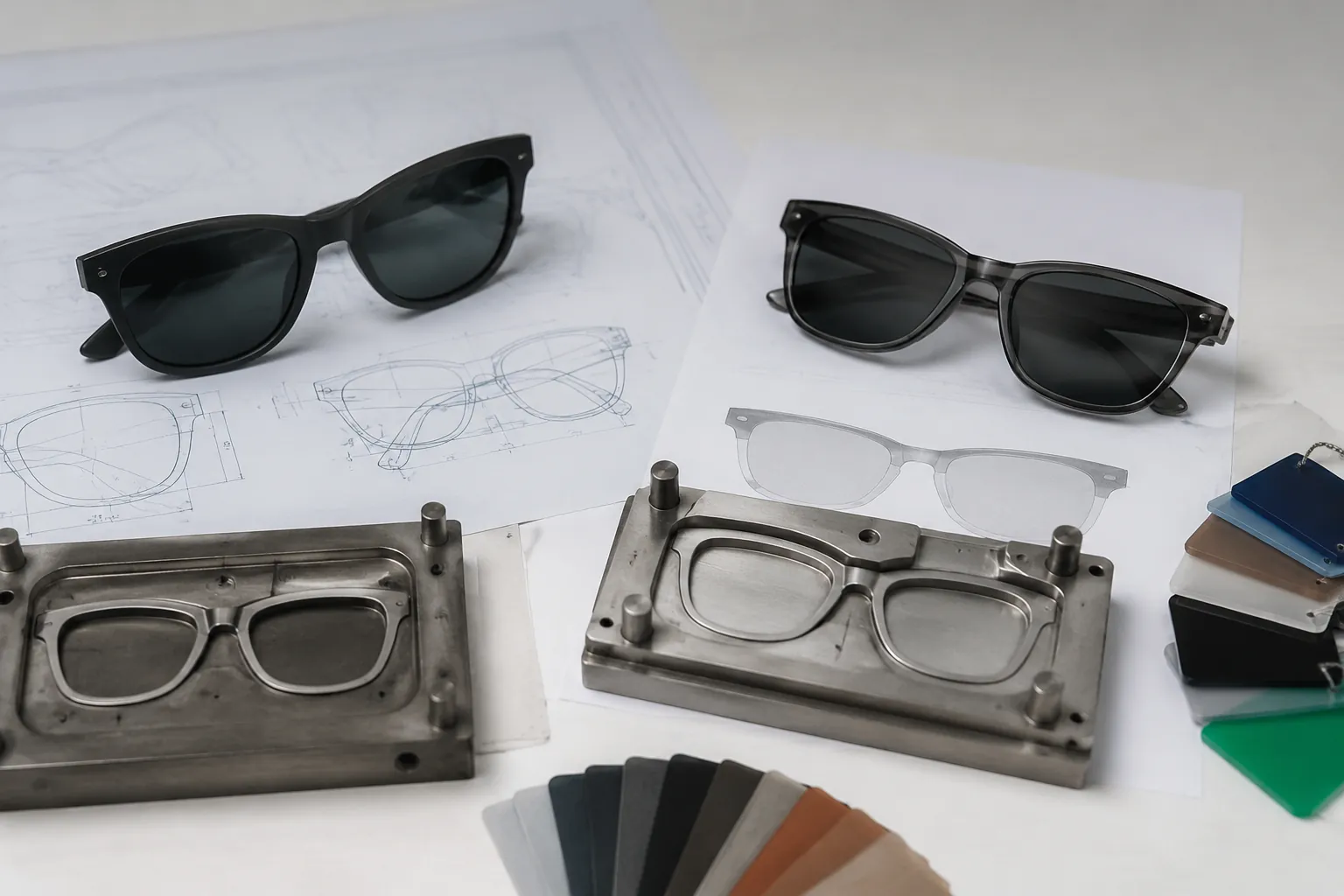
This guide is for brands, importers, distributors, and retailers choosing between factory-ready sunglasses frames and private tooling. The right route depends on launch timing, order quantity by SKU, target margin, design ownership, compliance duties, and how much development risk you can carry before bulk production. OEM and ODM are used inconsistently in eyewear sourcing. So this article focuses on the practical decision: use an existing factory frame platform, or develop a private frame shape, fit, or construction for your brand.
The real sourcing choice: speed, exclusivity, or control
OEM and ODM are often used loosely in eyewear. In many industries, OEM means manufacturing to the buyer's own design. ODM means using or adapting a supplier-developed design. In sunglasses sourcing, those labels are not always used that way. Do not rely on the label. Define what is being controlled.
In this article, a factory-ready program means using an existing frame mold, acetate model, or production platform, then customizing color, lens, logo, finish, packaging, and feasible construction details. A private-tooling program means developing a frame shape, temple structure, bridge profile, lens geometry, or fit specification intended to be private to your brand. That may require new tooling, new CNC programs, dedicated fixtures, or controlled engineering files.
If the buyer needs sunglasses on shelves quickly, start with factory-ready frames. If the brand depends on a shape competitors cannot source from the same open catalog, private tooling may be worth the cost. The wrong choice hurts. A private mold for a short trend can miss the season. An open-mold frame for a premium launch can invite direct price comparison.
For a Wenzhou eyewear factory such as LumiShades, the issue is not only frame production. The project must coordinate frame molding or acetate machining, lens cutting, tinting or coating, logo decoration, assembly, packaging, inspection, and export documents. Both routes fail for the same reason: vague specifications. Lens fitting, decoration, labeling, and inspection must be controlled against an approved sample.
Head-to-head: factory-ready frames vs private tooling
| Decision point | Factory-ready frame program | Private-tooling program |
|---|---|---|
| Best use | Fast launches, test orders, retail promotions, distributor catalogs, seasonal color drops, and multi-SKU programs | Signature shapes, brand-owned collections, premium lines, sport-fit projects, and products expected to repeat for multiple seasons |
| MOQ logic | Lower starting quantities may be possible because the frame platform already exists; confirm MOQ by SKU, color, lens, logo, and packaging version | Usually needs a higher volume forecast because tooling, engineering, sampling, trial runs, and storage or maintenance must be paid back |
| Sample lead time | Shorter when existing molds, available materials, standard lens options, and standard decoration methods are used | Longer because drawings, prototypes, trial tooling, corrections, lens-fit checks, and fit reviews must be completed before approval |
| Bulk lead time | Starts after sample approval, material confirmation, deposit or payment terms, and production slot confirmation | Starts only after tooling is approved and a sealed production sample is signed; tooling development is a separate stage |
| Cost structure | Lower startup cost; unit price depends on material, lens type, coating, decoration, packaging, inspection level, and order breakdown by SKU | Higher upfront development cost; better suited to products with repeat orders, stronger margins, or protected distribution |
| Differentiation | Frame color, lens tint, mirror coating, polarization, logo, temple print, metal plate, pouch, case, hangtag, barcode, and retail packaging | Front geometry, lens shape, bridge, temple profile, hinge placement, thickness, wrap, nose fit, and face-fit behavior |
| Main risk | Lower development risk, but similar or identical frames may be available to other buyers unless exclusivity is agreed in writing | Higher development risk; stronger design control only if fit, lens retention, durability, and compliance are validated before bulk production |
Use factory-ready frames when shape is not the main sale
Factory-ready sunglasses make sense when the commercial value comes from brand story, price point, channel access, packaging, color rotation, lens effect, or speed. Many profitable programs are built this way. The silhouette may be familiar. The product can still sell because the lens color, mirror finish, logo, display packaging, and delivery are right.
A practical factory-ready development path looks like this:
- Select existing injection, TR90, PC, nylon, metal, or acetate frame options from the supplier's current range.
- Confirm the destination market before sampling: EU, US, UK, Australia/New Zealand, or mixed markets.
- Choose frame material and finish: solid color, translucent color, tortoise effect, matte, glossy, rubberized coating, or another available finish.
- Choose lens material and performance: PC, TAC polarized, nylon, UV400, category 0 to 4 where applicable, gradient tint, solid tint, flash mirror, or another approved coating.
- Approve decoration: pad printing, laser engraving, temple printing, hot stamping, metal logo plate, or another method suitable for the material and finish.
- Confirm packaging: polybag, microfiber pouch, EVA case, paper box, retail hangtag, barcode label, warning label, carton marks, and carton strength.
- Request pre-production samples that represent the actual frame color, lens, logo, packaging, and labeling as closely as possible.
- Move to bulk production only after the approved sample, SKU breakdown, inspection standard, and compliance requirements are documented.
This route suits importers and distributors managing many styles across men's, women's, sport, fashion, and kids' categories. But do not judge MOQ only by total quantity. A 3,000-pair order split across 30 SKUs behaves like 30 small productions, not one large run. Ask the supplier to quote by SKU. Also ask which combinations create extra setup, material, coating, or packaging cost.
Use private tooling when shape ownership changes the math
Private tooling makes sense when the frame shape itself carries value. That may be a distinctive oversized front, a sport wrap with a specific temple geometry, a thick acetate profile, a special bridge, a shield lens construction, or a fit made for a defined consumer group. Private tooling is not automatically better. It is better only when margin, exclusivity, repeat orders, or brand protection justify the cost and time.
Consider private tooling if at least three of these are true:
- You expect repeat orders for the same frame beyond one short selling season.
- Your wholesale or retail margin can absorb tooling, sampling, correction, and testing cost.
- Your sales channel penalizes lookalike products or competes directly against open-catalog styles.
- You need a fit, wrap, bridge, lens shape, temple structure, or hinge position that existing frames cannot provide.
- You can allow time for prototype review and correction before bulk production.
- You can provide clear 2D drawings, 3D files, reference samples, Pantone or material targets, measurements, or fit requirements.
Private tooling changes more than appearance. It can affect hinge position, temple opening angle, lens groove depth, nose pad contact, front curvature, frame thickness, material shrinkage, assembly yield, and wearer comfort. Small errors become production problems fast. A loose lens groove can cause lens popping. A temple angle that looks fine in a rendering may press behind the ears. A bridge that is too narrow or too wide can increase returns.
Approve private-tooling samples on real faces, not only from renderings. Check front width, lens height, bridge width, temple length, pantoscopic tilt, opening angle, hinge tension, lens retention, nose contact, and overall balance. Wear-test the sample. Look for slipping, pinching, temple pressure, and lens movement. Do not release bulk production until the approved sample is sealed and retained by both buyer and factory.
What changes in production
For injection-molded frames, existing molds are faster because the supplier already understands plastic flow, cooling behavior, shrinkage, gate position, ejection, and common defect points. Production still needs control. Color consistency, burr removal, hinge fitting, lens cutting, screw torque, polishing, alignment, and final inspection all matter. The main advantage is simple: the highest-risk geometry questions have already been tested in prior runs.
For private injection tooling, the factory must create or modify mold steel, run trial shots, check sink marks, evaluate weld lines, confirm gate position, and review assembly fit. Material choice matters. PC is widely used for value and impact resistance, but processing conditions and design thickness can affect stress marks and durability. TR90 is light and flexible, but thin sections and temperature control need attention. Nylon is often used for sport frames and wraps, but shrinkage, front curvature, and lens fit must be controlled closely.
For acetate frames, tooling works differently. Acetate production usually involves sheet selection, front and temple cutting, CNC milling, tumbling, hand polishing, hinge insertion, lens edging, and final assembly. Private design work may involve CNC programs, cutting fixtures, lamination choices, color sheet sourcing, temple core design, and polishing standards rather than one injection mold. Acetate can give rich color depth and a premium hand feel, but it is slower, more labor-sensitive, and more dependent on polishing consistency.
Typical production control points include lens groove consistency, bridge symmetry, temple opening, hinge alignment, screw tightness, surface finish, logo position, lens fit, frame balance, and packaging accuracy. Set tolerances by function. Critical areas such as lens groove, hinge location, bridge width, and temple opening need tighter review than cosmetic zones. Write the tolerance into the specification, or confirm it against the sealed sample with a clear inspection method. "Same as sample" is not enough.
Cost, MOQ, and lead-time checks before a PO
Do not ask only for the lowest unit price. Ask what the price includes, what it excludes, and which order breakdown supports that price. Confirm MOQ by frame model, frame color, lens type, lens color, logo method, packaging version, and destination labeling. A supplier may accept a low total order, then price it differently because the order is fragmented across many SKUs.
For a factory-ready program, cost usually includes the frame, lenses, assembly, standard inspection, basic packaging, and export carton packing, unless the quotation says otherwise. Add separate cost lines for TAC polarized lenses, mirror coating, custom lens color, special frame color matching, metal logo plates, retail packaging, barcode labeling, third-party testing, third-party pre-shipment inspection, and urgent shipment.
For a private-tooling program, add design engineering, 2D or 3D drawing work, prototype sampling, mold or fixture development, trial runs, corrections, and possible retesting after geometry changes. Clarify tooling ownership. Who owns it? Where is it stored? Can the supplier use it for other customers? What happens if orders stop? Are maintenance or replacement costs included?
Run a payback check before approving private tooling. Divide all development and tooling cost by a realistic first-year order volume, not the best-case forecast. Add that amount to the expected unit cost. Then compare it with your landed-cost target and required margin. If the numbers do not work, start with a factory-ready frame, validate sell-through, and develop a private version only after the direction proves itself.
Also check lead time by stage. Sampling time, tooling time, testing time, material preparation time, bulk production time, inspection time, and shipping time are separate. A quoted production lead time usually starts only after sample approval, deposit or payment confirmation, material confirmation, and production slot confirmation. For seasonal sunglasses, build in time for corrections. The first sample may not pass.
Decoration, lenses, and QC details that decide the result
Customization is where a factory-ready frame can still become a disciplined brand program. The highest-value choices are often lens tint, mirror finish, polarization, logo execution, temple decoration, and packaging. A basic open-frame model with weak decoration looks generic. The same frame with controlled lens color, clean logo placement, consistent packaging, and correct labeling can look retail-ready.
Common decoration methods include:
- Pad printing: suitable for many simple logos on temples or lenses; test adhesion, especially on coated, matte, or rubberized surfaces.
- Laser engraving: clean and durable on suitable plastics, metals, or coated parts; usually less colorful but often more premium in appearance.
- Metal logo plate: strong brand impact; requires controlled placement, adhesive performance, or mechanical fixing.
- Hot stamping or foil: useful for metallic effects; abrasion resistance and alignment must be checked.
- Temple printing: useful for fashion, sport, or promotional lines; confirm alignment, color tolerance, and rub resistance on the actual production surface.
Lens selection affects cost, performance, labeling, and compliance. PC lenses are common for value and impact resistance. TAC polarized lenses reduce glare and are popular for driving, fishing, and outdoor use. Nylon lenses are often used where optical performance, impact resistance, or sport-frame design requirements justify the cost. Any change in tint, mirror coating, polarization, or visible light transmission can change the lens category and required label.
QC should not stop at appearance. A serious inspection checks lens scratches, frame scratches, color match, logo position, logo adhesion, hinge function, screw tightness, lens retention, temple balance, frame alignment, front warpage, nose fit, packaging accuracy, barcode accuracy, warning labels, carton marks, and carton condition. For B2B orders, define AQL level, critical defects, major defects, minor defects, retained samples, and whether inspection occurs inline, during production, before shipment, or all three.
Compliance and the final PO decision framework
Sunglasses are not only fashion items in many markets. They may need to meet optical, labeling, chemical, and safety requirements. For EU markets, buyers commonly require CE marking supported by testing to EN ISO 12312-1 for sunglasses. For the US, ANSI Z80.3 is commonly requested, and FDA registration or listing may be relevant for non-prescription sunglasses importation. For Australia and New Zealand, AS/NZS 1067 applies. REACH is relevant to chemical restrictions for materials, coatings, and components sold into the EU.
Private tooling can create new compliance risk because geometry changes may affect lens retention, coverage, optical performance, field of view, and labeling. A compliant lens used in one frame does not automatically make every new frame compliant. A deeper wrap, thinner lens groove, new shield shape, different tint, or different mirror coating may require renewed checks.
Before approving either route, send the factory a precise PO brief:
- Destination market and required standard or requirement: CE with EN ISO 12312-1, ANSI Z80.3, AS/NZS 1067, REACH, FDA registration or listing where applicable, or a combination.
- Expected quantity by SKU, not only total quantity.
- Frame material, lens material, lens category, UV requirement, polarization requirement, and lens color or coating.
- Logo size, position, color, artwork file, and decoration method.
- Packaging specification, barcode rules, warning labels, language requirements, carton marks, and carton packing method.
- Target ex-factory price, required delivery date, shipment method, and Incoterms if already agreed.
- Inspection level, defect definitions, approval sample process, retained sample requirements, and who pays for third-party inspection or testing.
LumiShades works with the compliance documents commonly requested for sunglasses programs, including CE with EN ISO 12312-1, FDA registration where applicable, ANSI Z80.3, AS/NZS 1067, REACH, ISO 9001, and BSCI. Ask for documents that match your actual SKU, lens specification, destination market, and production batch where possible. Do not rely on a generic certificate that does not identify the product you are buying.
The rule is clear. Choose factory-ready frames if speed, lower development cost, SKU testing, and flexible customization matter most. Choose private tooling if shape ownership, fit control, and long-term margin justify the development cost and schedule. In both cases, specifications prevent disputes. Vague specifications create rework, missed delivery dates, compliance gaps, and avoidable defects.
Have a custom sunglasses project in mind?
Send us your styles, target market and quantities and we will return a detailed quote with MOQ, lead time and a sample plan.
Get a QuoteWhy source this from Wenzhou with LumiShades
Wenzhou in Zhejiang Province is widely regarded as China’s eyewear manufacturing capital, producing a large share of the world’s sunglasses. That concentration matters to buyers: a deep local supply chain for acetate sheet, hinges, lens blanks, plating and packaging means shorter component lead times, easier color and material matching, and a workforce with decades of eyewear-specific skill. LumiShades has manufactured in this ecosystem since 2009, and our vertical integration — in-house injection molding, acetate cutting, CNC milling, lens tinting, decoration and quality control — means no part of your order is quietly subcontracted to a workshop you cannot audit.
For international buyers, that vertical control translates into accountability. When a single factory owns every step, defects are traced and fixed at source rather than bounced between vendors, and your specifications survive intact from first sample to bulk. We back this with 15+ years of experience, shipments to 60+ countries, more than 5 million pairs produced per year and a 98.5% on-time delivery rate. Our certifications — CE EN ISO 12312-1, FDA registration, ANSI Z80.3, AS/NZS 1067, REACH, ISO 9001 and BSCI audit — mean the compliance documentation your market requires already exists. Explore our manufacturing capabilities and quality control process to see how this works in practice.
Frequently asked questions
Can I start with a factory-ready frame and later make it exclusive? Usually not if the frame is part of the supplier's open catalog. Ask the supplier in writing whether the mold or acetate model is open, semi-exclusive, or exclusive. If you need exclusivity, request a written agreement covering the model number, territory, sales channel, time period, minimum annual order quantity, and what happens if the minimum is not met. A safer route is to use the open model for market testing, then develop a private version with changed front geometry, temple design, bridge, lens shape, thickness, or hinge structure.
What is the safest MOQ for testing a new sunglasses design? The safest MOQ is the smallest quantity that still gives useful sell-through data by SKU. Do not judge only by total quantity. Confirm MOQ and price for each frame color, lens color, logo method, and packaging version. For a first test, reduce variables: choose fewer frame colors, fewer lens tints, and one packaging format. After you know which combinations sell, increase quantity on the winning SKUs to improve unit cost and production consistency.
Will a new lens color affect compliance? Yes. Lens tint, mirror coating, polarization, and visible light transmission can change the lens category, warning label, and applicable test result. Before approving a new lens color, ask the supplier to confirm the lens category, UV performance, visible light transmission, and labeling requirement for your destination market. If you sell in the EU, check CE with EN ISO 12312-1. For the US, check ANSI Z80.3 and FDA registration or listing requirements where applicable. For Australia/New Zealand, check AS/NZS 1067.
How long should I allow for private tooling before bulk production? Do not include tooling development inside normal bulk production time. Plan separate time for drawings, prototype review, tooling or fixture development, trial shots or CNC samples, fit corrections, lens-retention checks, surface and logo approval, compliance review, and final sealed sample approval. Bulk production should start only after the sealed sample is approved and the factory confirms materials, production slot, inspection standard, and payment terms.
Which customization gives the best value without private tooling? The strongest value usually comes from lens tint, mirror coating, TAC polarization, clean temple logo placement, laser engraving, pad printing, metal logo plates, microfiber pouches, EVA cases, hangtags, barcode labels, and retail packaging. To make these options work, approve the exact lens color, logo size, logo position, packaging artwork, and label content before production. Also request adhesion or rub checks for decoration on coated or rubberized surfaces.
What documents should I request before shipment? Request documents that match your order, not only generic factory files. At minimum, ask for the approved sample record, final order specification, packing list, carton list, QC inspection report, and compliance documents for the destination market. Depending on where you sell, this may include CE with EN ISO 12312-1, ANSI Z80.3, AS/NZS 1067, REACH documentation, and FDA registration or listing information where applicable. Keep these records with the purchase order, invoice, and shipment documents in case of customs, retailer, or recall questions.
Ready to start?
Explore our shield & oversized sunglasses or request a quote — our sales team replies within 12 hours.
Request a Quote