
When Should You Open a Sunglasses Mold?
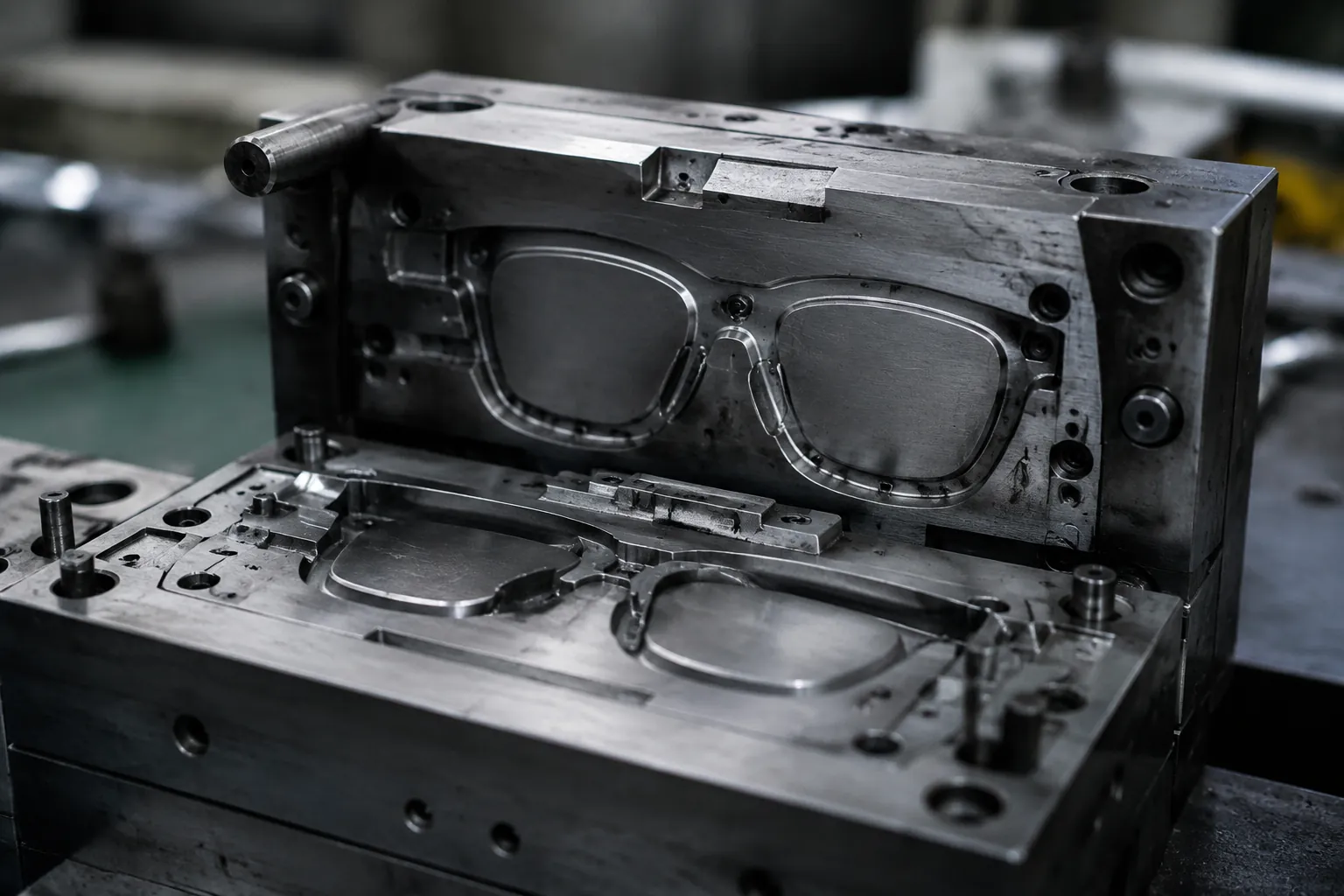
This guide is for brand owners, importers, distributors, and retail buyers deciding whether to pay for a new sunglasses mold or adapt an existing factory model. Treat the mold decision as a business decision, not a design impulse. The right choice depends on confirmed volume, product differentiation, fit, compliance, margin, and launch risk. Use this guide to decide when tooling is worth it, when a modified stock frame is safer, and what to confirm before mold work begins.
The mold decision is a commercial decision first
A new sunglasses mold often starts with a design request. In production, it becomes a cost and risk decision.
If the order is a small campaign, distributor test, or early brand launch, an existing frame with custom lenses, colors, logos, and packaging is usually the safer route. It is faster. It protects cash. It gives you market feedback before you commit to fixed tooling cost.
If the product is expected to repeat and the frame shape is central to the brand identity, tooling may be justified. But the key question is not, "Can this design be molded?" A better question is, "Will confirmed and repeatable sales volume recover the tooling cost without damaging margin or launch timing?"
A mold is a fixed cost. It may or may not reduce the unit price. Material, frame structure, assembly efficiency, lens choice, decoration method, packaging, and inspection requirements all affect the final economics.
Use conservative order assumptions. Do not amortize tooling over the sales forecast you hope to reach. Amortize it over the volume you can support with purchase orders, retailer commitments, or proven sell-through data.
Practical rule: if you are still testing whether customers like the frame shape, do not open a full new mold. Use an existing model or a limited modification first.
Four paths before you pay for full tooling
Most buyers have more than two choices. The decision is not simply stock frame versus new mold. Sunglasses customization sits on a spectrum, and each level changes MOQ, sampling, cost, timing, and control.
| Option | What changes | Typical MOQ logic | Sample timing | Best use |
|---|---|---|---|---|
| Stock model decoration | Logo, lens color, available frame color, packaging | Lowest MOQ route, subject to available materials and supplier policy | Usually the fastest path when materials are in stock | Market test, promotional run, distributor catalog fill |
| Stock model with process changes | Custom tint, gradient lens, pad print, laser engraving, metal logo plate where feasible | Better economics when setup cost is spread across a larger order | Depends on lens, color, decoration, and material availability | Brand look without structural change |
| Modified existing model | Small temple change, bridge adjustment, logo recess, hinge-area edit where tooling or inserts allow it | Usually requires a stronger volume commitment than decoration only | Depends on whether fixture, insert, or mold work is needed | Improving fit or brand detail while limiting tooling risk |
| New mold | Full frame geometry, temples, bridge, lens shape, logo positions, structural features | Most suitable for confirmed repeat programs or designs with clear commercial justification | Requires design review, tooling, trial shots, correction, and approval | Owned design direction, long-running SKU, protected visual identity |
Material matters too. Acetate frames can allow more flexibility through cutting, CNC milling, polishing, and lamination. Injection-molded plastic frames are different. The mold cavity controls much of the final product.
That means a bridge change, rim-thickness change, hinge-boss change, lens-groove change, or temple-profile change may require tooling work. It is not just a drawing update.
Open a mold when existing models force real compromises
New tooling is justified when stock models or light modifications create problems that affect sales, fit, compliance, durability, or assembly yield. Vague preference is not enough. Name the gap.
- The lens shape must be exact. Fashion and retail programs often need a specific lens outline. A few millimeters can change the whole look.
- The fit target is different. A wider bridge, longer temple, flatter front curve, deeper lens groove, or different nose geometry may be hard or impossible to achieve on an existing frame.
- The logo must be molded into the part. Pad printing, laser engraving, and metal plates are decoration methods. Raised or recessed molded branding normally requires tooling.
- The hinge structure must change. Spring hinges, reinforced hinge bosses, thicker temples, or different opening angles can affect strength, mold flow, and assembly.
- The current model creates quality failures. If lenses pop out, the frame twists, the hinge area cracks, or the part deforms after assembly, decoration will not fix it.
- You need a product family. If the same design language will run across adult, youth, polarized, non-polarized, and seasonal color collections, owning the geometry can have long-term value.
A good supplier should separate cosmetic requests from structural requirements. Some changes are process changes. Some need fixtures. Some need inserts. Some require a new mold. These are different cost and timing categories. Ask for them to be quoted separately.
Volume breakpoints change the answer
Small test orders are about speed, sampling discipline, and avoiding fixed cost. Mid-size orders bring more risk around material consistency, decoration yield, lens assembly, and packaging quality. Larger repeat programs can justify tooling if the design will stay in the line long enough to recover the investment.
Use a simple recovery calculation before approving tooling:
Tooling burden per pair = total tooling and development cost ÷ realistic lifetime order quantity.
Run this against the total volume you can reasonably expect over the life of the design, not only the first purchase order. If the added cost per pair is higher than the expected margin gain, retail-price advantage, or brand value, use an existing model or partial modification.
One short run can make the tooling burden painful. Repeat orders over several seasons can make it reasonable. This is why buyers with confirmed retailer programs can approve tooling earlier than new brands still testing demand.
Do not assume tooling will lower the unit price. It might. It might not. Complex hinges, heavier frames, polarized lenses, custom metal parts, special packaging, tighter color matching, and extra testing can all raise cost. Treat every quote as specification-dependent.
Tooling changes the lead time
Customizing an existing frame is usually faster than building a new tool. The frame geometry, mold behavior, and assembly process are already known. A new mold adds stages. Skipping them creates risk.
- Design file and brief review. The supplier checks lens curve, frame thickness, hinge position, temple length, bridge, nose area, logo placement, lens category, packaging, and target market.
- DFM review. The production team reviews draft angles, gate position, sink-mark risk, warpage risk, lens insertion clearance, screw-boss strength, and assembly access.
- Prototype or 3D confirmation. This helps catch proportion, fit, and branding problems before steel or production tooling is committed.
- Mold build or insert work. For injection frames, this is the fixed-cost stage. Late geometry changes can be expensive or impractical.
- First trial shots. The supplier checks shrinkage, flash, short shots, surface finish, hinge fit, lens seating, temple opening, and visible defects.
- Correction round. Tool polishing or minor adjustment may be normal. Major geometry changes should be avoided after this point.
- Pre-production sample approval. Color, lens tint, decoration, packaging, labeling, and compliance requirements should be locked before bulk production.
Do not plan a new mold on the same timeline as a stock-frame reorder. Add approval buffers, especially if design, merchandising, quality, compliance, or the end customer must sign off.
Technical and compliance limits buyers miss
Sunglasses can look simple in a rendering and still be difficult to produce. Common problems include lenses that do not seat correctly, temples that open unevenly, hinge areas that crack, frames that twist after cooling, and sink marks near thick sections.
Injection-molded materials shrink as they cool. Thick and thin sections shrink differently. That can cause warpage or visible sink marks. A chunky temple, sharp transition, deep logo recess, or decorative groove may look fine in a 3D file but fail in molding.
Acetate has different constraints. It can be cut and polished to a high finish, but it still needs stable sheet material, controlled milling, enough thickness around the hinge, and a precise lens groove.
Tolerance is critical. Lens seating has little room for error: too loose and the lens can rattle or pop out; too tight and assembly can scratch the lens, stress the frame, or cause distortion. Temple opening angle affects wearing comfort. Metal logo plates need a secure recess, suitable adhesive or mechanical retention, and enough surface area to survive handling, humidity, and packing pressure.
Discuss compliance before mold approval. Lens shape, lens category, material, labeling, and destination market affect the test plan. Common standards and requirements include CE EN ISO 12312-1 for Europe, ANSI Z80.3 for the United States, AS/NZS 1067 for Australia and New Zealand, and REACH for chemical safety in relevant markets. FDA registration may be relevant for companies placing eyewear into the U.S. market, but it does not replace product performance testing. ISO 9001 and BSCI are management-system or social-compliance references; they are not substitutes for sunglasses performance testing.
What to ask before approving a new mold
You do not need to be a mold engineer. You do need to ask questions that expose cost, timing, ownership, and quality risk before money is spent. Vague answers are a warning sign.
- Which parts require new tooling? Confirm whether the front, temples, nose pads, decorative parts, inserts, or only one component requires tooling.
- What files or samples are needed? Ask whether the supplier needs 2D drawings, 3D files, reference samples, Pantone references, lens requirements, or packaging artwork.
- What is the sample approval path? Confirm whether you will receive a prototype, first trial shot, corrected sample, and final pre-production sample.
- Where are the highest-risk areas? Ask specifically about bridge strength, hinge boss, lens groove, thick-to-thin transitions, temple opening angle, and logo placement.
- What can still change after the first trial? Minor surface or fit adjustments may be possible. Moving a hinge, changing the lens shape, or altering the bridge may require major tool changes.
- Who owns the mold? Put mold ownership, exclusive use, storage location, maintenance responsibility, repair cost, and future access in writing.
- Which compliance route applies? Confirm the target market and required standards before approving lens color, lens category, material, labeling, and packaging.
- What is the QC plan? Include incoming material checks, in-process frame checks, lens inspection, decoration adhesion, hinge function, assembly fit, cosmetic inspection, and final AQL inspection.
Ask for written confirmation of the tooling scope and approval stages before paying a mold charge. If the supplier has ISO 9001 or BSCI certification, request current certificates and check their validity. These certificates can support supplier evaluation. They do not replace product inspection, performance testing, or clear purchase specifications.
A practical decision rule for buyers
Prove the market with existing models. Approve tooling for repeatable volume. Reserve new geometry for design or fit features that cannot be achieved any other way.
For a new brand launch, start with existing models or limited modifications. Test lens category, frame color, logo size, packaging, wearer feedback, and sell-through before committing to full tooling.
For an importer with retailer forecasts, consider tooling only after specifications, compliance requirements, and expected repeat volume are clear. For a distributor or brand with a long-running program, a new mold can protect visual identity, improve fit, and reduce dependence on shared stock shapes.
Separate decoration ownership from design ownership. A frame carrying your logo is not the same as a frame shape that is exclusive to your line. If competitors can buy the same base model and add their own branding, differentiation is limited. That may be fine for promotional sunglasses. It is weaker for a core retail SKU.
The strongest mold decisions are specific and documented: confirmed commercial volume, locked fit target, approved lens category, realistic lead time, written tooling ownership, defined QC criteria, and a clear compliance route. If those items are not ready, use stock-frame customization or a smaller modification first.
Have a custom sunglasses project in mind?
Send us your styles, target market and quantities and we will return a detailed quote with MOQ, lead time and a sample plan.
Get a QuoteWhy source this from Wenzhou with LumiShades
Wenzhou in Zhejiang Province is widely regarded as China’s eyewear manufacturing capital, producing a large share of the world’s sunglasses. That concentration matters to buyers: a deep local supply chain for acetate sheet, hinges, lens blanks, plating and packaging means shorter component lead times, easier color and material matching, and a workforce with decades of eyewear-specific skill. LumiShades has manufactured in this ecosystem since 2009, and our vertical integration — in-house injection molding, acetate cutting, CNC milling, lens tinting, decoration and quality control — means no part of your order is quietly subcontracted to a workshop you cannot audit.
For international buyers, that vertical control translates into accountability. When a single factory owns every step, defects are traced and fixed at source rather than bounced between vendors, and your specifications survive intact from first sample to bulk. We back this with 15+ years of experience, shipments to 60+ countries, more than 5 million pairs produced per year and a 98.5% on-time delivery rate. Our certifications — CE EN ISO 12312-1, FDA registration, ANSI Z80.3, AS/NZS 1067, REACH, ISO 9001 and BSCI audit — mean the compliance documentation your market requires already exists. Explore our manufacturing capabilities and quality control process to see how this works in practice.
Frequently asked questions
What order volume usually justifies a new sunglasses mold? There is no universal volume. Tooling cost, frame complexity, material, margin, and expected repeat demand all matter. New tooling is easier to justify when the design has confirmed repeat demand, not only a one-time order. Ask the supplier for the total tooling and development cost, then divide it by the realistic lifetime order quantity. If the added cost per pair cannot be recovered through margin, retail price, or brand value, use an existing model or partial modification.
Can I start with a small order and open a mold later? Yes. This is often the safer path. Start with an existing frame or limited customization to test sell-through, fit feedback, lens category, colors, logo size, and packaging. Track returns, wearer comments, and reorder demand. If the design proves commercial and the required changes cannot be achieved on the existing frame, move to tooling with better evidence.
Will a new mold reduce my unit price? Not necessarily. A new mold can improve efficiency if the design is simple, stable, and ordered in repeat volume. It can also increase cost if the frame uses complex geometry, heavy material sections, special hinges, polarized lenses, metal parts, difficult decoration, tight color matching, or extra testing. Compare the full economics: tooling cost, unit price, defect risk, inspection cost, lead time, and expected reorder volume.
How much extra lead time should I allow for tooling? Allow additional time beyond normal stock-frame customization for design review, DFM review, prototype or 3D confirmation, mold build, first trial shots, corrections, and pre-production sample approval. Ask your supplier for a written timeline with approval gates. Do not commit to a retail launch date until you know who must approve each stage and how long corrections may take.
Which compliance standards should I discuss before making a new mold? Start with the destination market. Common references include CE EN ISO 12312-1 for Europe, ANSI Z80.3 for the United States, AS/NZS 1067 for Australia and New Zealand, and REACH for chemical safety where applicable. FDA registration may be relevant for U.S. eyewear supply-chain obligations, but it does not replace product performance testing. Confirm the required standard, lens category, labeling, and test plan before approving lens color or bulk production.
What changes can usually be made without opening a full mold? Common non-tooling or low-tooling changes may include frame color, lens tint, gradient lens, mirror coating, logo printing, laser engraving, packaging, labels, and sometimes applied logo plates. Feasibility depends on the material and existing frame surface. Changes to lens outline, bridge shape, rim thickness, hinge structure, temple geometry, nose geometry, or molded logos usually require tooling or at least insert work. Ask the supplier to classify each requested change as decoration, process change, fixture change, insert change, or new mold.
Ready to start?
Explore our shield & oversized sunglasses or request a quote — our sales team replies within 12 hours.
Request a Quote