
Factory vs Buyer-Owned Tooling for Custom Sunglasses
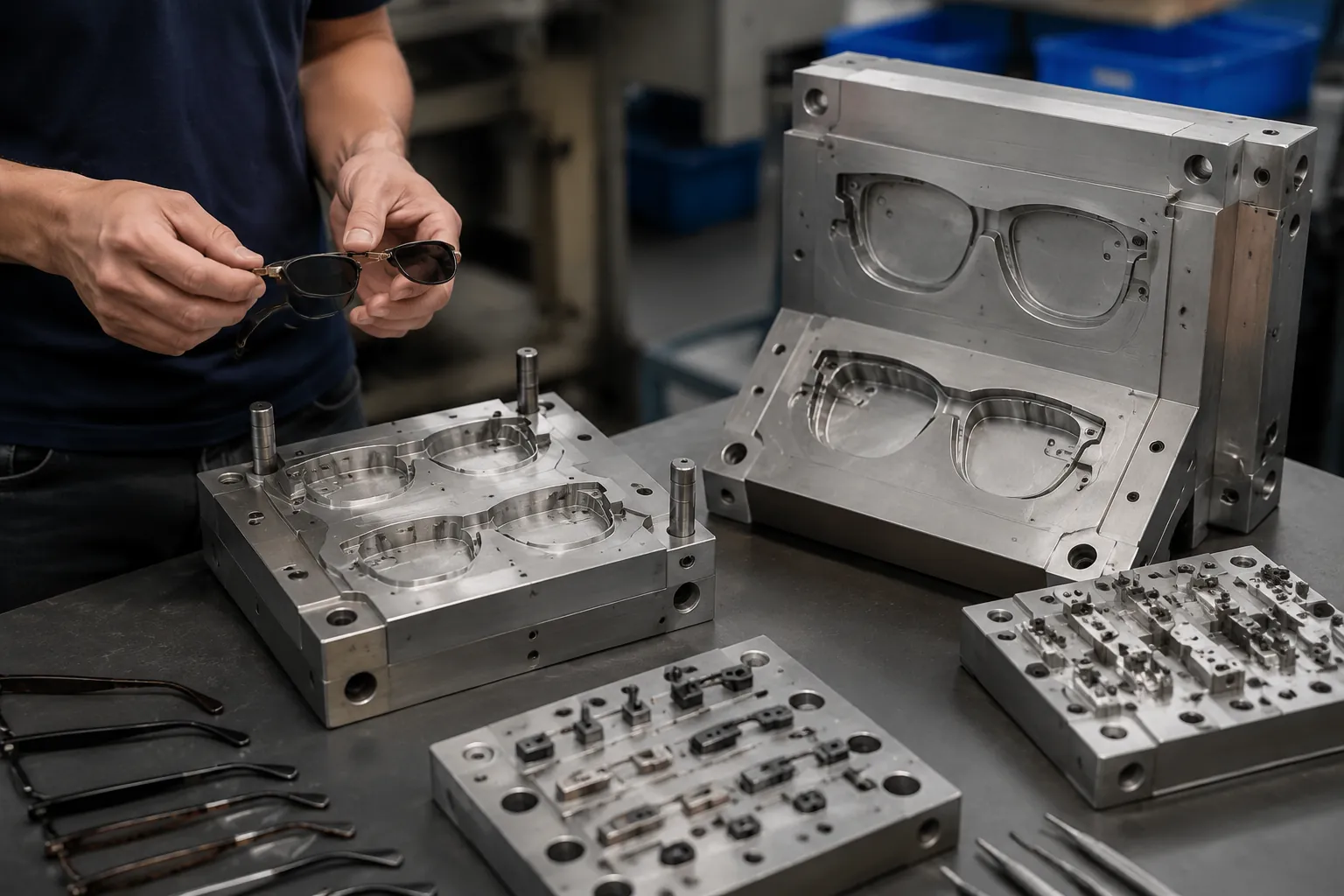
This guide is for eyewear brands, importers, distributors, resort retailers, and promotional buyers planning custom sunglasses programs. Tooling decisions affect launch speed, unit cost, design control, quality consistency, and who can use the frame after the first order. Use it to decide when a factory mold is enough, when exclusivity should be negotiated, and when buyer-owned tooling is worth the cost, paperwork, and oversight.
The Four Tooling Paths Buyers Actually Use
For injected sunglasses, tooling usually includes the mold for the front frame and temples. It may also include lens trimming templates, assembly fixtures, logo positioning jigs, and inspection gauges. For acetate sunglasses, the package is different. CAD files, CNC cutting programs, lamination plans, polishing fixtures, temple core settings, and lens edging templates may matter more than a full injection mold.
The commercial question is the same in both cases: who paid for the setup, who may use it, and who controls it later?
| Tooling option | Best use case | Typical upfront cost | Typical development time | Control level |
|---|---|---|---|---|
| Factory-owned stock mold | Fast private label, small tests, promotional orders | Low or none. Usually sample, decoration, and packaging charges only | Samples may be available in about 7-15 days when materials and lenses are standard. Bulk timing depends on order size, decoration, and packaging | Low. Other buyers may use the same base frame unless exclusivity is agreed in writing |
| Hybrid customization | Stock front with custom temples, colorway, logo plate, lens tint, or packaging | Low to medium, depending on the custom parts, decoration method, and sampling rounds | Often faster than full new tooling. Custom metal parts, temples, coatings, or packaging can still add time | Partial. Custom details can be controlled; the base frame is not exclusive unless stated |
| Exclusive factory-owned tooling | Shape matters, but the buyer does not need to physically own the tool | Medium to high, paid as a tooling charge, development charge, or amortized into unit price | Usually longer than stock development because the tool must be designed, cut, sampled, corrected, and approved | Medium. Exclusivity is only as strong as the written terms |
| Buyer-owned tooling | Long-term OEM line, protected shape, repeat program, or multi-factory control strategy | Highest upfront cost, plus maintenance, records, and transfer documentation | Longest cycle: design, DFM review, trial samples, correction, golden sample approval, then bulk production | High if the contract covers use, storage, transfer, digital files, maintenance, and confidentiality |
Use a simple rule. If you are buying a small quantity to test demand, do not start with full buyer-owned tooling unless design protection is central to the business case. If you expect repeat orders for the same model family, tooling control matters more. Base the decision on forecast volume, margin, launch timing, intellectual property risk, and the cost of being copied or locked into one supplier.
Use Existing Molds When Speed and Cash Matter
Existing molds are the practical route for many first orders. They let buyers test fit, color, lens category, branding, packaging, and channel demand without tying up capital in new tooling. Unit price usually improves as order quantity rises because material purchasing, lens cutting, decoration setup, inspection, and packing labor are spread across more units. The exact price still depends on frame material, lens type, hinge construction, decoration method, packaging, test requirements, and inspection level.
The trade-off is ownership. A stock frame silhouette is not yours. Another brand may sell the same base shape with a different logo, color, lens, or package. That does not make the route useless. Many products can still look distinct through lens tinting, mirror coating, gradient lenses, temple printing, laser engraving, metal logo plates, rubber nose pads, hinge color, acetate sheet selection, pouch design, retail box artwork, or hangtag language.
- Good fit: market tests, seasonal drops, resort shops, influencer launches, corporate gifts, distributor catalog lines, and lower-risk retail trials.
- Typical timing: stock or semi-custom samples are often faster than new tooling, but timing still depends on material availability, lens specification, logo method, and packaging.
- MOQ logic: smaller quantities help test demand; larger orders improve purchasing efficiency, setup absorption, and production planning.
- Main risk: the base frame may appear elsewhere if it is a public factory mold.
- Best control point: lock color codes, lens category, logo size, logo position, packing method, barcode placement, inspection standard, and approved sample reference in the purchase order.
Using an existing mold is not weak sourcing. It is often the right decision when speed and cash discipline matter more than shape ownership. The mistake is treating a stock mold as if it creates exclusive design rights. It does not.
Choose Exclusive Tooling When the Shape Sells
Exclusive tooling makes sense when the front outline, bridge, lens shape, temple profile, end-piece geometry, or side detail carries the brand value. For injected PC, TR90, TPE, or other plastic frames, a new tool may be needed for the front and both temples. For acetate frames, exclusivity may come from a new CAD shape, custom laminated sheet, special temple core, CNC cutting program, or proprietary metal decoration instead of an injection mold.
Do not start exclusive tooling from a mood board only. A useful eyewear technical package should include front width, lens width, bridge width, temple length, lens height, frame base curve, pantoscopic angle, hinge type, screw size, lens thickness, lens material, frame material, logo depth, surface finish, packaging requirements, and destination market.
For injection molds, wall thickness, rib design, gate location, hinge boss thickness, and cooling balance affect sink marks, warpage, and cracking. A frame can look good in a rendering and still fail at the hinge if the screw boss is too thin or the temple has poor material flow.
Exclusive factory-owned tooling is common. The factory builds and stores the mold, then agrees not to sell the same frame to other customers. This can cost less and run with less administration than buyer-owned tooling, but the agreement must be precise. Define the model number, protected drawings, territories, sales channels, term, similar-shape restrictions, and any minimum annual order quantity. Otherwise, exclusivity is just a handshake with an invoice behind it.
Practical threshold: consider exclusive tooling after demand is validated and the model has realistic reorder potential. The larger and more repeatable the program, the easier it is to spread tooling cost across colors, lens options, and future purchase orders.
Buyer-Owned Tooling Is a Contract Asset
Many buyers assume, "We paid the mold fee, so we own the mold." Not automatically. A tooling charge on an invoice may cover design work, DFM review, mold base machining, trial shots, sample correction, polishing, and factory engineering time. Ownership depends on written terms.
Treat buyer-owned tooling as an asset. Identify it. Accept it. Control who can use it. Decide how it is stored, maintained, repaired, and transferred before the first production order turns into a dispute.
- Define the tooling package: front mold, left and right temple molds, lens trimming templates, assembly fixtures, inspection gauges, decoration jigs, CNC files, CAD files, artwork files, and logo fixtures if relevant.
- Record identification: mold number, model name, cavity count, frame material, surface finish, accepted sample version, drawing revision, and acceptance date.
- State permitted use: the factory may produce only for the buyer, not for other brands, related trading companies, domestic channels, sample rooms, marketplaces, or online stores.
- Set maintenance rules: define rust prevention, cleaning, storage humidity, repair approval, normal wear, damage responsibility, and replacement after major failure.
- Cover transfer rights: if the relationship ends, the buyer can collect the tooling after open balances and reasonable packing or handling costs are settled.
- Protect digital files: CAD, CNC paths, artwork, inspection drawings, trial records, and rejected prototype designs should not be reused, copied, modified, or offered to other customers.
Tooling ownership does not remove the need for factory cooperation. A mold without process knowledge can be hard to move. Injection temperature, holding pressure, cooling time, gate trimming, hinge insertion, screw torque, lens edging, and assembly sequence all affect the final sunglasses. Ask for a production record, approved material specification, and controlled parameter range as part of the tooling file.
Model Cost, MOQ, and Lead Time Before Paying
Tooling affects more than the mold invoice. New development can add sampling rounds, lens testing, color matching, packaging revisions, compliance review, and launch delays. A new injected sunglasses frame normally moves through design review, DFM adjustment, mold cutting, first trial sample, correction, surface polishing or texturing, final material sample, pre-production sample, and bulk approval. One bridge-fit issue or lens-groove problem can force another correction round.
| Program type | MOQ logic | Cost behavior | Timing risk | Buyer advice |
|---|---|---|---|---|
| Small order using stock mold | Test quantity, low commitment | Higher unit price, low setup cost | Low when standard colors, lenses, and packaging are used | Spend on samples, packaging review, compliance check, and QC definition before paying for new tooling |
| Commercial launch with custom colors and logos | Early sell-through test with repeat potential | Decoration setup spreads across the order; unit price usually improves with volume | Medium if Pantone matching, mirror coating, gradient lenses, or strict logo placement is required | Use stock or hybrid tooling unless shape protection is commercially important |
| Repeat line with exclusive details | Program has reorder potential and defined channels | Tooling charge can be amortized across purchase orders, colors, and lens variants | Medium to high during first development | Negotiate exclusivity, MOQ conditions, reorder pricing, and breach remedies clearly |
| Long-term OEM model family | Multi-season or multi-market program | Best case for tooling control, but highest documentation burden | High upfront; lower after golden sample and process approval | Consider buyer-owned tooling with documented asset control and transfer rights |
Request a written development timeline that separates sample lead time from bulk production lead time. Bulk lead time should start only after final sample approval, confirmed material availability, approved packaging artwork, deposit or payment milestone, and confirmed compliance requirements. New tools must be proven by physical samples and inspection results. Renderings are not proof.
Material and Decoration Choices Change the Tooling
Material choice changes the tooling decision. PC frames are cost-effective and common for promotional and fashion sunglasses, but thin designs may be more vulnerable to stress whitening, cracking, or weak screw retention. TR90 is lighter and more flexible, which helps sport and comfort-focused frames, but mold flow, shrinkage, and dimensional stability must be controlled. Acetate offers color depth and a premium hand feel, but production depends on cutting, tumbling, polishing, lamination, and skilled finishing rather than one injection cycle. Metal sunglasses require stamping, soldering, plating, nose-pad assembly, and tighter fixture control.
Decoration should be selected early because it affects tooling, fixtures, and QC. Pad printing is economical for logos on temples but needs a stable, flat-enough print area. Laser engraving can be durable on suitable materials and metal details, but contrast depends on the substrate. Metal logo plates need recesses or accurate bonding areas. Hot stamping and foil logos need surface testing. Embedded logos or molded-in details must be designed before tooling is cut.
- Pad printing: good for low to medium-cost branding; check adhesion, alignment tolerance, and rub resistance.
- Laser engraving: suitable for many premium programs; confirm contrast on black, tortoise, clear, translucent, and coated materials.
- Metal logo plate: strong retail look; requires accurate recess, adhesive control, plating specification, and corrosion review.
- Lens tint or mirror coating: changes appearance quickly but may require optical, labeling, and compliance confirmation for the destination market.
- Custom temple mold: useful when the buyer wants a unique side profile without paying for a full new front frame.
Decide decoration before sample approval. Not later. A logo that looks small in a PDF may be oversized on a narrow temple. A mirror lens that looks premium may miss the target filter category if the lens specification is vague.
Technical Checks Decide Whether a Tool Is Good
A tool is not approved because the first sample looks acceptable on a desk. Sunglasses are wearable products. Fit, hinge tension, lens retention, surface finish, and symmetry must survive handling, heat, packing, and transport.
For injected frames, check parting lines, gate marks, sink marks near the hinge boss, temple warpage, screw alignment, flash, and whether the lens groove holds lenses consistently. For acetate frames, check polishing roundness, end-piece symmetry, core wire position, lamination stability, and color consistency across sheets.
Agree on dimensional tolerances before production. Practical controls often include lens-groove consistency, hinge alignment, front-frame symmetry, temple opening angle, screw torque, lens retention, surface defects, and color variation. Do not rely on one universal tolerance for every feature. A small variation at the lens groove can cause lens popping, while the same variation on a broad outer curve may be harmless. Tie the tolerance to function, appearance, and inspection method.
- Fit sample: confirms bridge comfort, temple length, face curve, weight balance, and wearing feel.
- Engineering sample: confirms material flow, hinge construction, lens groove, screw boss, and assembly method.
- Pre-production sample: must use final frame material, final lens tint, final logo method, final screws, final packaging, and final labeling.
- Golden sample: becomes the factory and buyer reference for bulk QC, packing approval, and dispute resolution.
Do not approve tooling from photos only. Check physical samples under normal and bright light. Open and close the temples repeatedly. Test lens retention by handling. Inspect several pieces from the same trial. Then compare the results against the technical package. Weak tooling often shows up first in fit, assembly, and handling, not in photos.
Put Compliance and Tooling Terms in the Agreement
Tooling ownership has limited value if the final sunglasses cannot enter the buyer's market. Compliance is tied to the finished product: lenses, frame material, nickel release where applicable, coatings, labeling, warning text, and packaging claims. Common references include CE EN ISO 12312-1, ANSI Z80.3, AS/NZS 1067, REACH, FDA registration, ISO 9001, and BSCI. State the destination market and required standard before sampling starts.
For the EU, sunglasses are commonly assessed against EN ISO 12312-1 for general use sunglasses, with CE marking requirements, filter category, UV protection, and labeling. For the United States, buyers often reference ANSI Z80.3 for non-prescription sunglasses and should confirm FDA registration or other regulatory obligations with the responsible importer or compliance adviser. Australia and New Zealand buyers should confirm AS/NZS 1067 requirements. REACH matters for restricted substances in frame materials, coatings, and metal components. ISO 9001 and BSCI relate to management systems and social compliance; they do not replace product testing.
The purchase agreement should be specific. State whether tooling is factory-owned, buyer-owned, or factory-owned with exclusive use rights. Define exclusivity by model, drawing revision, similar shapes, countries, channels, and term. If exclusivity depends on annual MOQ, write the number, measurement period, cure period, and consequence of missing the target. Also cover modification approval, maintenance cost, transfer process, unpaid balance settlement, CAD confidentiality, sample confidentiality, rejected-part disposal, and end-of-life storage or destruction.
For many buyers, the most controlled path is staged: start with a stock mold for demand testing, move to hybrid customization after sell-through, then negotiate exclusive or buyer-owned tooling when reorders prove the model deserves protection. Keep cash tied to verified demand, not assumptions.
Have a custom sunglasses project in mind?
Send us your styles, target market and quantities and we will return a detailed quote with MOQ, lead time and a sample plan.
Get a QuoteWhy source this from Wenzhou with LumiShades
Wenzhou in Zhejiang Province is widely regarded as China’s eyewear manufacturing capital, producing a large share of the world’s sunglasses. That concentration matters to buyers: a deep local supply chain for acetate sheet, hinges, lens blanks, plating and packaging means shorter component lead times, easier color and material matching, and a workforce with decades of eyewear-specific skill. LumiShades has manufactured in this ecosystem since 2009, and our vertical integration — in-house injection molding, acetate cutting, CNC milling, lens tinting, decoration and quality control — means no part of your order is quietly subcontracted to a workshop you cannot audit.
For international buyers, that vertical control translates into accountability. When a single factory owns every step, defects are traced and fixed at source rather than bounced between vendors, and your specifications survive intact from first sample to bulk. We back this with 15+ years of experience, shipments to 60+ countries, more than 5 million pairs produced per year and a 98.5% on-time delivery rate. Our certifications — CE EN ISO 12312-1, FDA registration, ANSI Z80.3, AS/NZS 1067, REACH, ISO 9001 and BSCI audit — mean the compliance documentation your market requires already exists. Explore our manufacturing capabilities and quality control process to see how this works in practice.
Frequently asked questions
If I pay a mold fee, do I automatically own the sunglasses tooling? No. A mold fee does not automatically create ownership. The purchase agreement or tooling contract should state that the tooling is buyer-owned, identify each tool and related file, define permitted use, confirm storage and maintenance responsibility, and give the buyer transfer rights after agreed balances and handling costs are settled.
Can I protect my design while using an existing factory mold? Only partially. You can protect your trademark, packaging artwork, custom colors, custom temples, lens specification, logo placement, and exclusive decoration details if they are documented. The base frame from a public factory mold is not exclusive unless the factory signs written exclusivity terms that define the model, channels, countries, term, and similar-shape restrictions.
At what order volume does buyer-owned tooling start to make sense? There is no universal volume threshold. Buyer-owned tooling starts to make sense when the model has proven repeat demand, the shape has commercial value, and the expected margin or risk reduction justifies the tooling cost and contract work. For small demand tests, stock or hybrid tooling is usually more practical. For repeat model families, compare tooling cost, expected reorders, unit-price savings, exclusivity value, and the cost of switching suppliers.
Will new tooling delay my launch? Usually, yes. New injected frame tooling may require design review, DFM adjustment, mold cutting, trial samples, corrections, surface finishing, final material samples, pre-production samples, and bulk approval. Build a schedule that separates development time from bulk production time, and do not count bulk lead time until final samples, materials, packaging artwork, and compliance requirements are approved.
What tolerances should I discuss before approving sunglasses tooling? Discuss lens-groove fit, lens retention, hinge alignment, temple opening angle, front-frame symmetry, screw torque, surface defects, color variation, and logo placement. Tie each tolerance to a test method and an approved sample. Lens-groove and hinge areas need tighter functional control than non-critical cosmetic curves because small errors can affect assembly, wearing feel, or lens security.
Which compliance standards should I mention in the RFQ? State the destination market and required compliance references before sampling. Common references include CE EN ISO 12312-1 for EU sunglasses, ANSI Z80.3 for non-prescription sunglasses in the United States, AS/NZS 1067 for Australia and New Zealand, and REACH for restricted substances. FDA registration, ISO 9001, and BSCI may also be relevant, but confirm exactly what applies to the product, factory, importer, and sales market.
Can tooling be moved from one factory to another? Only if the contract allows transfer and commercial balances are settled. The agreement should define who owns the tooling, when it can be collected, who pays packing and transport costs, and whether digital files and production records must be provided. Even with the physical tool, request process settings, material specifications, fixture details, lens edging data, and approved samples because these affect whether the tool can run successfully elsewhere.
Ready to start?
Explore our sport wrap sunglasses or request a quote — our sales team replies within 12 hours.
Request a Quote