
Sunglasses Tooling Approval: Questions to Ask First
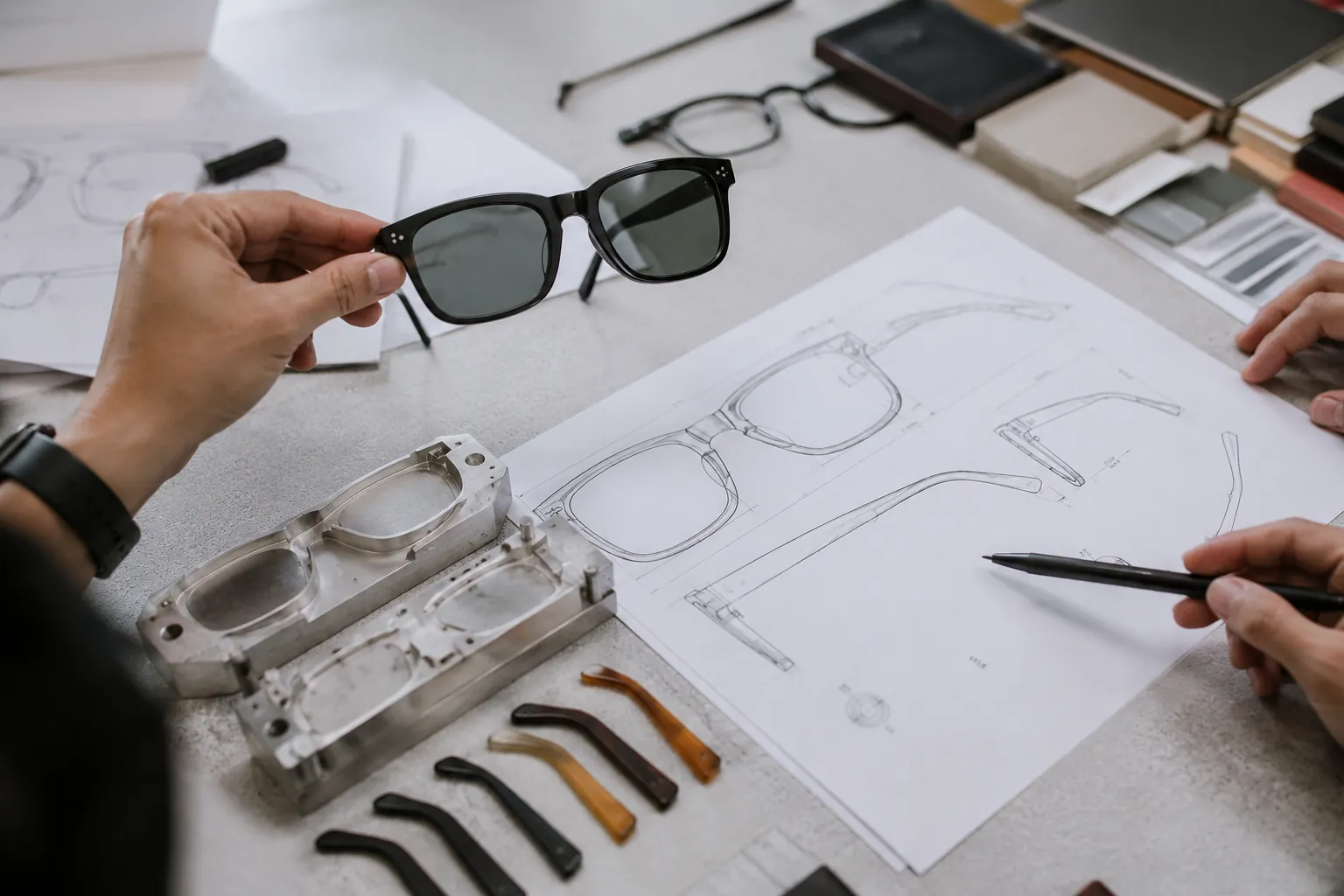
This guide is for overseas brands, importers, distributors, and retailers preparing to pay for custom sunglasses tooling. Tooling approval is where a design becomes a production asset. Steel is cut. Shrinkage is built in. Hinge position, lens fit, decoration limits, compliance duties, schedule risk, and cash exposure all become harder to change. Do not approve tooling until the commercial plan, technical file, sample route, ownership terms, and production tolerances are clear enough to protect bulk production.
Start With the Manufacturing Route, Not the Rendering
Many buyers approve sunglasses tooling too early. They have a 3D rendering, a logo position, and perhaps a color reference. Then they expect the factory to solve the rest during production. That is risky. A capable factory can recommend fixes, but those choices affect comfort, lens stability, surface quality, MOQ, tooling cost, and unit price.
Confirm the manufacturing route before releasing tooling money. Injection-molded PC, TR90, or nylon-family frames need early discipline because shrinkage, gate position, parting line, lens groove, hinge seat, temple opening angle, and ejection marks are built into the tool. Acetate frames are usually cut from sheet or block material by CNC, then tumbled, polished, and assembled. Acetate allows more shape adjustment before bulk production than an injection mold, but it still has limits: minimum wall thickness, lamination stability, polishing consistency, and hinge installation. Metal and hybrid frames add soldering, plating, screw assembly, pad arm adjustment, and color-matching risks.
For molded plastic sunglasses, ask production questions early. Can the front hold the planned lens edge thickness without stress? Does the hinge area need a metal insert? Is the temple thick enough around the hinge screw or barrel? Will the logo area stay flat after shrinkage? Can the part eject cleanly without cosmetic damage? These are tooling questions. Not artwork questions.
If LumiShades or any other manufacturer will mold, cut, tint, decorate, assemble, and inspect the product, tooling feedback should come from those production teams before payment. Ask for a tooling review based on the real process route, material, lens specification, and decoration method.
Blunt rule: do not approve sunglasses tooling from a rendering alone. Approve it from a locked technical package and a confirmed production route.
Lock the Spec Sheet Before Steel Is Cut
The tooling file should not leave basic specifications open. Every open item becomes a factory assumption. Some assumptions are harmless. Others create expensive tool changes or weak bulk quality.
A complete sunglasses tooling specification should cover frame material, lens material, base curve, bridge width, lens width, temple length, hinge type, screw size, lens groove depth, nose pad style, logo placement, surface texture, color reference system, packaging fit, and testing target. If the product will be sold in the EU, US, Australia, or New Zealand, name the compliance targets before sample approval. Relevant requirements may include CE EN ISO 12312-1 for Europe, ANSI Z80.3 for the United States, AS/NZS 1067 for Australia and New Zealand, REACH chemical requirements for the EU, and FDA registration relevance for US importers. Factory credentials such as ISO 9001 and BSCI may matter, but they do not replace product testing.
Useful starting tolerances for molded sunglasses are often around +/-0.20 mm for non-critical frame dimensions, +/-0.10 mm to +/-0.15 mm for hinge seats and lens groove areas, plus clear visual alignment expectations for left-right temple balance. These numbers are not universal. Confirm them against the material, geometry, lens design, and testing requirement. Lens fit is especially sensitive. A groove that is too tight can cause stress marks, lens popping during heat exposure, or frame distortion. A groove that is too loose can cause rattling and returns.
- Frame dimensions: lens width, bridge, temple length, front width, pantoscopic angle, wrap, and agreed tolerance.
- Lens fit: lens edge thickness, base curve, groove depth, groove width, bevel style, and replacement method.
- Hinge performance: opening angle, screw retention, barrel alignment, temple drop, and acceptable side pressure.
- Decoration: pad printing, laser engraving, hot stamping, metal logo plate, color fill, embedded badge, or another approved method.
- Lens function: UV protection, tint category, polarization, mirror coating, gradient, visible light transmission, and required market labeling.
Ask the factory to mark critical-to-function dimensions on the drawing. If a dimension controls lens retention, hinge strength, frame alignment, or wearer comfort, it belongs on the approved technical file. Do not leave it buried in an email thread.
Write Mold Ownership Like a Purchase Term
Mold ownership is not a handshake topic. If the buyer pays the tooling charge, the agreement should state who owns the mold, where it is stored, who may use it, how it is maintained, and what happens if orders stop.
One sunglasses project may include separate tools for the front frame, left temple, right temple, temple tips, nose pads, decorative plates, lens fixtures, or insert components. Some suppliers quote one tooling charge without listing the individual assets. Ask for a mold list by component, with cavity count, tool steel or tool material where applicable, and the intended molded material. If a dispute happens later, that list matters.
- Ownership: state whether the buyer owns the mold after full tooling payment and whether ownership depends on any unpaid production invoices.
- Exclusivity: state that the mold and finished frame design cannot be used for other customers without written approval.
- Storage: confirm factory location, storage conditions, labeling, and maintenance responsibility.
- Life: ask for expected shot life and the assumptions behind it, including steel grade, resin, texture, maintenance, and part complexity.
- Transfer: define whether the mold can be moved, who pays packing and freight, and what technical documents move with it.
- Idle molds: agree what happens if no reorder is placed for a defined period, such as 18 or 24 months.
A serious manufacturer should be able to discuss these points clearly. If the first order is small, ask whether new private tooling is commercially justified. Existing molds with custom color, lens, packaging, and logo decoration are often more practical for low-volume tests. For a private shape, connect tooling approval to a 12-month forecast, not just the first purchase order.
Match Cavity Planning to Volume and Risk
Cavity count controls how many parts are made in each injection cycle. More cavities can reduce molded-part cost at volume, but they increase tooling cost and make cavity balance harder. The right question is not, "How cheap can the mold be?" The better question is, "What cavity plan fits the first order, reorder speed, quality risk, and 12-month volume?"
| Tooling choice | Best use case | Typical trade-off | Buyer question |
|---|---|---|---|
| Single-cavity mold | Low-volume tests, uncertain demand, unusual frame geometry | Lower tooling cost, slower output, higher molded-part cost | Can the supplier still meet the required bulk lead time if demand increases? |
| Two-cavity mold | Repeat programs with moderate volume and stable design | Better output, but both cavities must be dimensionally balanced | Will cavity 1 and cavity 2 be measured and reported separately at T0? |
| Multi-cavity mold | High-volume programs with stable geometry and repeat colors | Lower molded-part cost, higher tooling investment, more complex correction | What happens if one cavity creates a tight lens groove, visible sink, or warpage? |
| Family mold | Small related parts such as logo plates, nose pads, clips, or temple inserts | Efficient, but one problem component can affect the whole shot | Can problem parts be isolated or blocked without remaking the full tool? |
Ask the factory to connect the cavity plan to quoted price breaks, first-order quantity, reorder forecast, and target lead time. A cheap tool can become expensive if it cannot produce enough acceptable parts during reorder production. A high-output mold can be wasteful if the design is unproven or demand is uncertain.
Also ask about cycle time and bottlenecks. A front frame cycle may be limited by material, wall thickness, cooling, and cosmetic requirements. But the real schedule also includes trimming, lens cutting or tinting, decoration curing, assembly, inspection, and packing. Cavity planning must match the whole production flow, not only the injection machine.
Understand Material Behavior Before Tool Approval
Material choice affects shrinkage, flexibility, surface finish, lens retention, durability, and comfort. Tooling cannot be separated from material behavior. A tool designed around one material may not work the same way with another.
| Material | Strengths | Tooling concern | Best fit |
|---|---|---|---|
| PC | Good impact resistance, economical, suitable for many fashion frames | Can show stress whitening, flow marks, or brittleness if geometry and processing are poor | Promotional, retail, and price-sensitive programs |
| TR90 / nylon family | Lightweight, flexible, comfortable, strong recovery | Requires disciplined processing; shrinkage and warpage must be managed | Sport, active, and comfort-focused sunglasses |
| Acetate | Premium hand feel, rich colors, layered effects | More manual variation; polishing, lamination, and sheet quality affect consistency | Fashion, boutique, and higher perceived-value collections |
| Metal or hybrid | Thin profiles, premium detailing, adjustable pads possible | Plating, soldering, screw assembly, coating adhesion, and galvanic compatibility add risk | Designer, optical-style, and premium sun frames |
For molded frames, avoid very thin sections near the hinge unless the material, screw design, insert design, and tool layout support them. Thin hinge areas can crack or loosen. Thick sections create the opposite problem: sink marks, longer cooling time, uneven shrinkage, and extra weight. Gate location also matters. A poor gate position can leave a visible mark, create flow hesitation, weaken a cosmetic surface, or increase warpage.
Approve color from physical samples whenever possible. Pantone or another color reference helps communication, but plastic color depends on resin, pigment loading, surface texture, wall thickness, and lighting. Transparent, translucent, pearl, tortoise, and recycled-content materials can vary more than solid opaque colors. Approve color chips or molded parts under agreed lighting before bulk production.
Define Sample Stages and What Each One Proves
One sample rarely proves everything. Separate visual approval from tool approval, functional approval, decoration approval, and production approval.
- Prototype or 3D printed check: reviews shape, size, bridge comfort, lens outline, and logo location. It does not prove final resin shrinkage, hinge strength, polishing quality, lens retention, coating adhesion, or bulk repeatability.
- T0 tooling trial: first molded parts from the new tool. Expect findings such as flash, sink marks, tight lens grooves, uneven temples, visible gate marks, short shots, or dimensional drift.
- T1 or revised sample: confirms corrections after tool adjustment. Buyers should check assembly, wear feel, folding action, lens stability, screw retention, surface finish, and left-right balance.
- Pre-production sample: made with intended material, color, lens tint, screws, hinge, logo, packaging, labeling, and inspection standard. This is the sample to sign before bulk production.
Sample timing depends on tool complexity, material availability, decoration method, lens type, and correction loops. Samples from existing molds are usually faster than samples from new tooling. New tooling adds mold design, steel or tooling material preparation, machining, electrode work where needed, polishing or texturing, assembly, T0 trial, and correction.
Do not build a retail launch calendar around a perfect T0. That is wishful thinking. A realistic new-tooling plan allows time for at least one correction loop. Ask the factory to label every sample stage clearly. A sample from an existing mold in a similar color is not a tooling trial. A hand-polished prototype is not proof that the injection mold will release clean production parts at speed.
Set Revision Limits and Acceptance Criteria
Tool revisions are normal. Unlimited revisions are not. Before paying, define which corrections are included in the tooling charge and which buyer changes trigger new cost.
A fair rule separates factory corrections from buyer design changes. If the approved drawing says the bridge is 18.0 mm and the T0 part measures 17.3 mm because shrinkage was not controlled within the agreed tolerance, treat it as a tooling or process correction. If the buyer wears the sample and decides the bridge should become 20.0 mm for style reasons, that is a buyer change. It may require welding, re-cutting, an insert change, a new electrode, or a new tool section.
| Revision or decoration issue | Usually included? | Why it matters |
|---|---|---|
| Flash removal, tool polishing, gate mark improvement | Often yes | Normal tuning after T0 trial |
| Small dimensional correction to match approved drawing | Often yes | The tool must produce the confirmed specification within agreed tolerance |
| Logo position changed after sample review | Usually no | This is a buyer design change, not a tooling fault |
| Lens shape or groove changed after mold completion | Usually no | Frame front and lens tooling or fixtures may need major rework |
| Pad print rubs off during handling test | Case by case | Ink, surface treatment, curing, logo location, and test method must be reviewed |
Decoration should be approved with process limits in mind. Pad printing is flexible and cost-effective but needs compatible ink, surface treatment where required, and controlled curing. Laser engraving is durable but depends on material response and contrast. Metal logo plates look premium but require a recess, adhesive or mechanical fixing, and tolerance control. Hot stamping can create a bright effect, but flatness, pressure, temperature, and wear location matter.
Put the included revision count in writing. Two rounds after T0 may be enough for a straightforward plastic frame. Complex designs, special hinges, decorative inserts, or tight lens-fit requirements may need more planning. If a factory promises unlimited changes, ask what is included, what is excluded, and how schedule impact will be handled.
Run a Final Tooling Release Checklist
Before transferring tooling payment, run one last checkpoint. This protects ownership, schedule, cost, quality, and compliance. It also gives both sides a written reference if the first samples miss the target.
- Approved 2D drawing with key dimensions, critical-to-function points, and tolerances.
- Confirmed 3D file version, file date, revision number, and responsible approver.
- Frame, temple, lens, screw, hinge, logo plate, nose pad, and packaging materials confirmed.
- Cavity plan agreed and matched to first order, reorder forecast, and target price breaks.
- Mold ownership, exclusivity, storage, maintenance, expected shot life, idle period, and transfer terms written.
- Revision rules separated into factory corrections and buyer design changes.
- Sample stages named: prototype, T0, T1 or revised sample, and final pre-production sample.
- Target markets and compliance standards listed, such as CE EN ISO 12312-1, ANSI Z80.3, AS/NZS 1067, REACH, and FDA registration where applicable.
- Factory documentation requirements confirmed where relevant, such as ISO 9001 and BSCI.
- Decoration method confirmed: laser engraving, pad printing, hot stamping, metal logo plate, color fill, or another approved process.
- Bulk timeline tied to final pre-production sample approval, not only to deposit date.
LumiShades is based in Wenzhou, Zhejiang, a major eyewear manufacturing area in China. Whether you work with LumiShades or another OEM sunglasses supplier, treat custom tooling as a production asset. Ask hard questions before steel is cut. It is cheaper and faster than trying to fix ownership, compliance, tolerance, or lens-fit problems after the mold is already made.
Have a custom sunglasses project in mind?
Send us your styles, target market and quantities and we will return a detailed quote with MOQ, lead time and a sample plan.
Get a QuoteWhy source this from Wenzhou with LumiShades
Wenzhou in Zhejiang Province is widely regarded as China’s eyewear manufacturing capital, producing a large share of the world’s sunglasses. That concentration matters to buyers: a deep local supply chain for acetate sheet, hinges, lens blanks, plating and packaging means shorter component lead times, easier color and material matching, and a workforce with decades of eyewear-specific skill. LumiShades has manufactured in this ecosystem since 2009, and our vertical integration — in-house injection molding, acetate cutting, CNC milling, lens tinting, decoration and quality control — means no part of your order is quietly subcontracted to a workshop you cannot audit.
For international buyers, that vertical control translates into accountability. When a single factory owns every step, defects are traced and fixed at source rather than bounced between vendors, and your specifications survive intact from first sample to bulk. We back this with 15+ years of experience, shipments to 60+ countries, more than 5 million pairs produced per year and a 98.5% on-time delivery rate. Our certifications — CE EN ISO 12312-1, FDA registration, ANSI Z80.3, AS/NZS 1067, REACH, ISO 9001 and BSCI audit — mean the compliance documentation your market requires already exists. Explore our manufacturing capabilities and quality control process to see how this works in practice.
Frequently asked questions
Should I pay for new tooling at 50 pairs per design? Usually no, unless the private frame shape is central to the brand and there is a realistic repeat-order plan. For a 50-pair test, ask the supplier first for existing molds that can accept your frame color, lens tint, logo, packaging, and labeling. Pay for new tooling only after you have a costed forecast, written mold ownership terms, and a sample plan that supports the launch schedule.
Who should own the sunglasses mold if I pay the tooling charge? The tooling agreement should state whether you own the paid mold after full payment, whether the factory has any right to use it for other customers, where the mold will be stored, who maintains it, what expected shot life is assumed, and whether it can be transferred. Ask for a component-level mold list, including the front, temples, tips, nose pads, inserts, and decorative parts where applicable.
How many sample rounds should I expect before bulk production? Plan for at least a T0 tooling trial, one corrected T1 sample if needed, and a final pre-production sample using the real material, color, lens, hinge, screw, logo, packaging, and labeling. Do not approve bulk production from a 3D print, a hand-finished prototype, or a sample made from an existing mold unless the final product will use that exact mold and process.
Can one mold cover several colors and lens options? Often yes. Frame color and lens tint can usually change without changing the frame mold, provided the material family, shrinkage behavior, lens thickness, lens base curve, and lens groove requirements stay compatible. Shape changes, lens groove changes, hinge relocation, temple structure changes, nose pad changes, and recessed logo plates may require tool modification or new tooling.
What compliance details should be confirmed before tooling? Confirm the sales market, product category, lens function, labeling requirement, and target standards before tooling. Common references include CE EN ISO 12312-1 for Europe, ANSI Z80.3 for the US, AS/NZS 1067 for Australia and New Zealand, REACH chemical requirements for the EU, and FDA registration relevance for US import. Ask who will arrange testing, which lab will be used, who pays for failures, and whether the final tested sample must match the bulk material and lens specification.
What is a realistic schedule after tooling approval? The schedule should be quoted from the actual project file, not guessed from a generic lead time. New tooling normally needs time for mold design, machining, polishing or texturing, T0 trial, measurement, correction, and pre-production sample approval. Bulk production should be scheduled from final sample approval because unresolved tooling, decoration, lens, or packaging issues can change the shipment date.
Ready to start?
Explore our shield & oversized sunglasses or request a quote — our sales team replies within 12 hours.
Request a Quote