
ODM vs OEM Sunglasses: Cost, Lead Time, and Control
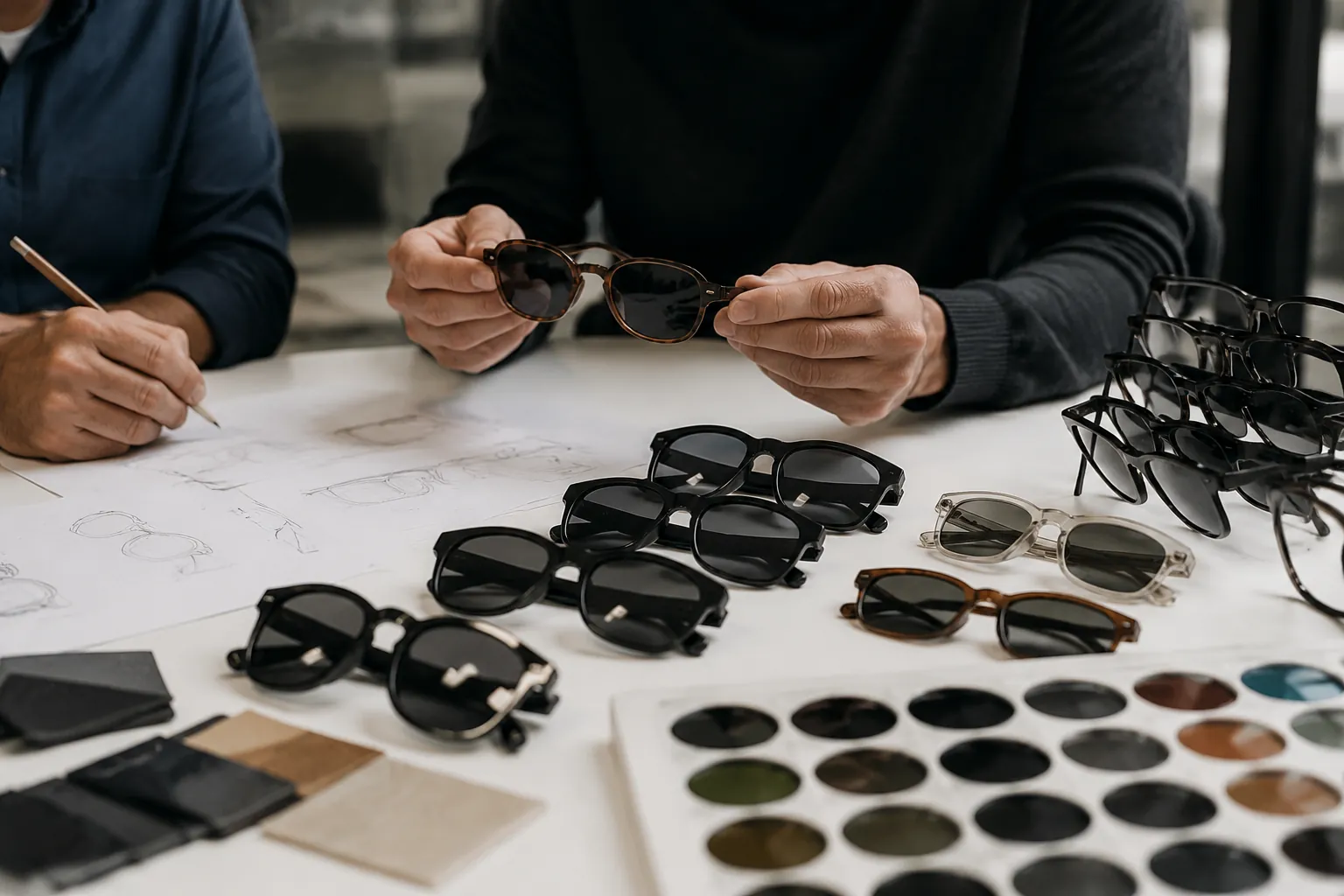
Buyers often treat ODM versus OEM as a design decision. It is usually a commercial one first. Choose the wrong path too early and the damage shows up later: slower launches, thinner margin, messy reorders, or weak shelf differentiation. Start with operating facts instead. Look at landed cost, target ship date, opening order quantity, expected reorder volume, and the level of exclusivity the market will actually notice. Then choose the development path. This guide breaks the decision into the issues a sourcing team has to manage: tooling, sample timing, MOQ, unit-cost behavior, materials, decoration, compliance, and reorder control.
Start with the business case, not the sketch
Many teams start with appearance. That is the wrong order. Start with four numbers: target landed cost, latest acceptable ex-factory ship date, opening order quantity, and expected 12-month reorder volume. Those numbers usually clarify the ODM versus OEM choice faster than a mood board will.
ODM means adapting an existing factory platform. That usually includes an existing mold or established frame construction, known hinge positions, defined lens sizes, and a process the factory has already run. Depending on the supplier, the buyer may still be able to change lens tint, frame color, logo application, temple finish, packaging, and a few cosmetic details. OEM is different. It starts a new development path based on the buyer's drawing, CAD, reference sample, or original concept. That path may require new mold tooling, new CNC programming, custom metal parts, prototype rounds, fit corrections, and more approval gates before production settles down.
As a working rule, ODM fits programs that need speed, lower development risk, and a smaller opening commitment. OEM fits programs where the frame itself is part of the brand asset and the style is likely to stay in line long enough to repay development cost. If reorder volume is uncertain, ODM is often the safer commercial call. If the style is meant to become a core carryover item and the protected design feature is visible enough to matter at retail, OEM may make sense.
- Use ODM for fast launches, retailer tests, promotional programs, and seasonal capsules.
- Use OEM for carryover styles, signature silhouettes, and products where geometry supports brand identity.
- Do not pay for full custom development unless the protected design feature is commercially meaningful.
The trade-off buyers actually need to compare
| Decision Factor | ODM Sunglasses | OEM Sunglasses | What It Means for the Buyer |
|---|---|---|---|
| Development base | Existing mold, frame platform, or proven construction | New design developed from drawing, CAD, or physical sample | ODM reduces engineering uncertainty; OEM gives more control over shape, construction, and details |
| Sample lead time | Usually shorter because the base product already exists | Usually longer because prototypes, revisions, and fit checks are required | If the sales window is close, ODM usually has the schedule advantage |
| Bulk lead time | Often more predictable once approvals are complete | Often less predictable on the first run because tooling validation and process tuning may be needed | First-run OEM calendars need more contingency |
| MOQ logic | Often lower because development cost is already absorbed in the platform | Often higher in practice because development cost must be justified across volume | ODM is usually better for low-risk market testing |
| Unit-cost behavior | Usually more efficient at small and mid volumes | Often higher on the first run; may improve if repeat volume becomes consistent | OEM economics depend on a believable reorder path |
| Exclusivity | Usually limited to color, trim, branding, packaging, or negotiated restricted use | Stronger when the front geometry, temple tooling, or custom components are unique | This matters most for brands selling on recognizable silhouette |
| Reorder control | Good if the platform remains active and the approved specification is documented | Good if molds, BOMs, color masters, and approval samples are controlled carefully | Both models can reorder well, but OEM demands tighter technical-file discipline |
Neither model is better by default. The real issue is simple: are you trying to test demand quickly, or build a protected style with a longer commercial life? Those are different sourcing jobs. Buy them differently.
Where the money moves: tooling, unit cost, and reorder math
Piece price matters. It is not the whole decision. Buyers should model total program cost across at least the first two or three orders, including tooling, prototype rounds, packaging setup, testing, and the cost of delay if development misses the launch window.
ODM usually starts with a cost advantage because the core product architecture already exists. Existing molds, established process settings, and known assembly methods reduce non-recurring expense. That makes ODM attractive for pilot programs, customer-specific assortments, and private-label launches where the first order is meant to test demand rather than establish a long-term hero style.
OEM changes the cost structure immediately. A custom injection mold, a new acetate machining path, custom temple tooling, or unique metal ornaments create upfront cost before the first sell-through result is known. If the opening order is small, that development spend can absorb the margin the buyer expected to gain from a more distinctive frame. Then the pressure shows up elsewhere. Often in packaging, logo execution, or lens specification.
A better approach is to stress-test the program at three volume levels: opening order, likely reorder, and optimistic reorder. If the project only works at the optimistic number, the business case is weak. A custom mold for a style that never repeats is not a premium strategy. It is poor capital allocation.
- ODM works best when the first PO is exploratory and margin is already tight.
- OEM works best when repeat volume is credible enough to spread development cost over multiple runs.
- Low-volume OEM gets harder to justify when paired with custom ornaments, unusual lens curves, laminated acetate, or frequent color changes.
Lead time is four clocks, not one
Factories and buyers often talk about lead time as if it were one number. It is not. On sunglasses, at least four clocks run at once: design freeze, sample completion, compliance or performance validation, and production-slot availability.
ODM is usually faster because the hard engineering already exists. The supplier is adapting a known platform instead of proving a new one from scratch. Even then, sample approval does not mean production starts the next day. Final artwork, packaging approval, deposit timing, material readiness, and slotting into the production plan still affect the ship date.
OEM adds more gates. A concept must be translated into manufacturable dimensions. Then prototype parts need to be checked for hinge alignment, lens seating, temple opening angle, bridge fit, and cosmetic quality. Common control points include left-right symmetry, lens groove consistency, front-shape stability, and the fit of any metal ornament or inlay. Small dimensional errors become visible fast in mass production, especially around logos, hinges, and lens fit.
Material choice changes the schedule too. Acetate programs usually involve more manual processing steps, including cutting, machining, tumbling, polishing, hinge insertion, and heat adjustment. Injection styles depend more on mold behavior and process tuning. Neither path is unusual. But both explain why first-run OEM calendars should be handled more cautiously than repeat orders built on established platforms.
- ODM is usually the better fit when the launch date is fixed by retail handover, promotion timing, or a seasonal reset.
- OEM is easier to defend when the style will stay active long enough to justify the longer development path.
- If third-party testing is required, schedule it before packaging is finalized, not after.
Most missed launches do not come from one big failure. They come from several small approvals that each slip by a few days.
Materials, tolerances, and decoration details that decide the model
Material and process capability often drive the ODM versus OEM decision more than buyers expect. Injection-molded sunglasses usually support better efficiency, repeatability, and lower unit cost at scale. That makes them a natural fit for many ODM programs because established molds can be recolored, relensed, and rebranded relatively quickly. Acetate offers richer color expression, layered laminations, and a heavier hand feel, but it also brings more manual operations and more variation to control. If the design identity depends on custom acetate shaping, thickness transitions, or distinct edge work, OEM becomes more logical.
Decoration matters too. Pad printing is efficient, but durability depends on the ink system, surface preparation, curing, and placement. Laser engraving can be more stable for some uses, but it produces a different visual effect. Metal logo plates can increase perceived value, yet they add separate component sourcing, insertion tolerances, fixing methods, and extra QC points. Every visible trim detail should be reviewed as a production feature, not just a styling detail.
Before approving samples, buyers should ask for production-relevant checks, not visual approval alone:
- Lens fit: no rattle, no visible edge stress, and stable seating in the groove.
- Hinge action: smooth opening torque, consistent screw retention, and no loosening after basic cycling checks.
- Temple symmetry: matched left-right angle and a level resting position on a flat surface.
- Decoration alignment: repeatable logo placement, especially on outer temples and other high-visibility surfaces.
- Color match: front and temples should remain visually consistent under normal daylight conditions.
- Surface finish: no obvious sink marks, over-polish distortion, sharp edges, or inconsistent edge break.
These details decide whether a good-looking sample can survive scale production without a rising reject rate.
Exclusivity only matters when it is specific
Many buyers say they want exclusivity. Fewer define it. In practice, there are three levels. First is cosmetic exclusivity on an ODM platform: your colorway, your logo, your lens tint, your packaging, and your trim package. This is common and cost-effective, but the underlying frame shape may still be available to other buyers in different finishes. Second is restricted use of a modified platform, where a specific temple treatment, ornament package, or frame-lens combination is reserved by agreement. Third is true OEM exclusivity, where new mold geometry or a unique acetate construction creates a frame another buyer cannot reproduce without developing a separate product.
If exclusivity matters, define the protected element in writing. Is it the front shape, the temple tooling, the custom metal ornament, the acetate pattern, or the full assembly? Vague exclusivity language causes avoidable disputes later. Buyers should also clarify duration, territory, sales channels, and whether derivative versions or replacement parts are included.
There is a discipline issue here as well. Not every difference is worth protection spend. Paying for full OEM to secure a subtle contour change that retail customers will not notice often destroys value instead of creating it. The protected feature should be visible enough to support price integrity, margin, or channel separation.
Pay for exclusivity when the protected element is commercially visible. If the market will not notice it, disciplined ODM branding is usually the better buy.
Compliance belongs at the start, not the end
For export programs, compliance should be discussed before sampling starts. Relevant reference points may include CE EN ISO 12312-1, ANSI Z80.3, AS/NZS 1067, REACH, FDA registration, ISO 9001, and BSCI. They do not mean the same thing. Buyers need to be precise about what they expect a supplier to provide.
For sunglasses, CE EN ISO 12312-1, ANSI Z80.3, and AS/NZS 1067 relate to product requirements such as UV performance, transmittance classification, and labeling expectations in different markets. REACH covers chemical-substance restrictions that may affect materials, coatings, inks, adhesives, and plating. FDA registration refers to facility registration and should not be described as blanket product approval for every sunglass configuration. ISO 9001 concerns the supplier's quality-management system. BSCI relates to social compliance auditing.
The ODM versus OEM choice affects compliance risk. ODM often carries less technical uncertainty because the frame-lens combination may already be based on known dimensions and established lens categories. OEM increases the chance that a change in lens size, curvature, groove profile, tint, or material will require new validation. That does not make OEM a bad choice. It means compliance has to be built into the calendar, BOM control, sample approval, and labeling workflow from the start.
A disciplined buyer confirms the destination market, lens category, warning language, and any material restrictions before mass production. Waiting until packaging is printed is too late.
A practical buyer framework before RFQ
Before requesting samples or quotations, reduce the decision to operating facts. That cuts unnecessary custom development and makes supplier discussions more precise.
| Buyer Situation | Better Fit | Reason |
|---|---|---|
| Need a market test in a short timeline with limited opening risk | ODM | Usually faster to sample, lower in development cost, and easier to trial without committing to tooling |
| Need a private-label retailer program with custom logo, color, and packaging | ODM | Brand presentation matters more than unique frame geometry |
| Need a core carryover style expected to reorder at scale | OEM | Development cost can be recovered over repeat orders and exclusivity has greater value |
| Need a signature silhouette competitors should not copy easily | OEM | Unique mold geometry or construction creates stronger product separation |
Then ask four direct internal questions:
- Will this style realistically reorder beyond the first buy?
- What is the latest acceptable ship date, not the hoped-for date?
- How much non-recurring development cost can the target margin absorb?
- What exactly must be exclusive for the product to succeed?
If the team cannot answer those questions clearly, it is usually too early to launch an OEM program. Start with ODM. Learn from sell-through. Commit to tooling only when demand and positioning justify it.
Have a custom sunglasses project in mind?
Send us your styles, target market and quantities and we will return a detailed quote with MOQ, lead time and a sample plan.
Get a QuoteWhy source this from Wenzhou with LumiShades
Wenzhou in Zhejiang Province is widely regarded as China’s eyewear manufacturing capital, producing a large share of the world’s sunglasses. That concentration matters to buyers: a deep local supply chain for acetate sheet, hinges, lens blanks, plating and packaging means shorter component lead times, easier color and material matching, and a workforce with decades of eyewear-specific skill. LumiShades has manufactured in this ecosystem since 2009, and our vertical integration — in-house injection molding, acetate cutting, CNC milling, lens tinting, decoration and quality control — means no part of your order is quietly subcontracted to a workshop you cannot audit.
For international buyers, that vertical control translates into accountability. When a single factory owns every step, defects are traced and fixed at source rather than bounced between vendors, and your specifications survive intact from first sample to bulk. We back this with 15+ years of experience, shipments to 60+ countries, more than 5 million pairs produced per year and a 98.5% on-time delivery rate. Our certifications — CE EN ISO 12312-1, FDA registration, ANSI Z80.3, AS/NZS 1067, REACH, ISO 9001 and BSCI audit — mean the compliance documentation your market requires already exists. Explore our manufacturing capabilities and quality control process to see how this works in practice.
Frequently asked questions
Can an ODM sunglass still feel unique to my brand? Yes. An ODM style can still be differentiated through lens tint, frame color, logo execution, temple finish, packaging, and trim details. To make that differentiation repeatable in production, ask the supplier to document every approved element in the final specification: frame material, color code or master sample, lens color and category, logo method and position, packaging contents, and carton markings. Also confirm whether the underlying frame platform can be sold to other buyers and, if so, which elements are exclusive to your program.
What order volume usually justifies OEM development? There is no fixed threshold because tooling cost, frame material, complexity, and reorder frequency vary by project. The practical test is financial, not arbitrary volume. Build a cost model that includes development cost, sample rounds, testing, and expected unit cost across at least the first two or three orders. If the project only meets margin targets when optimistic reorder volume is assumed, OEM is probably premature. If repeat demand is credible and the frame itself is a meaningful brand asset, OEM becomes easier to justify.
Does a shorter sample lead time mean bulk production can start immediately after approval? No. Sample approval is only one gate. Production usually still depends on final BOM sign-off, logo and decoration approval, packaging approval, destination-market labeling, deposit receipt, material readiness, and available production capacity. Before placing the PO, ask the supplier for a dated critical path covering sample approval, testing if required, packaging sign-off, production start, inspection, and ex-factory ship date. That is more useful than relying on a single lead-time number.
How should I handle compliance for different markets? Start by defining the destination market and the exact product you plan to ship. Then confirm the applicable standard and evidence required for that configuration. For example, sunglasses sold into different markets may need alignment with CE EN ISO 12312-1, ANSI Z80.3, or AS/NZS 1067. Also confirm REACH-related material restrictions where relevant, and do not confuse FDA registration with product approval. Ask the supplier to match the tested lens and frame specification to the final BOM, and review labeling and warnings before packaging is printed.
Is a low MOQ enough reason to choose one supplier? No. A low MOQ is useful for testing demand, but it does not make up for weak process control. Evaluate the supplier on five practical points: whether the approved sample can be repeated consistently, whether decoration and color remain stable across reorders, whether lead times are realistic, whether compliance documents match the actual product specification, and whether the factory can maintain a clear technical file for future orders. A slightly higher MOQ from a controlled supplier is often less risky than a very low MOQ from a supplier with weak repeatability.
Ready to start?
Explore our square sunglasses or request a quote — our sales team replies within 12 hours.
Request a Quote